
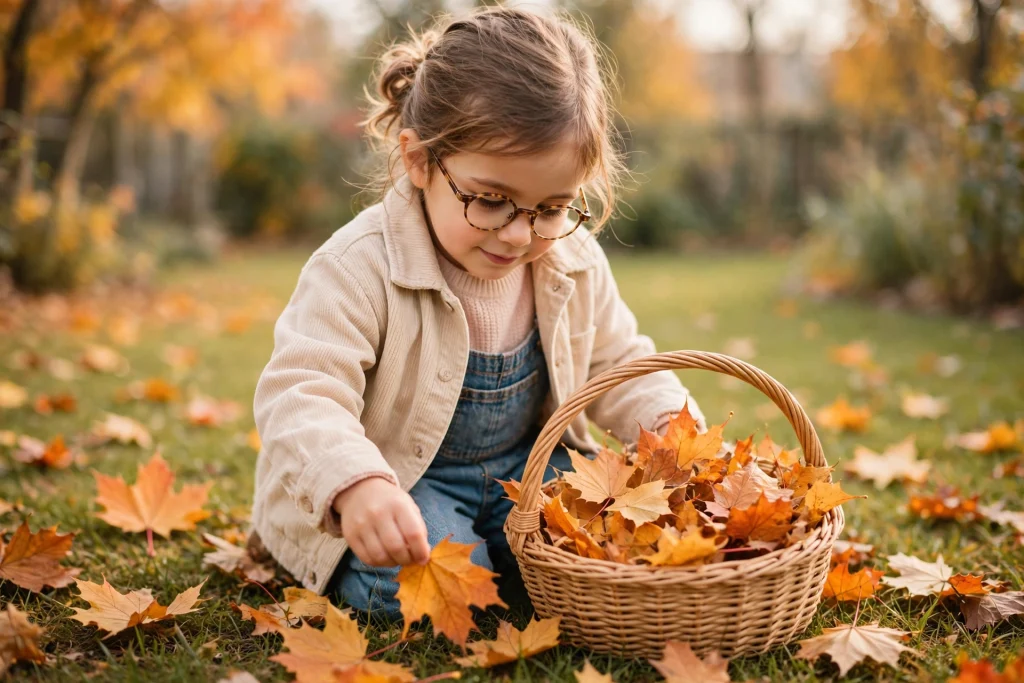
Short answer: Autumn theme preschool activities start with materials the season hands you for free — armfuls of leaves, pockets of conkers and pinecones, and colour everywhere. Fifteen cosy ideas here turn them into a full theme week of play for ages 3–5.
Quick facts
- Ages: 3–5 years
- Theme week: 3–7 days — one theme, dipped into a little each day
- Cost: free — collected leaves and conkers, ordinary household things
- Screen-free: yes — every activity on this page
- Theme: autumn theme — falling leaves, conkers, pinecones and cosy colour
Move and play
Autumn is a season on the move — leaves falling, squirrels storing, wind rising and dropping. This first set borrows all of it, and it is the energy-burning part of the week.
1. Leaf-catch chase
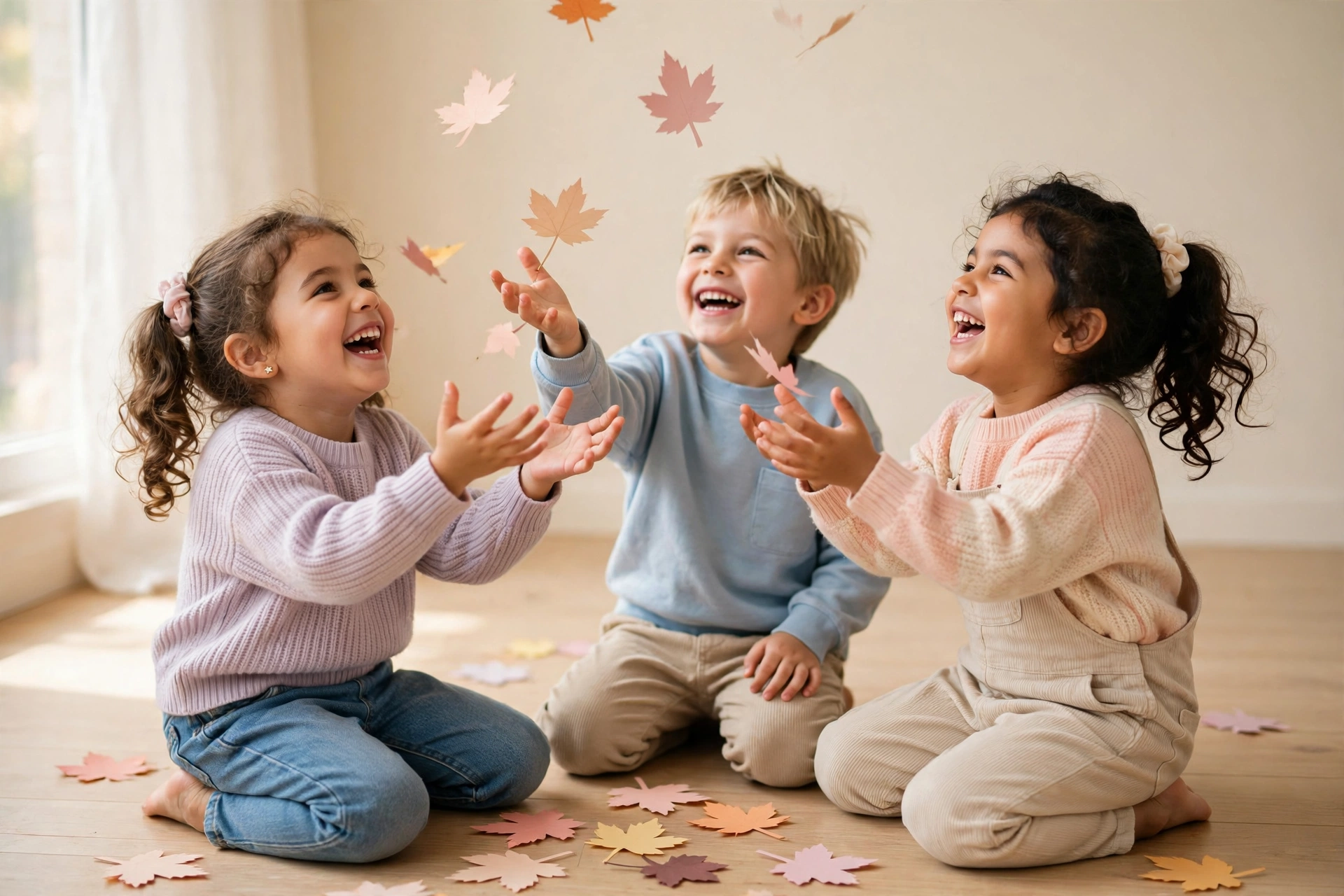
On a breezy day under a tree, throw a handful of dry leaves into the air and catch as many as you can before they land — in two hands, or in a basket for a bigger challenge. Count the catch together: that is early maths at a run. No breeze, or no garden? Paper leaves work indoors exactly the same way: cut simple leaf shapes from red, orange and yellow paper, toss them high and chase. Clear the floor of tripping hazards first, and keep the game on grass or a mat — falling leaves make everyone look up, not down.
2. Squirrel gather-and-store
Hide “nuts” around the room or garden — rolled-up socks, soft balls and big pinecones all make fine pretend nuts — then send your squirrel out to gather them into a basket and store them in a “nest” (a box or a cushion den) before winter comes. Add a gentle race against a sand timer, or a second squirrel, and the storing becomes deliciously urgent. Searching, remembering hiding places and carrying without dropping is planning and coordination together. Keep the nuts big — nothing small enough to be a mouth hazard — and wash hands after outdoor collecting, conkers included: conkers are for looking and playing, never for mouths.
3. Autumn wind dance
Give everyone a scarf, a ribbon or a big light leaf-shape of paper — these are your leaves. Play music and be blown by the wind: a soft breeze means slow swaying and drifting; a gust means twirls and scurries; and when the music (the wind) stops, every leaf settles to the ground and lies still. Your child can be the wind-master and call the weather. Reading the music’s speed with the whole body is listening and self-control practice, and the settling-still part is the calmest game of the week.
4. Pinecone rolling races
Find a gentle slope in the garden or park — or build a ramp indoors from a plank or a big book — and roll pinecones down it. Which pinecone rolls farthest? Mark the landing spots with sticks and measure the winner in footsteps. Balls can race alongside for comparison: the pinecone’s bumpy roll against the ball’s smooth one is a first, very giggly, science observation. Slopes mean supervision: an adult stays beside the course, and rolling stays on grass or carpet, never towards paths or roads. Wash the pinecones’ handlers’ hands afterwards — outdoor treasures carry the outdoors on them.
5. Harvest parade
Arm everyone with a basket and march — a real parade, knees up, around the garden or from room to room — gathering the “harvest” as you go: fallen leaves, toy fruit and vegetables, pinecones, anything autumn that is safe to carry. Sing a marching song, swap the leader each lap, and end by emptying every basket onto one big harvest pile for admiring. Marching in time, carrying without spilling and taking turns at the front is rhythm, balance and patience in one noisy package. Anything gathered outdoors is for the parade and the pile only — unknown berries are never picked up at all, and nothing from the ground is ever tasted.
Make and create
Five cosy makes that fill the windows and the walls with autumn — and every one of them is fingers-and-glue practice wearing a leaf costume.
6. Leaf rubbing art
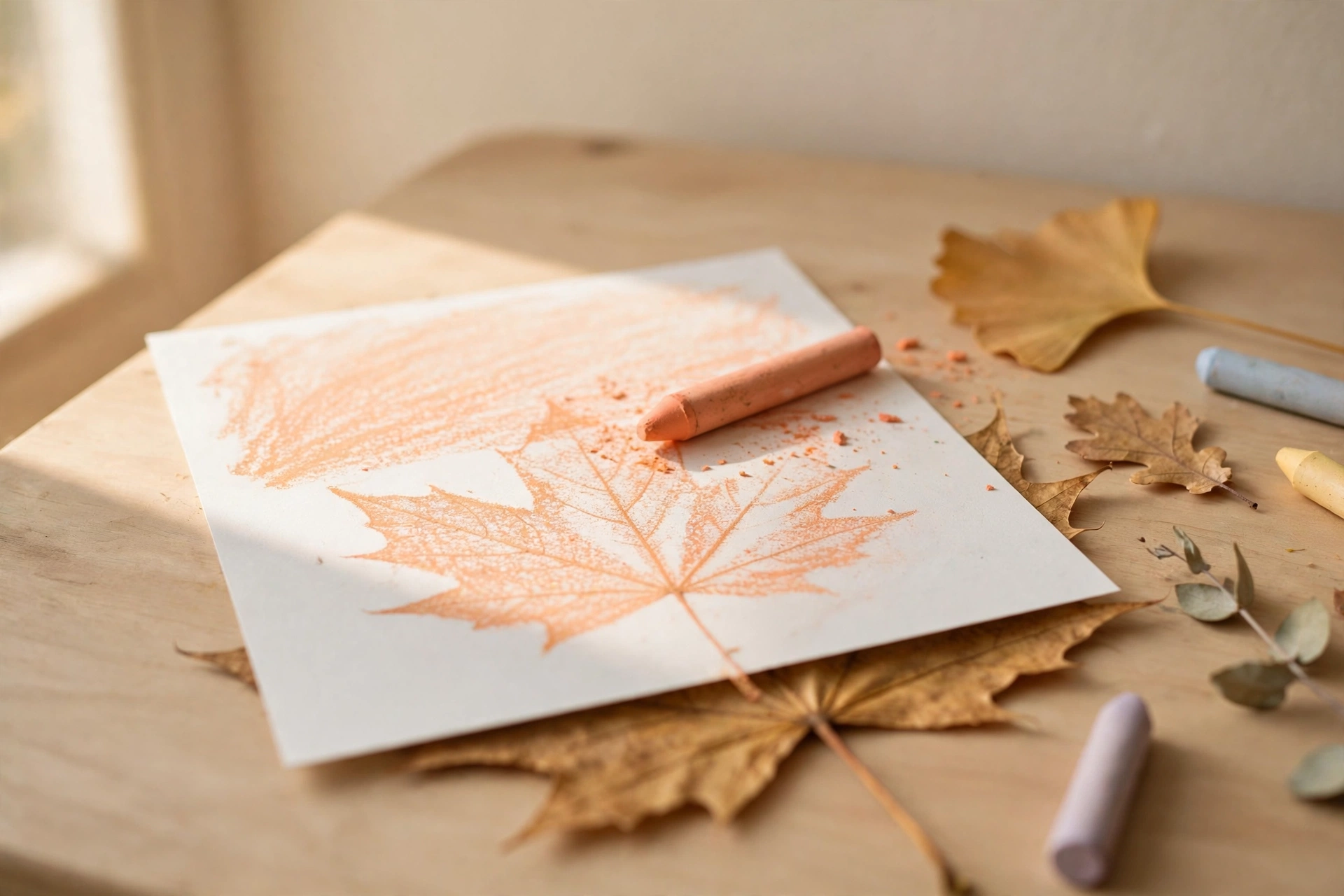
The classic, and still the best first autumn make. Collect flat leaves with strong veins, wash them and pat them dry. Place one vein-side up under a sheet of paper and rub the side of a crayon over it — the leaf appears like magic, veins and all. Try the same leaf in red, gold and brown, and overlap rubbings into a falling-leaves picture. Choosing pressure and keeping the paper still is hand strength and control, and the reveal never stops being a small miracle. Thin paper works best; an adult holds the leaf steady for younger hands.
7. Leaf people and animals collage
Glue washed, dried leaves onto card and turn them into creatures: a big oval leaf is a hedgehog’s body or a mouse, a long leaf is a fox’s tail, two small round leaves are ears. Draw or stick on eyes and legs, and give each creature a name and a home in a drawn autumn wood. Arranging shapes into a something-recognisable is early design thinking, and the naming and stories are language practice. Press leaves under a heavy book for a day first if they curl — flat leaves glue far more happily — and keep the glue at the table, with hands washed when the wood is finished.
8. Pinecone hedgehogs
Roll a ball of playdough into a plump teardrop — fat at one end, pointed at the other — then press a pinecone into the fat end as the prickly back. Add tiny playdough or drawn eyes on the point and your hedgehog is ready to hibernate in a shoebox of shredded paper. Squeezing and shaping the dough is hand-strength work, and a row of hedgehogs in different sizes is ordering practice. Pinecones are washed and dried first (a rinse and a day on a windowsill), they stay on the table rather than in mouths, and hands are washed after handling — hedgehogs, like conkers, are look-and-play treasures, not snacks.
9. Autumn colour mixing
Red, yellow and a little brown paint, big paper, and one question to explore: what colours can autumn make? Red and yellow swirled together give the orange of the best leaves; yellow with a touch of brown goes golden-mustard; red with brown deepens to chestnut. Print with leaf shapes, sponges or fingers, and name each new colour together — pumpkin, honey, rust, bonfire. Predicting and then seeing a mix is cause-and-effect science, and all that swirling is wrist control. Aprons on, washable paint only, and hands washed straight after — paint, like everything else this week, is not for tasting.
10. Leaf crown and woodland bracelet
For the crown: measure a strip of card around your child’s head, let them glue or stick washed leaves all along it, and an adult staples or tapes it closed — instant autumn royalty, ready to wear for the harvest parade. On a collecting walk, add the bracelet: a wide strip of tape worn sticky-side-out on the wrist, with small leaves and petals stuck on as you find them, a wearable collection of the walk. Measuring, choosing and arranging in a row is pattern sense, and wearing your own art is pure pride. Choose leaves from the ground rather than pulling from trees where you can, wash hands after the walk, and anything unidentified — berries especially — is admired with eyes only.
Learn and discover
The thinking set: sorting, counting, matching and the story of the season itself — maths and science hiding inside a basket of leaves.
11. Sort the leaves
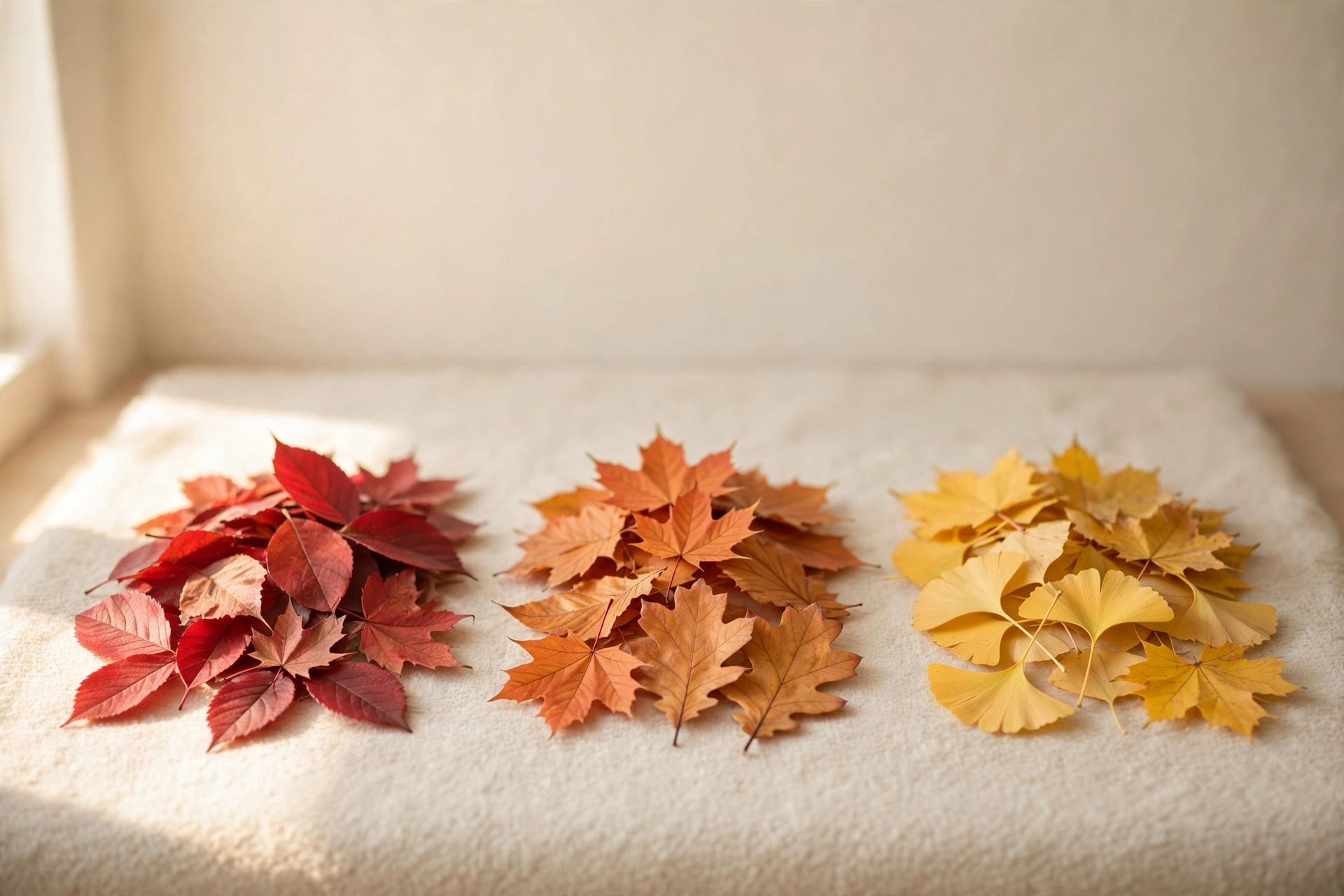
Empty the collecting basket onto a mat and sort the treasure three ways: first by colour (red, gold, orange, brown), then by size (big, middle, little), then by shape (round, pointy, hand-shaped). Talk about the rule each time — “these are all the red ones” — and let your child invent a sorting rule of their own: leaves with nibbled holes in one pile, perfect leaves in another. Sorting by a rule, and being able to say the rule, is classifying — the same thinking maths and science run on. Washed leaves only at the table, and the piles go back outside or into the craft box when the game ends.
12. Count the conkers into nests
Draw or print big numbered circles (1 to 5) as “nests” on a sheet, or use a muffin tin with a number card in each cup. Your child counts conkers into each nest — three conkers in nest 3 — checking by touching each one as they count. Then the questions begin: which nest has most? Can you give every nest one more? Counting out an exact number is one-to-one correspondence with a story attached. And the safety rule rides along every single time: conkers are not food — they are for looking, counting and playing only, never in mouths — an adult stays at the table, the counting is supervised, and hands are washed when the nests are emptied.
13. Leaf matching pairs
On a walk, collect two leaves from the same tree — the same shape, the same edges, near-twins. Back home, lay all the pairs muddled on the mat and hunt for the matches: find the two that came from one tree. Turn it into a memory game by flipping leaves face-down and turning two at a time. Looking closely enough to tell one leaf from another — edges, points, veins — is observation, the scientist’s first skill. Leaves from the ground only, washed before table play, and unknown seed cases or berries never join the set: eyes only for anything you cannot name.
14. Autumn weather and clothes chat
The season is changing, and your child can dress for it. Lay out summer clothes and autumn clothes in two piles — shorts and sandals beside jumpers, socks and a raincoat — and sort them together, talking about why: the air is cooler, the rain comes more, the evenings darken earlier. Then dress a doll or a drawn character for an autumn walk, head to toe, and check the choices against the real weather outside the window. Sorting by a reason, and dressing for conditions, is practical thinking and new weather words all at once — and it makes the morning battle over the jumper a tiny bit smaller.
15. The leaf story — green to gold to ground to soil
Tell the leaf’s year as a simple true story, with real examples hunted on a walk: in spring and summer the leaf is green and busy, catching sunlight to feed the tree. In autumn the green fades and the golds and reds that were hiding underneath show through. The leaf lets go, falls, and lies on the ground — and there it slowly crumbles into the soil, which feeds the tree again next spring. Find one leaf at each stage and line them up in order: green, gold, fallen, crumbling. Sequencing a real cycle in the right order is early science at its most honest, and it makes every leaf pile a story, not a mess. Ground-stage leaves are looked at, not handled much — a stick makes a good pointer — and hands are washed when you come in.
Turn it into a theme week
Spread the fifteen across five days, two or three a day, and the theme does the teaching by repetition:
- Day 1 — Collecting day: a harvest parade (5) to gather the week’s treasure, then sort the leaves (11) and start the leaf story line-up (15).
- Day 2 — Moving day: the leaf-catch chase (1), squirrel gather-and-store (2), and the autumn wind dance (3) to finish.
- Day 3 — Making day: leaf rubbing art (6), leaf people and animals (7), and autumn colour mixing (9) if the walls still have room.
- Day 4 — Cosy day: pinecone hedgehogs (8), count the conkers (12), and the weather-and-clothes chat (14) before the evening walk.
- Day 5 — Autumn finale: pinecone rolling races (4), leaf matching pairs (13), and crown the week — literally — with the leaf crown (10) worn to a final harvest parade.
Short on time? Three days still works — pick one activity from each section per day. And a note for the season itself: autumn weather will rearrange your plans; that is part of the theme. A rained-off collecting day is simply a paper-leaf day indoors, and every activity on this page has an indoor version waiting.
Finish the week with printables
After five days of autumn play, some preschoolers ask for a leaf page of their own to colour or trace — and that request is the perfect moment for paper. FIMS Schools has free printable preschool and kindergarten worksheets, including first tracing and colouring pages: free preschool and kindergarten worksheets. An autumn leaf colouring page or two to close the week is plenty — the play was the learning; the printable is the souvenir.
Read next
- Preschool Theme Activities — every theme week in one place: pick next week’s theme here
- Farm Theme Preschool Activities — another outdoor-hearted theme week: animal walks, farm art and counting games
- 30 Activities for 4 Year Olds — everyday play for the middle of the preschool years
Autumn theme questions parents ask
Are conkers safe for preschoolers to play with?
Yes for play, no for eating — that is the whole rule. Conkers are not food: children can collect them, count them, roll them and admire their shine, always with an adult there, and they never go in mouths. Wash hands after handling conkers (and after any outdoor collecting), and store the conker basket up high between games so the rule is easy to keep. Children who still mouth everything they hold are better given the big pinecones and soft pretend nuts this year, with conkers saved for looking at together.
We have no garden — can we still do an autumn theme?
Completely. One collecting walk to a park, a tree-lined street or even a single generous tree fills the basket for the whole week — leaves, conkers and pinecones all travel home happily. Everything else on this page is indoors already: the leaf-catch chase runs on paper leaves, the rolling races run down a plank ramp, and the sorting, counting and making all happen at the table. No walk possible at all? Cut and paint paper leaves in autumn colours and the whole week still works — the learning is in the play, not the postcode.
What if the leaves are soggy and wet most days?
Autumn’s honest problem — and easily solved. Collect on the driest day you get, then press the leaves: lay them flat between sheets of newspaper or kitchen paper inside a heavy book for a day or two. Pressed leaves come out dry, flat and perfect for rubbing, collage and matching games — arguably better than fresh ones. Leaves too far gone even for that? Skip to the indoor versions: paint and cut paper leaves, print with sponges in autumn colours, and let the colour-mixing activity (9) carry the season’s palette on its own.