
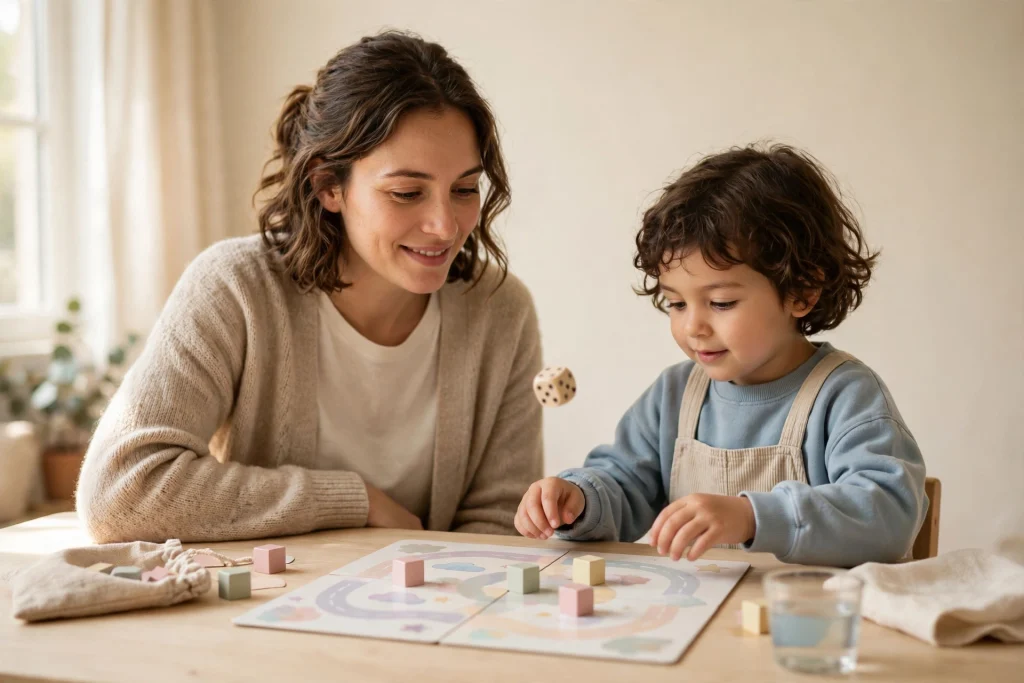
Short answer: The best preschool board games for ages 3–5 are short, need no reading, and run on luck more than skill. Here are 12 — six to make at home tonight, six classic styles to buy or borrow.
Quick facts
- Ages: 3–5 years
- Cost: free home-made versions, or one boxed game
- Screen-free: yes — every game on this page
- Skills: turn-taking, counting, colours, patience
What makes a good first board game?
A first board game has one job: to end with your child wanting to play again. Four things make that happen. Short rounds — ten to fifteen minutes is plenty at this age; a game that drags will be abandoned face-down. No reading needed — pictures, colours and counting dots only, so a 3 year old and a 5 year old can play the same game. Luck over skill — dice and spinners, not strategy, so a small child can genuinely beat a grown-up, and a grown-up can genuinely lose; that is what makes it exciting rather than discouraging. And big, sturdy pieces — chunky counters and thick cards that survive being dropped, chewed on (briefly) and loved hard.
Everything on this page passes those four tests. The first six cost nothing but a little card and some crayons. The second six are classic styles you will find in any toy shop or library — described by type, so you can spot a good one whatever the brand.
One more test, the parent test: can you explain the whole game in two sentences? If the rules take longer to explain than the round takes to play, it is a game for next year, not this one. The best first games are understood before the first turn is over — the learning happens inside the playing, turn by turn, with you there to steady the wobbles.
Make-it-yourself games
You do not need a shop to start. These six games are made from card, paper and things already in the house — and making them together is half the fun.
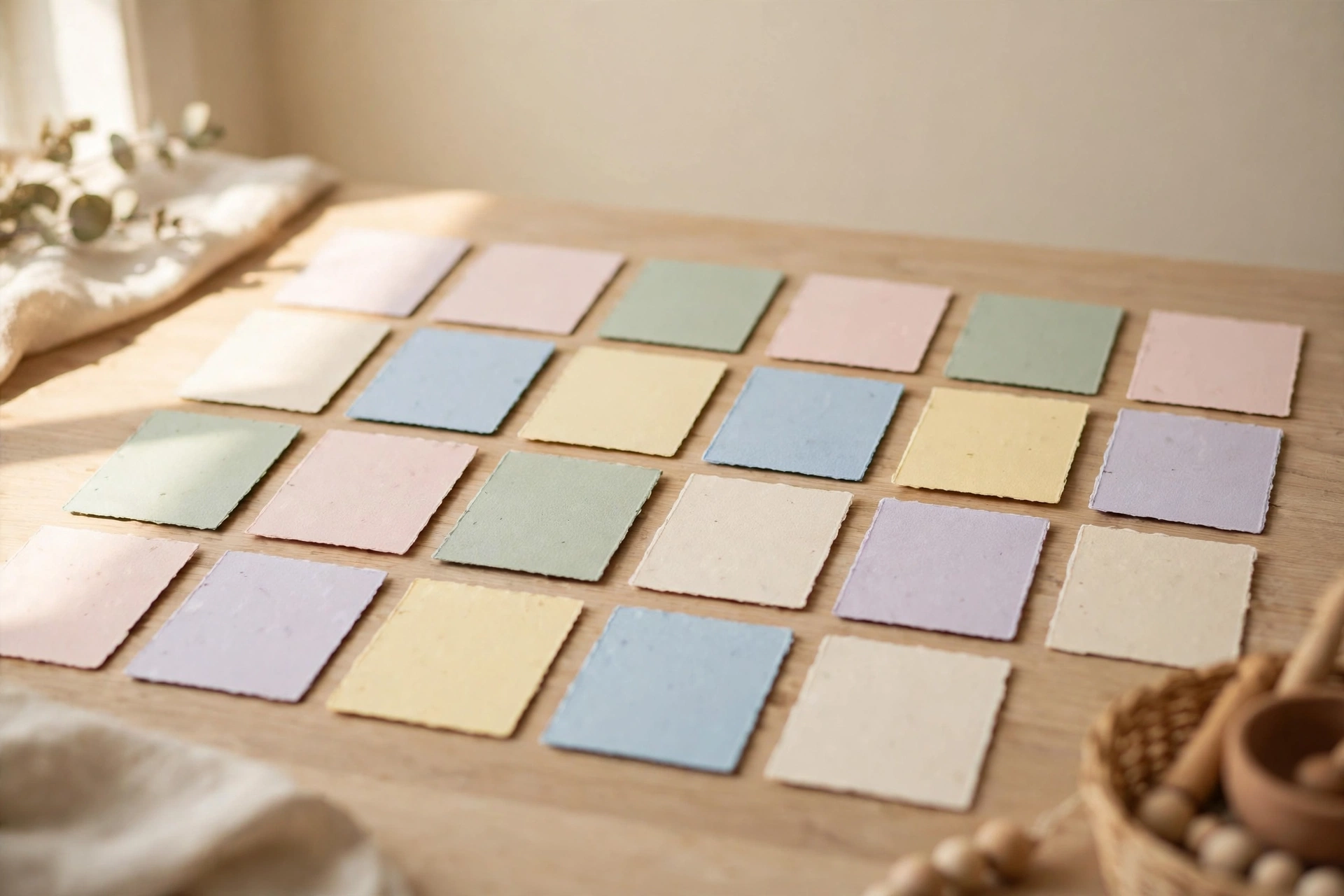
1. Matching pairs with picture cards
Draw or print twelve simple pictures — a sun, a fish, a cup — twice each, on twenty-four cards. Shuffle, lay them face down in rows, and take turns flipping two: keep the pair if they match, turn them back if they don’t. The winner holds the most pairs at the end. Start with six pairs for a 3 year old and grow the grid as memory sharpens. It teaches concentration, memory and the patience of waiting for a turn.
2. Colour lotto boards
Give each player a board divided into six squares, each square a different colour. Make a matching set of small colour cards, shuffle them into a pile, and draw one at a time: whoever’s board has that colour covers the square with a counter or a coin. First to cover the whole board calls “Lotto!” and wins. No reading, no counting — just colour-spotting and the lovely tension of one square left. Swap colours for animals, shapes or family photos as your child grows.
3. A giant floor race track
Tape a winding path of paper squares across the floor — twenty squares is plenty — and finish with a star, a castle or a cup of tea drawn at the end. Each player moves a toy figure along the path by rolling a big dice and counting the squares aloud. Land, cheer, wait your turn. The counting is real maths practice in disguise, the track can snake around the furniture, and because everyone can see the finish line, even the player at the back stays hopeful.
4. Domino matching with big cards
Cut card into chunky domino-sized pieces and draw a picture on each end — an apple, a star, a dog. Shuffle the pile face down, give each player five, and take turns matching a picture on your card to a picture at either end of the growing line; pick up from the pile if you cannot go. Pictures instead of dots keep it playable at three, and matching end-to-end builds the scanning and comparing that early reading quietly needs.
5. Treasure-hunt bingo around the house
Each player gets a card with six pictures of things that live in your home: a spoon, a sock, a book, a plant. Then everyone sets off — walking feet only — to find each thing, point at it (no carrying the plant), and cross it off. First full card wins, and the finder gets to choose the celebration dance. It burns energy on a rainy afternoon, needs zero pieces to lose, and turns “tidying your eyes” into a game.
6. Simple card snap with picture cards
Use a small deck of picture cards in matching sets of four — four cats, four boats, four cakes. Deal them out, and take turns placing one card face up on a central pile, saying the picture’s name as you go. When the new card matches the one beneath it, the first player to slap the pile and shout “Snap!” takes it. Slow the pace right down for beginners — at this age, spotting the match together matters more than who slaps first.
Classic styles to buy or borrow
Shops are full of board games, and most are too long, too fiddly or too competitive for a first game. These six styles are the ones that work at 3–5 — look for the style, in whatever version your shop or library has.
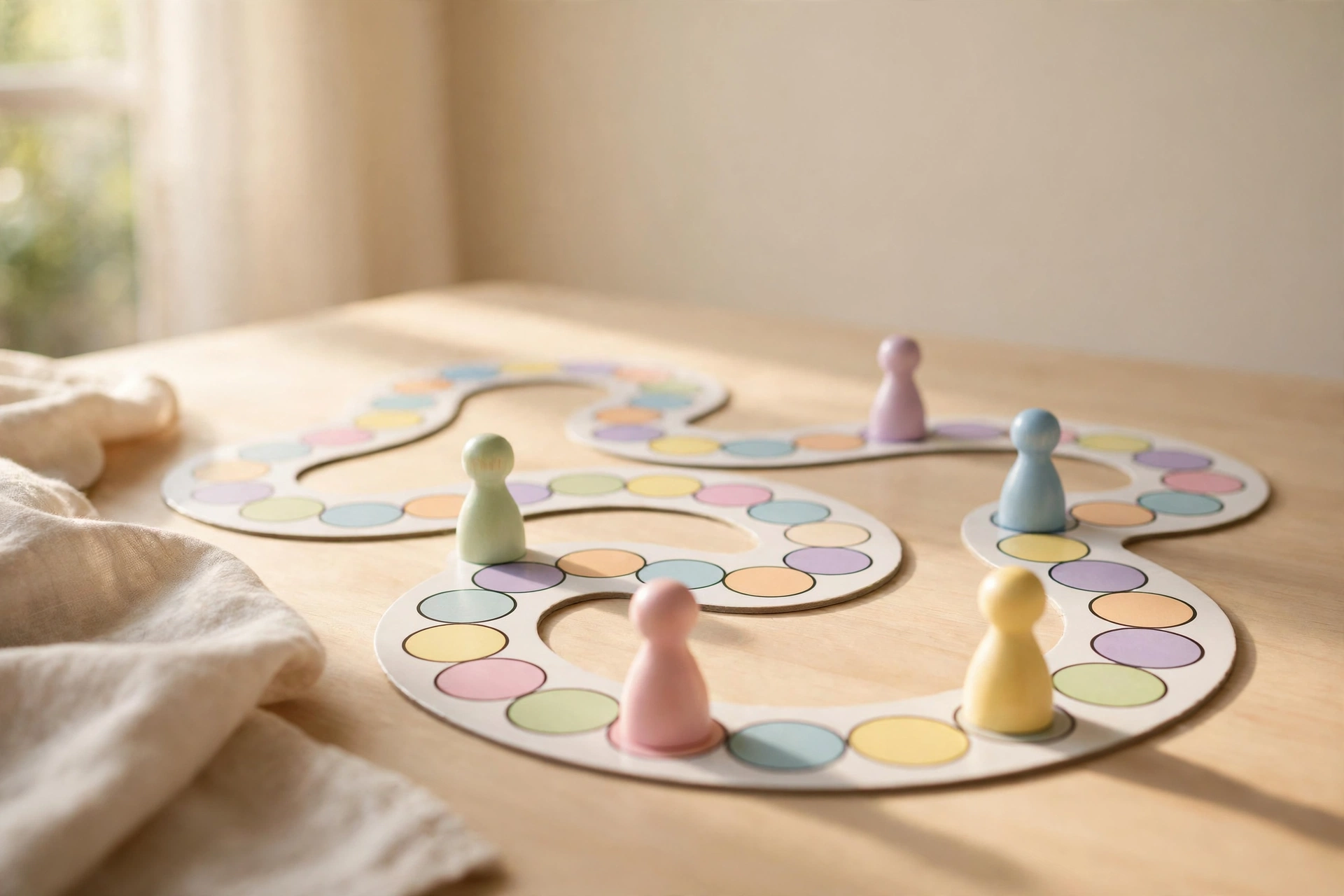
7. A co-operative colour-path game
In this gentle style, everyone moves along a colourful path towards a sweet or magical finish, advancing by drawing a colour card and hopping to the next square of that colour. Nobody is knocked out and nobody races anyone else — the whole family arrives together or not at all. It is the softest possible introduction to “games have rules”: turns, moving a counter, and waiting, with all the competition taken out.
8. A fruit-orchard co-operative picking game
Players work as a team to “pick” fruit from cardboard trees — by colour matching or a simple dice — before a puzzle of a cheeky bird or animal is completed in the middle. Win together or lose together, which changes everything: an adult can narrate the tension (“quick, the bird is nearly built!”) and a loss belongs to everybody, so nobody cries alone. A beautiful first game for a child who currently finds losing unbearable.
9. A memory tray game
A tray of familiar objects is shown, everyone studies it, then a cloth covers it and one object is secretly removed — or everyone’s eyes close while one is taken away. Uncover the tray: who can spot what is missing? Shop versions exist with picture cards, but the style is ancient and endlessly replayable. It stretches memory and attention in sixty-second rounds, and children love being the one who hides the object.
10. An animal-sound lotto
Each player has a board of animal pictures; a caller — or a simple sound button, or just a very game parent — makes an animal sound, and players cover the animal they hear. First to fill the board wins and gets to be the caller. Listening games are rarer than looking games, and this one rewards careful ears, delights everyone who gets to moo, and works beautifully with mixed ages because the littlest player only has to recognise a sound.
11. A first dice-and-counter counting game
The classic race in a box: a short track, big counters, one dice, first to the finish. Choose a version where the dice shows colours or dots up to three rather than full numbers, the track is short, and nothing sends a player backwards — at four, moving six squares back can feel like the end of the world. Counting the dots, then counting the hops, is exactly the one-to-one counting preschool maths is built on.
12. A balancing and stacking game
Players take turns adding a piece — a block, an animal, a boat passenger — to a tower, a bridge or a wobbling base, until it all comes down in the best crash of the day. There is barely a rule to learn, the falling-down is the point, and the real skills are a steady hand, a held breath and laughing when it topples. A good one for a child who struggles with turn-taking in longer games, because every turn takes five seconds.
Playing happily — the parent’s guide
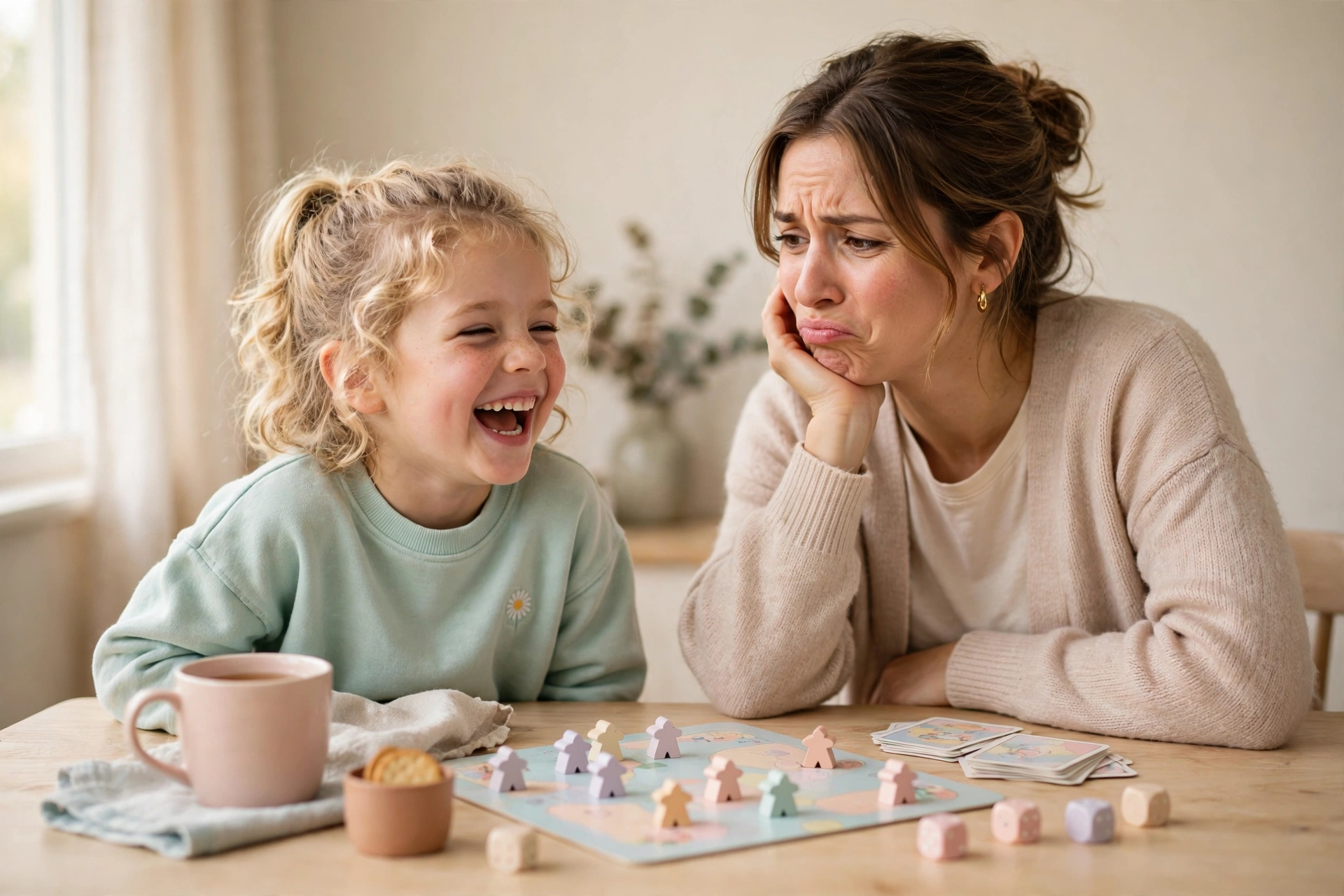
The game is the excuse; the togetherness is the point. A few habits keep game time happy at this age. Keep rounds short — ten or fifteen minutes, and stop while it is still fun; a game put away mid-laughter gets asked for again, a game that dragged gets avoided. Let them win sometimes, but not always — honest dice will do this for you if you simply play gently; children can smell a thrown game by five, and a real win tastes far better. Model losing kindly — when you lose, say so cheerfully: “Oh well — well played! Again?” Losing without falling apart is a skill, and your child learns it by watching you, not by being lectured. House rules are fine — at this age the printed rules are a suggestion; if skipping the “miss a turn” square keeps the peace, skip it, and change the rule back next year. And if a game ends in tears now and then, that is not failure — it is practice at big feelings, with you right there.
Finally, expect the game to change. Preschoolers invent rules mid-round, move counters to the wrong square on purpose, and declare the cat the winner. This is not cheating and it is not a problem to fix — it is how young children explore what rules are. Join in lightly, hold only the rules that keep the game kind (taking turns, being gentle with pieces), and let the rest bend. The board game habit you are really building is “we sit together, we take turns, we have fun” — the official rules can arrive in a year or two.
One safety note: board games come with dice, counters and small cards, all of which are choking hazards for babies and toddlers. Keep game pieces on the table, pack them away out of reach afterwards, and if an under-3 sibling is nearby, choose the big-piece games on this page and stay within arm’s reach — or let the little one be the official dice-roller’s assistant from your lap.
When game time has built the counting habit, keep it growing with our math activities for preschoolers — the same counting, sorting and matching, in active play.
Read next
- Activities by Type — every activity on the blog, sorted by kind
- Rainy Day Activities for Kids — more indoor ideas for a stuck-inside day
- Activities for 4 Year Olds — 30 ideas for the middle of the board-game years
Frequently asked questions
What age can children start board games?
Most children can join a simple game somewhere around age 3 — matching, lotto and co-operative styles with no reading and rounds of a few minutes. Some 2 year olds enjoy rolling a dice and moving a counter with heavy help. Start with the co-operative and matching games on this page, sit them next to you as a “team”, and let staying for three turns count as success at first.
My child hates losing — is that normal?
Completely normal, and very common between 3 and 5. Losing feels enormous when you are small and the game was your whole world for ten minutes. Co-operative games — where everyone wins or loses together — take the sting out while your child grows into competition. Model cheerful losing yourself, keep games short, and never force a rematch: the wish to play again comes back on its own.
How long should a board game last at this age?
About 10 to 15 minutes is the sweet spot for ages 3–5; simpler matching and lotto games may finish in five, and that is fine. If a game regularly outlasts your child’s attention, shorten it — use half the pairs, a shorter track, fewer cards — rather than pushing through. Many short, happy games build far more than a few long, tearful ones.