
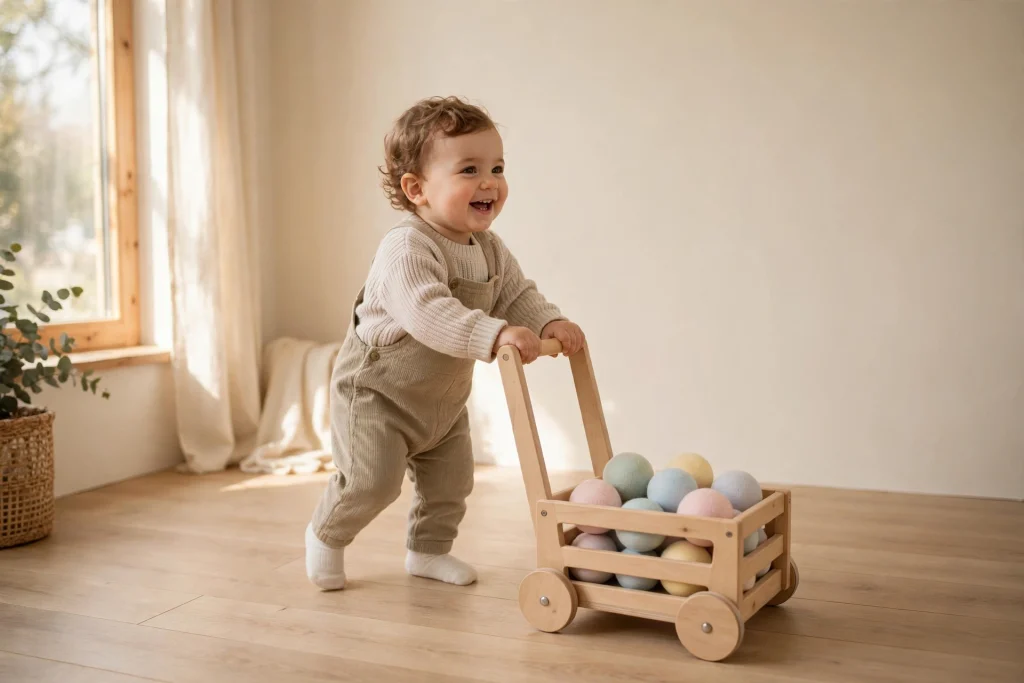
Short answer: the best activities for a 15–18 month old are short, active and repeatable — climbing over cushions, pushing and posting games, big stickers, scooping and pouring, and calm sensory play with water, oats and textures. Everything below uses ordinary household things, takes five to fifteen minutes, and matches what toddlers this age are busy learning: walking with confidence, using their hands with purpose, and doing more and more “by myself”.
Quick facts
Age: 15–18 months
Time: 5–15 minutes per activity (a few happy minutes is a full session at this age)
Materials: everyday household items — cushions, boxes, big stickers, cups, spoons, water, oats
Mess: low overall (water, oats and dough activities are marked)
Supervision: an adult nearby at all times — toddlers this age climb first and think later (see the safety notes)
What you need
One small basket of basics covers nearly every activity on this page:
- Sofa cushions and a low, sturdy box or laundry basket
- A big soft ball and a few beanbags (or rolled-up socks)
- A cardboard box big enough to crawl through, or two chairs and a blanket
- Large, easy-peel stickers and big sheets of paper
- Chunky crayons and masking tape
- Wooden blocks, stacking cups or clean food tubs
- Two bowls, a large spoon, big pom-poms or cotton balls
- Playdough and a couple of chunky knob puzzles
- A shallow tray, a small jug and two plastic cups for water play
- A scoop bin: a tub of dry oats with cups and spoons
- Clean jars with lids, scarves or light cloths, and a tissue box
On the move — movement and big play

Your 15–18 month old’s whole body is the project right now: steadier walking, first climbing, early running and a lot of carrying things from place to place. These games give that energy a safe direction.
1. Cushion Climb
Lay two or three sofa cushions in a row on the floor and put a favourite toy at the far end. Your toddler crawls and climbs over the “mountains” to reach it. Climbing over soft, uneven surfaces builds leg strength, balance and the confidence to handle real steps and playground slopes later.
2. Push the Loaded Box
Put a few soft toys in a sturdy box or laundry basket and let your toddler push it around the room, then pull it back. Pushing a loaded box is heavy work in the best sense — it strengthens arms, legs and core, and gives determined walkers a job that feels important.
3. Dance and Freeze
Play a lively song and dance together; when the music stops, everyone freezes. Your toddler will mostly bounce, sway and giggle at first — that is the activity. Stopping and starting with the music is early listening and self-control practice wrapped in pure fun.
4. Roll-the-Ball Partners
Sit on the floor facing each other, legs wide, and roll a big soft ball back and forth. Rolling (not throwing) keeps the game going, and waiting for the ball to come back is your toddler’s first lesson in turn-taking. Count the rolls out loud for a gentle first taste of numbers.
5. Cardboard Tunnel Crawl
Open both ends of a big cardboard box, or drape a blanket over two chairs, and crawl through after your toddler. Tunnels invite crawling, peeking and lots of “where did she go?” laughter — and crawling still matters at this age: it coordinates both sides of the body together.
6. Tape-Line Parade
Stick a long line of masking tape on the floor and walk along it slowly, carrying a teddy. Your toddler will wander off the line constantly — follow them anyway. Trying to step on or near a line is early balance work, and carrying a passenger makes it a game with a story.
7. Beanbag Bucket Toss
Set a wide bucket or box a short distance away and toss beanbags (or rolled socks) into it together. At this age, “close” counts as success and dumping the bucket out is part of the game. Aiming and releasing builds arm control and hand–eye coordination.
8. Bubble Chase and Pop
Blow bubbles outdoors or in the bath area and let your toddler chase, reach and pop them. Tracking a drifting bubble with the eyes and timing a grab or a stomp is real coordination practice — and a guaranteed way to burn off the last energy of the day. (Outdoor or easy-clean floor recommended.)
Busy hands — fine motor and first little jobs
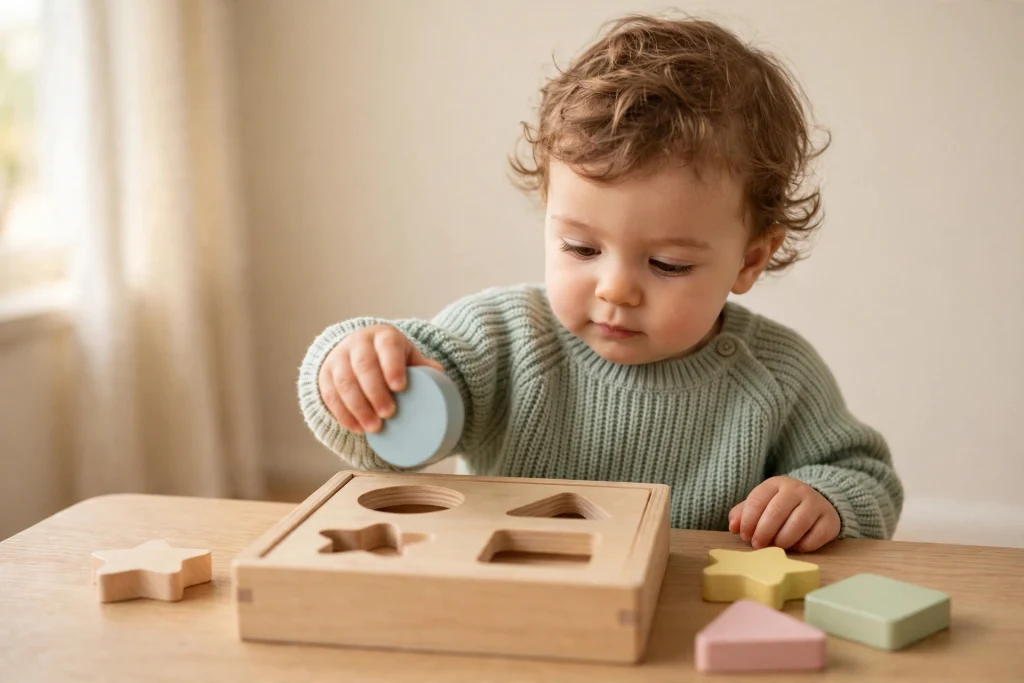
Hands are getting purposeful now: pointing, posting, peeling, stacking and the first real attempts at helping. These activities feed exactly that — and our dedicated fine motor page (linked below) goes deeper when you want more.
9. Big Shape Posting
Cut one wide slot or circle in the lid of a tub and give your toddler chunky shapes, big lids or soft blocks to post through it. The slot should be generous — success matters more than challenge at this age. Posting builds aim, wrist control and the satisfying logic of “it fits, it falls, I hear it land”.
10. Sticker Road
Draw a thick, curvy road across a large sheet of paper and let your toddler peel big stickers and press them along the road. Peeling works the fingertips and the thumb-and-finger pinch; pressing the sticker onto a target adds aim. Expect stickers on the table, the floor and everyone present — that is normal.
11. Stack, Build, Crash
Stack blocks, cups or clean tubs into towers of three to five for your toddler to knock down — then start handing them the pieces to stack themselves. Balancing one block on another takes a steady hand and a gentle release, and the crash is the reward that keeps them practising.
12. Spoon-and-Pom-Pom Transfer
Two bowls and a big spoon: scoop pom-poms or cotton balls from one bowl to the other. Your toddler will use the spoon, then their hands, then tip the bowl — all three are real learning about how tools, hands and gravity work. Scooping is also the direct ancestor of self-feeding.
13. Playdough Poke, Pinch and Pull
Give your toddler a ball of playdough to poke with one finger, pinch pieces off and squash flat. Dough gives resistance that soft toys don’t, so fingers and hands work harder with every squeeze. Roll a thick “snake” together and let them pull it apart — pulling is a whole-hand strength builder. (Supervise — dough is not a snack.)
14. Turning Pages, Finding Pictures
Sit with a chunky board book and play “find the…”: ask for the dog, the ball, the banana, and let your toddler turn the thick pages and point. Turning one page at a time is genuine fine motor work, and pointing at named pictures is how vocabulary quietly grows.
15. Knob Puzzle First Tries
Offer one or two chunky knob puzzles with big, simple shapes. Your toddler grasps the knob, pulls the piece out and — with time and luck — fits it back. Start by removing just one piece yourself and letting them finish the job; completing something is a powerful motivator.
16. Helping Hands Jobs
Give your toddler real jobs with soft edges: putting spoons in a drawer, carrying a cloth to the table, dropping soft toys into the tidy-up basket one by one. Toddlers this age desperately want to help, and carrying, placing and dropping on purpose builds coordination, independence and pride all at once.
Sensory and quiet play — calm-down time
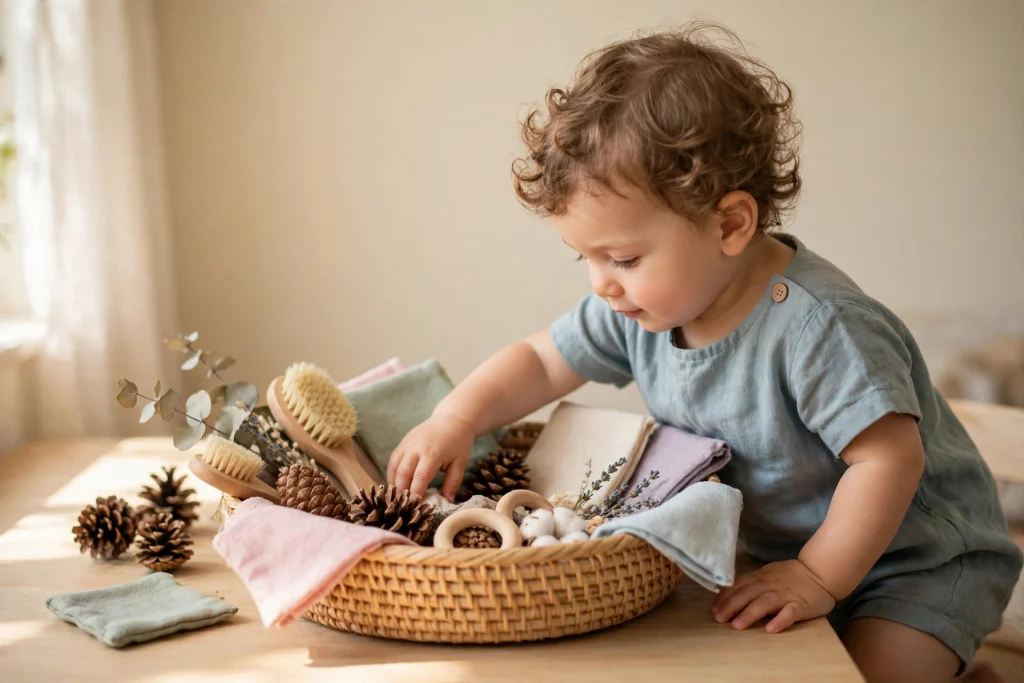
Not every minute needs to be busy. Sensory play settles toddlers, holds their attention a little longer, and is the part of the day many parents find easiest to sit down and share.
17. Water Pouring Station
In a shallow tray (or the bath), give your toddler a small jug and two cups to pour between. Start with very little water. Pouring needs two hands cooperating — one holding, one tipping — and the sound and splash of water is its own reward. (Water — tray and a dry floor plan recommended.)
18. Oats Scoop Bin
Fill a tub with dry oats and add cups, spoons and a small funnel-shaped bottle. Scooping, pouring and sprinkling oats is peaceful, absorbing work that toddlers return to again and again. It lives happily in a corner and resets in seconds. (Supervise — oats will be tasted at least once.)
19. Treasure Texture Basket
Fill a basket with safe objects of different textures — a soft scarf, a smooth wooden spoon, a bumpy ball, a crinkly cloth, a cool metal lid. Let your toddler take each one out, explore it with hands and mouth, and put it back. Naming the textures as they go (“soft… rough… cold”) builds first describing words.
20. Sound Shakers
Put a few dried beans or pasta pieces into small, firmly sealed pots (tape the lids) and shake them together. Different fillings make different sounds — one loud, one soft. Shaking, listening and swapping shakers is early music, and noticing “that one is quiet” is early comparison thinking. (Check seals before every use.)
21. Scarf Pull Box
Push two or three light scarves or tissues into an empty tissue box and let your toddler pull them out one by one, then stuff them back with your help. The pull-and-stuff rhythm is calming and repetitive in the way toddlers love, and it quietly strengthens the whole hand.
22. Ice-Cube Slide Play
Put a few large ice cubes in a shallow tray and let your toddler push them around, watch them slide and feel them melt. Cold, slippery and always changing, ice holds attention surprisingly well — and chasing a sliding cube is fine motor practice in disguise. (Use big cubes, and sit with your toddler — small melting pieces are not for mouths.)
23. Calm-Down Glitter Bottle
Fill a small, strong plastic bottle with water, a spoon of glitter glue and a drop of food colouring; seal the lid firmly (glue or tape it). Shake it together and watch the glitter settle. Watching something slow down helps your toddler slow down too — a gentle tool for the minutes before naps and meals. (An adult makes and seals this one.)
24. Unwrap the Treasure
Wrap favourite small toys loosely in scarves, cloths or a clean tea towel and let your toddler unwrap them. Pulling cloth away, finding the edge and working out the “parcel” is problem-solving with the fingers — and the reunion with a beloved toy is the prize. Works beautifully as a quiet game before bed.
What your 15–18 month old is learning
Between 15 and 18 months, development moves fast — but it does not move to a timetable. Children reach each new skill in their own order and their own week; a wide range is normal at this age. What follows are the kinds of things many toddlers are working on in these months — the same skills the activities above are built to feed — not a checklist to measure your child against.
- Moving with confidence. Many toddlers now walk steadily, start to run in a stiff, joyful way, climb onto low furniture, and carry objects while walking. Some are still happiest with a push-along toy for support — that is within the normal range too.
- Hands with a purpose. Stacking two or three blocks, scribbling with a chunky crayon, turning board-book pages, posting shapes and feeding themselves with a spoon (messily) are typical projects of this stage.
- First words and lots of understanding. Many toddlers say a handful of clear words and understand far more — they can point to named pictures, follow simple everyday instructions like “give it to me”, and shake or nod their head with meaning. Some children’s words come a little later while their understanding races ahead.
- “By myself!” Wanting to help, to carry, to feed themselves and to copy what adults do is a big feature of this age. It can be slow and messy — and it is exactly how independence and coordination grow.
If an activity on this page looks too easy or too hard for your child today, follow their lead: offer the easier version without worry, or put the harder one away for a few weeks. Play that meets your child where they are is never wasted time.
The information on this page is general information for parents, shared for learning and activity ideas. It is not medical advice, and it does not replace the guidance of a qualified professional. Every child develops at their own pace — if you have any concern about your child’s development, please talk to a qualified doctor or child-development professional.
Safety notes — please read
- Always stay within reach. At 15–18 months, climbing, pulling up and sudden dashes are the whole point of the day. Clear the climbing zone of hard corners and anything that can topple, and never leave your toddler alone with these activities.
- Small-object rule: if an item can fit through a toilet-roll tube, it is too small for this age without you sitting right beside your child. Pom-poms, beans, pasta and buttons all count — choose the biggest versions, and pack small pieces away the moment play ends.
- Sealed means sealed. Check shakers, zip bags and the glitter bottle before every use; re-tape or throw away anything that is opening, cracked or leaking.
- Water play: use small amounts, in a tray, with you beside your toddler. A child this age should never be left alone near water — not even for a moment, and not even a few centimetres of it.
- Check before play. Look over boxes, lids and posting slots for sharp cut edges, splinters and loose parts; smooth or tape edges, and throw away anything cracked.
- Stop at “enough”. Wandering off, throwing everything or getting frustrated is your toddler saying the session is over. Short and happy beats long and pushed — you can always offer the same game again tomorrow.
Activities for 15–18 month olds — questions parents ask
How much screen time is okay at 15–18 months?
For children under two, the common guidance is to keep screen time very limited — none as a routine, apart from video calls with family, which are a conversation rather than a show. In real life, the practical swap is a “busy box” kept by the sofa or in the kitchen: scarves to pull, a posting tub, a board book. When you do need ten quiet minutes, a short shared video you watch and talk through together is a gentler choice than solo scrolling — and it happens in most homes, without harm to anyone’s day.
My toddler only plays alone for two or three minutes. Is that normal?
Completely normal. At 15–18 months, two to five minutes of independent play is a good stretch — toddlers this age are built to check back with you constantly. It grows slowly: stay nearby but slightly boring, let them return to the activity on their own, and resist re-entertaining the moment they look up. A familiar, low-challenge activity (the oats bin, the scarf box) usually holds attention longest.
Do I really not need to buy special toys or activity kits?
You really don’t. Every activity on this page runs on cushions, boxes, lids, stickers, spoons and water. A few cheap basics — chunky crayons, big stickers, playdough, a set of stacking cups — will carry you through months of play. Toddlers this age famously prefer the box to the toy anyway; your job is variety of simple things, not more things.
We’re stuck indoors all day. How do I structure it?
Think in short rounds rather than a schedule: a movement burst (cushion climb, bubbles, dance), then a busy-hands activity (stickers, posting, dough), then something calm (water pouring, oats bin, a book) — and repeat the loop with different pieces after naps and meals. Put out only two or three things at a time and swap them between rounds; the same activity feels new again after a break. Our rainy-day and indoor activities guide in this series collects the whole indoor toolkit in one place.
Looking ahead — from play to first printables
At 15–18 months your child is a player, not a worksheet child — and that is exactly right. But the hands being built here, with posting, peeling and scribbling, are the same hands that will one day hold a pencil. When your toddler is older and starts showing interest in paper-and-pencil play, our free preschool worksheets are the natural next step, starting with big, simple pre-writing and early-learning pages.
See the free preschool and kindergarten worksheets →
Read next
- Fine Motor Activities for Toddlers — the same age band, all about fingers, grip and the pincer grasp
- Activities by Age — ideas matched to every age from babies to 5 year olds