
Short answer: the best fine motor activities for toddlers are simple posting, squeezing, peeling, pouring and threading games that use things you already have at home — a box with a hole in the lid, stickers, clothespins, sponges and playdough. Five to ten minutes a day of this kind of play is enough to strengthen your toddler’s fingers, grip and pincer grasp, step by step, towards holding a pencil.
Quick facts
Age: 1–3 years (grouped below: 12–18 months · 18–24 months · 2–3 years)
Time: 5–10 minutes per activity
Materials: everyday household items — no special toys needed
Mess: low (one or two activities use water or paint; each is marked)
Supervision: an adult should always be present — several activities use small items (see the safety notes)
What you need
You do not need to buy anything to start. Gather what you have from this list and rotate it:
- A plastic tub or box with a lid you can cut a slot or hole in
- Large pom-poms, cotton balls or soft balls
- Big, easy-peel stickers
- Wooden clothespins
- A clean sponge, two bowls and a small jug
- Chunky crayons and large sheets of paper
- Playdough (bought, or made at home)
- A colander and pipe cleaners or thick straws
- Clean jars and bottles with screw lids
- Large wooden beads and a shoelace (for the 2–3 years group only, and only with you sitting beside your child)
Fine motor activities for 12–18 months
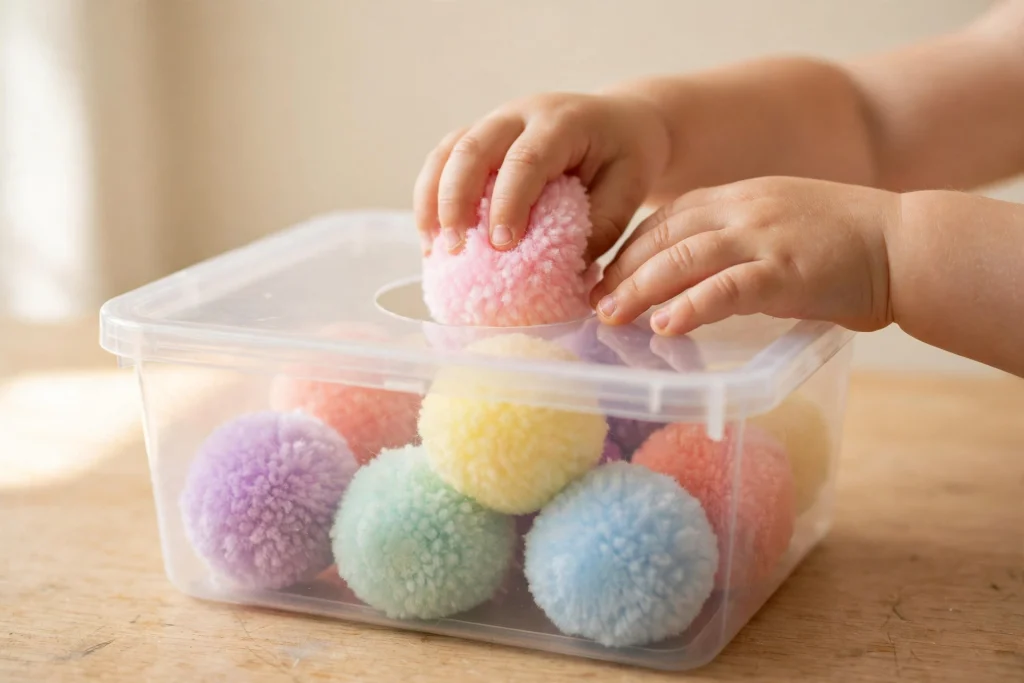
At this age, everything is about grasping, releasing and posting — picking something up and letting it go in the right place. Keep pieces big, and expect most of the play to be tipping things out again.
1. Pom-Pom Drop
Cut a round hole in the lid of a tub, just bigger than a large pom-pom. Show your baby how to push the pom-poms through the hole, then shake the tub and start again. Pushing against the slight resistance of the lid builds finger strength and the first pincer grasp.
2. Scarf Pull
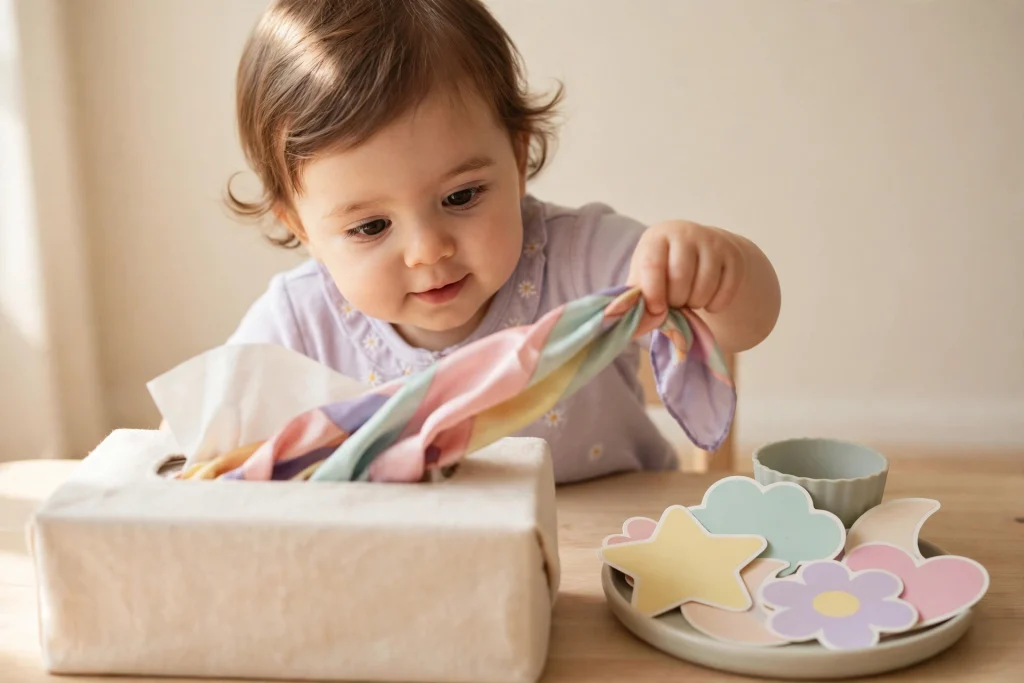
Push two or three light scarves (or tissues) into an empty tissue box and let your child pull them out one by one. The pulling movement strengthens the whole hand and teaches cause and effect — and the game resets itself in seconds.
3. Big Sticker Peel
Stick large stickers around the edge of a table or on a baking tray and let your toddler peel them off. Peeling works the fingertips and the pinch between thumb and first finger — the same pinch they will later use on a pencil.
4. Nesting Cup Stack and Knock-Down
Stack plastic cups or nesting bowls into a small tower for your child to knock down, then show them how to fit the cups inside each other. Grasping the rims, turning the cups and fitting them together all practise hand control.
5. Sponge Squeeze
Put a wet sponge and two bowls side by side in a shallow tray of water. Your toddler squeezes the sponge over one bowl, then the other. Squeezing is one of the strongest whole-hand exercises there is, and most toddlers will happily repeat it for a long time. (Water — expect splashes.)
6. Ball Posting Box
Cut a hole in a cardboard box a little larger than a soft ball, and let your child post the balls in and fish them out again. Reaching, holding with two hands and releasing into the hole builds hand–eye coordination.
7. Zip-Bag Paint Squish
Put two blobs of paint inside a strong zip bag, seal it well (tape the top for safety) and tape the bag flat to the table. Your toddler pushes the paint around with their fingers — all the colour mixing, none of the mess. Pressing and dragging strengthens fingers and is a gentle first step towards finger tracing. (Mess-free.)
8. Chunky Crayon Scribbles
Tape a large sheet of paper to the table and give your toddler one chunky crayon at a time. Big, free scribbles are real work at this age: your child is learning to hold a tool, press it down and move it on purpose.
Fine motor activities for 18–24 months
Hands are getting cleverer now. Your toddler can pinch smaller (still safe-sized) things, aim more accurately and start to enjoy “jobs” with a clear finish — filling, emptying, matching and pouring.
9. Clothespin Drop
Give your toddler a wide-mouth bottle and a handful of wooden clothespins to drop in one by one. Holding the pin, aiming and letting go at the right moment is a tidy little coordination exercise — and tipping them all out is half the fun.
10. Cotton Ball Scoop and Pour
Two bowls, a handful of cotton balls and a large spoon. Your child scoops the cotton balls into the second bowl, then pours them back. Scooping builds wrist control; pouring builds a steady hand.
11. Sticker Line-Up
Draw a thick line across a large sheet of paper and let your toddler peel stickers and press them onto the line. It sounds simple, but peeling, turning the sticker the right way and pressing it onto a target takes real fingertip control.
12. Colander Threading
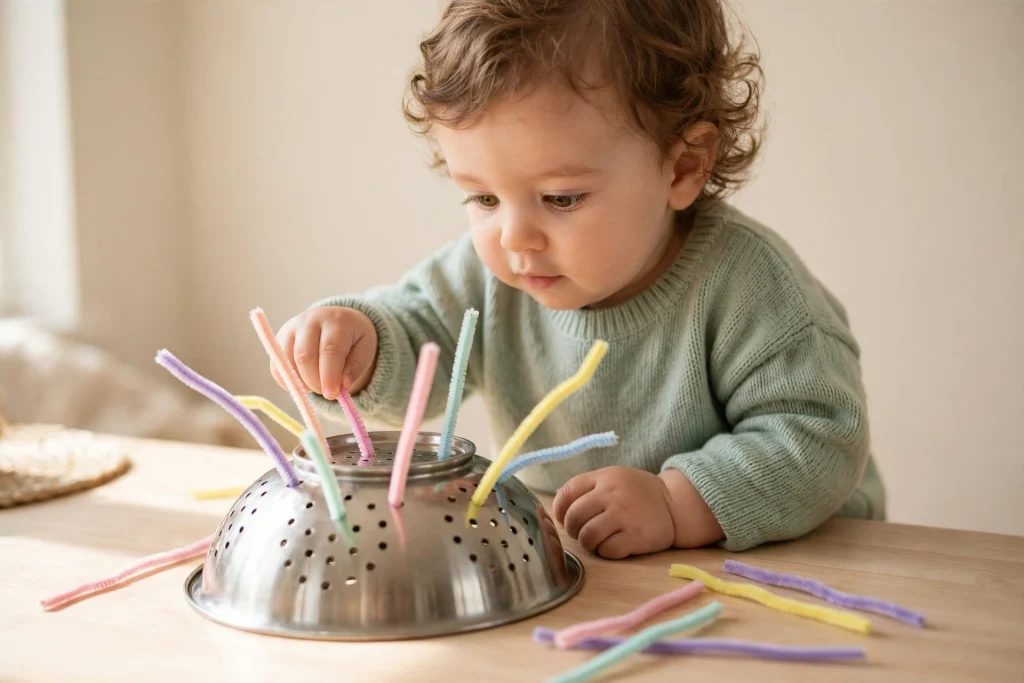
Turn a colander upside down and show your child how to poke pipe cleaners or thick straws into the holes. Aiming a bendy pipe cleaner into a small hole is a genuine challenge for little hands and a classic first threading activity.
13. Lids On, Lids Off
Collect clean jars and bottles with screw lids of different sizes. Your toddler twists the lids off, mixes them up and tries to match and screw them back on. Twisting strengthens wrists and teaches the turning motion used later for taps, jars — and door handles.
14. Easy Tongs and Pom-Poms
Give your toddler soft, easy-squeeze tongs (or a pair of sugar tongs) and large pom-poms to move from one bowl to another. Squeezing tongs open and shut is the same action as scissors, practised safely and early.
15. Playdough Poke and Squash
Roll playdough into balls and let your toddler poke holes in them with one finger, squash them flat and pull pieces off. Poking, pinching and pulling dough is a full finger workout disguised as play.
16. Little Pouring Job
With a small jug and two cups in a tray, let your toddler pour water from jug to cup and back again. Start with very little water. A steady pour needs two hands working together — one holding, one tipping. (Water — tray recommended.)
Fine motor activities for 2–3 years
Now the fingers can work more independently, and your child is ready for early pre-writing skills: threading, snipping, pinching along a line and copying simple marks.
17. Big Bead Threading
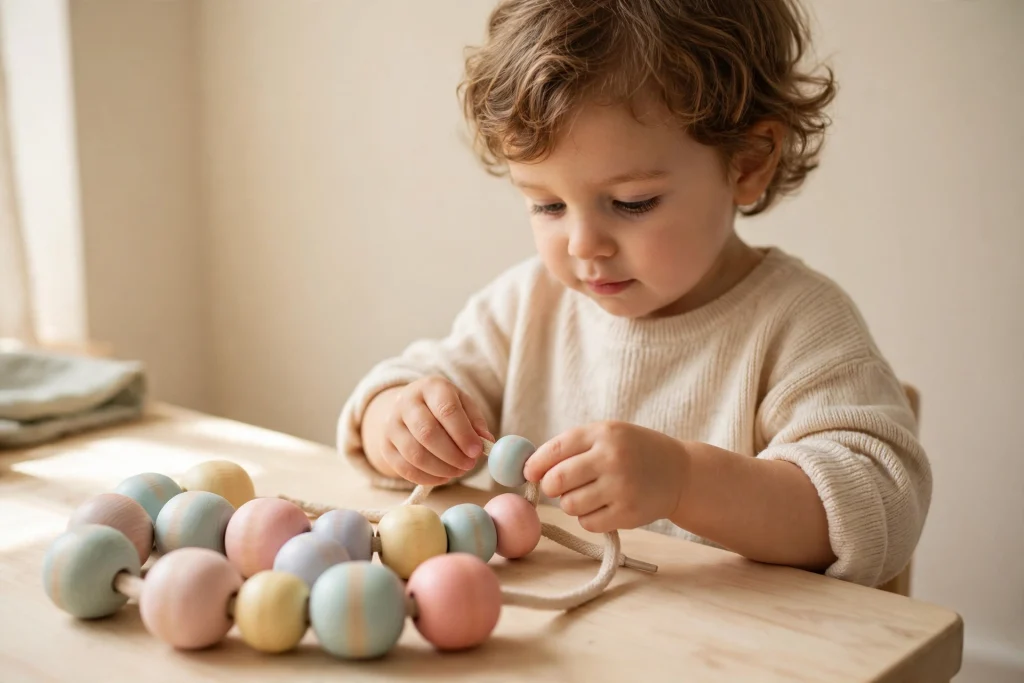
Thread large wooden beads onto a shoelace with a stiff, taped end. Holding the bead in one hand and pushing the lace through with the other is the clearest two-hands-together exercise on this list. (Small parts — sit with your child for this one.)
18. Clothespin Colour Match
Draw or stick coloured dots around the edge of a stiff card, colour the tips of wooden clothespins to match, and let your child pinch each clothespin onto its colour. The pinching builds the exact muscles used to hold a pencil, and the matching adds a thinking game on top.
19. Tweezers Sorting
Give your child chunky tweezers and a muffin tray, with pom-poms or large buttons to sort into the cups by colour. Tweezers demand a controlled pinch and a steady release — a real step up from tongs. (Supervise with buttons.)
20. Playdough Snakes and First Snips
Roll playdough into long “snakes” and let your child snip them into pieces with child-safe scissors. Dough is far easier to cut than paper, so your toddler can learn the open–close scissor action and succeed straight away.
21. Button Snake
Sew one large button to the end of a ribbon and cut squares of felt with a slit in each. Your child pushes the button through each slit to “build the snake”. This is the same skill as buttoning their own clothes, practised as a game. (Large button only, and supervise.)
22. Screw-Top Treasure Jars
Fill a few clean jars with a pom-pom or a jingly bell each, and let your child unscrew the lids to find the “treasure” and screw them shut again. The twist-and-grip combination builds wrist strength and persistence.
23. Pipette Colour Drops
With two or three cups of coloured water and a large pipette or medicine dropper, your child squeezes up water and drops it into an empty cup. Controlling a pipette — squeeze, hold, release — is delicate, satisfying work for the pincer grasp.
24. Lacing Cards
Punch holes around the edge of a stiff card (a simple shape — a circle or a leaf) and give your child a shoelace to sew in and out around the edge. Lacing combines aiming, pushing, pulling and pattern-following in one quiet activity.
25. Salt Tray Finger Tracing
Pour a thin layer of salt or fine sand into a tray and show your child how to draw lines, circles and zigzags with one finger, then shake the tray smooth and start again. This is the direct bridge from finger play to pencil work: the same movements, with no tool to manage yet.
A note on big movements, too: fine motor play works best alongside plenty of gross motor play — climbing, pushing, carrying and ball games build the shoulder and arm strength that steady hands grow from. Mix a few minutes of finger play into a day that is mostly active.
What this builds
- Pincer grasp — the thumb-and-finger pinch used for picking up small things, doing buttons, and later, holding a pencil correctly. Posting, peeling and threading games are built on it.
- Grip and finger strength — squeezing sponges, playdough and tongs builds the hand muscles that stop writing from becoming tiring.
- Hand–eye coordination — aiming a bead, a sticker or a pour teaches the hands to follow what the eyes see.
- Two hands working together — one hand holding while the other twists, threads or pours. Almost every everyday task, from opening lunchboxes to getting dressed, needs this.
- Pre-writing readiness — scribbling, finger tracing and controlled marks are the honest first steps towards writing. There is no rush and no set age: your child is ready for each step when the one before it looks easy.
Safety notes — please read
- Always supervise. Fine motor play uses fingers, not mouths — but toddlers explore with their mouths first. Stay within arm’s reach, especially with beads, buttons, pom-poms and coins-sized items.
- Small-object rule: if an item can fit through a toilet-roll tube, it is too small for a child under 3 without you sitting beside them. When in doubt, choose the bigger version.
- Check items before play. Throw away cracked plastic, loose parts and anything with sharp edges. Make sure lids used for posting boxes have smooth-cut holes.
- Water activities: a toddler can slip or tip a bowl — use a tray, small amounts of water, and dry the floor afterwards.
- Stop when your child has had enough. Tired hands and a wandering attention are the sign to pack away and try again another day.
Fine motor activities for toddlers — questions parents ask
My child is only 14 months old. Are these activities right for her?
Yes — start with the 12–18 months group. At that age the activities are mostly grasping, posting and pulling, with big pieces and no “right way” to do them. If your child mostly mouths the pieces or tips them out, that is still normal exploration; keep sessions short and stay beside her.
How long should we practise each day?
Five to ten minutes is plenty, once a day or even a few times a week. Short, happy sessions beat long ones. You can also spread the practice through the day — peeling a banana, screwing a lid, turning pages — it all counts.
Do I need to buy special toys or activity kits?
No. Everything on this page uses ordinary household things — boxes, lids, stickers, sponges, clothespins and dough. A few cheap basics (chunky crayons, large stickers, playdough) will last for months of activities.
What if my child loses interest after a minute?
That is completely normal for toddlers — a minute of real focus is a good session at this age. Put the activity away without any fuss and offer it again in a few days; children often return to the same game many times. Rotating two or three activities, instead of offering everything at once, also helps each one feel new again.
From finger play to pencil practice
When your toddler’s fingers are busy and confident, the next step is putting those same movements onto paper. Our free tracing worksheets were made for exactly that moment — big, simple lines and shapes to trace, at a pace your child controls.
Explore the free tracing worksheets →
Read next
- Activities by Type — browse sensory play, learning activities, indoor and outdoor ideas
- Activities by Age — find ideas matched to your child’s exact age