

Short answer: These 12 activities for 4 month old babies use things you already have — kicking games, two-handed grabs, rattles, mirrors and first rolling practice — all free, safe and screen-free. Four months is the grabbing month.
Quick facts
- Ages: 4 months
- Cost: free — ordinary household things
- Screen-free: yes — every idea on this page
- Skills: grabbing, kicking and first rolling
What to expect at 4 months
Around four months, play gets busy. Most babies hold their head steady now and push up strongly on their forearms in tummy time. Hands are the headline: your baby reaches on purpose, grabs with both hands together, brings toys straight to the mouth for a proper inspection, and may hold a rattle and give it an experimental shake. Legs are just as active — expect enthusiastic kicking whenever something interesting hangs nearby. Many babies roll from tummy to back around this age — sometimes as a complete surprise. And the sounds: coos grow into squeals, chuckles and the first real belly giggles, especially when you are being silly on purpose. Everything still goes to the mouth first, so keep offered toys big, clean and washable.
The information on this page is general information for parents, shared for learning and activity ideas. It is not medical advice, and it does not replace the guidance of a qualified professional. Every child develops at their own pace — if you have any concern about your child’s development, please talk to a qualified doctor or child-development professional.
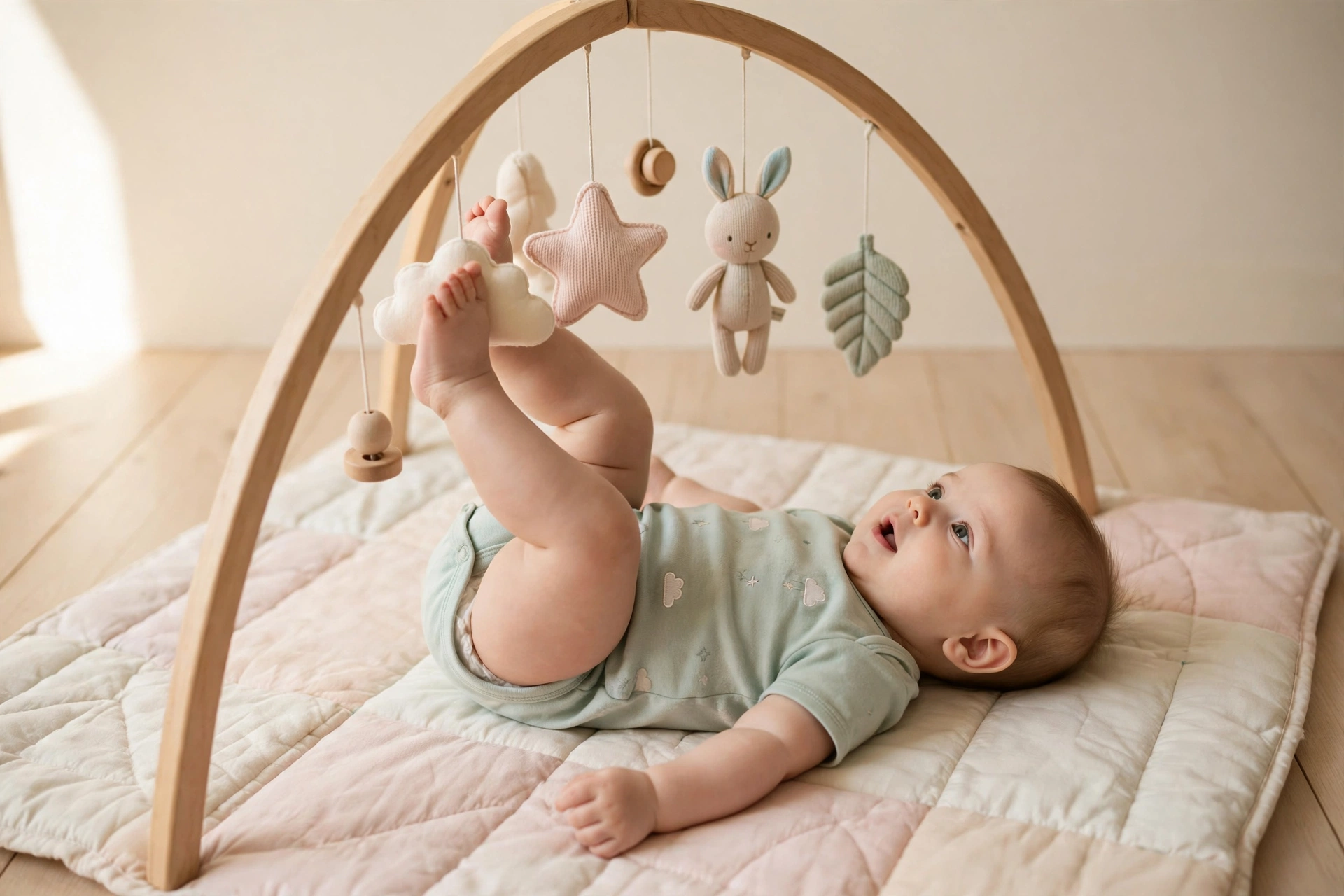
Grabbing and kicking
Four month olds play with their whole body — hands reaching, feet kicking, everything heading for the mouth. Set your baby on a soft mat on the floor, stay close, and let those hands and feet get busy.
1. Kick gym with toys at foot height
Lay your baby on their back on a mat and hang or prop a few soft toys just above their feet — tied securely to a play gym frame, a clothes airer, or the side of a sturdy chair. Four month olds kick with real intent: contact, jingle, repeat. Move one toy slightly further away and watch the stretch and determination. Keep strings short and knots tight.
2. Two-handed grabbing games
Hold a soft toy right in front of your baby’s chest, at the midline, and wait. Around four months, both hands start arriving together — that two-handed grab is a milestone in the making. Let your baby win the toy every time; the reaching, closing and triumphant wave is the exercise. Swap in different shapes and weights so those hands learn something new each round.
3. Rattles to hold and shake
Place a light rattle or a firmly sealed, adult-made shaker into your baby’s hand and let them discover the shake. At first the noise is an accident; within days it is a decision. Shake yours, pause, and let your baby answer — an early duet. Check seals before every use, and any container that looks worn or loose goes straight in the bin.
4. Foot rattles and bells
Fasten soft rattle socks — or bells sewn firmly inside a cloth band — onto your baby’s ankles for floor play (an adult job: snug, nothing loose). Every kick makes music, and your baby will kick harder to hear it again: cause and effect, learned through the feet. Supervise the whole session and take the bells off as soon as playtime ends.
5. Texture cloths to stroke and grasp
Gather clean cloths that feel different — a smooth muslin, a nubby washcloth, a soft fleece, a crinkly scarf — and stroke them over your baby’s hands, feet and cheeks, naming the feeling as you go. Then lay one within reach and let those fingers close around it — soft, bunchy cloth is different practice from a firm toy. Big cloths only, and they stay with you when the game ends.
6. Crinkle cloth play
Offer a big piece of baby crinkle cloth, or a large sheet of clean, sturdy paper, and let your baby scrunch it between both hands. The sound rewards every squeeze, and the material keeps changing shape, which is half the fun. Use pieces far too big to fit in a mouth, stay right there throughout, and pack paper away afterwards — soggy paper and mouths do not mix.
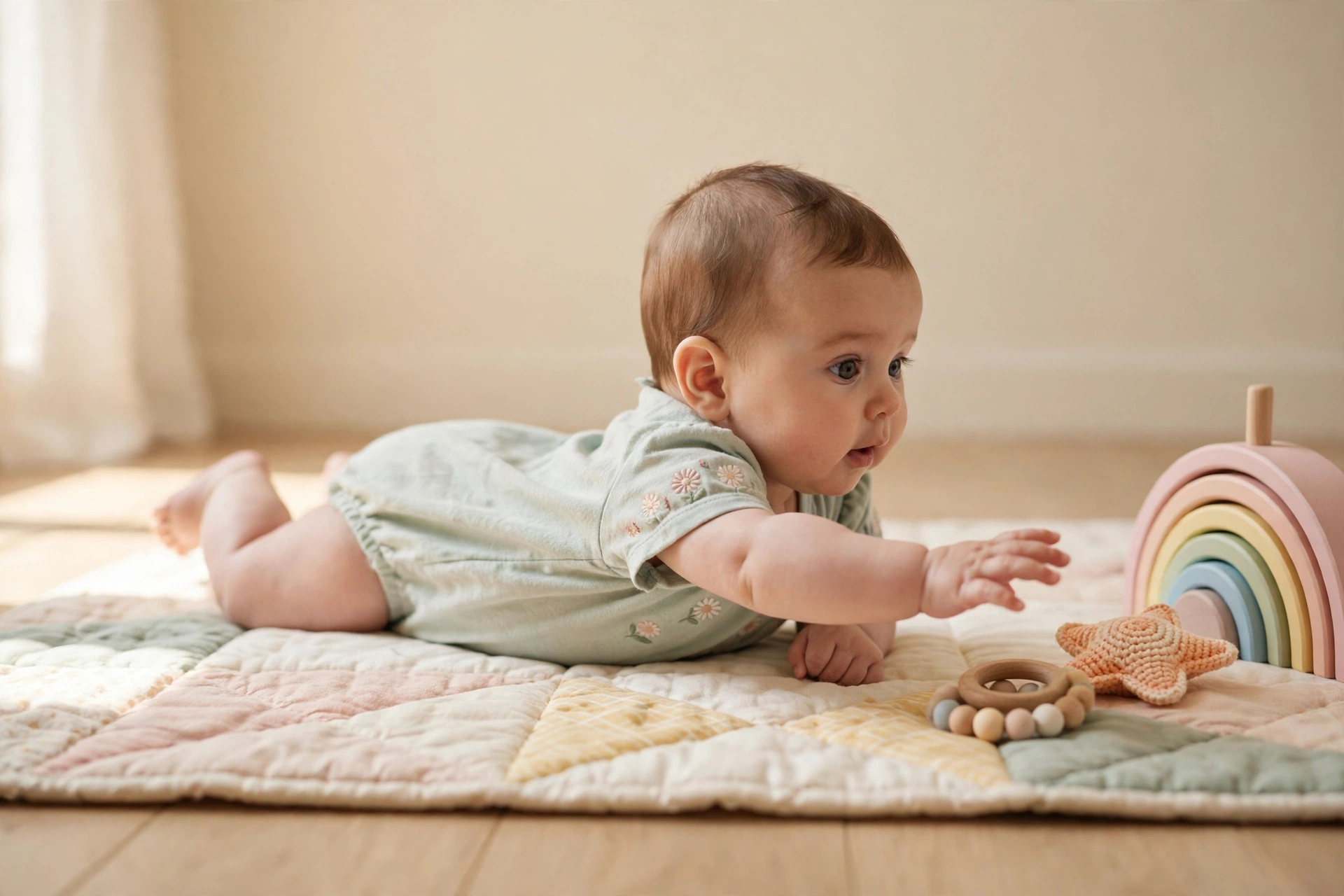
Rolling and first giggles
This is the month the floor starts moving — first rolls, first belly laughs, and games built around faces, mirrors and your voice.
7. Tummy time with a toy arc
Lay your baby on their tummy and arrange three or four favourite toys in an arc just at the edge of reach — close enough to swipe at, far enough to stretch for. Reaching while propped on the forearms builds the shoulder and back strength that rolling and, later, sitting are made from. Little and often beats one long session; stop for a cuddle whenever the grumbling starts.
8. Rolling practice, tummy to back
Give the roll a gentle head start. With your baby in tummy time, tuck one arm slightly under and slowly tilt them towards that side with your hands supporting their body the whole way — never pulling on an arm. Place a beloved toy (or your face) where they will land looking at it, and celebrate the arrivals. Most babies roll tummy-to-back first; keep practice on a soft mat on the floor, a few gentle turns at a time.
9. Mirror charm time
Prop a baby-safe mirror beside your baby in tummy time, or against the wall at floor level while they lie on their back. Four month olds are enchanted by the baby in the mirror — expect grins, coos and determined attempts to pat them. Point, name (“that’s you!”) and let the flirting continue. Use a shatterproof baby mirror or a polished metal sheet, never household glass.
10. Peekaboo giggles
Cover your own face with your hands or a light scarf, wait a beat, then — “peekaboo!” At four months this game can produce the first real belly giggles, and your baby is starting to anticipate the reveal: watch for the grin before you appear. Let your baby pull a light cloth off your face themselves for the advanced version. Light, breathable fabric only, and the scarf goes away with you afterwards.
11. Water kick splash
Pour a shallow layer of warm water into a baking tray or washing-up bowl on a towel on the floor, hold your baby securely on your lap above it, and let those busy feet pat and splash. Warm water, instant noise, very happy kicking. You hold your baby the whole time and stay within arm’s reach — water play at this age happens with you, every second.
12. Sing-and-chat face time
Settle face to face — your baby on your knees or propped safely on a cushion on the floor — and hold a real conversation. Sing a song, tell them the news, then pause and genuinely wait: four month olds answer with coos, squeals and whole-body wiggles, and the pause is where their turn lives. Copy their sounds back, add one of yours, and keep the turns rolling. This back-and-forth is the first brick of language.
Staying safe at 4 months
- Babies explore with their mouths — offer only big, clean, washable things that cannot break or come apart.
- Nothing small: if it could fit inside a cardboard toilet-roll tube, it is too small for a baby.
- Water is only ever for splashing while you are holding your baby or within arm’s reach — never leave a baby alone with water, not even for a second.
- Play on the floor or a mat only. Rolling can start any day now, often without warning — never leave your baby on a bed, sofa or changing table, not even for a moment.
- Dangling toys must be tied on securely, with strings kept short — and check the knots before every session.
Read next
- Baby Activities — Simple Play Ideas for 0–12 Months — the whole first year, month by month
- Activities for 6 Month Old — Sitting, Splashing and Exploring — the next-but-one stage, when sitting frees both hands
- When Do Babies Say Their First Word? — a gentle guide to babbling, first words, and how everyday talk helps them along
Activities for 4 month olds — questions parents ask
How long will a 4 month old play at one activity?
Usually just a few minutes at a time — and that is plenty. Babies this age play in short bursts between feeds, naps and nappy changes, and several little play moments across the day add up to a lot. When your baby looks away, goes quiet or starts to fuss, that activity is finished for now; bring it back later and it will feel brand new.
My baby is not rolling yet. Are these activities still OK?
Yes. Babies reach rolling in their own time — some roll at three months, some at six, and plenty take the scenic route. Keep offering the tummy time and toy-arc play in these activities: the strength built there is exactly what rolling is made of, and activity 8’s gentle guided practice is made for babies who are nearly there. If your baby’s movement ever worries you, mention it to your doctor or health visitor.
Do I need special toys for any of this?
No — look at the lists again: cloths, rattles, a scarf, a mirror, a tray of water, your own face and voice. The one thing worth choosing carefully is anything that goes in the mouth: big, clean, washable and impossible to break apart. Your floor, cleared and safe, is the best toy of this month.