
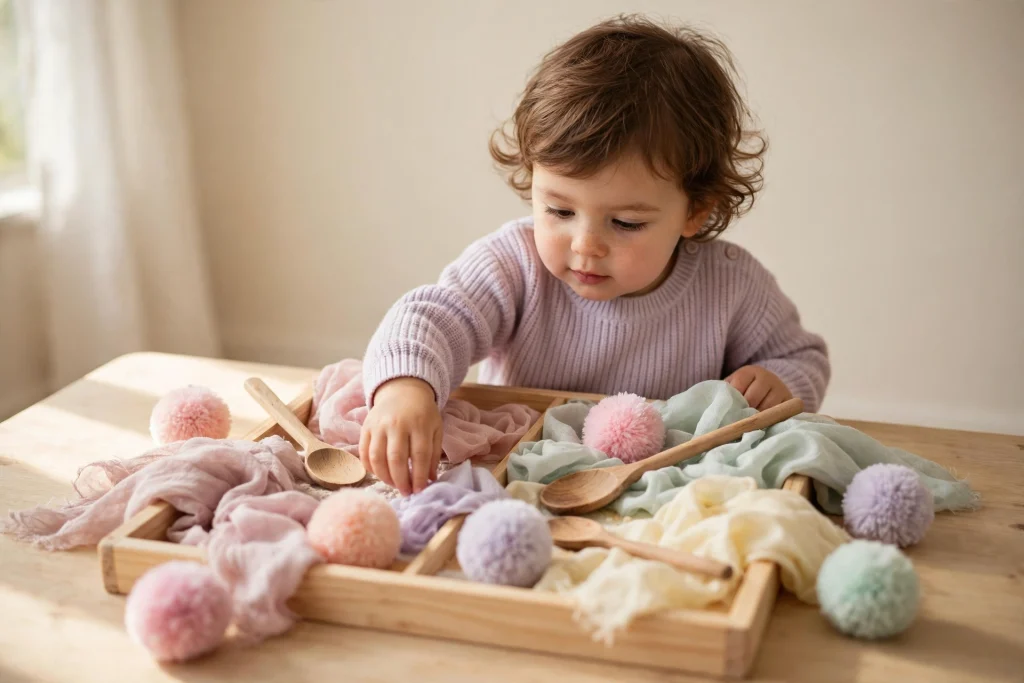
Short answer: Sensory activities for toddlers are really sensory play — squishing, pouring, shaking and splashing — and that is exactly how toddlers learn: it builds brains, hands and calm. These 25 ideas are safe for ages 1–3, use things you already own, and keep the mess your choice, not an accident.
Quick facts
- Ages: 1–3 years
- Prep: 2–5 minutes each
- Cost: free — ordinary household things
- Mess: low to joyful — you choose
- Supervision: an adult with your toddler at all times (see the safety notes below)
Sensory play safety for toddlers
Toddlers learn through their mouths as much as their hands, so safety comes first on this page — and it is simple. Always stay with your toddler during sensory play; none of these activities is a leave-them-to-it activity. Choose taste-safe materials and big pieces wherever you can, and use this easy test: if something fits through a toilet-roll tube, it is too small for under-3s — keep it for later. Anything sealed (bags, bottles, shakers) gets its lid or edges taped and checked before play, and small pieces are put away as soon as play ends. With water, the rule is absolute: a toddler is never left alone with water, even a shallow bowl. Follow those few habits and every idea below is a safe one.
Touch and feel
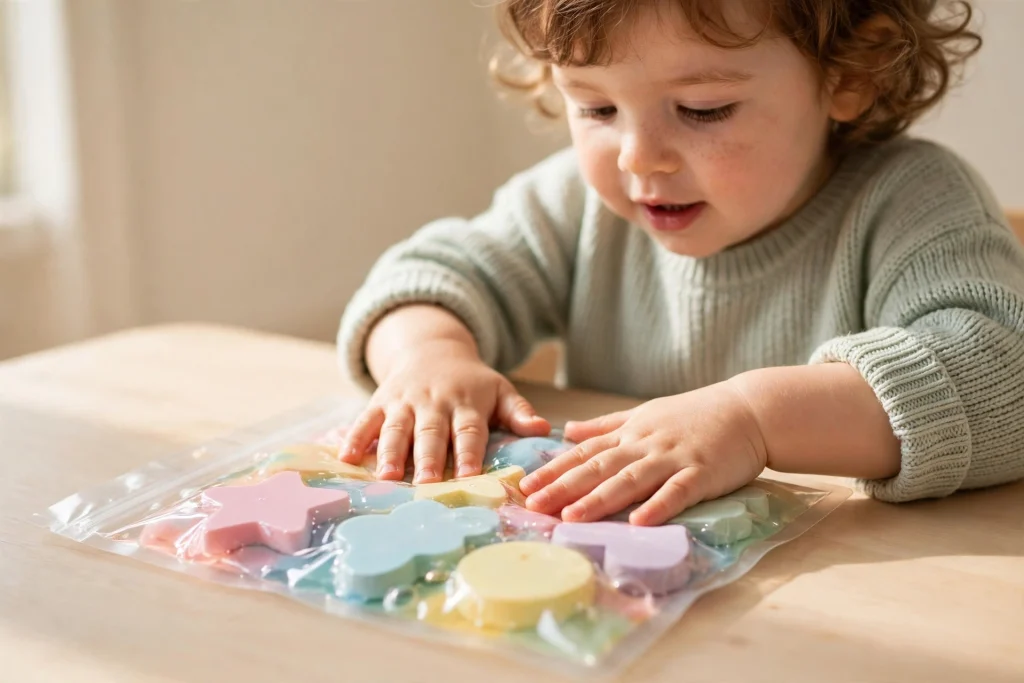
These nine ideas are all about hands: squishing, squeezing, stroking and poking. Most are mess-free or nearly, and most can live in a box ready to pull out again tomorrow.
1. Squishy sensory bags
Fill a strong zip-lock bag with hair gel, or water with a drop of food colouring and a few big foam shapes, seal it, and tape all the edges. Tape the bag flat to the table or floor and let your toddler squish, press and push the shapes around. Everything stays sealed inside, so it is mess-free and safe even for determined mouthers.
2. Homemade playdough
Soft dough is the classic toddler sensory material: poke it, squash it, roll it into sausages and press in big buttons or pasta tubes. Our easy no-cook playdough recipe takes ten minutes and keeps for months. It is made from kitchen ingredients, but it is salty and not a snack — supervise, and let the playing be the point.
3. Fabric scraps box
Fill a box or basket with clean scraps of very different fabrics: a silky scarf, a rough towel, soft fleece, a crinkly piece of wrapping material, a square of corduroy. Your toddler pulls them out one by one, rubs them on cheeks and hands, and buries toys in them. Naming “soft”, “rough” and “smooth” builds first describing words.
4. Sticky wall
Stick a sheet of clear contact paper to the wall at toddler height, sticky side facing out. Give your toddler big, light things to press on and peel off: large pom-poms, foam shapes, fabric pieces, big leaves. Sticking and peeling works little hand muscles hard, and because everything is big, there is nothing small to worry about.
5. Oat tray digging
Pour rolled oats into a shallow tray or baking dish and add scoops, cups and a toy digger or two. Toddlers dig, pour, bury their hands and “cook” oat cakes. For under-2s, oats are the taste-safer choice (skip dry flour at this age — the dust is not good for little lungs), and keep the tray on a mat so the clean-up is one shake outside.
6. Texture cards and balls
Make a simple set of texture cards by gluing a different material onto each piece of stiff card: felt, sandpaper (fine grade), corrugated card, foil, fake fur, a piece of sponge. Add a basket of balls with different surfaces — smooth, bumpy, squishy. Your toddler strokes, matches and carries favourites around; this is touch vocabulary being built by hand.
7. Frozen peas in a bag
Put frozen peas in a strong zip-lock bag, seal and tape it, and let your toddler squish the cold, bumpy bag, roll it and press it flat as the peas slowly thaw. The cold is a brand-new sensation and completely safe because the peas stay sealed away from mouths. A frozen bottle of water works the same way.
8. Pom-pom bin
Large pom-poms — the 5 cm kind, well bigger than a toilet-roll tube — in a tub with scoops, big tongs and two bowls for sorting. Toddlers scoop, squeeze, transfer and tip the whole lot out again (the tipping is part of the fun). Bright colours invite first colour naming, and the softness makes it a quiet, calm activity.
9. Cooked spaghetti play
Cook a pan of spaghetti, let it cool completely, and put it in a tray with tongs and cups; a drop of food colouring in the cooking water makes rainbow strands. It is slippery, wiggly and gloriously strange to hold — and because it is plain cooked pasta, a taste is harmless. Pick up strands, wind them round fingers, snip them with toddler scissors if your child is nearer 3.
Water and wonderful mess
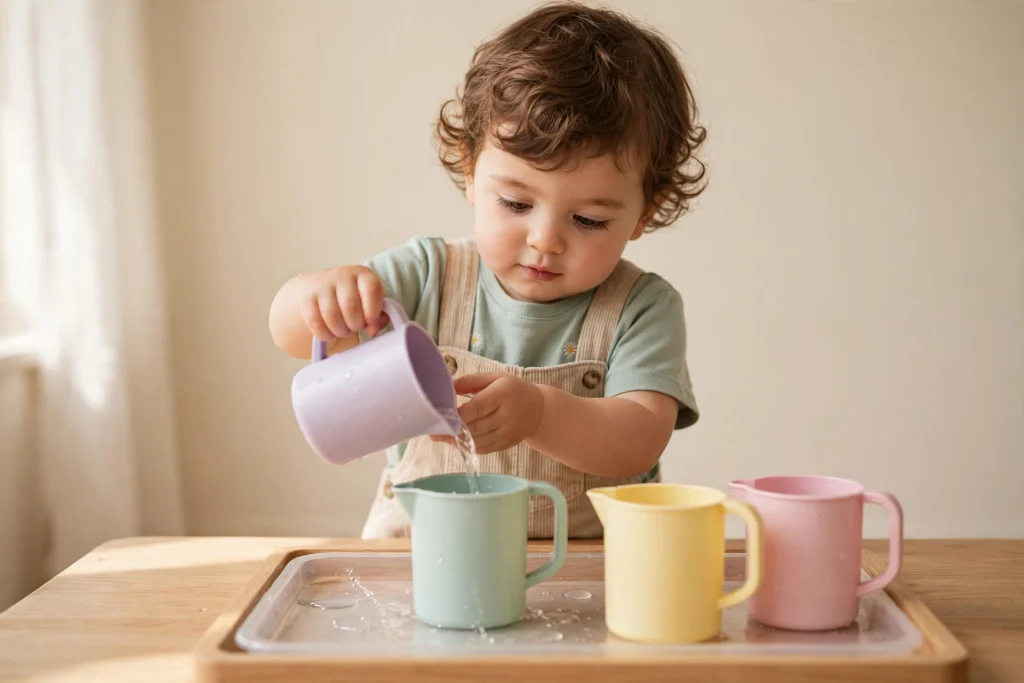
Water is the toddler sense magnet — and yes, it can stay controlled. Work on a towel or tray, keep amounts small, and remember the golden rule: never leave a toddler alone with water, even for a moment.
10. Pouring station
Two small jugs and a bowl of water on a deep tray: pour from jug to bowl, bowl to jug, again and again. Add a funnel or a cup with holes for variety. Pouring builds concentration, wrist control and the independence skills behind “I pour my own drink”. Start with very little water — you can always add more.
11. Sponge squeezing
Two bowls, one with water, one empty, and a couple of big sponges. Your toddler soaks a sponge in the water bowl, carries it dripping to the empty bowl and squeezes. Moving water with a sponge takes real hand strength — this is a workout disguised as a job, and toddlers love having a job.
12. Bath painting
Bath time doubles as art time: bath crayons draw on the tub and tiles and wash straight off, or your toddler “paints” the tiles with a big brush and plain water. Everything is contained, the mess rinses away, and a reluctant bather often forgets to object. Keep bath crayons for the bath only, so walls elsewhere stay safe.
13. Big ice block play
Freeze water in a large tub or mixing bowl overnight to make one big block of ice. Tip it onto a tray and let your toddler slide it, pat it, sprinkle it with warm water from a cup and watch it melt and shrink. One big block only — never give small ice cubes, which are a choking risk. Cold, smooth and changing: a whole science lesson in one block.
14. Foam and bubble play
Whisk a bowl of water with a squirt of washing-up liquid into a mound of stiff foam (the drained water from a tin of chickpeas whips up the same way and is taste-safer for younger toddlers). Hide big toys in the foam for digging out, or scoop it into cups for “ice creams”. Keep foam out of eyes, and for keen mouthers stick with the chickpea version.
15. Indoor “rain” bottles
Fill clear plastic bottles part-way with water, add a drop of blue colouring if you like, then glue or tape the lids firmly shut. Tip and shake: the swirling water sounds and looks like rain. Two bottles with different amounts of water sound different — an early listening game with zero puddles.
16. Washing-up station
A tub of warm, slightly soapy water, a cloth, and a pile of dolls, toy dishes or plastic animals in need of a wash. Toddlers scrub, dunk and dry with total seriousness. It is real-life play, wonderful for hand skills — and, as with all water play, you stay right there for every splash.
17. Painting with water
Give your toddler a big brush and a pot of water, then “paint” cardboard, paving stones, a fence or a wooden gate. Dark wet marks appear like magic and slowly dry away, ready to paint again. It is all the joy of painting with none of the clean-up, and a perfect first step before real paints.
Sounds, light and calm
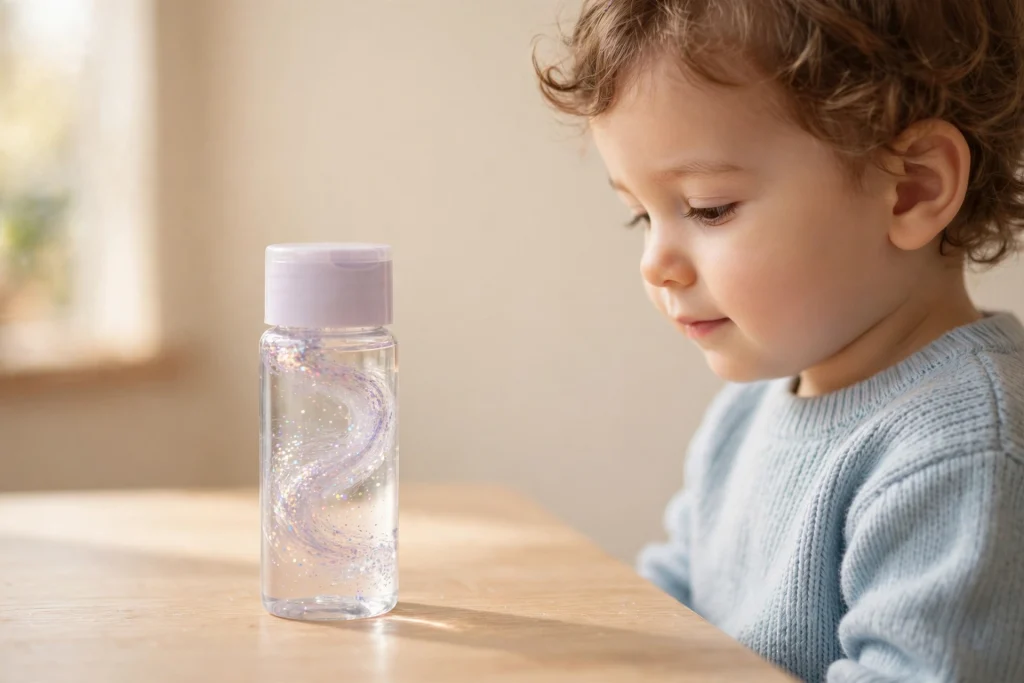
Not all sensory play is high energy. These eight ideas are for winding down: listening, watching, moving slowly and breathing — the sensory version of a deep sigh.
18. Sealed sound shakers
Half-fill small plastic bottles with different things — rice in one, dried pasta in another, bells or big beads in a third — then glue or tape every lid shut and check it before play. Shake, listen, and guess: which one is loud, which is soft? Match two the same for a first listening game.
19. Ribbon and dance scarves
Tie wide ribbons to a ring or just hand over light scarves and put on some music. Wave them high and low, twirl, hide behind them for peekaboo, throw them up and watch them float down — scarves fall slowly enough for toddlers to catch. Moving to music builds rhythm and whole-body control.
20. Torch play
Dim the lights and give your toddler a torch: spot the teddy, find the ball, watch the circle of light grow and shrink on the wall. You can make simple shadows with your hands, or tape a paper shape over the torch for a star or moon beam. Keep the beam pointed at walls and toys, not eyes.
21. Calm-down bottle
Fill a clear bottle with water, a squirt of clear glue and some glitter, then seal the lid with glue or strong tape. Shake it together and watch the glitter swirl and slowly settle — breathing slowly while it settles is a first, gentle way to learn calming down. Because the lid is sealed, it is safe to carry around and use whenever big feelings arrive.
22. Nature texture walk — indoors
Lay a short path of big, clean natural textures across the floor: a smooth pebble slab or large smooth stones, a piece of bark, a handful of large leaves, a big pinecone. Your toddler walks the path in bare feet or explores it by hand, feeling cool, rough, smooth and bumpy. Check every piece is too big to fit through a toilet-roll tube, and stay close for mouthers.
23. Lullaby freeze
Play a gentle song and sway, rock a teddy or dance slowly together. When the music stops, everyone freezes — statues — until it starts again. The calm tempo keeps it peaceful rather than wild, and stopping and starting builds listening and self-control. Nearer bedtime, this is a lovely bridge from play to quiet.
24. Cardboard-box echo play
A really big cardboard box is a sensory room of its own: climb inside (you nearby, always), shout, sing, whisper and listen to the echo, drum on the sides, feel the cardboard flex. Voices sound different in the box, which fascinates toddlers. Cut a door flap if you like — and take it away if it gets chewed or soggy.
25. Sensory story basket
Choose a favourite picture book and gather a basket of safe props that match it: a soft bear for a bear story, a wooden spoon and bowl for a cooking tale, a feather and a leaf for an outdoor adventure. As you read, your toddler holds, strokes and plays with the matching object. Stories become something you can feel, not just hear — and listening lasts noticeably longer.
Pairs well with
Sensory play and fine motor play feed each other: the squeezing, pinching and pouring above is exactly what little hands need. When you are ready for the next step, our 25 Fine Motor Activities for Toddlers picks up right where this page leaves off.
Read next
- More play ideas by kind: Activities by Type
- 25 Fine Motor Activities for Toddlers
- Stuck indoors? Rainy Day Activities for Kids — including its sensory play section
Sensory play questions parents ask
What is sensory play for toddlers?
Sensory play is any play that explores the senses: touching, pouring, squeezing, listening, watching and moving. For toddlers it is not an extra — it is how the brain builds connections. Squishing dough strengthens hands, pouring water teaches early maths ideas like full and empty, and shaking a sound bottle trains listening. Simple, everyday materials do the job perfectly.
Is sensory play messy — how do I keep it manageable?
It can be as tidy as you like. Start with the mess-free options on this page — sealed sensory bags, sound shakers, sticky walls and water-painting leave almost nothing to clean. For messier play, work on a tray or towel, use small amounts, and keep a “sensory box” so everything goes back in one place. Mess you have chosen and prepared for feels very different from mess that happens to you.
What sensory activities are safe for a 1 year old who mouths everything?
Choose taste-safe or fully sealed activities: cooked spaghetti play, the oat tray, sealed sensory bags, frozen peas in a sealed bag, and big-piece ideas like the pom-pom bin with large pom-poms. Use the toilet-roll test for anything loose, tape every lid and bag edge, and stay within arm’s reach. At this age, mouthing is learning too — your job is simply to choose what there is to mouth.
How often should toddlers do sensory play?
A little most days is plenty — even ten minutes counts, and much of it happens naturally in baths, meals and outdoor play. Keep two or three prepared ideas in a box so you can rotate them; toddlers learn by repetition and will happily squish the same sensory bag all week. Follow your child’s energy: busy days suit water and movement, tired days suit the calm-down ideas.