

Short answer: The best activities for 4 year olds make the most of what four year olds are — question machines with busy hands and big plans. These 30 activities channel all that energy into running, making and first school skills — with household things, no screens and nothing to buy.
Quick facts
- Ages: 4 years
- Cost: free — ordinary household things
- Screen-free: yes — every activity on this page
- Skills: school-readiness play — movement, making, letters, numbers and taking turns
What to expect at 4
Four is the year of “why?” — and “watch me!” Your 4 year old can probably run, climb, hop and stand on one foot for a few wobbly seconds, and their talk has become real conversation: long stories, endless questions and a growing love of silly words and rhymes. Friendships matter more now, and so do rules — four year olds are fascinated by them, even while testing every single one. This is also the year many children start recognising their own name, some letter sounds and numbers well past ten, all picked up through play. Attention stretches further than at three: a good game can hold a 4 year old for twenty minutes or more.
Four year olds also love real jobs. Setting the table, sorting laundry, watering plants and carrying their plate to the sink are genuine activities at this age, not filler — they build independence, counting, sorting and pride. Give your child two or three regular helper jobs and let them own them.
The information on this page is general information for parents, shared for learning and activity ideas. It is not medical advice, and it does not replace the guidance of a qualified professional. Every child develops at their own pace — if you have any concern about your child’s development, please talk to a qualified doctor or child-development professional.

Move and play
Four year olds move with rules, targets and teammates. This first set is built for all that new control.
1. Obstacle course with rules
Build a course of five or six stations — over the cushions, under the table, around the chairs, along the tape line — then add one rule per round: hop this bit, carry a beanbag on your head there, Freeze! when the music stops. Holding a rule in mind while moving is real brain-and-body work at four. Let your child redesign the course for you.
2. Throw, catch and kick
Ball skills step up at four. Practise underarm throwing at a target (a box, a hoop, a chalk circle), catching a big soft ball with two hands from a short distance, and kicking at a goal of two cushions. Count the hits together and move the target further back each day. Judging distance and aiming is hand–eye and foot–eye coordination growing fast.
3. Tape balance beam challenges
Stick a long tape line on the floor and walk it heel-to-toe — then level up: walk it carrying a spoon with a beanbag on it, walk it backwards, walk it with a book balanced (briefly!) on your head. A low garden wall works outdoors with you right beside them. Balance is the quiet foundation under confident running and climbing.
4. Real hopscotch
Chalk a proper hopscotch grid outside, numbered 1 to 10, or tape paper squares indoors. Throw a beanbag onto a number, then hop and jump the course, missing that square. Four year olds can manage the one-foot, two-feet pattern with practice — counting, aiming and turn-taking in the same game. Start with numbers to 5 if 10 feels big.
5. Freeze dance statues
Music on: dance. Music off: freeze — but at four, freeze as something: a statue, a superhero, a sleeping lion. Hold the pose while you count slowly to five. Listening for the stop, then holding a pose against the giggles, is self-control practice. Hand the music controls to your child and let them catch you moving.
6. Relay races
Set up a simple out-and-back relay: run to the cushion, do three star jumps, run back, tag the next runner — even if the team is just you, your child and a very slow teddy. Add a carrying challenge (a beanbag, a ball on a spoon) for the return leg. Waiting for a tag and following a sequence are early team skills, and nobody minds losing to a teddy.
7. Simon Says
The classic listening game, perfect at four. “Simon says touch your toes… Simon says hop… Touch your nose!” — no Simon says, so freeze. Your child has to listen to the whole instruction before moving, exactly the skill school will ask for. Swap roles and let them be Simon: being the leader is half the learning.
8. Animal yoga poses
Try simple poses together: tree (stand on one leg, arms up like branches), cat (on all fours, arch and round your back), cobra (lie on your tummy and lift your head), frog (crouch and spring). Hold each for a few slow breaths. Yoga-style movement builds strength and balance, and a short pose sequence makes a good calm-down before quieter play.
9. Scavenger hunt dash
Give your 4 year old a picture list of five things to find — something red, something round, a leaf, a spoon, something that smells nice — and a bag to collect them in. Indoors or in the garden, the hunt mixes searching, matching and running between finds. Read the list together first; hunting from a list is early reading behaviour.
10. Bike and scooter practice
Regular short rides on a balance bike, pedal bike or scooter build leg strength, steering and stopping control. Keep to quiet, flat, safe spaces away from roads, practise starting and stopping on purpose, and make the helmet a habit every single ride, fitted snugly before wheels move. An adult walks (or jogs) alongside at this age, always.
Make and create
At four, little makers can follow a plan, use real tools with supervision and finish something they’re proud of.
11. Cutting along the lines
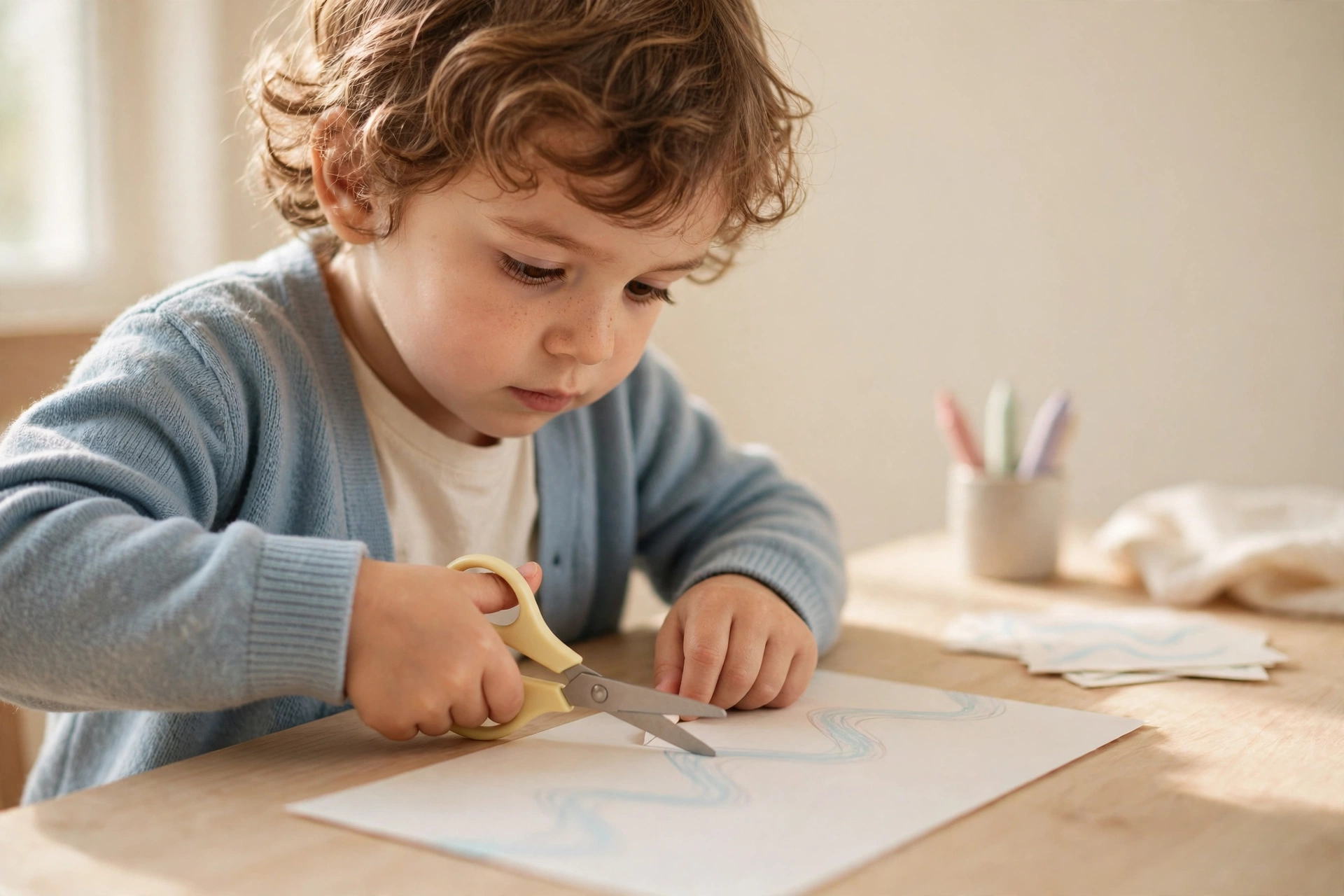
This is the year scissors graduate from snipping to following. Draw bold lines on paper — straight first, then zigzags, curves and big shapes — and let your child cut along them slowly. Safety is the routine, every time: child scissors only, sitting at the table, you beside them, scissors away when finished. Steady cutting along a line is some of the best hand-strength practice there is.
12. Junk modelling with a plan
Before the building starts, draw it: “I’m making a rocket — it needs a tube body and three fins.” Then raid the recycling box (clean boxes, tubes, pots, lids) and build to the plan with tape and glue, adjusting as real engineering demands. Drawing first and building second is planning — a brand-new skill at four.
13. Playdough sculpture challenge
Deal a challenge card: build a dog, a house, a birthday cake with four candles, a snail with a spiral shell. Rolling, pinching and joining dough sculptures takes more finger strength and problem-solving than flat playdough play. Our no-cook playdough recipe makes a fresh batch in ten minutes if your tub has dried out.
14. Paint a story
After a favourite story, paint it: the house, the bear, the boat, the storm. Your child chooses the moment that matters most and paints that scene, then tells you the story back from their picture. Choosing a scene is early comprehension; painting it is planning and control; telling it back is language gold. Big paper, washable paint, aprons on.
15. My name collage
Write your child’s name in big hollow letters on card, then let them fill each letter with something different — stickers, torn paper, pasta shapes, glitter glue — or build the letters from sticks, buttons and ribbon on a big sheet. Four year olds are proud of their name like nothing else, and decorating it letter by letter teaches the shapes their writing will soon need. Keep small pieces at the table.
16. Lacing and sewing cards
Cut a simple shape from stiff card, punch holes around the edge (an adult job), and thread a shoelace or thick wool in and out of the holes. Then try “sewing” a running stitch along a line of holes on card or hessian with a big, blunt needle and wool. In-out, in-out is rhythm, pattern and two-handed coordination — the same hand control that fastening and later writing use.
17. Marble run from tubes
Tape cardboard tubes to a wall, door or big box at gentle slopes, one feeding into the next, and roll balls down the run into a bowl at the bottom. Your child tests, moves a tube, tests again — real engineering, with gravity as the teacher. Use chunky balls that can’t be mouthed, and keep small marbles for older children only.
18. Nature art pictures
Collect flat treasures on a walk — leaves, petals, feathers, small sticks — and arrange them into pictures on card: a leaf becomes a fish, petals make a flower, sticks build a house. Glue the best ones down; leave the rest as a changing loose-parts picture on a tray. Arranging natural materials mixes art, noticing and gentle science talk.
19. Make a mask
Cut eye holes in a paper plate or card mask (adult cuts the holes), then hand over the decorating: paint, feathers, ears, whiskers, a crown. Tie on elastic or a stick handle, and the mask launches an afternoon of dress-up play. Making the character and then being the character links craft to the pretend play four year olds live for.
20. Little chef cooking
Four year olds can do real cooking jobs with you: spreading butter or jam, pouring measured ingredients, stirring batter, washing fruit, tearing lettuce, sprinkling toppings. Follow one simple recipe together — sandwiches, fruit salad, no-bake biscuits — reading each step aloud as you go. Cooking is measuring and sequencing in the tastiest possible form. Adults handle anything hot or sharp, every time.
Learn and play
The school-readiness set — name writing, counting to 20, letter sounds, turn-taking games — all disguised as play, because at four that is how it should arrive.
21. Write my name — through play
Name writing starts as play, not worksheets. Trace the letters of their name in a salt or sand tray with a finger, build them from playdough sausages, find them on magnetic letters on the fridge, and chalk them big outside. When your child wants to try with a crayon, thick triangular crayons are easiest to grip. A few playful minutes most days, and the letters of the most important word in their world settle in.
22. Counting to 20 games
Four is the year counting stretches past ten. Count stairs as you climb them, cars as they pass, jumps as you do them; line up twenty blocks and count them with a pointing finger, then hide some and count again. Games with a dice stretch the count further — “you rolled a 6, move 6 spaces!” Counting real things is how 20 becomes solid.
23. First proper board games
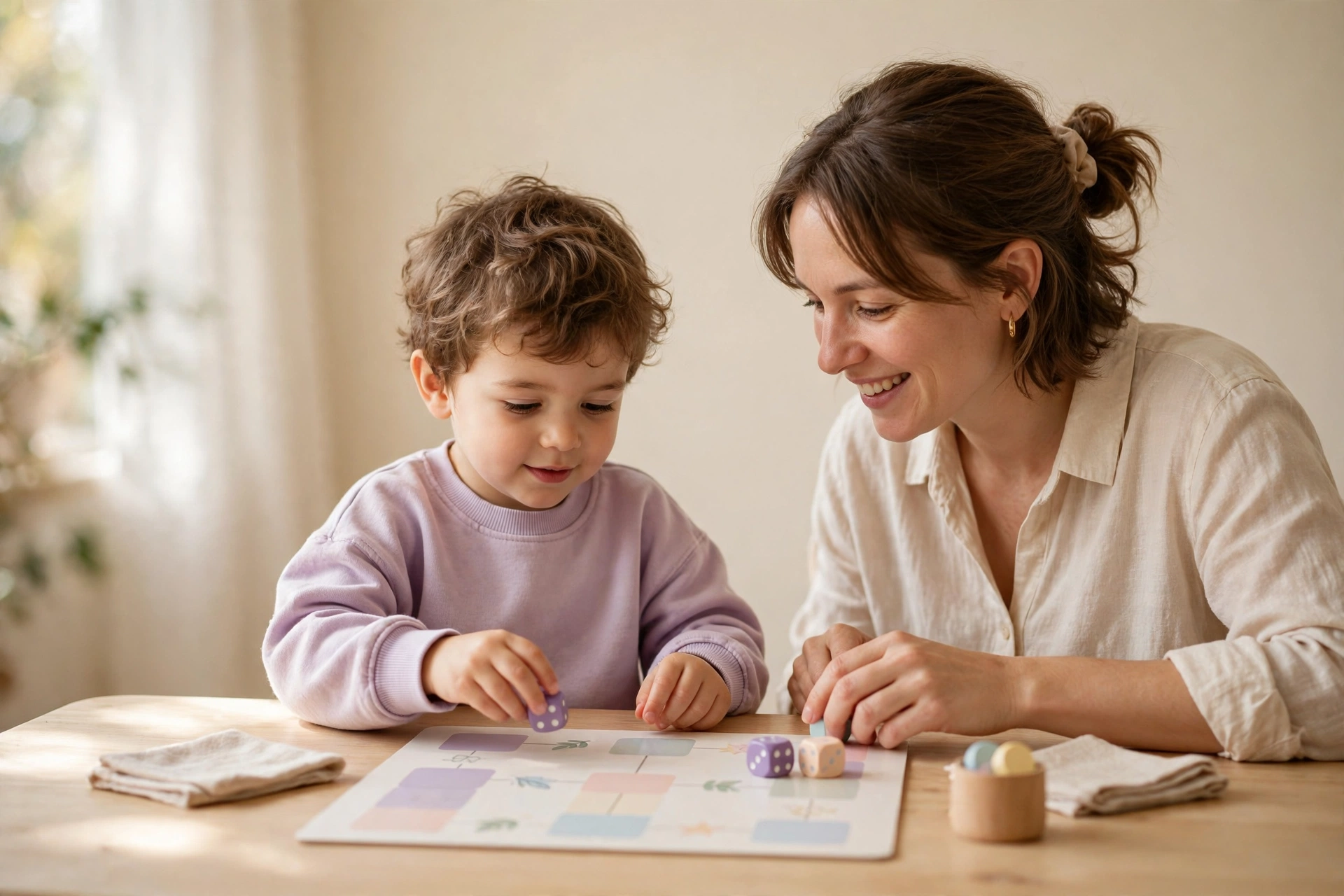
Graduate from simple lotto to board games with a dice, a spinner and a track to move along. At four, your child can roll, count the spaces, move their own counter and — the big one — wait for their turn and cope with losing a round. Keep games short and choose luck over strategy. Ten minutes of this is turn-taking, counting and patience in one box.
24. Rhyming games
Rhyme is everywhere at four. Play odd-one-out: “cat, hat, dog — which one doesn’t rhyme?” Pause before the rhyming word in a favourite book and let your child shout it. Invent nonsense rhymes for everyone’s names — Sam-jam, Mia-pia. Hearing which words rhyme is one of the strongest early reading skills there is.
25. Story sequencing cards
Take three or four photos (or draw simple pictures) of a familiar sequence — planting a seed, a seedling, a flower; or getting dressed; or making toast. Mix them up and let your child put them in order and tell the story: first, then, next, finally. Sequencing is early reading comprehension and science thinking at once, and being the storyteller builds serious language.
26. Magnet and water science lab
Set up a little science tray: a magnet and a basket of things to test (paperclip, coin, leaf, key, plastic spoon) — predict, test, sort into “sticks” and “won’t stick”. Then revisit float-or-sink with new testers. Guessing first, testing second and talking about why is the whole scientific method, sized for four. Water play stays at the table with you beside it.
27. Pattern play
Patterns grow up at four: from red-blue-red-blue to red-red-blue, or clap-clap-stomp rhythms. Build patterns with blocks, beads or buttons, then let your child continue yours — and set you one to continue. Patterns are the roots of maths, and spotting the rule (“it repeats!”) is genuine mathematical thinking. Big pieces, played with at the table.
28. Pretend school and shop
Four year olds love playing at the grown-up world: a pretend school (register, story time, a class of teddies), a shop with priced items and play money, a post office with letters to deliver. Being “in charge” lets them practise the language and routines of school and shopping safely. Slip real learning in sideways — a scribble-written shopping list, counting coins, reading the register names aloud.
29. Letter-sounds treasure hunt
Pick one letter sound — “ssss” — and hunt the house for things that start with it: sock, spoon, soap, sandwich. Write or draw each find on a treasure list. Start with the first letter of your child’s name and add a new sound every few days. Hearing the first sound in a word is the doorway into reading, and hunting makes it a game rather than a lesson.
30. Memory matching pairs
Play matching pairs with the set turned up a notch: ten or twelve pairs of identical picture cards, face down. Turn two, remember, match. At four, children get genuinely good at this — remembering where the lion was three turns ago is real working-memory exercise. Shorten the set on tired days, and let your child deal and shuffle.
From play to printables
All this cutting, lacing and pattern play is quietly getting hands and eyes ready for pencils. When your 4 year old starts asking for “real schoolwork”, FIMS Schools has free printable preschool and kindergarten worksheets — tracing lines, shapes, letters and numbers made for exactly this stage: free preschool and kindergarten worksheets. Print one or two pages at a time and keep it playful.
Read next
- Activities by Age — activity ideas for every age, from babies to 5 year olds
- 30 Activities for 3 Year Olds — the stage just before this one, handy if you have a younger child too
- 25 Math Activities for Preschoolers — counting, patterns, shapes and measuring games for this age
Activities for 4 year olds — questions parents ask
What should a 4 year old be learning?
Through play, mostly: talking in full conversations and telling stories, counting real things to about 20, recognising their name and some letter sounds, rhyme, taking turns in games with simple rules, and practical skills like dressing, cutting with scissors and helping with real jobs. There is no formal syllabus at four — everything on this page covers that ground inside ordinary play.
How long can a 4 year old concentrate on one activity?
Longer than at three — fifteen to twenty-five minutes on something they have chosen is typical, and a beloved project can hold them far longer. Attention is at its best when the activity was their idea and their hands are busy. If interest fades, change one element — a new rule, a new material, a new role — rather than insisting.
My 4 year old won’t sit still for “learning” — what works?
You’re describing most four year olds. Put the learning inside movement: count jumps, hunt for letter sounds around the house, throw beanbags at number targets, act out the story. Start with Section 1 to burn energy, then ride the calmer patch that follows into a table game. Short, active and playful beats long and seated at this age — and skills learned on the move count in full.