
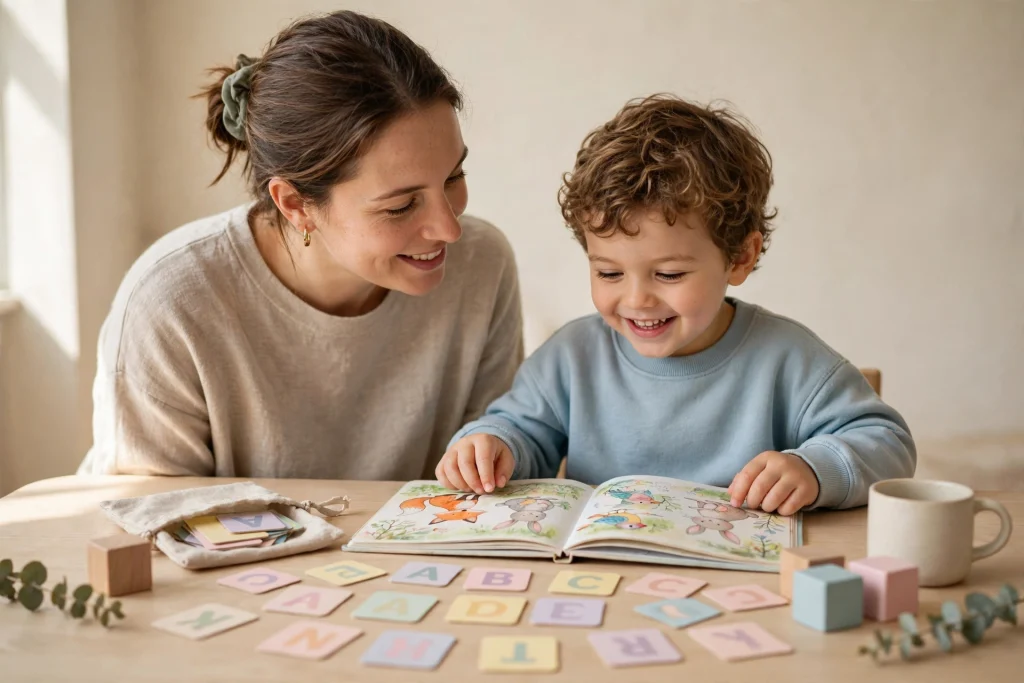
Short answer: Yes — you can build a homeschool preschool curriculum for free and homeschool preschool with library books, household items and free printables. A good preschool curriculum is mostly play: stories, songs, counting games and making things. This page gives you the six areas to cover, a gentle weekly rhythm, and free printables for ages 3–5.
Quick facts
- Ages: 3–5
- Time: 30–90 minutes of gentle focus a day, inside a play-filled day
- Cost: free
- You need: library books, household items, free printables
What a preschool curriculum actually covers
Strip away the catalogues and the big boxes, and every preschool curriculum — paid or free — covers the same six areas. They are not school subjects in disguise. For a 3 to 5 year old, each one is learned through play, talk and everyday life, which is exactly why homeschooling preschool works so well at the kitchen table and costs so little.
1. Talking, stories and sounds. This is the biggest area of all. Chatting, listening to stories, singing rhymes and playing with sounds (“what else starts like sun?”) build the language your child will later read and write with. A child who hears lots of stories and talk arrives at reading with a head start no workbook can give.
2. Letters and first writing marks. Preschoolers learn that print carries meaning: their own name first, then favourite letters, then the alphabet as a friendly song rather than a test. Their “writing” is scribbles, lines, circles and letter-like shapes — the natural first marks every reader makes before real letters arrive.
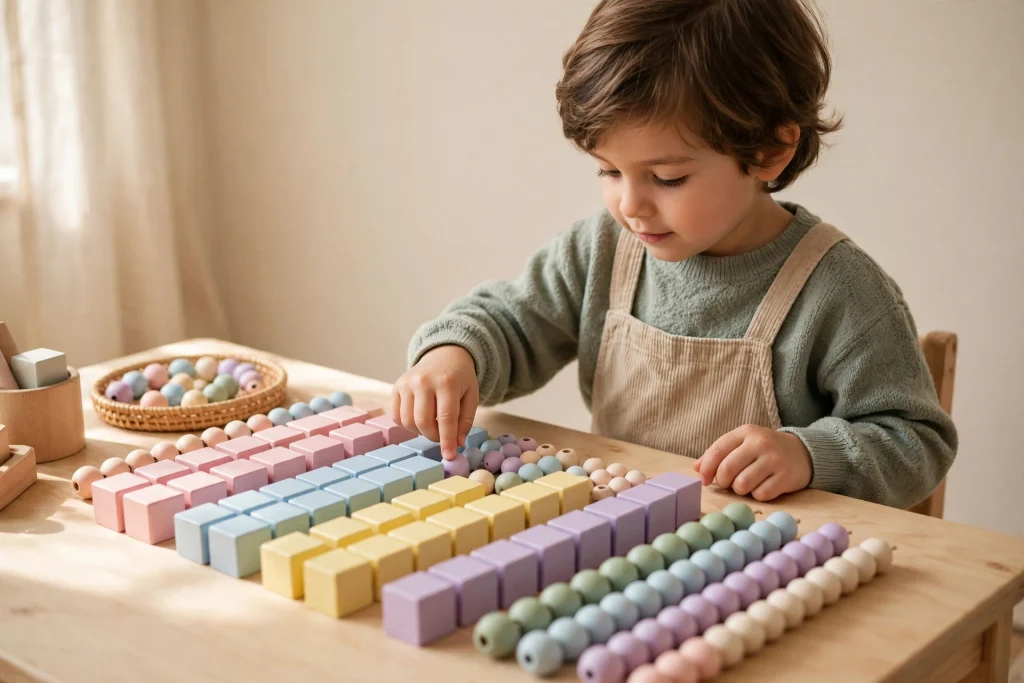
3. Numbers, counting and shapes. Real counting — stairs, spoons, buttons, buses — comes before written numbers. Alongside it sit sorting, matching, simple patterns and shape-spotting: the round plate, the square window. This playful maths builds the number sense that later school maths stands on.
4. Fine motor and practical skills. Little hands need strength and control for writing later: threading, pouring, cutting with safety scissors, playdough, buttons and zips. Practical jobs count too — setting the table, watering a plant, wiping a spill. Everyday life is full of free fine motor practice.
5. Exploring the world. Why does ice melt? What do worms eat? Preschool science is wondering out loud, watching, collecting and trying things: nature, weather, water, magnets, shadows and the senses. You do not need answers for everything — “let’s find out” is the whole method.
6. Moving, music and playing with others. Running, climbing, dancing and ball games grow the big muscles and balance. Music and rhymes feed language and memory. And playing with siblings, friends and family teaches turn-taking, sharing and kindness — the social curriculum underneath everything else.
The free plan — a gentle weekly rhythm
Forget the school timetable. Young children learn best from a rhythm — the same friendly shape to each week, with plenty of room to breathe — instead of lessons pinned to a clock. Here is a simple rhythm that covers all six areas without a single purchase. Repeat it week after week; the activities change, the shape stays, and that predictability is what makes small children feel secure and ready to learn.
- Monday — Letters and songs. Sing the alphabet song, hunt for the first letter of your child’s name around the house, and read a favourite picture book twice.
- Tuesday — Numbers walk. Take counting outside: count steps, red cars, dogs, doors. Back home, sort and count something real — socks, spoons or stones.
- Wednesday — Making day. Playdough, drawing, cutting, sticking, building with boxes. This is fine motor day disguised as art.
- Thursday — Story and acting day. Read a story, then act it out with toys or dress up and retell it in your own words. Add a rhyme or two.
- Friday — Nature and free play. A walk, a garden or balcony potter, puddles, leaves, a bug hunt — then long, unstructured free play, which is real curriculum too.
Weekends need no plan at all: cooking together, errands, visiting family and helping around the house are full of talking, counting and learning. And when a day collapses — illness, a new baby, or just weather that will not quit — swap in a rainy day of indoor play and carry on tomorrow. The rhythm bends; it does not break. In total, the focused parts add up to roughly 30–90 minutes spread across the day. The rest is the play-filled day itself — and that is not the gap in the curriculum, that is the curriculum.
If you like a little variety, give each week a loose theme — the sea, autumn leaves, farm animals, colours, our family — and let the stories, songs and nature finds follow it. A theme is a garnish, not a requirement: the five days work perfectly well without one. But it gives library trips a purpose, gives you an easy answer to “what shall we do today?”, and lets a favourite interest (dinosaurs, trains, the moon) carry a whole week of talking, counting and making. Rotate four themes and you have a month planned in five minutes — then repeat them next season and watch how much more your child finds in them.
Area by area — free ideas that cover it
You do not need a new activity for every day of the year. A small bank of favourites, repeated often, covers each area deeply — repetition is how preschoolers master things. Here are free ideas for each of the six areas, all using what you already have.
Talking, stories and sounds
Borrow a stack of picture books from the library every week or two and read a few every day — the same favourites again and again are a feature, not a failure. Play sound games while you cook or walk: “I spy something starting with b…” Tell each other the story of your day at bedtime, and let your child “read” a memorised book back to you, turning the pages and telling it their way.
Letters and first writing marks
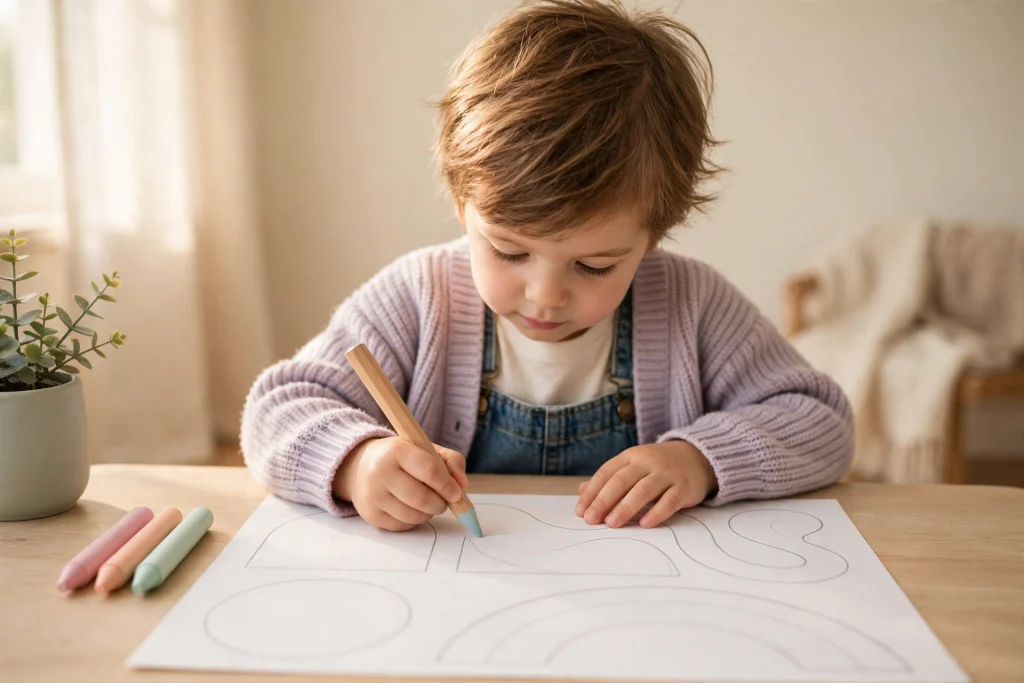
Start with the letters in your child’s name — write it on everything, and let them trace it in a tray of salt, flour or sand with a finger. Make an alphabet scrapbook together: one page per letter, with drawings and pictures cut from old magazines. Keep chunky crayons and big paper always within reach, and value every mark: scribble is the first draft of writing.
Numbers, counting and shapes
Count real things all day — buttons while dressing, stairs while climbing, apples while shopping. Set the table together (“we need four forks — one, two, three, four”). Play sorting games with buttons, lids or socks, make repeating patterns (spoon, fork, spoon, fork), and go on shape hunts: find me something round, something square, something with corners.
Fine motor and practical skills
Threading pasta or big beads, pouring water between jugs at the sink, playdough rolling and pinching, and cutting along lines drawn on scrap paper all build the hand strength writing needs. Our 25 fine motor activities were written for younger toddlers, but most of them still delight 3 and 4 year olds — and they are perfect if a younger brother or sister wants to join in. Add real jobs too: peeling a banana, spreading butter, matching lids to pots.
Exploring the world
Keep a nature tray or shelf where treasures live — stones, leaves, shells, feathers — and talk about them often. Do simple kitchen science: what sinks and what floats, ice melting in a sunny spot, a bean sprouting in a jam jar on the windowsill. Grow something, however small: a pot of herbs counts. Answer questions together with library books, and let “I don’t know — let’s watch and see” be a normal, happy sentence in your house.
Moving, music and playing with others
Build an obstacle course from cushions, dance to favourite songs and freeze when the music stops, kick and throw a ball in any open space you have. Sing rhymes with actions every day — the words and the memory work are as valuable as the moving. Arrange regular play with other children when you can, at a park, with cousins or with a local group, and let board games and pretend play teach taking turns the painless way.
Your free printable library
The printable backbone of this plan is already free: our preschool and kindergarten worksheets give you no-cost pages for letters, numbers, tracing and early writing practice — print one or two on making day or letters day, and let your child work at their own pace. No account, no payment: print, play, learn.
Start this week — three tiny steps
If this all sounds good but big, shrink it. You do not start a curriculum; you start a rhythm, and a rhythm begins with whatever tomorrow already holds.
Step 1 — Pick your book supply. Join the library if you have not already, and borrow six to ten picture books. That pile, read and re-read, is your literature curriculum for the next two weeks. No library nearby? Swap books with another family, or use the well-loved books you already own — familiarity is a strength at this age, not a gap.
Step 2 — Set up two small invitations. Put playdough and a few tools in a tray that lives on the table, and start a nature basket by the door. These two quiet invitations will fill more learning time than any planned lesson this week, because your child will return to them again and again on their own.
Step 3 — Try the rhythm for one week only. Print or copy the five days onto one sheet on the fridge, and simply live alongside it — no records, no evidence files, no judging the week until it ends. Most families find the second week easier than the first, and the third week starts to feel like “just what we do”. That feeling is the curriculum working.
What you do NOT need to buy
Homeschool catalogues are designed to make you feel behind, and preschool is where the pressure sells best. Here is what you can safely skip — and what actually replaces it.
- Boxed all-in-one curricula. Pretty boxes mostly package the six areas above into expensive paper. Your library card, your kitchen and this rhythm cover the same ground for free.
- Stacks of workbooks. A preschooler who does a page now and then is fine; a pile of workbooks turns learning into a chore and teaches little that play does not teach better. One or two printed pages at a time is plenty.
- “Educational” apps and subscriptions. Screens cannot talk back, wait for an answer or hand a child a pinecone. Your voice, real objects and real play are the premium product here — and they are free.
- Flashcard sets and letter-of-the-week kits. Make your own from cardboard and magazine pictures in an afternoon, personalised with your child’s name, family and favourite animals — better than the bought kind, because it is theirs.
What is worth having costs nothing or nearly nothing: a library card, paper and crayons, playdough (homemade lasts for months), a ball, and a basket for nature treasures. Everything else is decoration.
Homeschool preschool — questions parents ask
How many hours a day should I homeschool a preschooler?
Far less than school. For a 3 to 5 year old, around 30–90 minutes of gentle, focused activities spread across the day — a story here, a counting game there — is plenty, and the rest of the learning happens inside ordinary play, talk and family life. Preschool “hours” are not shorter school hours; play is the curriculum at this age, so a happy, busy day is a full homeschool day.
Is homeschooling preschool legal?
In most places, yes — and usually it is not even regulated as homeschooling, because preschool (ages 3–5) is not part of compulsory schooling in most countries and states. Rules differ by country and state, though, and they can change, so check your own local requirements for peace of mind — your local education authority’s website is the right place to look. This page offers general information only, not legal advice.
Does my child need to read before kindergarten?
No. Children are not expected to arrive at kindergarten or school already reading — learning to read is the job of those early school years, not a ticket for entry. What genuinely helps is readiness built through play: hearing stories and rhymes, knowing that print tells a story, recognising their own name, holding a crayon happily, and being able to listen, chat and take turns. This free plan builds exactly those things.
What if I work, or have a baby too?
Then the rhythm flexes — that is what it is for. Fifteen-minute pockets count: a story at breakfast, counting on the walk to the shop, playdough while the baby naps. Babies and toddlers can join in at their own level too — our activities for 18 month olds and activities for 2 year olds are full of ideas for the smallest ones alongside their preschool brother or sister. Some weeks will be mostly free play, and that is fine: young children learn from a lived-in, loving home, not from a completed checklist.
Read next
- Homeschooling — Simple Ideas for Learning at Home — the rest of our homeschooling guides for the preschool years
- 25 Fine Motor Activities for Toddlers — the hand-strength play that sits underneath first writing
- 30 Activities for 2 Year Olds — play ideas for younger brothers and sisters learning right alongside