
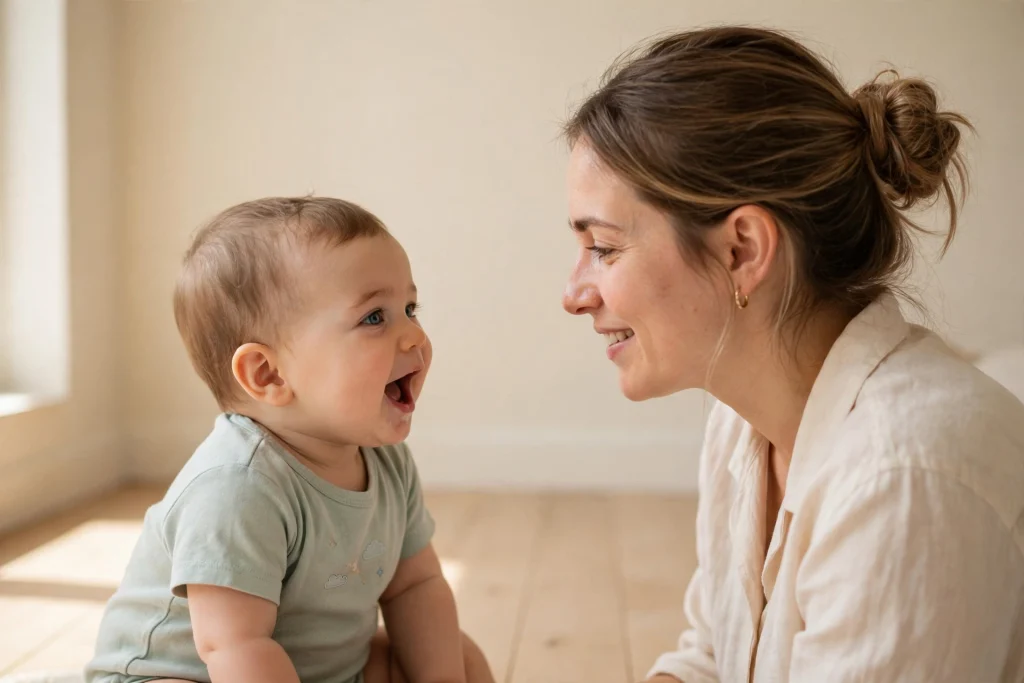
Short answer: When do babies say their first word? Most say their first real word around their first birthday — between 10 and 14 months — after months of cooing, babbling and gesturing. The range is wide, and every baby reaches that moment at their own pace.
Quick facts
- Typical first word: around 12 months
- Before words: cooing, babbling, gestures
- Helps most: talking, reading, singing
- Remember: every baby has their own pace
The road to the first word
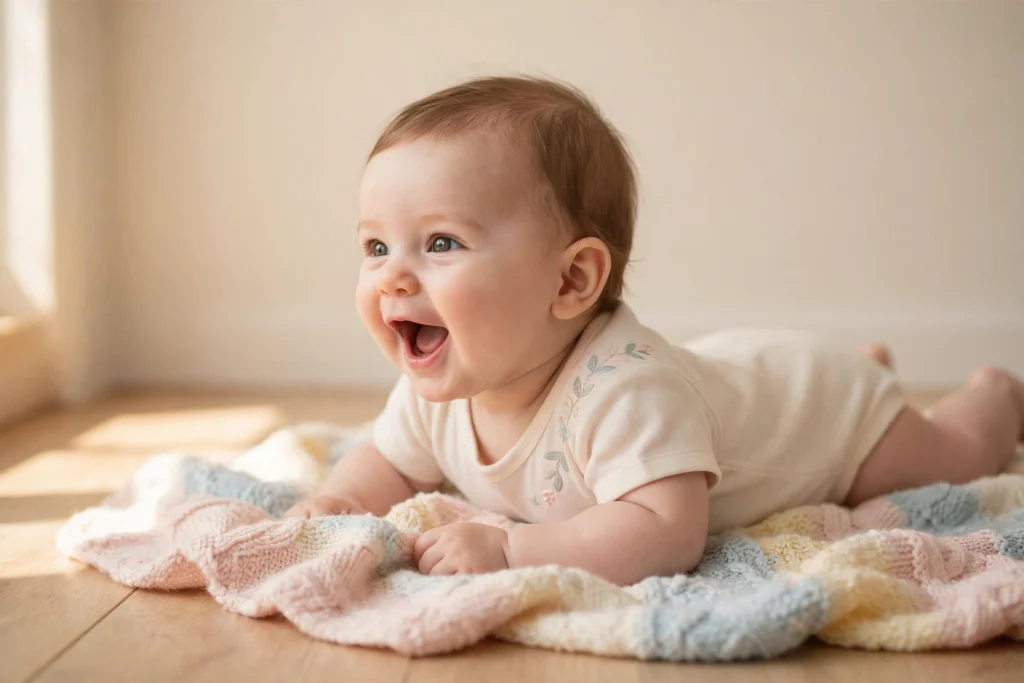
Long before a baby says anything you would call a word, they are busy practising. Voices, sounds and gestures build up step by step over the first year, and the first word is really just the moment all that practice becomes recognisable. Here is the journey many babies take — not a timetable to measure your baby against, just the shape of how talking usually begins.
Cooing — around 2 to 4 months. Many babies start with soft, sing-song sounds: gentle “oohs” and “aahs” made at the back of the mouth, often with a big smile when you talk to them. Cooing is your baby’s first conversation — they make a sound, you answer, and they learn that voices go back and forth.
Babbling — around 6 months. Sounds start to join up into chains like “ba-ba-ba” or “da-da-da”, as babies discover they can repeat the same sound on purpose. This babbling is play and practice at the same time: lips, tongue and jaw are learning the moves that real words will need later.
Babble with a tune — around 9 to 12 months. The babbling becomes varied and musical — longer strings of different sounds that rise and fall like real sentences, sometimes called jargon. Many babies sound as if they are holding a whole conversation in their own language, and by now pointing, waving and reaching are doing a lot of the communicating too.
The first word — around 12 months. Somewhere around the first birthday, many babies produce one sound they use the same way every time for the same person or thing — and that is a first word, even if it does not sound quite like the grown-up version yet. Some babies arrive here a few months earlier, some a few months later; both are part of the normal picture.
A few words — around 15 to 18 months. After the first word, others usually follow one by one: a handful of words for favourite people, foods, animals and games. Many toddlers understand far more than they can say at this stage — they can point to named pictures and follow simple everyday requests long before their own word list catches up.
What counts as a first word?
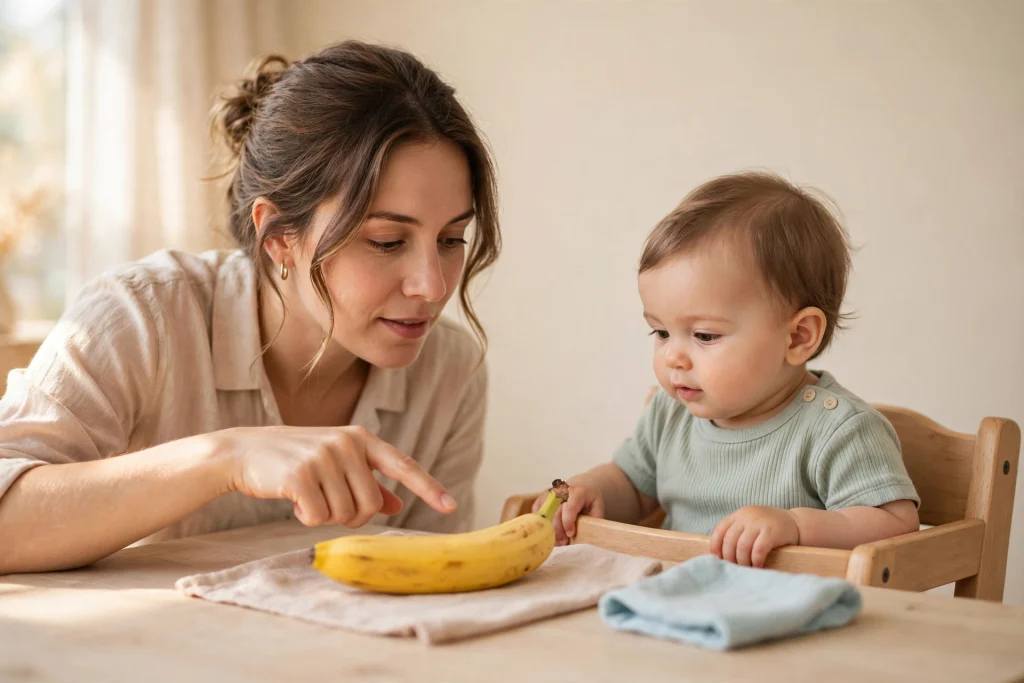
A first word is not about perfect pronunciation. It is about meaning: a sound your baby uses consistently, on purpose, for the same thing. If “ba” always means the ball — said while reaching for it, looking at it or offering it to you — then “ba” is a real word in your baby’s world, whatever the dictionary would say.
The same test applies to the famous firsts. “Dada” babbled happily at everyone is wonderful practice, but it becomes a first word when your baby says it for Dad specifically — looking at him, calling to him, reaching for him. Many parents find the word appears in real use weeks before it sounds crisp and clear.
First words are usually the important people and things in a baby’s everyday life. Common ones include:
- Mama and Dada (often the headline act)
- Names of brothers, sisters, grandparents and pets
- Ball, dog, cat, bird and other favourite things to point at
- Milk, banana and other favourite foods, usually shortened
- Hi, bye-bye and hello — the social words babies hear with a wave
- Uh-oh — a firm favourite, because things fall down so often
- More — one of the most useful words a baby can own
If you are not sure whether a sound counts, watch for the pattern: same sound, same thing, said on purpose, more than once. When all three line up, you can write it in the baby book with confidence.
When do babies start talking?
Parents often use “talking” to mean the whole journey, so here is the gentle version of it. Talking does not switch on in one moment — it grows. Around the first birthday comes the first word; over the following months, a handful of words builds up one by one. Somewhere in the second year, many toddlers hit a livelier patch where new words seem to arrive every week, and around 18 to 24 months many begin joining two words together — “more juice”, “Dada car”, “bye-bye dog”.
Understanding runs well ahead of speaking through all of this. A toddler who says only five words may still follow you around the kitchen carrying out little jobs, point out every dog in a picture book, and know exactly which cupboard the biscuits live in. Gestures bridge the gap too: pointing, showing you things and shaking or nodding a head are all part of talking, even before the words arrive.
And the pace really does differ. Some babies chat early and climb late; others walk at nine months and keep their words for later. Talking grows out of everyday life — meals, baths, walks, songs and stories — and it arrives on each child’s own schedule.
10 easy ways to encourage first words
There is no special equipment for this and no lessons to buy. First words grow out of ordinary, chatty days — and these ten simple habits give your baby the most chances to join in.
1. Talk through your day. Narrate the small stuff as you go: “I’m putting your socks on — one foot, two feet.” It feels ordinary, but your baby is hearing how words attach to actions and objects, all day long, in exactly the moments those words are used.
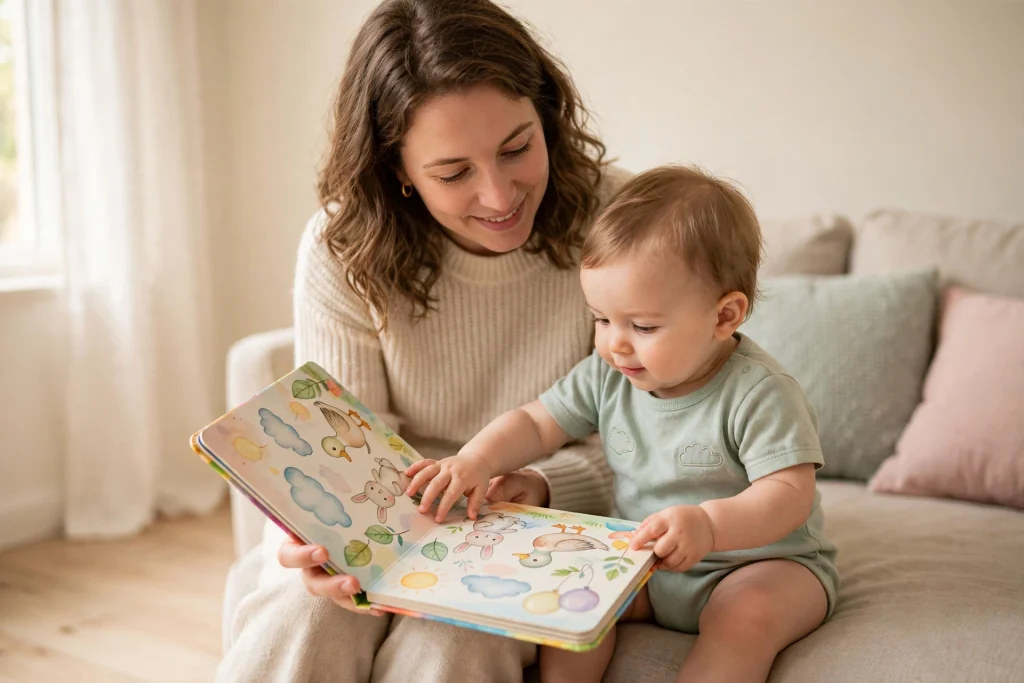
2. Read board books every day. Sturdy little books with one clear picture per page are perfect at this age. Point, name, and let your baby turn the pages and point back — being asked “where’s the dog?” and finding it is a first conversation, even without words yet.
3. Sing action songs. Songs with movements — clapping, waving, peekaboo — pair words with actions and happy repetition. Leave a pause before the favourite last word of a line; babies love finishing a song, and one day a sound will land in that gap.
4. Play name-and-wait. Name something your baby is looking at, then wait, watching expectantly. The waiting matters as much as the naming: it leaves a space shaped exactly like your baby’s turn, and turns — babbles, sounds, eventually words — are how conversation grows.
5. Copy your baby’s sounds. When your baby babbles “ba-ba”, answer “ba-ba!” right back, then add a little: “ba-ba — ball!” Copying tells your baby their voice works, it starts a game, and games are where babies practise most.
6. Offer simple choices. Hold up two real options — “milk or water?”, “the ball or the book?” — and let your baby point, reach or vocalise. Choices make communication powerful: using a sound or a gesture gets your baby something they actually want, which is the best reason in the world to communicate again.
7. Point and name on walks. The everyday world is a picture book that never runs out: dogs, buses, leaves, postboxes. Name what your baby is already looking at — attention first, word second — and you will find you are giving a gentle language lesson the whole way round the block.
8. Repeat their attempts warmly. When your baby tries a word — “gah” for cat — say it back the grown-up way, kindly and without correction: “Yes! Cat. There’s the cat.” Your baby hears the right version, feels understood, and never feels tested. That warmth is what keeps attempts coming.
9. Keep some screen-free talk time. Voices on screens do not wait for answers, and conversation is built on answers. Some unhurried face-to-face time each day — at meals, in the bath, before bed — gives your baby the back-and-forth practice that talking is made of. Video calls with family are the happy exception: that is a real conversation, with real waiting and waving.
10. Celebrate every try. Every pointing finger, copied sound and brave first attempt deserves a delighted response. Babies repeat what gets a reaction, so your smile, clap and echo are not just nice — they are the engine that turns one word into two, and two into talking.
If you are worried
Every parent wonders, at some point, whether their baby’s talking is coming along as it should. That wondering is normal — and it does not mean anything is wrong. Babies genuinely do develop at their own pace, the normal range for a first word is wide, and a baby who is busy pointing, babbling, understanding and joining in games is communicating in all sorts of ways before words arrive.
What this page cannot do is look at your individual child — no website can. So the gentle rule is simply this: if you are ever worried, or if that worried feeling keeps coming back, your doctor or health visitor is the right first call. That is exactly what they are there for, they hear this question every week, and a short chat is the quickest way to put your mind at rest. Trust the niggle enough to ask; you will never be sorry you checked.
The information on this page is general information for parents, shared for learning and activity ideas. It is not medical advice, and it does not replace the guidance of a qualified professional. Every child develops at their own pace — if you have any concern about your child’s development, please talk to a qualified doctor or child-development professional.
First words — questions parents ask
What is the most common first word?
In most families the first real word is “Mama” or “Dada” — the sounds are among the easiest for a baby’s mouth to make, and babies hear them all day long. After that, first words tend to be whatever matters most in that baby’s world: a pet’s name, “ball”, “more”, “bye-bye” or a favourite food. There is no required first word — the most common one is simply the one your baby needs most.
My baby said “mama” at 9 months — is that a real word?
It counts as a real word if your baby uses it the same way every time — said for you, while looking at you, reaching for you or calling you. Some babies do reach that stage before their first birthday, and it is a lovely early milestone to record. If it was happy babbling aimed at everyone and everything, that is not a word yet — but it is exactly the practice that words are made from, and the real one usually is not far behind.
Do boys talk later than girls?
On average, girls in general tend to say their first words a little earlier than boys — but “a little” really is the word, and the overlap between individual babies is enormous. Plenty of boys are early talkers and plenty of girls take their time, and birth order, siblings, and sheer personality all play a part too. A baby’s own pace matters far more than any average, so treat the averages as background noise and enjoy your own baby’s order of doing things.
Should I worry if my 15 month old has no words yet?
Many 15 month olds are still in the babbling, pointing and understanding stage, with first words arriving in the months that follow — a 15 month old with no clear words yet can still be well inside the wide normal range. Keep doing the everyday things that help: talking, reading, singing and playing the games on this page, and enjoy the gestures and understanding that are already there. And if the worry keeps nagging at you, mention it to your doctor or health visitor at your next visit — that is what they are there for, and it is always fine to ask. Only someone who can see your child can give you advice about your child.
Read next
- Child Development — a Gentle Guide for Parents — the rest of our development series for the 0–5 years
- 24 Activities for 18 Month Olds — talk-rich play for the stage just after first words: movement games, busy-hands play and calm sensory ideas
- 30 Activities for 2 Year Olds — where the talking journey leads next, with games that stretch first words into phrases