
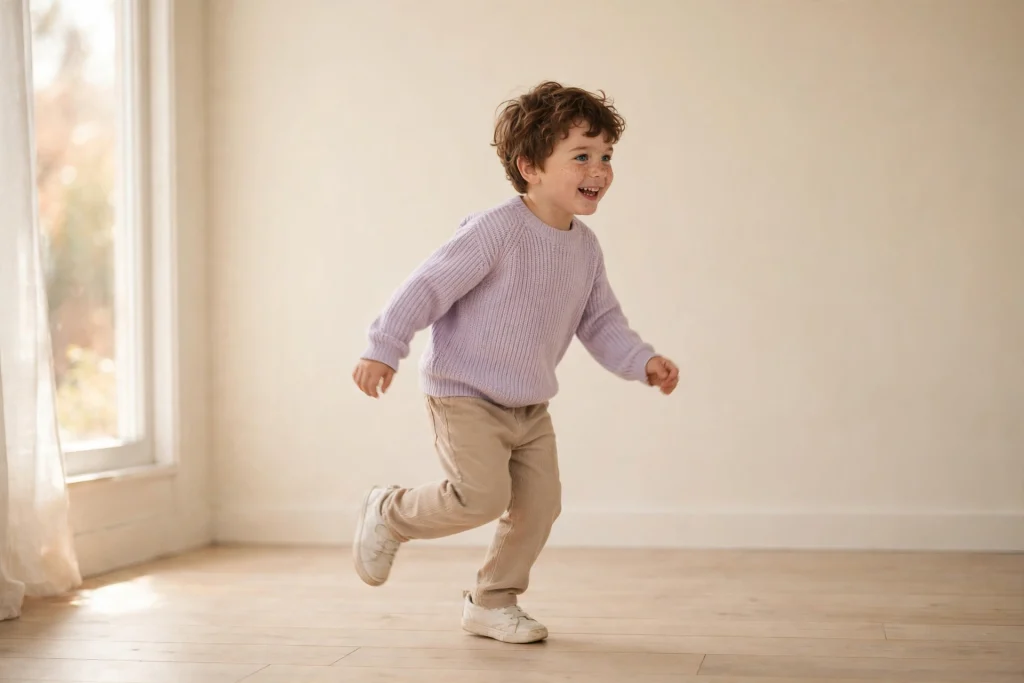
Short answer: The best activities for 5 year olds treat them as what they are — kindergarteners with stories to tell, games to win and inventions to build. These 30 activities stretch their skipping, making and first-reading skills — household things, no screens, nothing to buy.
Quick facts
- Ages: 5 years
- Cost: free — ordinary household things
- Screen-free: yes — every activity on this page
- Skills: school-start readiness play — movement, making, first reading and bigger numbers
What to expect at 5
Five is the kindergarten year — the top of the under-fives and the doorway to big school. Your 5 year old can probably skip, swing themselves and hold a real conversation, jokes and strong opinions about fairness included. Questions change at five: less ‘why?’ on repeat, more ‘how does it work?’ and ‘what does this word say?’ Many children start recognising letter sounds, writing their name and counting objects well past twenty — all arriving through play, not lessons. Friendships become real partnerships now — shared games, shared secrets, the occasional shared sulk.
Five year olds also want to be trusted with more. Laying the table, being in charge of the family calendar and carrying a small shopping list are genuine activities at this age — jobs with a visible result, finished their way. Attention stretches further again: a chosen project or a good game can hold a 5 year old for half an hour.
The information on this page is general information for parents, shared for learning and activity ideas. It is not medical advice, and it does not replace the guidance of a qualified professional. Every child develops at their own pace — if you have any concern about your child’s development, please talk to a qualified doctor or child-development professional.
Move and play
At five, movement gains skill and swagger: skipping, batting, balancing and games where they help invent the rules.
1. Skipping and galloping circuit
Set out a course — around the chairs, down the hallway, across the garden — and travel it in different ways: skip this stretch, gallop sideways like a horse there, tiptoe past the ‘sleeping dragon’, then run home. Skipping is a real coordination step (step-hop, step-hop), and five is the year it usually clicks. Take turns being the leader.
2. Design-your-own obstacle course
Hand over the clipboard: your 5 year old plans the course this time. They draw and build it (cushions, boxes, a tape river, a chair-and-blanket tunnel), set one rule per station, and time everyone with a stopwatch. Then the designer’s challenge: make one station harder and one kinder. Planning, building and improving is engineering — and being in charge is half the joy.
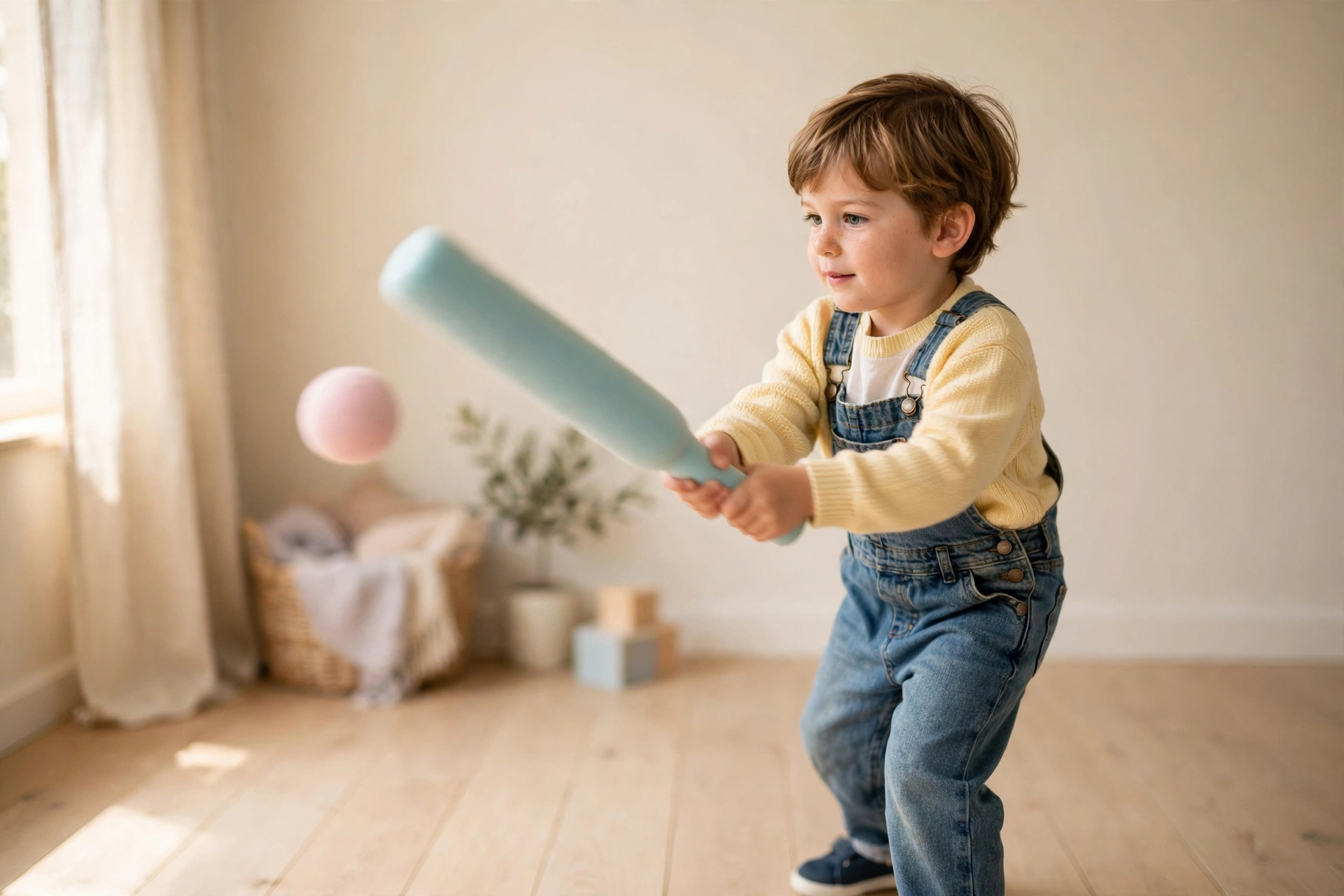
3. Batting practice
Stand a soft ball on a ‘tee’ — a stack of books, an upturned cup, a cardboard tube — and let your child swing with a foam bat or rolled-up newspaper. Soft balls only, one batter at a time, everyone else well behind. Timing the swing and connecting is serious hand–eye work, and keeping score adds counting with a grin.
4. Hopscotch to 20
Grow the classic grid: chalk or tape a hopscotch course numbered to 20. Throw the beanbag, call out every number you land on, and hop the course there and back. Try a partner’s-call version — land only on even numbers, or only on called numbers. Past ten, numbers stop being a song and start being a map.
5. Follow-the-leader dance routine
Build a tiny routine together: four moves in a row — spin, clap, jump, freeze — practised until everyone remembers the order. Then the leader adds a move and the chain grows; your child can lead a routine of their own invention to copy. Holding a sequence in mind is memory and rhythm training dressed as a dance party.
6. Team relay races
Split into teams — family members, or children versus the grown-ups (adults carry a cushion on their heads). Legs include running, egg-and-spoon, dressing up at the far end, and a baton carried back for the tag. Five year olds care about the team result, not just their own run — cheering team-mates on and losing gracefully are the real skills here.
7. Jump rope beginnings
Start without any swinging: lay the rope on the ground and jump over it forwards, backwards and side to side. Next, swing it slowly along the ground like a snake to hop over. Then the classic swing-and-step: rope held low, swung gently by two people (or tied to a door handle), your child stepping over as it passes. Grass or a mat, and stop while it’s fun.
8. Balance beam challenges, level two
The tape line or ground-level plank gets harder jobs at five: walk it with a beanbag on your head, turn around halfway, carry a cup of water along it (outside, over grass), or bounce a ball as you walk. Slow, controlled movement builds the balance playground climbing demands. Keep everything at ground level — the challenge is control, not height.
9. Playground skills circuit
Build a circuit of the big skills, at the park or on sturdy home equipment: climb the frame, cross the monkey bars as far as hands allow (you spotting underneath), swing and jump-land onto soft ground. Five year olds are stronger and bolder — which is why the rules matter: one at a time, an adult close by, landings onto something soft.
10. Tag games with their own rules
Freeze tag, shadow tag, colour tag (safe if you are standing on something blue) — five year olds can play them all, and better still, help run them. Before each round, let your child propose one rule change, agreed out loud: ‘this time the tree is also safe.’ Negotiating rules, accepting the group’s decision and being ‘it’ without a meltdown are social skills school uses daily.
Make and create
At five, makers have projects — a plan, a purpose and an audience. Expect detail, pride and long concentration.
11. Draw the story
Give your child a big sheet and a real subject — the family at breakfast, the cat asleep in a box, the bus ride. Talk about what will be in it first, then draw with real detail: windows on the house, whiskers on the cat, buttons on coats. Underneath, they dictate one sentence for you to write — or write the words they know themselves.
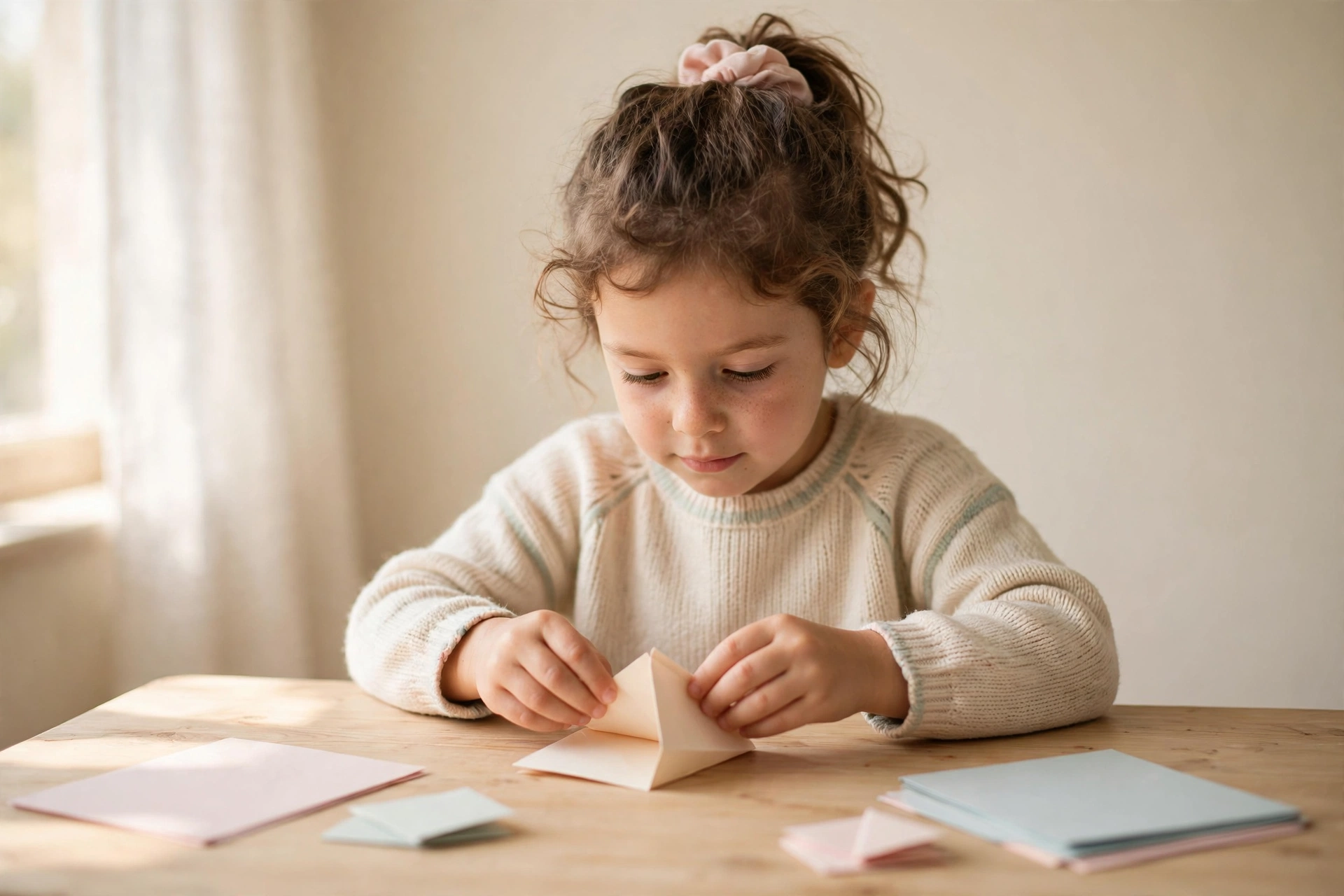
12. Paper projects — fold, cut, fly
Three paper jobs, one happy afternoon. Fold paper aeroplanes properly (sharp creases, wings level), test them outside, adjust and test again. Fold and staple a small booklet — an adult works the stapler — a blank book to fill across the week. Cut a folded-paper pattern: fold, snip, unfold, gasp. Scissors routine as always: child scissors, sitting down, you nearby, scissors away when finished.
13. Weaving and threading patterns
Weave paper strips over-and-under through a slotted card base, choosing two colours and keeping the pattern straight, or thread ribbon across a cooling rack or an old tennis racket. Fixing a mistake means spotting where the pattern broke — real attention to sequence. Finished weavings make bookmarks and placemats people actually use.
14. Building challenge cards
Deal a challenge card: the tallest tower that can hold a teddy; a bridge between two chairs a toy car can cross; a house with a door that opens. Blocks, boxes, cushions, books — anything stackable. Test it, watch it fail, change one thing, test again. This is the engineering loop in its purest form, and five year olds stay with it for ages.
15. Sew a simple shape
Cut two matching felt shapes — a heart, a star, a fish — and sew them together with a running stitch: big blunt needle, thick thread; an adult threads the needle and ties the starting knot. Leave a gap, stuff with cotton wool, and sew it closed. The finished stuffed shape is a genuine keepsake. Keep needles in a pincushion, counted out and back in.
16. Junk-model invention with moving parts
This year the junk model must do something: wheels that actually turn (an adult pokes the axle holes; a straw or skewer becomes the axle), a crane that lifts, a post box with a door that opens. Your child invents the machine, builds it from clean recycling, then demonstrates how it works. Explaining an invention is language and logic practice.
17. Painting with detail
Smaller brushes, real subjects. Set up a flower in a jar, a piece of fruit, or a photo of the family pet, and paint what is actually there: count the petals, mix the green until it matches the leaf, add the shadow. Try a two-part picture: sky first, dried, then the house over it. Paintings get a wall to be proud of.
18. Make your own board game
Draw a winding track on big card, with a start, a finish and a few special squares (‘miss a turn’, ‘jump ahead 3’, ‘roar like a lion’). Counters from bottle tops, a borrowed dice. Invent the rules, write the title in big letters, and play it as a family that evening. When a rule doesn’t work, the designer fixes it — real design thinking in disguise.
19. Little chef, level two
Follow a simple picture recipe together: measure flour, count out ingredients, stir, spread, sprinkle and assemble. Pancakes, pizza wraps and fruit kebabs are good first projects; cracking an egg is a proud moment. Reading each step aloud before doing it is exactly what it sounds like — reading. Adults handle oven, hobs and sharp knives, always; everyone washes hands first.
20. Nature journal
Give your child a plain notebook: a nature journal. They draw what they find — a leaf’s exact shape, a beetle (look closely, but let it walk away unhandled), the evening moon. You date each page; they add one sentence, dictated or written themselves: ‘The bean has two leaves now.’ Over a season it becomes a science record made with their own eyes.
Learn and play
The kindergarten-year set — real first reading, writing and number confidence — still arriving the way it should at five: inside games, stories and jobs.
21. Writing words that matter
Name writing should be confident by now, so widen the territory: labels stuck up around the house (door, table, bed, books), a shopping list in brave have-a-go spelling, a card for grandmother with a real sentence inside. Thick pencils, short happy sessions. Letters formed in play — chalkboard, sand tray, traced on your back — all count.
22. Counting to 100 and first adding
Counting stretches to 100 by grouping: make ten piles of ten things (buttons, pasta, blocks) and count the piles — ten, twenty, thirty — to a hundred. Board games build counting-on skill (‘you are on 24, you rolled 5…’). Then first adding: ‘4 shells and 3 more — how many altogether?’ Fingers and drawings are legal tools. Keep it a game with real things, never a test.
23. Games with first strategy
Five opens the door to thinking ahead: simple card games where you choose which card to play, draughts-style games of moving and capturing, tic-tac-toe. Talk through one move ahead — ‘if I go here, where will you go?’ Winning well, and losing without the board flying across the room, are both practised skills; short games keep both in reach.
24. Reading-along time
Two kinds of reading do the heavy lifting at five. Being read to — longer stories now, with chapters and cliffhangers — grows vocabulary and love of books like nothing else. And reading along: simple first books where your child manages some words themselves, your finger sometimes under the line. Libraries are built for this stage. Ten cosy minutes daily beats an hour of struggle on Sundays.
25. Word and sound games
Play I-spy with sounds: ‘I spy something beginning with buh…’ (ball, book, banana). Set rhyming riddles: ‘I’m thinking of something that rhymes with cat and you wear it on your head.’ Clap the beats in names and long funny words. At five, children’s ears tune into the sounds inside words — the machinery reading is built from — and a solved riddle feels like winning.
26. Treasure hunt with written clues
Hide a small treasure and write four or five clue cards: a word or two each, plus a picture hint while reading is new (‘under the BED’). Your child reads each with help, dashes off, finds the next. Then swap: they hide the treasure and write the clues, in their own spelling. A clue another person can follow is real, purposeful writing.
27. Growing and melting science
Grow a bean on damp cotton wool in a clear jar at the window: predict, check daily, draw the roots and shoot as they appear. Race ice cubes — sunny windowsill, fridge, wrapped in a cloth: which melts first, and was your guess right? Guessing, watching and explaining is the scientific method at five. Cold and simple only; no hot water needed.
28. Tell and write a three-part story
Invent a character together — a brave mouse, a bus that could fly — and build a story with a beginning (who and where), a middle (a problem!) and an end (how it worked out). Your child tells it, you write it in a homemade booklet, they illustrate every page; stronger writers add key words. Storytelling in order is the root system of later writing.
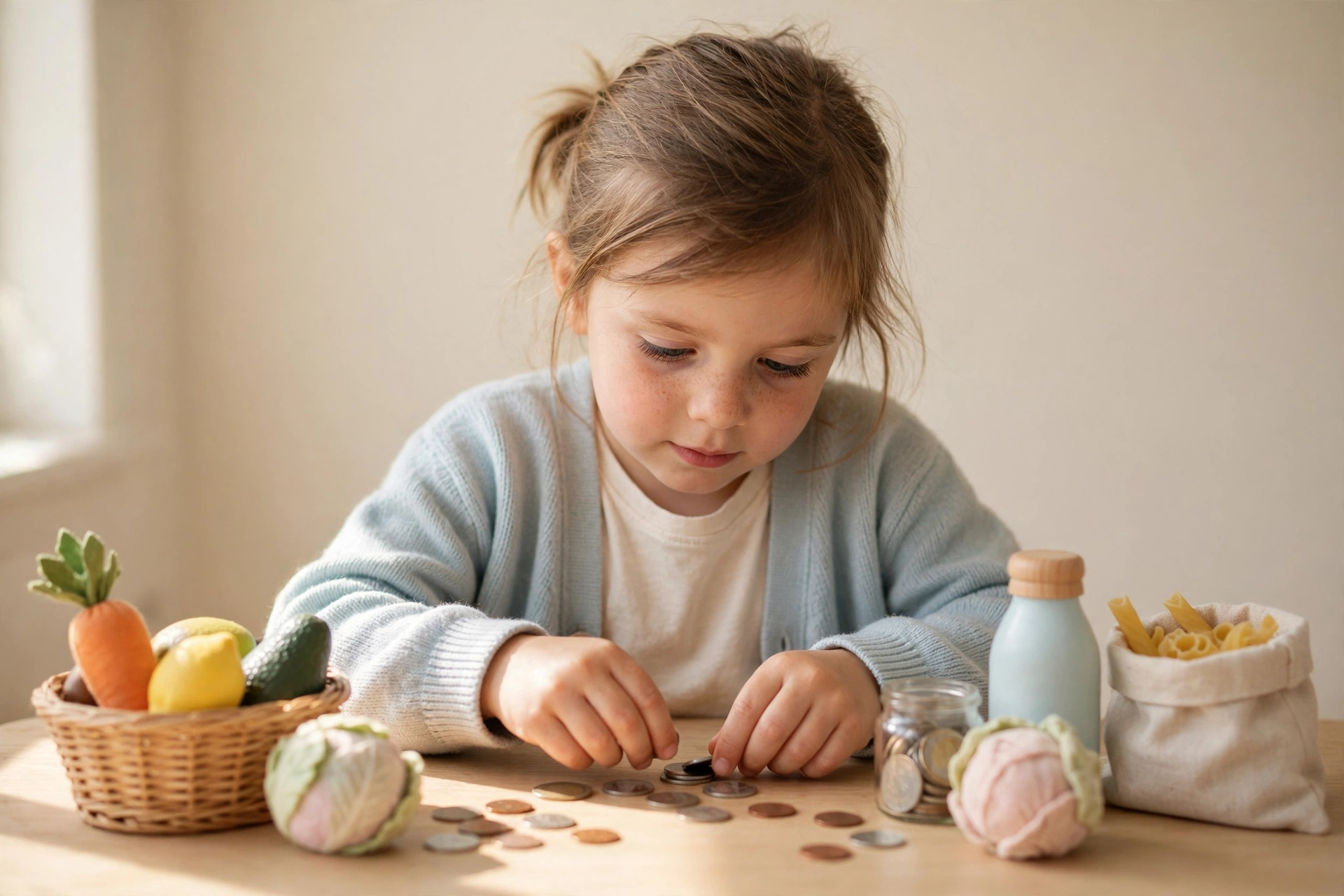
29. Real-coin shop
Set up a shop with price tags from 1 to 20 and a purse of real coins (wash coins and hands afterwards; keep them away from younger siblings who mouth things). Your child shops with a list, hands over coins, and starts checking simple change with your help; then they run the shop and you become the awkward customer. Real money turns counting into a skill with a purpose.
30. Time and calendar games
Make time visible: a weekly picture calendar your child helps fill in (park Saturday, library Tuesday), a days-of-the-week ordering game, and ‘what do we do after lunch?’ sequencing of their own day. A paper practice clock introduces ‘the big hand points up — it’s something o’clock’ as a puzzle, not a lesson. Knowing the shape of their week steadies a child for school routines.
From play to printables
Five is the home age of the kindergarten worksheet: tracing letters and numbers, counting and matching pages. When your 5 year old asks for ‘real schoolwork’, FIMS Schools has free printable preschool and kindergarten worksheets for exactly this stage: free preschool and kindergarten worksheets. Print one or two pages at a time and keep it playful.
Read next
- Activities by Age — activity ideas for every age, from babies to 5 year olds
- 30 Activities for 4 Year Olds — the stage just before this one, handy if you have a younger child too
- Homeschool Preschool Curriculum — a free, simple weekly plan for the years before big school
Activities for 5 year olds — questions parents ask
What should a 5 year old be learning?
Through play and everyday life: stories and conversation, first reading skills (letter sounds, rhyme, recognising words), writing their name and short words, counting and first adding with real objects, games with rules and first strategy, and practical independence with small jobs. If your child attends kindergarten or school, this page is the home side — and the two fit together like a zip.
How long can a 5 year old concentrate on one activity?
On something they have chosen, twenty-five to thirty minutes is common at five, and a project or game in progress can hold them much longer. Attention is longest when the idea was partly theirs. When it fades, park the project to continue tomorrow rather than pushing — returning to finish something is itself a school-ready habit.
My child is starting school (or already in kindergarten) — how do these activities help?
They practise exactly what school asks for, without feeling like school: following rules and sequences, holding a pencil and forming letters, hearing sounds in words, counting, waiting for turns and managing their own things. Keep home play light and fun — school is the lesson; home is the practice field and the rest camp. And if you ever have a real concern about your child’s development, ask their teacher or a qualified professional rather than worrying at home.