
Short answer: Pet theme preschool activities need no real pet and no special kit: animal walks, paw-print art, a pretend vet clinic and pet counting games fill five happy days for ages 3–5 — every activity here works with toy pets.
Quick facts
- Ages: 3–5 years
- Theme week: 3–7 days — one theme, dipped into a little each day
- Cost: free — ordinary household things and toy pets
- Screen-free: yes — every activity on this page
Move and play
Pets move all day — fetching, crawling, stretching, hopping, splashing in the bath. This first set borrows all of it, and it is the energy-burning part of the week.
1. Fetch-and-return relay
Set a basket of soft balls at one end of the room or garden and an empty basket at the other. Your child is the puppy: run (or crawl, puppy-style) to fetch one ball, carry it back — in two hands, or held gently “in the mouth” with a clean scarf as a pretend muzzle — and drop it in the home basket. Time how fast the whole litter of balls comes home. Fetching teaches turn-taking patience, counting the balls home is early maths, and the shuttle runs burn exactly the energy puppies have.
2. Pet obstacle course
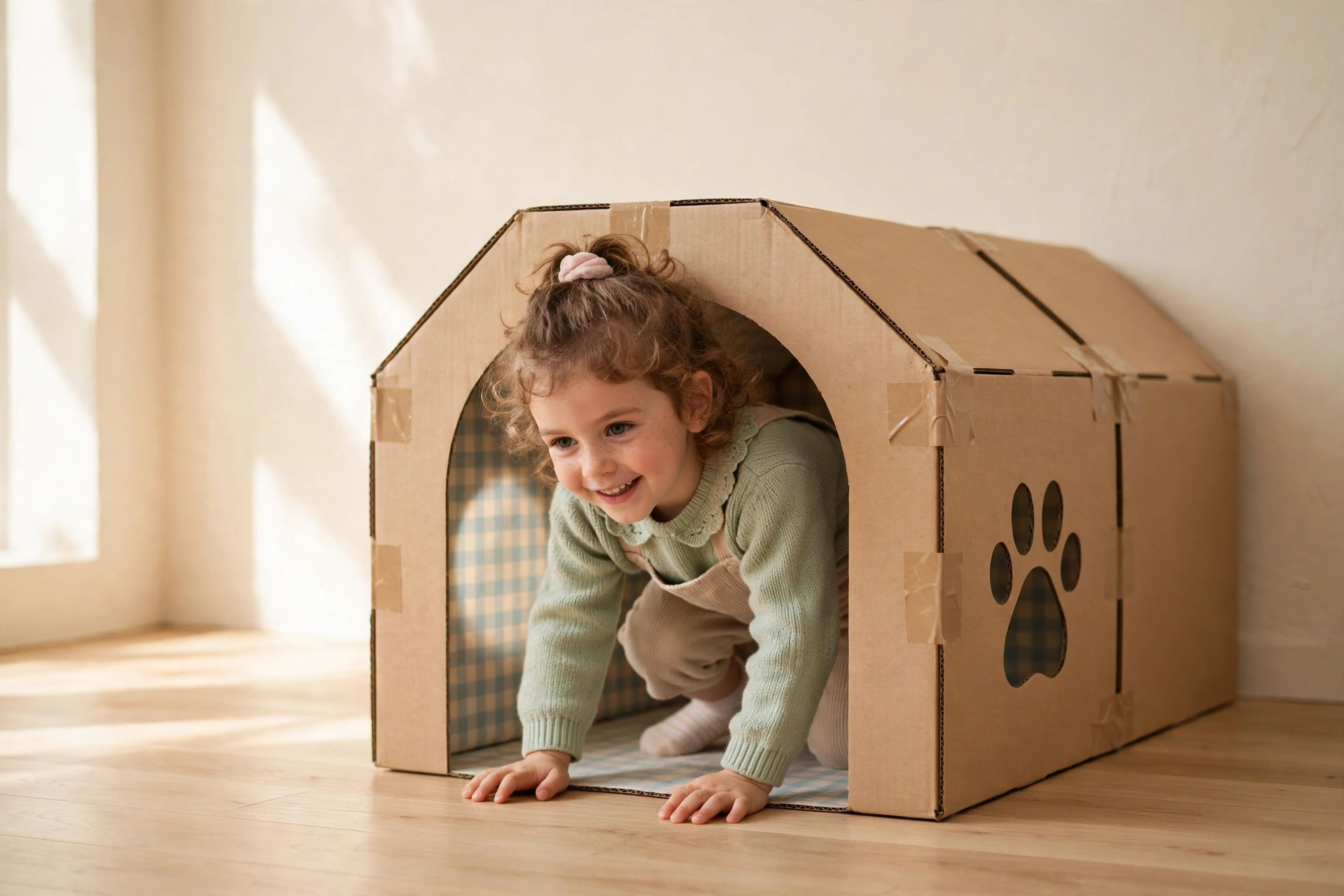
Build a course out of the pet day: crawl through a cardboard-box “kennel” tunnel, step carefully over the “sleeping cat” (a cushion — don’t wake her!), hop through hoops to the “vet visit” chair, and finish with a tail-wag wiggle dance. Run it forwards, then backwards, then let your child redesign one station. Sequencing the stations is memory work, and moving four different ways in one course is whole-body coordination.
3. Animal walks parade
Call an animal and everyone moves like it: dog crawl, cat stretch (up on all fours, back arched, then long and low), bunny hops, duck waddle, pony trot, slow tortoise. Your child leads the parade and you copy — however dignified that feels. Copying an animal’s movement builds body awareness and core strength, and guessing “which animal am I?” adds a thinking game on top.
4. Pet bath time
Fill a washing-up tub with warm water and a little bubble bath, add toy pets (the hard plastic kind that don’t mind a soaking), a sponge, a small jug and an old towel. Your child washes each pet, rinses it and dries it on the towel “bed”. Pouring, squeezing and scrubbing is hand-strength work, and caring for a pet — even a plastic one — is the gentle heart of this whole theme. Water rule, as always: an adult stays right there, and the tub is emptied when play ends.
5. Musical pets freeze dance
Play music and everyone dances like happy pets at a party. When the music stops, freeze — as a sleeping pet: curled up, eyes closed, not a whisker moving. Anyone caught mid-wiggle becomes the next music-master. Listening for the stop, and holding a pose against every giggle, is self-control practice disguised as the silliest game of the week.
Make and create
Five makes that fill the walls and the toy box with pets — and every one of them is fingers-and-scissors practice wearing a costume.
6. Paper-plate pet faces
A paper plate (or a circle of card), crayons or paint, triangle ears glued on top, whiskers drawn or stuck on with strips of paper — and you have a cat, a dog or a rabbit face. Hold them up as masks for the animal walks parade, or string several along a wall as the week’s pet gallery. Choosing where eyes, nose and ears go is early face-and-body awareness, and all that gluing and drawing is hand control.
7. Paw-print painting
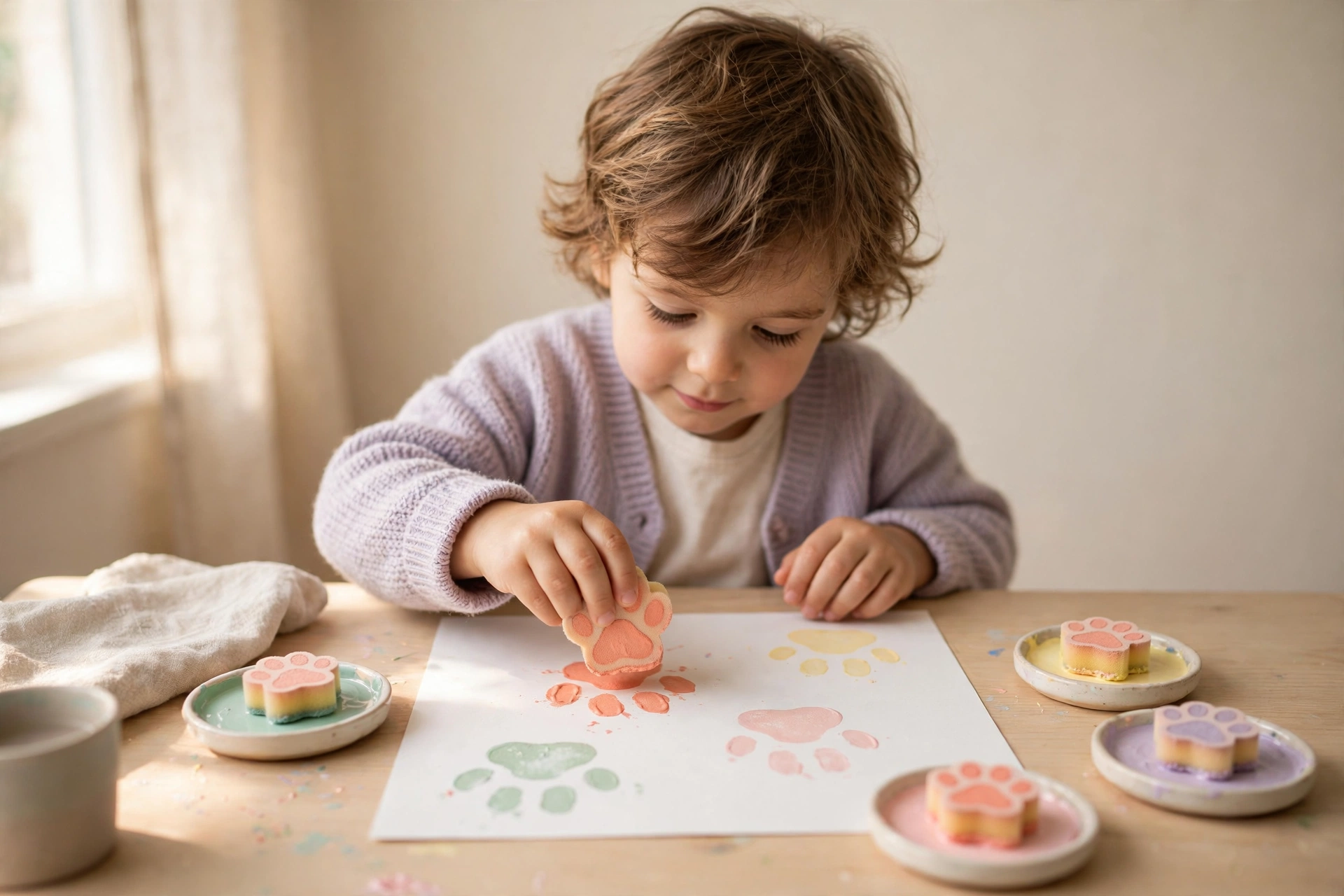
Cut a simple paw shape from a sponge (one big oval pad, four small toe ovals), dip it in washable paint on a plate, and stamp paw prints marching across a long sheet of paper — a trail to follow, a path to a “kennel”, or wrapping paper for a pet-lover’s present. Handprints and footprints make fine paws too. Stamping in a line, deciding where the next print lands, is spacing and pattern sense. Aprons on, and wash hands straight after — paint is for paper, not for tasting.
8. Cardboard pet house build
A big cardboard box becomes a kennel, a stable or a cat palace: an adult cuts the door, and your child decorates — crayon bricks, a name sign, a blanket inside, a bowl by the door. Add a roof of folded card if the engineering runs that way. Building a home for a toy pet is early construction play: planning, fitting, fixing what collapses, and a strong dose of pride.
9. Sock-puppet pets
An old clean sock, buttons or drawn-on eyes, yarn or felt ears — and a pet that talks. Puppets let a shy child speak through the dog, and a bold child perform a whole vet surgery. Acting out a little story (“the puppy who lost his ball”) with a beginning, a problem and an ending is early storytelling, and conversations between two puppets are language practice of the best kind. Glue eyes on firmly, or draw them — this puppet will be hugged hard.
10. Pet collar and lead craft
Thread big beads onto a thick cord or pipe cleaner to make a collar for a favourite toy pet, counting the beads and choosing a colour pattern as you go. Add a ribbon “lead”, and the pet can be taken for walks around the obstacle course. Big beads only, threading at the table with you beside them, and finished collars live on the toy — not around any neck, child or animal. Patterns, counting and fine fingers, all in one make.
Learn and discover
The thinking set: caring, sorting, counting and guessing — the parts of pet life that turn into maths, science and language without anyone noticing a “lesson”.
11. Pretend vet clinic
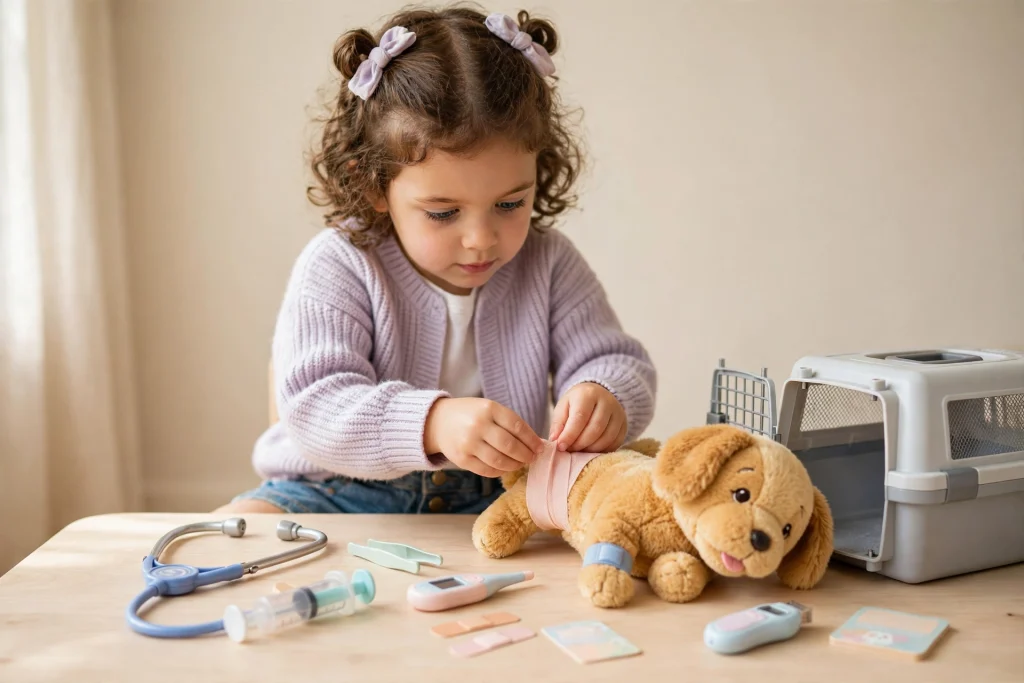
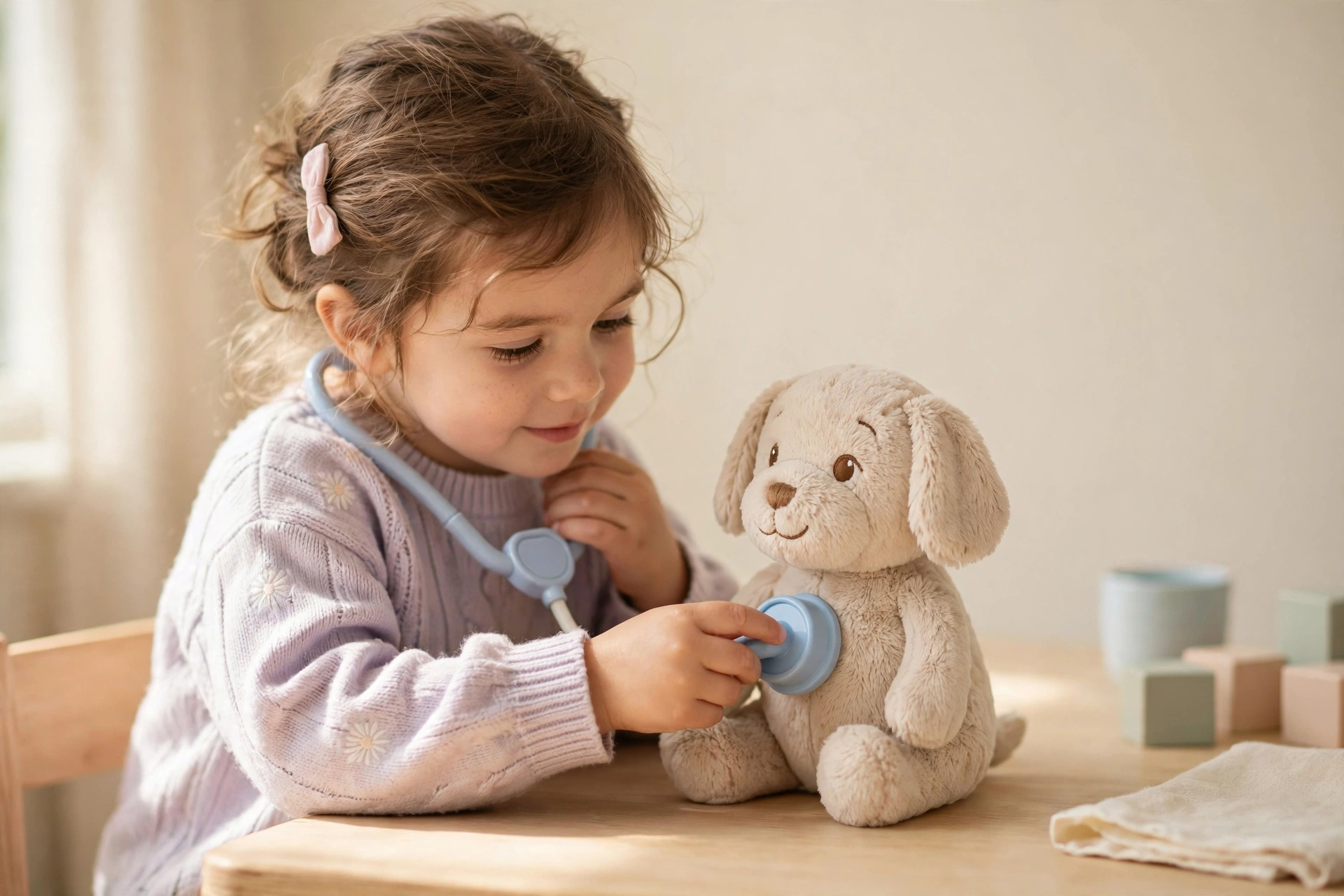
The star of the week. Set up a clinic corner: a toy stethoscope (or a funnel and tube), bandages, a clipboard check-up chart, a “medicine” spoon and a waiting row of poorly toy pets. Your child is the vet: listen to the heart, look in the ears, bandage the paw, write (or scribble) the chart, and tell the owner — you — to give lots of rest and cuddles. Role-playing care grows empathy and language together, and the chart is early writing with a real purpose. If a real pet is watching, it stays a spectator: gentle hands, an adult beside you, and hands washed after any real-animal cuddle.
12. Pet care station
A brushing and feeding corner for the toy pets: a soft brush, bowls, and scoops of “kibble” (dry pasta shapes in a tub). Your child brushes each pet, then feeds it — two scoops for the puppy, three for the big dog — counting every scoop aloud. Scooping, counting and remembering whose turn it is makes this quiet corner a maths and responsibility lesson at once. The pasta stays dry, the station closes at night, and everything goes back in the tub so real mice never get ideas.
13. Sort the pets
Gather every toy pet and pet picture you can find, and three “homes” — a box, a hoop and a basket. Sort them together: pets that live in a home, farm animals, wild animals. Talk about why as you sort: a lion is magnificent, but he is not a pet. Sorting by a rule, and being able to say the rule, is classifying — the same thinking maths and science run on. Move one animal and ask “does he still belong here?” for a lively argument.
14. Pet counting and feeding maths
Line up five toy pets and five bowls. Your child counts kibble (pasta pieces, buttons too big for mouths, or drawn kibble on paper) into each bowl — one pet wants 3, another wants 5 — then checks: does every pet have the same? Who has most? Counting out an exact number for a customer is one-to-one correspondence with a story attached, and comparing bowls is “more and less” you can see. Keep counting pieces large, count at the table, and put pieces away when the café closes.
15. Pet story basket and “Who am I?”
Fill a basket for a favourite pet story: the book, plus props — a toy pet, a bowl, a lead, a blanket. Read the story with your child holding the matching prop at each page. Then play “Who am I?”: make a pet sound or describe one (“I have long ears and I hop”) and guess each other’s animals. Listening, memory and describing words grow together here — and the sound effects alone are worth it.
Turn it into a theme week
Spread the fifteen across five days, two or three a day, and the theme does the teaching by repetition:
- Day 1 — Meet the pets: animal walks parade (3), sort the pets (13), and read the story basket (15).
- Day 2 — Busy pets: the obstacle course (2), paw-print painting (7), and the feeding maths game (14).
- Day 3 — Making day: paper-plate faces (6), the cardboard pet house (8), finished with the freeze dance (5).
- Day 4 — Caring day: open the vet clinic (11), run the pet care station (12), and give everyone a bath (4).
- Day 5 — Pet party: fetch relay championships (1), sock-puppet show (9), collars on (10), and pets tucked into their new house to sleep.
Short on time? Three days still works — pick one activity from each section per day. And a note for real-pet homes: the whole week runs perfectly well with toy pets alone. If you do have a real animal, theme week is a lovely time for the gentle-hands rules — an adult always there, calm voices, and hands washed after every cuddle. Families with pet allergies can take the cuddles out entirely: nothing on this page needs a real pet, ever.
Finish the week with printables
After five days of pet play, some preschoolers ask for a pet page of their own to colour or trace — and that request is the perfect moment for paper. FIMS Schools has free printable preschool and kindergarten worksheets, including first tracing and colouring pages: free preschool and kindergarten worksheets. A pet colouring page or two to close the week is plenty — the play was the learning; the printable is the souvenir.
Read next
- Preschool Theme Activities — every theme week in one place: pick next week’s theme here
- Activities by Type — more play ideas organised by kind
- 30 Activities for 3 Year Olds — everyday play for the younger end of preschool
Pet theme questions parents ask
Do I need a real pet to do a pet theme?
No — not at all. Every activity on this page is written for toy pets, picture pets and pretend pets, and the learning (movement, making, sorting, counting, caring role-play) is identical. If you do have a real pet, it can inspire the week from a safe distance: watched, talked about and gently stroked with an adult right there, with hands washed afterwards.
How do I run a theme week without it taking over the day?
Two or three short activities a day is the whole secret — fifteen to thirty minutes of theme play, fitted around ordinary life. Keep the theme things in one box or basket so setting up takes a minute, repeat favourites instead of forcing all fifteen, and let your child lead on which days become “making days”. A theme is a thread running through the week, not a timetable.
My child is scared of real animals — is a pet theme a good idea?
Often, yes — pretend pets are a kind way in. Play is fully under your child’s control: the toy dog never jumps up, never barks unexpectedly, and can be put in its box whenever your child has had enough. Many children warm to real animals gradually after weeks of confident pretend play. Go at your child’s pace and never force a stroke or a meeting; confidence built slowly lasts.