
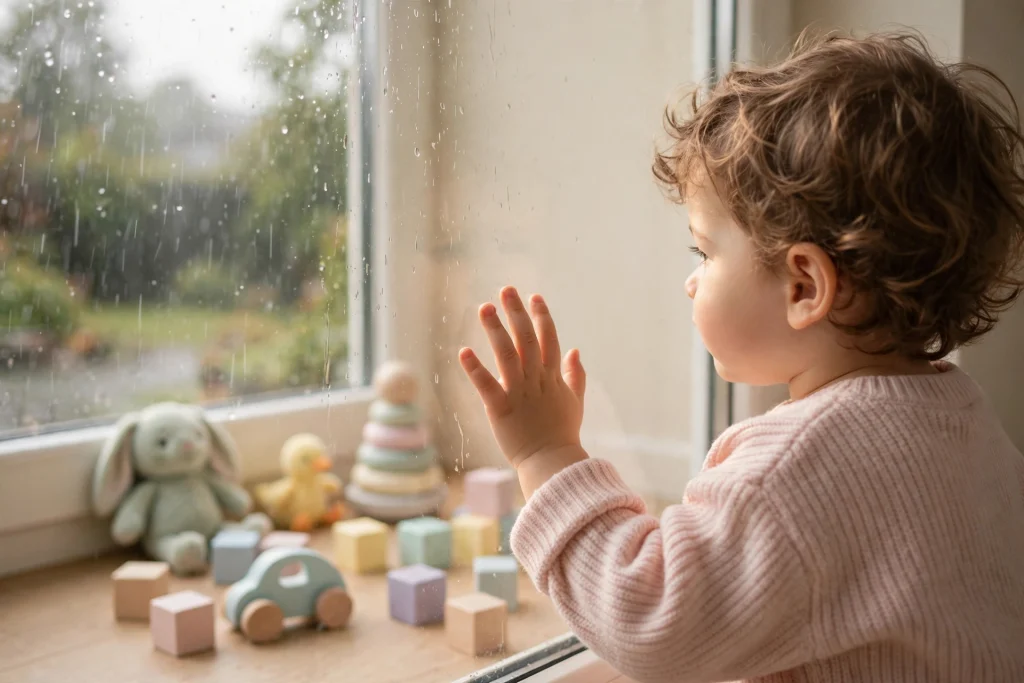
Short answer: Rain outside and the children are bouncing off the walls? Here are 35 rainy day activities for kids aged 1–5 — energy-burners, makes, sensory play and cosy quiet time, all indoors with things you already own and almost no prep.
Quick facts
- Best for: ages 1–5
- Prep: mostly none
- Cost: free — household items only
- Where: indoors
- Screen-free: yes — every activity on this page
Start with the energy games in Section 1, move on to making and sensory play, and save the cosy section for the last stretch of the day. You do not need all 35 — two or three, rotated through the day, beat a forced march through the whole list. Everything here works as gentle indoor activities for toddlers too: each activity notes the swap, or the supervision, the youngest children need.
Burn energy indoors
1. Cushion mountain course
Pull the cushions off the sofa and build a soft mountain range across the floor, with a favourite teddy stranded at the far end. Your child climbs, crawls and wobbles over the peaks to rescue it. Climbing on soft, uneven ground builds balance, leg strength and confidence better than almost any indoor game. Mess: none.
2. Hallway bowling
Line up six empty plastic bottles or stacking cups at the end of the hall and roll a soft ball to knock them down. Toddlers stand as close as they like; older children step back each turn. Rolling on purpose, watching the skittles fall and setting them up again is aim, patience and counting in one game. Mess: none.
3. Dance and freeze
Put on a favourite song and dance together as wildly as you can — then freeze like a statue when the music stops. At 2, the freeze lasts about a second; the dancing is the point. Stopping and starting with the music is early listening and self-control practice disguised as a party. Mess: none.
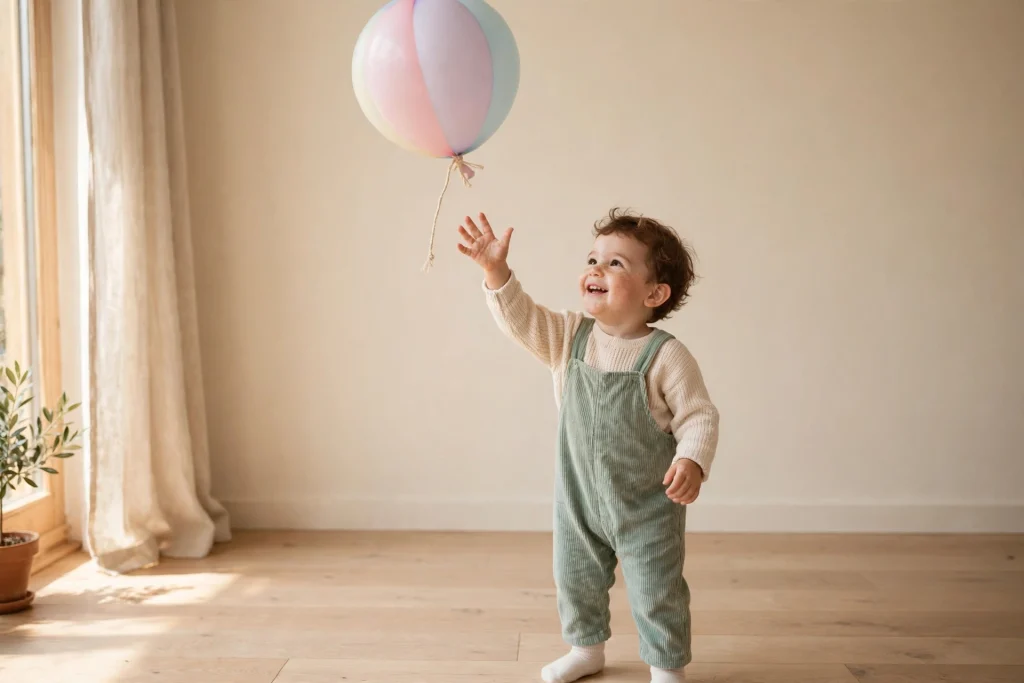
4. Balloon keep-up
Bat a foil balloon gently into the air and work together to stop it touching the floor. It floats so slowly that even a 2 year old can reach it, and nothing breakable is at risk. Safety: choose foil, never latex, at this age — burst latex pieces are a serious choking hazard. Play with an adult in the game, and clear away any popped piece at once.
5. Animal parade
Call out an animal and cross the room like it — bear walks on hands and feet, frog jumps, crab scuttles sideways, snake slithers on a tummy. Take turns choosing, and join in yourself; copying you is half the fun. Whole-body movement like this builds strength and coordination with no equipment at all. Mess: none.
6. Sock toss
Roll clean socks into balls and toss them into a laundry basket, bucket or big box. Start close together and step back as the throws start landing. Aiming, throwing and letting go at the right moment builds arm control and hand–eye coordination — and a basket of socks is the safest ball game in the world. Mess: none.
7. Pillow-case hop race
Step into a pillow case, hold the top up with both hands and hop to the other side of the room and back. Keep the course short and the floor clear of toys. Hopping with two feet together is real work for little legs — expect giggles and a few soft landings on bottoms. Mess: none.
8. Tape tightrope
Stick a long line of masking tape along the floor and walk it heel-to-toe, arms out like a tightrope walker. Make it harder with a bend, a zigzag, or a soft toy to carry. Slow, careful steps teach balance and concentration, and the tape peels off cleanly when you are done. Mess: none.
9. Jump the river
Two parallel tape lines on the floor are the banks of a river. Your child jumps across — then you move the lines a little further apart. Fill the river with paper fish if you like. Jumping and landing on two feet builds the leg power behind running and climbing. Mess: none.
10. Hide and seek, the small-home version
One grown-up hides somewhere un-scary while the child counts out loud to ten — slowly, with help — and then comes to find them. Swap roles, and agree first which rooms are in the game. The counting is real number practice, and being found never stops being thrilling at this age. Mess: none.
Make something
11. Big-box colouring
Find the biggest cardboard box you can and cut a door in the side (a grown-up job). Your child colours the inside walls, the outside — then moves in. Drawing on huge surfaces lets the whole arm move, which is exactly the movement handwriting grows from, and the finished box becomes a house, shop or garage for days. Mess: low.
12. Sticker scenes
A sheet of big stickers and a big piece of paper is the whole activity. Let your child place them anywhere — a dog in the sky is fine. Peeling a sticker off its backing and pressing it down in the right spot is fiddly finger work of the best kind, and there is no wrong answer. Mess: none.
13. Playdough bakery
Roll, squash and shape playdough into bread rolls, biscuits and birthday cakes for a pretend bakery, with bottle tops as cutters and a blunt knife for slicing. Squashing and rolling dough strengthens little fingers more than almost any other quiet make. No dough in the house? Our Easy No-Cook Playdough Recipe takes ten minutes and keeps for months. Mess: low.
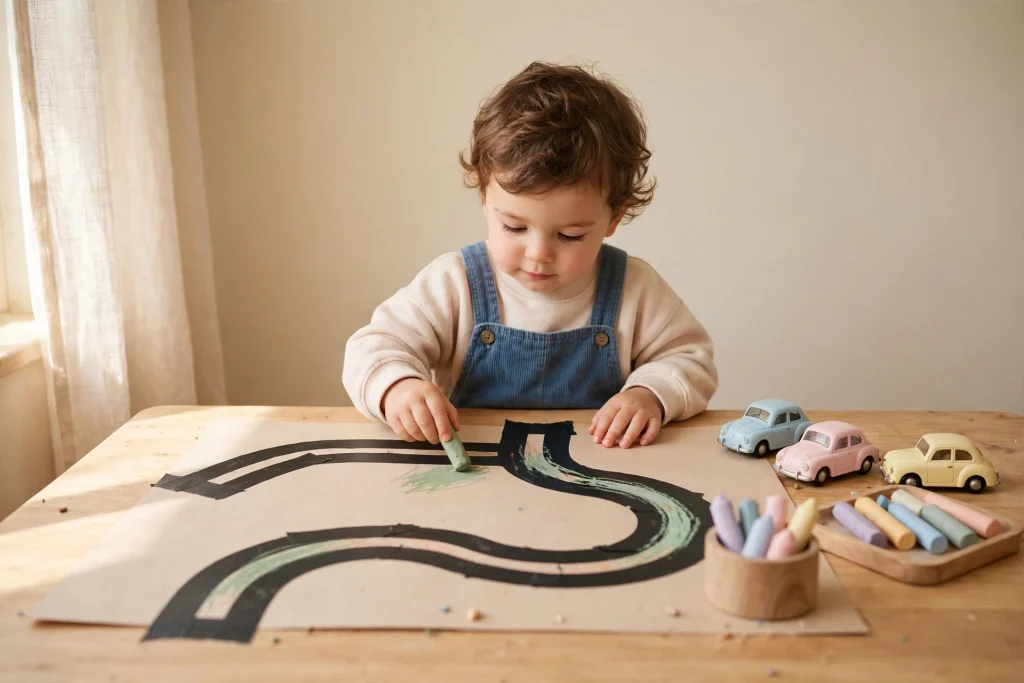
14. Tape roads
Stick masking-tape roads across the floor — straights, bends, a roundabout, a car park — then drive toy cars along them, over a book bridge and through a box tunnel. Children plan routes, name places and tell stories as they drive, so this is a language game as much as a car game. It peels up cleanly afterwards. Mess: none.
15. Paper plate masks
Draw a face on a paper plate, colour it in, and hold it up to become a lion, a cat or a very surprised owl. Safety: a grown-up cuts the eye holes — scissors are always an adult job on this page — and under-3s hold masks up rather than wearing them on elastic. Pretending to be someone else builds confidence with words and feelings. Mess: low.
16. Rain painting
Tape a big sheet of paper to the table and paint the weather you can hear: grey-blue streaks falling, splashes, fat puddles along the bottom. Water-based paint and one cup of water are all you need. Big sweeping strokes build the shoulder and arm control that handwriting will need later. Mess: medium — keep it on the table.
17. Tear-and-stick collage
Tear coloured paper, tissue or old magazine pages into pieces — no scissors needed — and glue them onto card to make a picture, a pattern or a glorious mess. Tearing is a genuine hand skill: one hand holds, the other pulls, and the two hands learn to work together. Mess: low.
18. Handprint cards
Dab paint onto one hand with a sponge, press it onto folded card, and let it dry into a flower, a fish, or a sun with rays drawn round the fingers. Grandparents keep these forever. A rainy day make that becomes a present is doubly satisfying. Mess: medium — one hand, one card at a time.
19. Bottle-top printing
Dip bottle tops, corks or a cut sponge into paint and stamp patterns onto paper — rows of circles, a caterpillar, a bunch of grapes. Pressing and lifting in a rhythm is calming, and choosing where the next print goes is early design. Wash hands and tops when you finish. Mess: medium — table only.
Sensory play without the flood
20. No-mess sensory bags
Half-fill a strong zip bag with hair gel or water, add big buttons, foam shapes or glitter, seal it, and tape all four edges to the table or floor. Your child squishes, pushes and draws patterns with a finger — all the sensory pleasure, none of the spill. Check the bag for leaks before each use and throw it away if it splits. Mess: none.
21. Ice treasure melt
Freeze a few waterproof toys in one big tub of water overnight. Turn the block out into a tray and let your child free the treasure with warm water, spoons and pouring. Safety: use one big block, never loose ice cubes for under-3s — cubes are a choking hazard — and stay beside them while water is out. Watching ice change is first science. Mess: medium — tray only.
22. Bath-time water park
Baths are not only for bedtime. Run a shallow, warm midday bath with cups, jugs, a sieve and floating toys, and let your child pour, splash and sail boats for as long as the water stays warm. Safety: never leave a child alone in a bath, even for a moment — bring everything you need in with you. It is the easiest rainy day win there is. Mess: all in the bath.
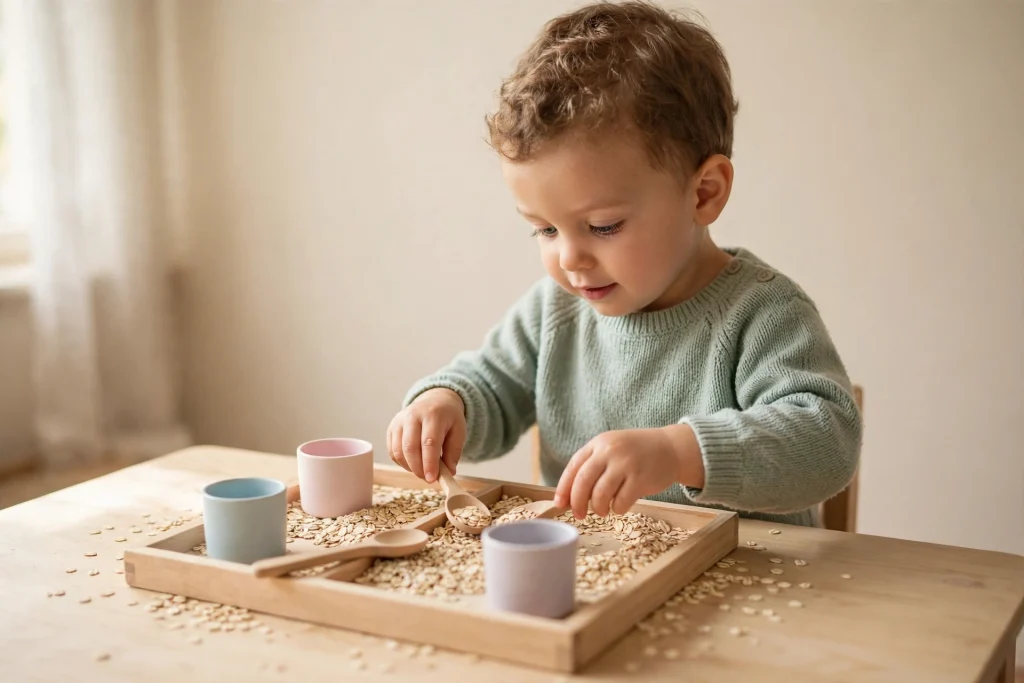
23. Oat tray treasure dig
Fill a deep tray with dry rolled oats — a kinder dry base than rice, because the flakes are bigger and softer — and bury chunky toys for your child to dig out with spoons and scoops. Keep it at the table and keep every piece big; for under-2s, choose the sensory bags (activity 20) instead. Scooping and digging here is the same calm concentration as the sandpit. Mess: low — tray only.
24. Sponge squeezing station
Two bowls on a tray — one with a little water, one empty — and a couple of sponges. Squeeze, carry, squeeze: moving water from bowl to bowl with a sponge absorbs small children completely and builds a strong grip. Add a cloth so they can mop their own spills; the mopping is part of the game. Mess: low — tray only.
25. Feely box game
Cut a hand-sized hole in a box (a grown-up job), hide a familiar object inside — a spoon, a sponge, a toy car, a sock — and let your child reach in and guess by touch alone. Guessing forces careful describing: “it is soft”, “it has a handle”. Start easy; hide trickier things as they grow. Mess: none.
26. Sound shakers
Put pasta in one lidded pot, dried beans in another, rice in a third — seal the lids with tape so nothing can spill — then shake, compare and guess what is inside. Loud, soft, rattly, swishy: a listening game that builds the sound awareness early reading grows from. Older children can hunt for matching pairs. Mess: none.
27. Barefoot texture path
Lay a path across the floor — a towel, bubble wrap, a sheet of foil, a rug, a square of cardboard — and walk it barefoot together, slowly, describing every step. Hold both hands for the youngest walkers and keep the path flat and taped down. Feeling with their feet wakes up balance and body awareness on a day spent stuck indoors. Mess: none.
Quiet and cosy
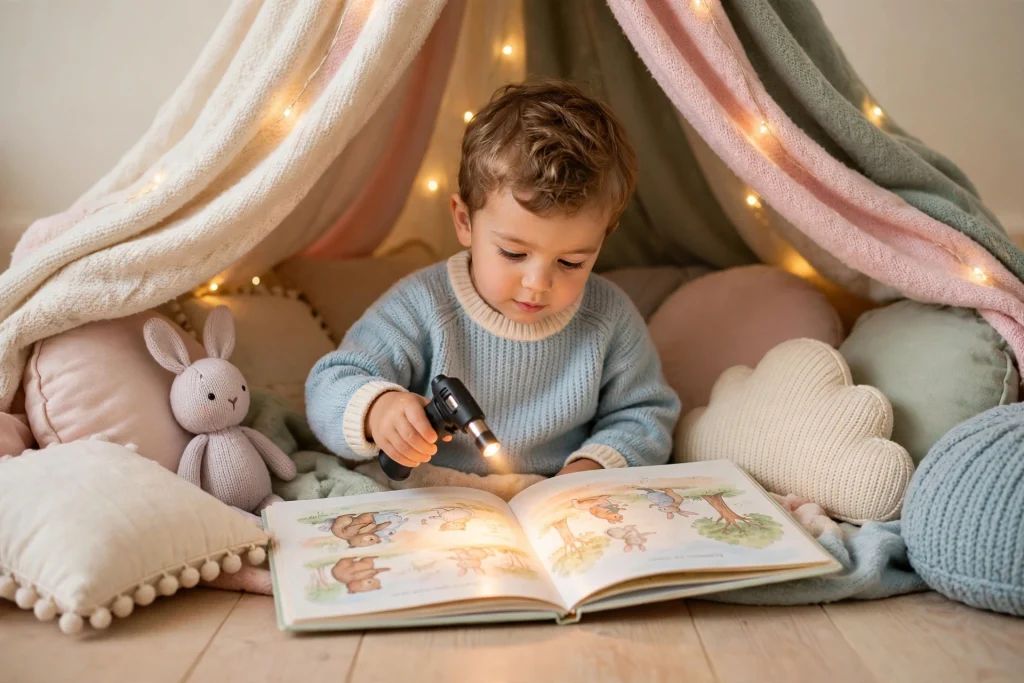
28. Blanket fort reading
Drape blankets over chairs and the sofa, fill the den with cushions, and take two or three favourite books inside to read by torchlight. A familiar book in a den feels brand new, and the small secret space makes listening magical. Let your child “read” one back to a teddy. Mess: none.
29. Torch shadow play
Darken the room, shine a torch at a plain wall, and make hand shadows — a dog, a bird, a butterfly. For older children, add cardboard shapes on sticks (a grown-up cuts these out; scissors are an adult job). Moving shadows invite stories, and every story is language practice in disguise. Mess: none.
30. Matching pairs game
Lay out pairs of real things — two matching socks, two spoons, two toy cars — then mix them up and find the pairs. Older children can play it as a memory game: picture cards face down, turn two at a time. Matching and remembering are exactly the skills school will ask for, learned on the living room floor. Mess: none.
31. Story stones
Collect a few smooth stones — or draw on paper circles — and mark each with one simple picture: a sun, a house, a cat, a boat. Take turns pulling one from a bag and adding a sentence to a shared story. Three sentences is a complete story at this age, and writing it down for your child makes it a book. Mess: none.
32. Indoor picnic
Spread a blanket on the floor, lay out a real snack or pretend food on small plates, and invite the teddies. Pouring pretend tea, passing plates and asking each guest what they would like is turn-taking and polite conversation practice — and a snack on a blanket tastes better than the same snack at the table. Mess: low.
33. Simple baking together
Make something simple together — banana oat bites, easy biscuits, fruit muffins. Your child can pour, stir, mash bananas and press out shapes. Safety: a grown-up does every hot part — oven, trays, kettle — with children kept well back from the heat. Baking is measuring, waiting and steps in order: a whole lesson that ends in a snack. Mess: medium — worth it.
34. Audio story snuggle
No screen needed: play an audio story, curl up together under a blanket, and listen. Following a story they cannot see builds listening and imagination in a way pictures cannot do for them — pause at a good moment and ask what happens next. Ten minutes is plenty for the youngest listeners. Mess: none.
35. Photo album stories
Finish the day with the family photographs — a printed album is lovely, a phone album works too. Tell the stories behind the pictures: who is that baby, where was that beach, what happened next? Children this age are building their own memory and their place in the family story, and hearing themselves in it is quietly powerful. Mess: none.
Safety notes — please read
- Always supervise. Indoor play feels safe, but water, small objects and climbing games still need an adult in the room.
- Small-object rule: if something can fit through a toilet-roll tube, it is too small for a child under 3 without you sitting right beside them. Sealed shakers and big pieces only.
- Water play: small amounts, in a tray or the bath — and a child is never left alone with water, even for a moment.
- Climbing games: cushions on the floor only — never chairs, tables or shelves — with a clear, soft landing space around the game.
- Stop when your child has had enough. Wandering attention means pack away and switch sections, not push on.
A look ahead — for older preschoolers
When a rainy afternoon turns quiet, an older 4 or 5 year old may enjoy some calm table time with a pencil. Our free Preschool and Kindergarten Worksheets are printable pages made for exactly that moment — a gentle look ahead to school skills, once play has done its work.
Rainy day activities for kids — questions parents ask
What can kids do on a rainy day with nothing planned?
You already own everything you need. Start with one energy game from Section 1 — the cushion course and dance and freeze need literally nothing — then one make, then something cosy. Cushions, socks, a cardboard box, paper and a tray of water cover most of this list. The day does not need a plan; it needs a first game.
How do I keep a toddler busy indoors all day?
Rotate, do not stretch. A toddler’s attention lasts ten to twenty minutes on one thing, and that is normal. Keep three or four activities ready and swap when interest fades, putting each away before the next comes out. Break the day with snacks, a story and the bath-time water park — the rhythm, not any single activity, is what fills the day.
What are good rainy day activities for a small flat?
Most of Section 4 was made for you: the blanket fort, torch shadows, matching pairs and story stones need one room and no running space. Add sticker scenes, the sensory bags and the sponge station — all table-sized — and shrink the energy games: sock toss over two metres, the tape tightrope and dance and freeze on one rug all work in a small living room.
Are these activities OK for a 1 year old?
Yes, with you beside them. The safest picks are the sensory bags and the texture path in Section 3, the blanket fort and photo stories in Section 4, and — with soft landings and you right there — dancing, sock rolling and the cushion course in Section 1. Skip the balloon game and the oat tray for now, keep every piece too big to swallow, and stay within arm’s reach throughout.
When the rain stops
The same children who built a cushion fort indoors will want the garden, the park and the pavement the moment the sun comes back — and there are ideas for those days on the hub below. For today, let the weather be the plan: stay in, burn it off, make something, and end in a blanket fort.
Read next
- Activities by Type — the full hub: sensory play, fine motor, crafts, learning activities and themes
- Activities for 2 Year Olds — 30 easy at-home activities for two year olds
- Fine Motor Activities for Toddlers — 25 activities that build the finger skills behind writing