
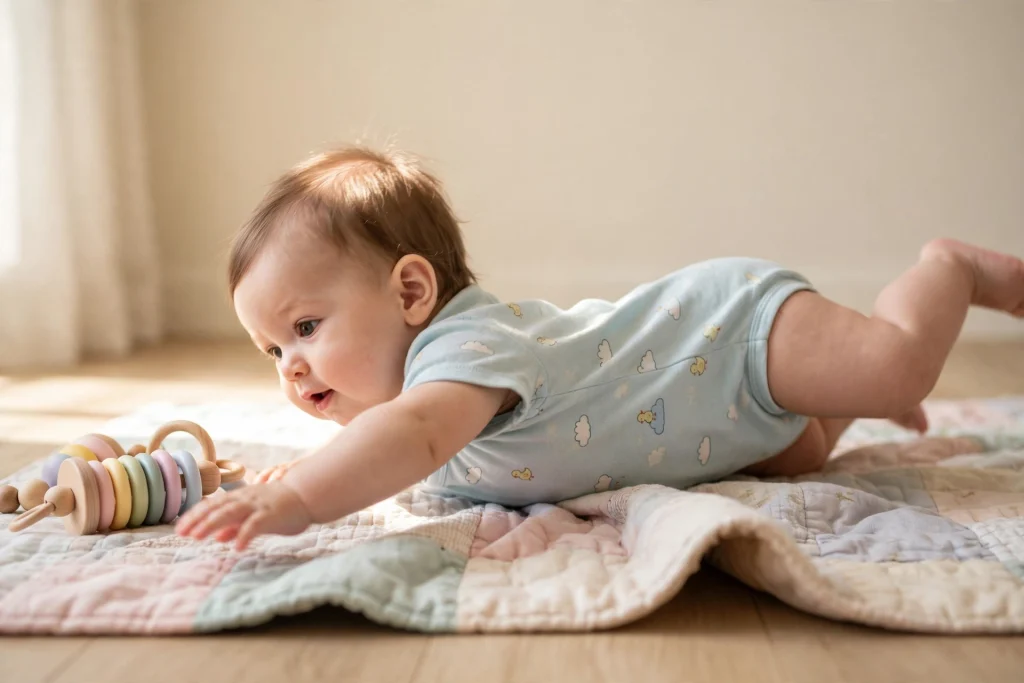
Short answer: These 12 activities for 5 month old babies use things you already have — rolling games, reaching practice, peekaboo and foot play — all free, safe and screen-free. Five months is the rolling month.
Quick facts
- Ages: 5 months
- Cost: free — ordinary household things
- Screen-free: yes — every idea on this page
- Skills: rolling, reaching and hand-to-hand play
What to expect at 5 months
Around five months, your baby is getting ready to move. Many babies are rolling one way by now — often tummy to back first — and rocking, twisting and pushing up on straight arms during tummy time as they work towards rolling the other way. Head control is strong, hands are determined: your baby reaches on purpose, grabs with both hands, passes toys from hand to hand, and brings everything to the mouth to investigate. Feet are fascinating now too — grabbed, waved and studied. Laughs, squeals and early babble sounds fill the house. Sitting still needs plenty of support at five months, so floor play — on the back and on the tummy — is where this month’s action is.
The information on this page is general information for parents, shared for learning and activity ideas. It is not medical advice, and it does not replace the guidance of a qualified professional. Every child develops at their own pace — if you have any concern about your child’s development, please talk to a qualified doctor or child-development professional.
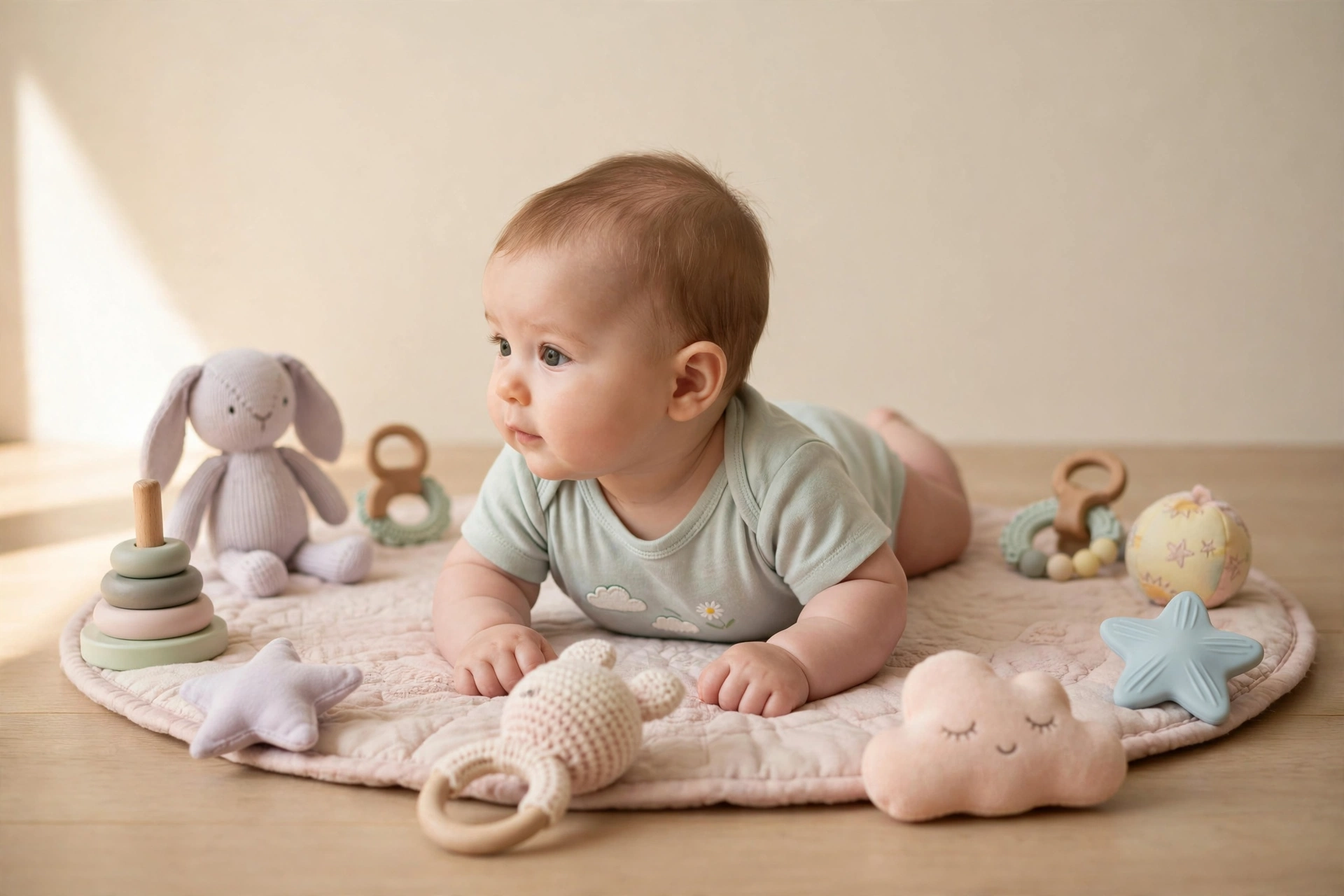
Rolling and reaching
Five month olds play on the floor in two modes — tummy and back — and both build the strength rolling needs. Spread a soft mat, get down there, and let the twisting, reaching and pivoting begin.
1. Rolling practice, both ways
Lay your baby on their back on a soft mat and hold a favourite toy just beside one shoulder, low, where they can only see it by turning. Most babies twist, reach across their body and — with the toy as the prize — tip themselves over. Then reverse it: on the tummy, place the toy beside the opposite hip to encourage the roll back. A few tries each way is plenty; rolling is hard work.
2. Tummy-time toy circle
Arrange five or six favourite toys in a wide circle around your baby while they are on their tummy, each just within sight and almost within reach. Your baby will push up, turn their head and shoulders, and begin to pivot towards the next treasure — the slow spinning that comes just before crawling. Move one toy slightly further each round, and spin the game the other way too.
3. Reaching gym on the back
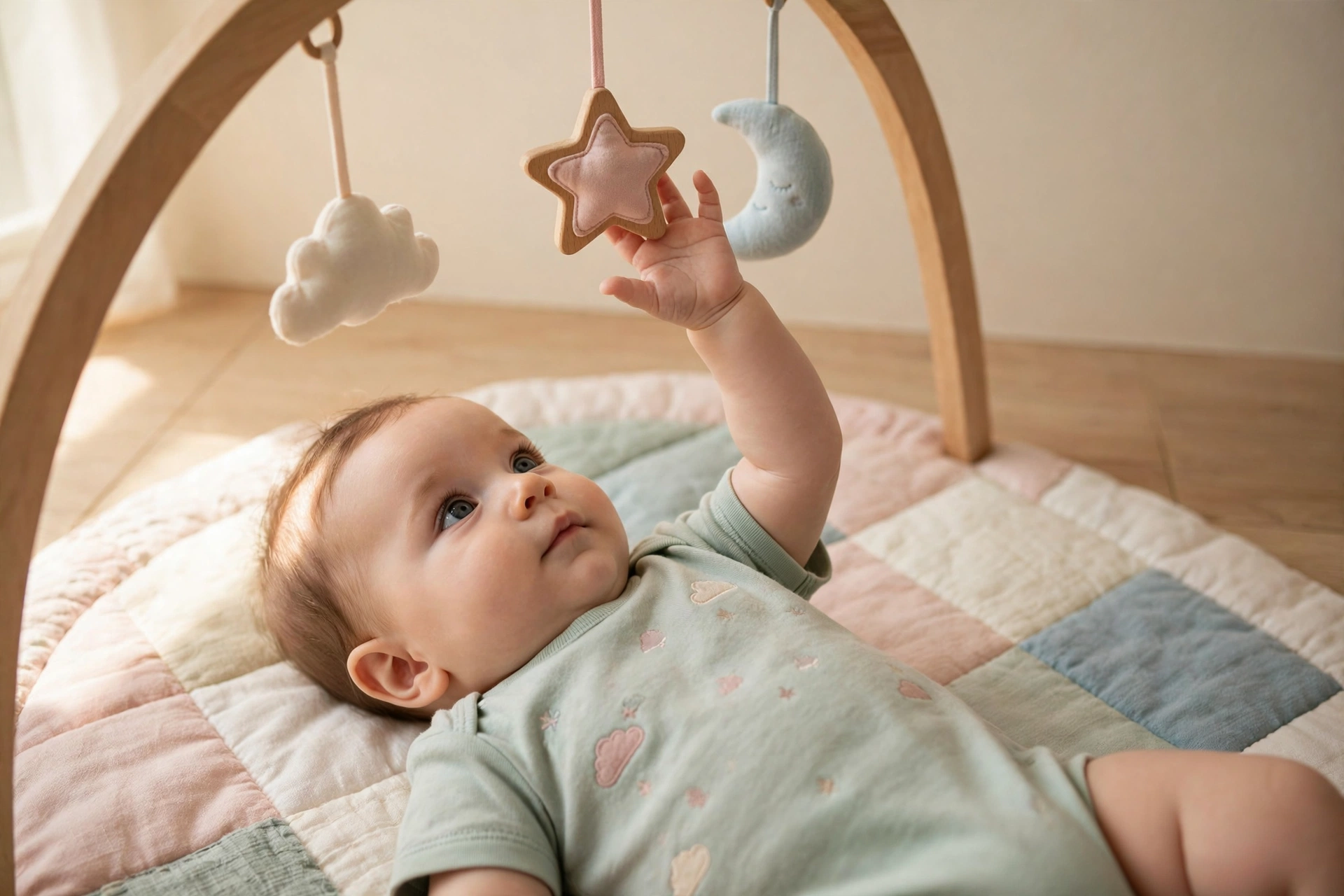
Hang two or three soft toys above your baby while they lie on their back — from a play gym, or from a scarf tied securely between two chair legs well out of pulling-down reach. Start with the toys low enough to bat, then raise them slightly so your baby reaches with straight, determined arms. Batting becomes grabbing, grabbing becomes shaking, and all of it is shoulder and arm strength in disguise.
4. Texture play on the tummy
During tummy time, swap the mat under your baby’s hands for different fabrics: a smooth cotton sheet, a crinkly cloth, a soft towel, a piece of corduroy. Babies explore texture with palms and fingers — watch them scratch, pat and rub each new surface. Keep every fabric flat and firmly held by the mat so nothing can bunch up over the face.
5. Mirror tummy time
Prop a baby-safe mirror on the floor in front of your baby during tummy time, low enough to catch their face when they push up. Few things buy you longer, happier tummy time than that fascinating baby in the glass — your baby will push higher, hold longer and grin at their reflection. Use a shatterproof baby mirror or a polished metal sheet, never household glass, and check it sits steady before you start.
6. Roll-and-track ball
Sit on the floor facing your baby and roll a big, soft, brightly coloured ball slowly across their view, a short distance away. At five months your baby will follow it with eyes and whole head, twist towards it, and reach as it passes — the tracking and turning that feed rolling and, later, crawling. Roll it back the other way, sometimes stopping it just within reach as the reward.
Hands, feet and peekaboo
Hands are cleverer, feet are suddenly hilarious, and peekaboo is the best joke in the world. This set is about grabbing, passing, kicking and disappearing.
7. Hand-to-hand passing games
Offer your baby a light, easy-grip toy in one hand, and once it is held, offer a second toy to the same full hand. Watch the problem-solving: the first toy gets studied, shifted, and often passed across to the free hand so the new one can be taken. That clumsy transfer is a real skill arriving. Use big, light, mouth-safe toys, and let your baby lead the swapping.
8. Feet-discovery play
Put a pair of brightly patterned socks — or soft, securely attached bells — on your baby’s feet while they lie on their back, then watch the discovery: legs lift, feet wave, and soon hands find feet and hold on. This is body awareness arriving with a giggle. Keep it for floor play only, check the socks or bells stay firmly on, and take them off as soon as the game ends — never leave them on for sleep.
9. Peekaboo, baby in charge
Drape a light cloth over your own face and let your baby pull it away — then, once that game is loved, cover a favourite toy instead and let your baby whip the cloth off to find it. Five month olds are moving from watching peekaboo to doing the reveal themselves, and the pull is lovely reaching and grasping practice. Light, breathable fabric only, and the cloth goes away with you when the game ends.
10. Water kick splash
Pour a shallow layer of warm water into a baking tray and set it at your baby’s feet while they lie on their back on a towel beside it — or hold your baby securely at the tray’s edge — so those feet can kick and splash. Kicking against water is joyful leg exercise, and the splashes are pure cause and effect. You stay within arm’s reach the whole time: water play at this age happens with you, every second.
11. Songs with a gentle knee bounce
Sit your baby on your knees facing you, held firmly under the arms with their back well supported, and sing a favourite rhyme with a soft, gentle bounce on the last line. Five month olds quickly learn to expect the bounce — watch for the grin and the excited kicks before it lands. That anticipation, plus your voice and eye contact, is language learning in its happiest form. Keep every bounce small and slow; your baby’s head and neck still need your support.
12. Board-book looking
Prop a chunky board book with big, bold pictures in front of your baby during tummy time, or hold it while they lie on their back. Name what they stare at — “dog!”, “ball!” — and let them pat the pages, grab the book and chew a corner; all of it counts as reading at five months. Two happy minutes is a full chapter at this age. Choose sturdy books made for babies, and retire any that are peeling or torn.
Staying safe at 5 months
- Babies explore with their mouths — offer only big, clean, washable things that cannot break or come apart.
- Nothing small: if it could fit inside a cardboard toilet-roll tube, it is too small for a baby.
- Water is only ever for splashing while you are holding your baby or within arm’s reach — never leave a baby alone with water, not even for a second.
- Do a quick floor check before floor play: coins, buttons, batteries, older children’s small toys and pet food all move out of reach first.
- Rolling changes the rules: never leave your baby on a raised surface — a bed, sofa or changing table — even for a second. A baby who has never rolled can choose today to start.
Read next
- Baby Activities — Simple Play Ideas for 0–12 Months — the whole first year, month by month
- Activities for 6 Month Old — Sitting, Splashing and Exploring — the next stage, when sitting opens up a whole new world of play
- When Do Babies Say Their First Word? — a gentle guide to babbling, first words, and how everyday talk helps them along
Activities for 5 month olds — questions parents ask
How long will a 5 month old play at one activity?
Usually just a few minutes at a time — and that is plenty. Babies this age play in short bursts between feeds, naps and nappy changes, and several little play moments across the day add up to a lot. When your baby looks away, arches or starts to fuss, that activity is finished for now; bring it back later and it will feel brand new.
My baby is not rolling yet. Are these activities still OK?
Yes. Babies roll in their own time — some go early, some spend longer rocking, twisting and pivoting first, and all of that groundwork counts. The tummy and floor activities on this page build exactly the strength rolling is made of. Keep it playful rather than training, and if your baby’s movement ever worries you, mention it to your doctor or health visitor.
Do I need special toys for any of this?
No — look at the lists again: scarves, socks, a mirror, a ball, fabrics, a tray of water. The one thing worth choosing carefully is books: sturdy board books made for babies stand up to the chewing and page-grabbing that are part of reading at this age. Everything else is already in your kitchen and laundry cupboards.