
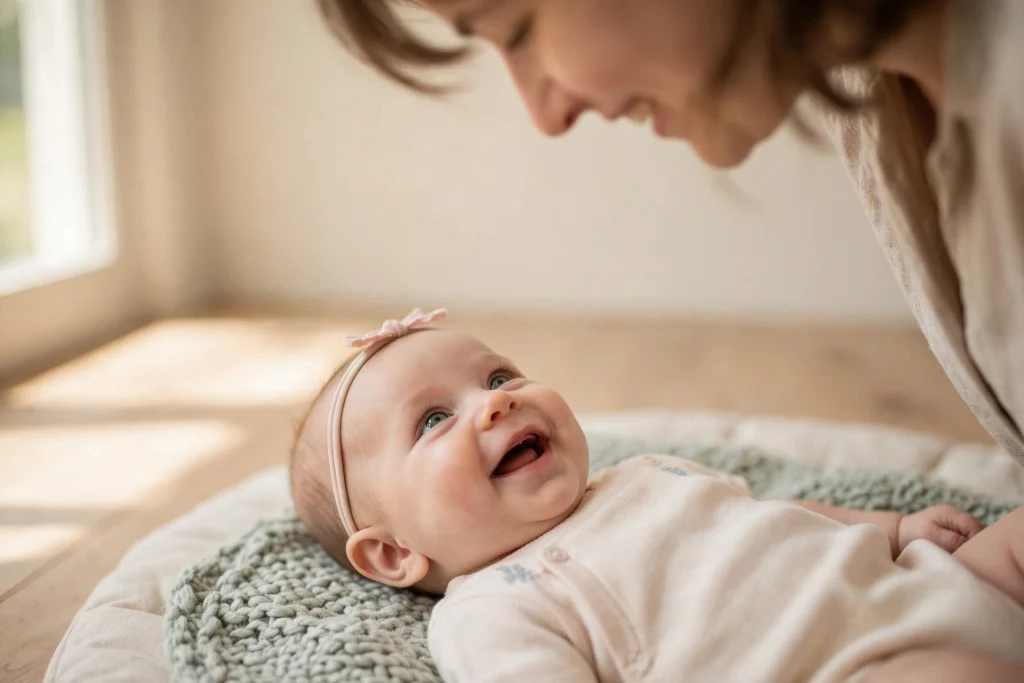
Short answer: These 10 gentle 2 month old baby activities build on the new smiles and coos — chats, tracking games, kicking play and short tummy time — all free, safe and screen-free. Two months is the smiling month.
Quick facts
- Ages: 2 months
- Cost: free — ordinary household things
- Screen-free: yes — every idea on this page
- Skills: smiling, cooing, tracking and kicking
What to expect at 2 months
Two months old — about eight or nine weeks — is when your baby starts answering you. The first real social smiles arrive this month: not wind, not a reflex, but a wide, deliberate grin aimed at your face, often with a happy kick of both legs. Cooing begins too — soft vowel sounds, “ooh” and “aah”, usually saved for the people your baby loves best. Awake windows are a little longer now, and your baby can follow a slow-moving face or picture with their eyes, turning their head to keep it in view. Hands are still mostly fisted but beginning to open, legs kick with real enthusiasm, and in tummy time many babies can lift their head briefly. Your baby still tires quickly — little and often is this month’s motto.
The information on this page is general information for parents, shared for learning and activity ideas. It is not medical advice, and it does not replace the guidance of a qualified professional. Every child develops at their own pace — if you have any concern about your child’s development, please talk to a qualified doctor or child-development professional.
Smiles, coos and looking
Month two is the conversation month: your baby has discovered that faces answer back. Everything in this first set is slow, close and face to face — exactly how a 2 month old likes it.
1. Smile-and-answer chats
Get face to face, about a forearm’s length away, and put on your most exaggerated expressions — a huge slow smile, raised eyebrows, a wide open mouth — then wait. Many babies this month answer with a real smile of their own, and the waiting is where it happens: your baby needs a few unhurried seconds to organise that grin. Answer every smile with an even bigger one.
2. Cooing conversations
When your baby coos — those soft “ooh” and “aah” sounds — copy the sound straight back, then pause and give your baby the floor. Back and forth, sound and answer: this is a genuine conversation years before words, teaching turn-taking, listening and the tune of speech. Face to face on the mat, in your arms or at the changing table all work.
3. Slow tracking games
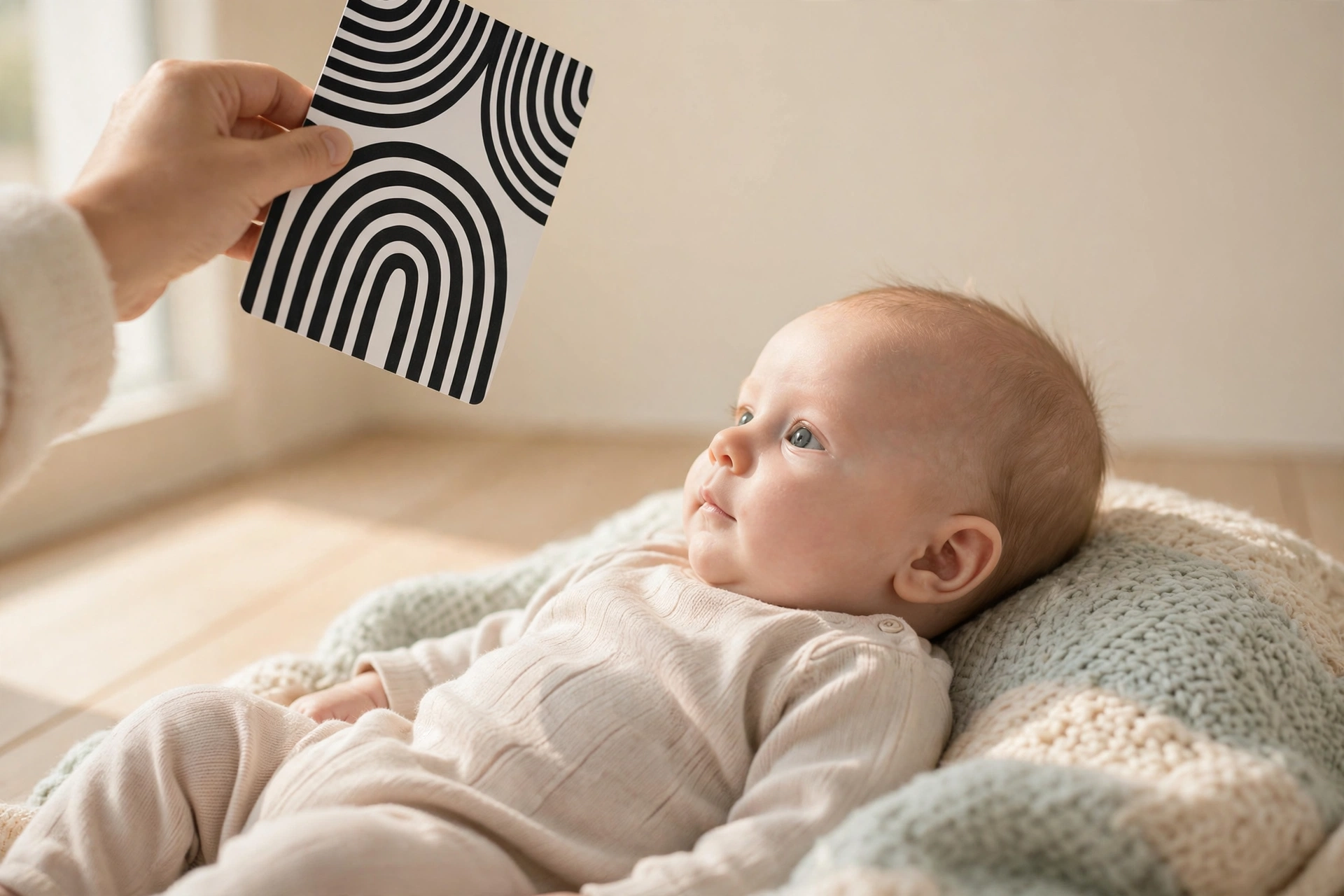
Hold your face, or a bold black-and-white card, about a forearm’s length in front of your baby and move it very slowly — first side to side, later in a gentle up-and-down. At two months your baby can follow a slow target with eyes and often their whole head, and will work hard to keep a favourite face in view. Stop while your baby is still keen.
4. Hand discovery time
Take the mittens off for playtime and let your baby find their own hands. Two month olds spend long, serious minutes watching a fist drift into view, open slightly and drift away — this is your baby mapping their own body. Lay them on the mat with bare hands free; the studying is the activity.
5. Songs with gentle hand actions
Sing a slow favourite while you gently move your baby’s hands for them — opening and closing them softly, or bringing them together in the slowest imaginable clap on the beat. Keep every movement small and smooth, and stop the moment your baby stiffens or looks away. Your voice, your face and the rhythm together are a full-body listening lesson.
Kicking, swiping and tummy time
Limbs are waking up this month: legs kick on purpose, arms swipe at the world, and tummy time stretches from seconds to minutes. This set gives all of that somewhere enjoyable to happen.
6. Kicking games on the mat
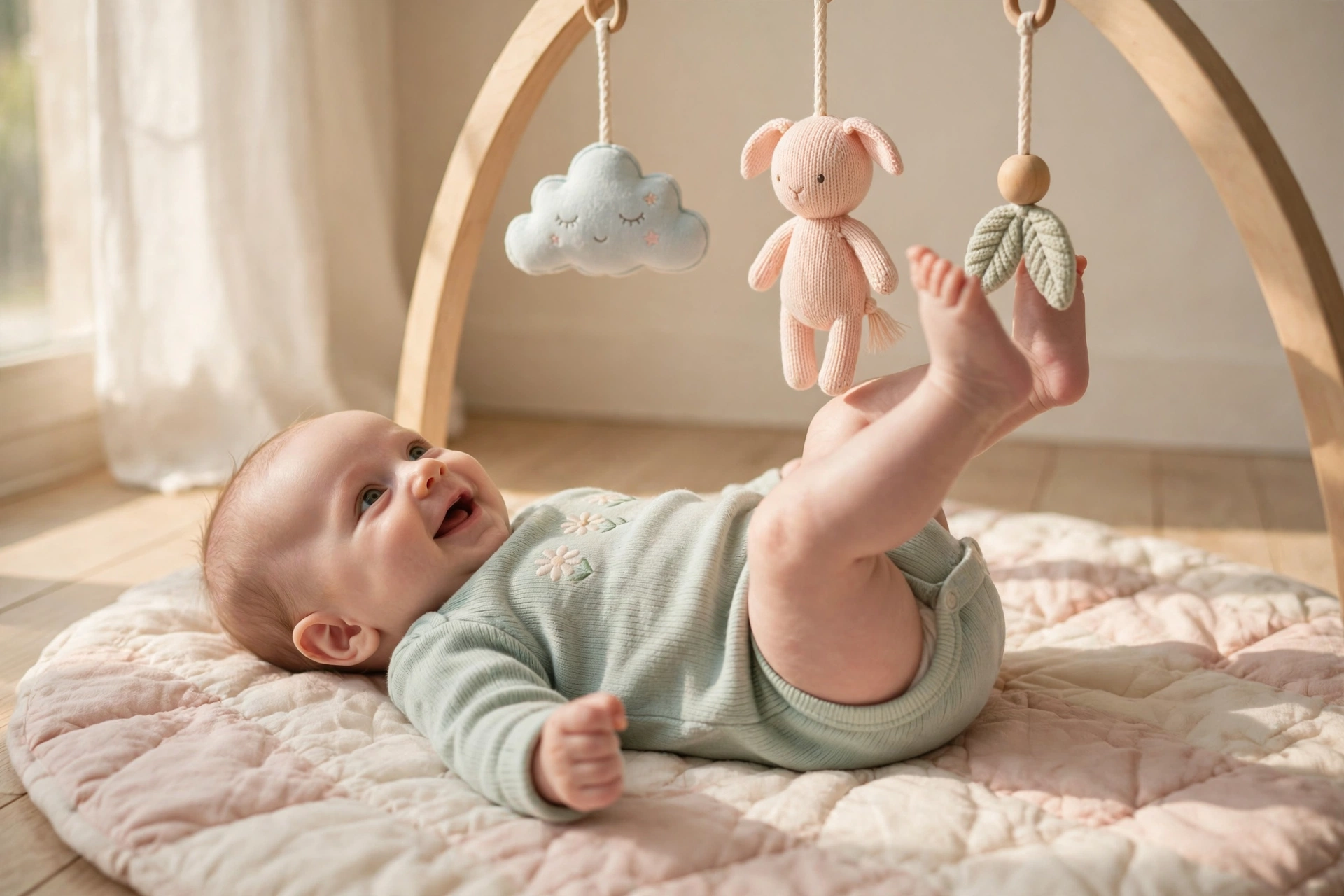
Lay your baby on their back on a firm mat and hang or hold something soft just at kicking height above their feet — a scarf, a soft ball, a crinkly cloth. Two month olds kick with delight when there is a target, and every connection teaches “my legs did that”. Stay right beside the mat the whole time, and expect the kicks to get stronger week by week.
7. First batting practice
Hang a soft toy or a bold contrast card where your baby’s waving arms can just reach it — at swiping distance from a play gym, a frame or your own steady hand. The first hits will be accidents; watch your baby’s face when a swipe connects and the toy wobbles — surprise first, then the swiping looks deliberate. Keep ties short and securely fastened, and take the setup away when play ends.
8. Tummy time, little and often
Several short sessions beat one long battle: a minute or two on a firm, flat mat, a few times a day, in a calm awake moment. Get down in front of your baby with your face at their eye level — or prop a baby-safe mirror there — and chat while your baby works at lifting their head to see you. A small rolled towel under the chest helps if the floor is hard going. Stop before grumbling turns to crying, and always on the floor, never a raised surface.
9. A listening tour of the house
Carry your baby slowly around your home, head and neck fully supported, and narrate the soundscape: the ticking clock, the kettle clicking off, birds at the window, the washing machine’s hum. Pause near each sound and let your baby listen — you will see them still, stare and turn towards a new noise. To your baby this is a story read in their favourite voice.
10. “Air swimming” during songs
Lay your baby on their back on the mat during a favourite song and gently move their arms and legs in slow, smooth swimming motions — little kicks, soft arm sweeps — in time with the music. Follow your baby’s lead completely: never force a limb straight, and stop if your baby resists or cries. Done gently, it is part song, part cuddle, part movement.
Staying safe at 2 months
- Support your baby’s head and neck at all times — a 2 month old still cannot hold their head steady, so a hand stays under it whenever you lift, carry or move them.
- Play only in awake, calm moments. Sleepy, hungry or crying hard means the activity is over — feeding and cuddling come first, always.
- Tummy time is awake-time play only, on a firm, flat surface, with you right there. For sleep, your baby goes down on their back, every time.
- Keep the sleep space completely empty: no pillows, toys, loose blankets or cot bumpers.
- Hang dangling toys securely, with ties short and firmly fastened — and take them away when play ends.
- Play happens on the floor or a firm mat, never on a bed, sofa or changing table left for “just a second” — babies this age can already wriggle further than you expect.
Read next
- Baby Activities — Simple Play Ideas for 0–12 Months — the whole first year, month by month
- Activities for 1 Month Old — Faces, Voices and Gentle First Play — the stage just before this one, for brand-new babies
- Activities for 3 Month Old — Batting, Grasping and Longer Tummy Time — what comes next, as swiping turns into real batting and grasping
Activities for 2 month olds — questions parents ask
How long will a 2 month old play at one activity?
Usually just a few minutes at a time — and that is plenty. Two month olds play in short, calm bursts between feeds, naps and nappy changes, and several little play moments across the day add up to a lot. Watch your baby rather than the clock: when the smiles fade and your baby looks away or yawns, that activity is finished for now.
My baby is 2 months and not smiling yet. Should I worry?
Smiles arrive across a range of weeks, not on a single day — many babies save their first definite social smile for the end of this month or the start of the next, and some smile first at one favourite person only. Keep offering the chats and the waiting; the smiles are very likely on their way. If your baby is not smiling at all by the end of the third month, or anything worries you, mention it to your doctor or health visitor.
Do I need special toys for any of this?
No — look at the lists again: your face, your voice, a scarf, a soft ball, a bold black-and-white card. If you make one thing, make it high-contrast pictures: bold stripes and simple black-and-white faces are what 2 month old eyes track best. Everything else on this page is already in your home — and most of it is you.