
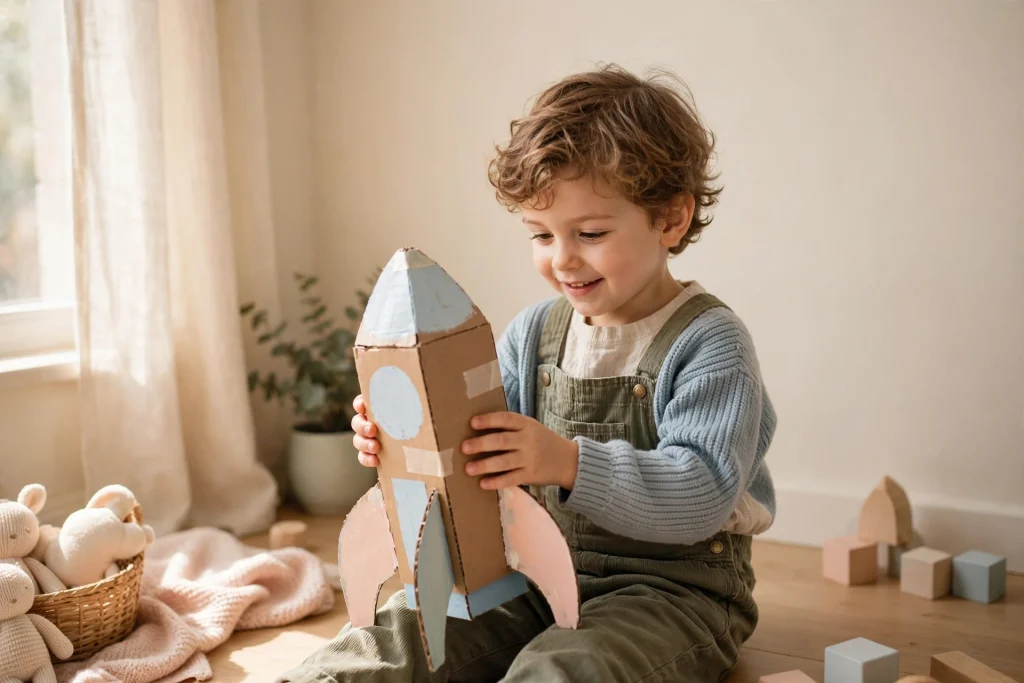
Short answer: Space theme preschool activities turn your home into a launch pad: countdown jumps, moon walks, splatter-paint stars and planet counting fill five days of wonder for ages 3–5.
Quick facts
- Ages: 3–5 years
- Cost: free — ordinary household things
- Screen-free: mostly — every activity works without a screen
- Theme: space theme
Move and play
Space is the moving theme: launching, floating, orbiting and moon-bouncing. This first set is the energy-burning part of the week — a whole astronaut training programme disguised as a game.
1. Rocket launch countdown jumps
Crouch down small together, hands on the floor, and count down out loud — “10, 9, 8…” — getting quieter and lower, until “…3, 2, 1, BLAST OFF!” and everyone jumps as high as they can, arms stretched into a rocket tip. Land soft, knees bent like a spring, then waddle back to the launch pad and go again. The countdown is early number order backwards — real maths — and the crouch-and-spring is leg strength and landing control. Clear the launch pad of toys first, and jump on a mat or carpet if the floor is hard.
2. Moon walking in slow motion
On the moon, everything happens slowly and bouncily. Practise together: huge slow steps, arms floating up and drifting down, each step a long, soft bounce — “the moon holds you up, so you float between steps.” Cross the room to plant a flag (a scarf on a stick) at the far “crater”, speaking in slow, echoing astronaut voices. Moving slowly is harder than moving fast — it is balance and body control — and holding the slowness against the giggles is the real workout.
3. Astronaut training course
Every astronaut trains before a flight. Build your course: crawl through a tunnel “airlock” (a blanket over two chairs, or a play tunnel), balance along a taped “space walk” line on the floor with arms out like solar panels, step in and out of hoop “craters”, and finish by “floating” a balloon across the room without letting it touch the ground. Run it forwards, then backwards, then let your trainee redesign one station. Sequencing the stations is memory work, and crawling, balancing and stepping in one loop is whole-body coordination.
4. Shooting-star scarves chase
Give everyone a scarf or a ribbon — that is the comet’s tail. One person is the comet: they run (or swoop, or moon-bounce) around the room trailing the scarf, and the star-catchers chase and try to gently catch the tail — a touch on the scarf, never a grab at clothes or arms. Then swap: a new comet, a new chase. Chasing and dodging builds speed control and stopping safely, and a scarf is the perfect target for small hands because it is slow, soft and easy to grab.
5. Zero-gravity freeze float dance
Play music and everyone floats: slow drifting turns, arms waving like seaweed in space, feet barely shuffling — astronauts in zero gravity. When the music stops, freeze mid-float, one foot off the ground if you dare. Anyone caught drifting becomes the next music-master. Listening for the stop and holding a wobbly one-foot pose is balance and self-control together — and floating slowly to music is the loveliest cool-down after the launches and chases.
Make and create
Five makes that fill the walls with the night sky — and every one of them is fingers-and-scissors practice wearing a space suit.
6. Foil-and-cardboard rocket build
A big cardboard box, or a tall piece of card rolled and taped into a tube, is the rocket body. Cut a triangle nose cone and two fins from card, then cover the body in kitchen foil — scrunch it a little first so it catches the light like real metal. Add a round window, a door, and your astronaut’s name in big letters. An adult does all the foil and card cutting — foil edges can be sharp — while your child does the sticking, smoothing and decorating. Building something taller than yourself, that you can then sit inside and fly, is construction play and pride in one.
7. Splatter-paint starry night sky
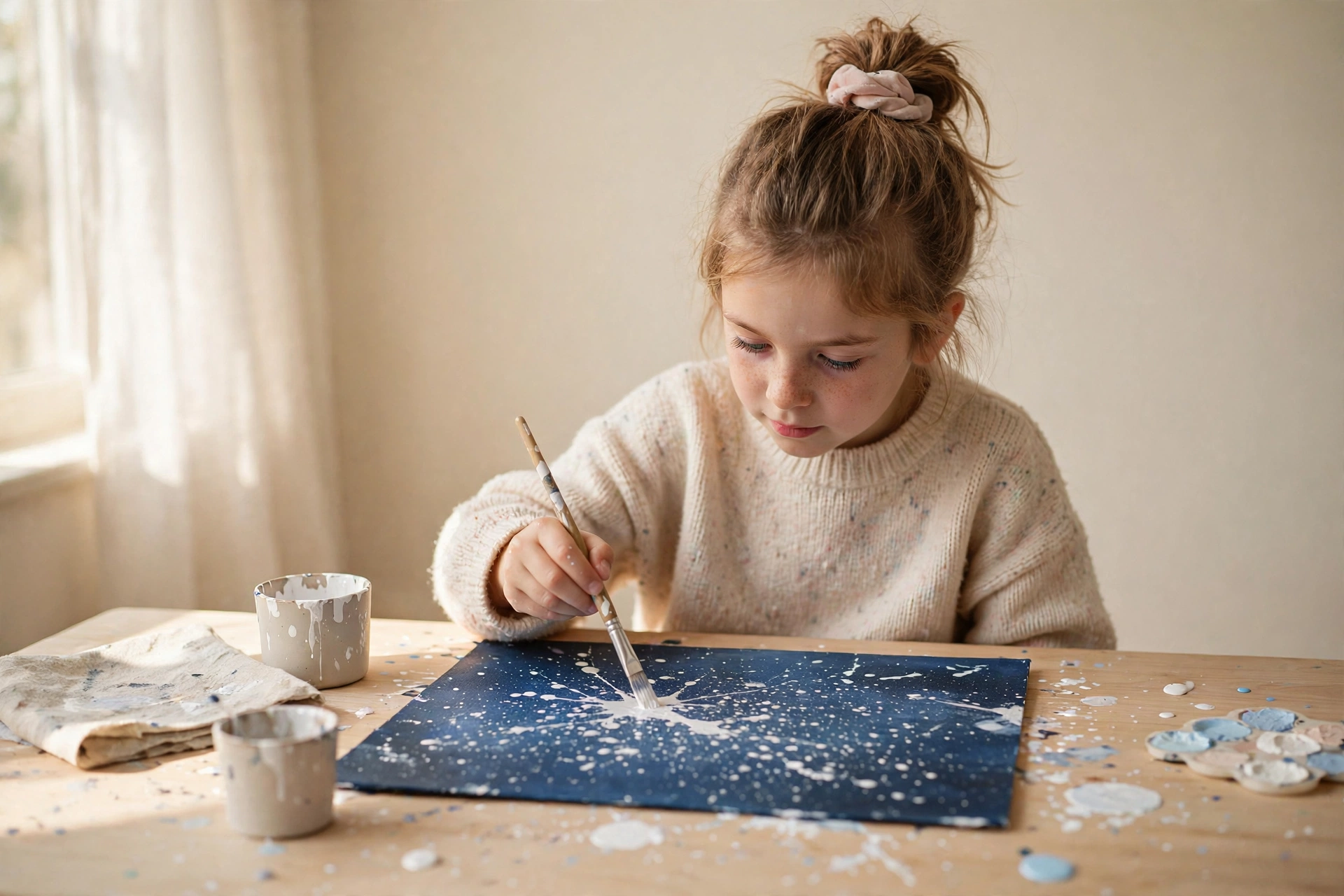
Lay dark blue or black paper in a tray or an old box (this one sprays), dip an old toothbrush in white paint, and flick — run a thumb or a craft stick across the bristles so the paint spatters into a sky full of stars. Add a big yellow moon circle and a few fat painted stars on top. Spatter control is aim and hand strength, and deciding where the moon goes is planning a picture. Aprons on, sleeves up, and the tray keeps the galaxy off your walls; wash hands and brushes straight after — paint is for paper, not for tasting.
8. Moon dough craters and moon rocks
An adult mixes a simple cloud dough — roughly eight cups of plain flour to one cup of cooking oil, stirred until it holds a squeeze like damp sand — into a wide, shallow tray. Now make the moon’s surface: press bowls and cups upside down into the dough to stamp craters, roll balls of dough into bumpy “moon rocks” (big ones only — fist-sized), and hide a few rocks under the surface for astronaut excavations. Dough play is hand strength and calm focus, and crater-stamping is cause and effect you can see. It is dough, not food: it is not for tasting, this one is not for children who still put everything in their mouths, and hands get washed when the mission ends.
9. Paper plate planets mobile
Paint a paper plate per planet — rusty red for Mars, ringed gold for Saturn (a second, bigger plate ring glued around it), swirly blue for home. Punch a hole in each, thread wool or string through, and hang them at different heights from a coat hanger or a stick: a solar system turning slowly over the reading corner. Ordering them as you hang — “which planet shall live nearest our paper sun?” — sneaks the planet order in through play. Hang the finished mobile well out of reach of any younger siblings: the strings are for the planets, never for necks.
10. Cardboard tube telescope
Decorate the outside of a kitchen-roll tube with foil stars and stickers, tape a ring of card around one end as the eyepiece, and your telescope is ready for moon-watching: lie on a blanket, find the moon, and describe it — “I can see a crater like a bowl!” A tube gives one eye a tunnel to look through, which is early focusing practice, and describing what you “see” is language growing. One rule is carved in stone from the very first mission: a telescope is never, ever pointed at the sun — pretend telescopes are for the moon, the stars and the neighbours’ roof only.
Learn and discover
The thinking set: counting, ordering, sorting and wondering — the parts of space that turn into maths and science without anyone noticing a “lesson”. Keep the facts light at this age: the wonder is the curriculum.
11. Count the stars
Stick star stickers (or draw stars) onto dark cards — one star on the first card, two on the next, up to ten — then shuffle them and play: your child counts the stars on a card, finds the matching number card or numeral written big on paper, and pairs them up. Finish with a sky hunt: “show me the card with seven stars.” Counting things you can touch and point at is one-to-one correspondence, and matching a counted pile to its numeral is the exact bridge from counting to reading numbers.
12. Day and night sorting game
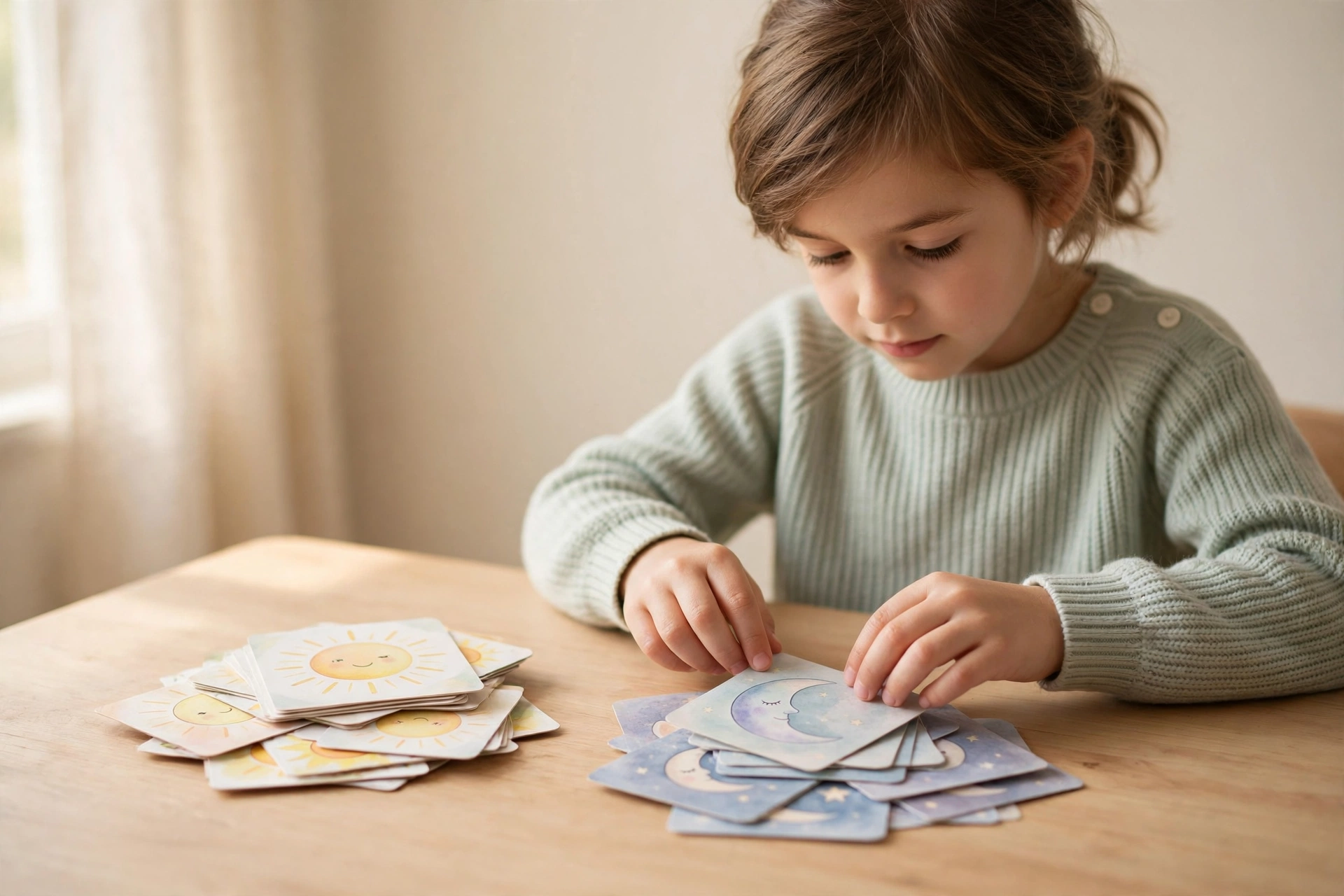
Draw or cut out simple picture cards together: sun, breakfast bowl, pyjamas, moon, toothbrush, playground, stars, bed, torch, sandals. Two big header cards — a smiling sun and a sleepy moon — make the piles. Your child sorts each picture into daytime or night-time, and you argue the interesting ones together (the toothbrush works twice a day; the torch is for the night, except in a daytime den). Sorting by a rule, and defending the rule, is classifying — the same thinking maths and science run on — and the day-night rhythm of your child’s own life is the science.
13. Planet name chant with ball planets
Line up soft balls, cushions or your paper plate planets as the planets, and learn the order the way children learn everything: as a chant with bouncing. “Mercury, Venus, Earth and Mars — Jupiter, Saturn, past the stars — Uranus, Neptune, far away — that’s the order, hip hooray!” Pass or roll each “planet” to your child as its name is chanted, then muddle the line-up and let them rebuild it from the chant. A song is memory’s oldest trick, and hearing the names in order, many times, is how the order quietly moves in.
14. Rocket number line — countdown towers
Build towers with blocks to match the countdown: a tower of 10 next to a tower of 9, then 8, all the way down to 1 — a staircase of rockets standing on the launch pad. Count each tower’s blocks as you build it, then run the launch: point at each tower down the line — “10, 9, 8…” — and blast off the toy rocket (or the astronaut teddy) from the top of tower 1. Building to an exact number is counting with a purpose, and a staircase you can see makes “one less” visible: each tower really is one block shorter than its neighbour.
15. Shadow play — what blocks the light?
The week’s little science mystery. In a dimmed room, shine a torch — always a torch, never a laser pointer — at a pale wall, and hold objects between the torch and the wall: a hand, a toy rocket, a book, a colander. Each one throws a shadow. Ask the scientist’s question — “what is the shadow doing there? What is blocking the light?” — then test predictions: does the colander make holes of light? Does the shadow grow if the rocket flies nearer the torch? Making a prediction, testing it and being surprised by the answer is the whole of science in miniature — and it explains, in one game, why the moon can block the sun and why night falls at all.

Turn it into a theme week
Spread the fifteen across five days, two or three a day, and the theme does the teaching by repetition:
- Day 1 — Lift off: countdown jumps (1), build the big rocket (6), and count the stars to finish (11).
- Day 2 — On the moon: moon walking (2), the moon dough tray (8), and shadow play as the lights go down (15).
- Day 3 — Training day: the astronaut course (3), splatter-paint the night sky (7), and the day-and-night sort (12).
- Day 4 — Planets day: the planet chant (13), painting the planet mobile (9), and countdown towers (14).
- Day 5 — Space party: comet scarves chase (4), telescope moon-watching (10), the freeze float dance (5), and every astronaut tucked into the big rocket to rest.
Short on time? Three days still works — pick one activity from each section per day. One thread is worth saying out loud before the week starts: at this age space is for wondering at, not for memorising. Your child does not need to know what a light-year is; they need to have gasped at the moon, flown a rocket they built themselves, and asked you one enormous question you could not quite answer. That gasp is the learning, and it lasts longer than any fact.
Finish the week with printables
After five days in space, some preschoolers ask for a rocket page of their own to colour or trace — and that request is the perfect moment for paper. FIMS Schools has free printable preschool and kindergarten worksheets, including first tracing and colouring pages: free preschool and kindergarten worksheets. A rocket or star colouring page or two to close the week is plenty — the play was the learning; the printable is the souvenir.
Read next
- Preschool Theme Activities — every theme week in one place: pick next week’s theme here
- 15 Ocean Theme Activities for Preschoolers — a sibling theme: crab walks, an ocean in a bottle and float-or-sink science
- 30 Activities for 5 Year Olds — everyday play for the oldest preschoolers, future astronauts included
Space theme questions parents ask
Is space too advanced for preschoolers?
No — as long as the wonder comes first and the facts stay light. A 4-year-old cannot grasp orbits, and does not need to: they can gasp at the moon, fly a rocket, sort day from night and chant the planet names, and every one of those is real learning at their level. Difficult ideas can wait for school; awe cannot be scheduled for later half as easily. Follow your child’s questions, answer them simply and honestly, and “I don’t know — let’s wonder together” is a perfectly good space fact.
How do I answer “why is the moon out in the day?”
With the simple, honest answer: the moon is up in the sky for part of most days — we just usually cannot see it because the sun is so bright. On some days the moon is pale and early, and we spot it. You can show it with activity 15’s torch: the torch is the sun, a ball is the moon — the moon is always travelling around; sometimes it stands in the daytime sky. Preschoolers accept this happily, because it matches what they saw: the moon, out before bedtime, being a little bit cheeky.
Can a space theme work indoors only?
Yes — almost all of it was written for indoors: the launches, moon walks, course, makes, sorting and shadow play all happen in one room, and the telescope works from a window or a blanket “observatory” on the floor. The only outdoor treats are bonuses, not requirements: spotting the real moon on a clear evening, and watching the planet mobile turn in a breeze. A small home is no barrier to a big universe — the cardboard rocket has landed in many a living room.