
Short answer: These spring theme preschool activities are the easiest of the year: plant a bean, paint the blossom, order the life cycle and jump the puddles — fifteen fresh ideas here fill a happy theme week for ages 3–5, indoors or out.
Quick facts
- Ages: 3–5 years
- Cost: free — ordinary household things, a packet of bean seeds is the only shopping
- Screen-free: mostly — every activity on this page
- Theme: spring theme — new growth, baby animals, rain and blossom
Move and play
Spring is a season that cannot sit still — seeds burst, lambs bounce, rain arrives and the sun chases it away. This first set borrows all of that energy, and it is the part of the week that wears everyone out happily.
1. Grow-like-a-seed movement story
Tell the story and your child acts it: “A tiny seed sleeps in the dark soil” (crouch small, arms wrapped tight, eyes closed). “The rain pats down” (fingers drumming lightly on shoulders). “The sun warms the soil” (a slow rub of the arms). “A root creeps down” (wiggle toes), “a shoot pushes up” (rise slowly, arms uncurling), “leaves open” (fingers spread), “and the flower turns its face to the sun” (stand tall, face up, gentle sway). Repeat it faster, then slower, then let your child narrate while you grow. Sequencing a story with the whole body is memory and listening work, and the slow rise from crouch to standing is real leg and core strength.
2. Puddle-jump course
After real rain, wellies on and out you go: chalk a route from puddle to puddle, with dry “islands” (a mat, a towel, a paving slab) for rest stops — and the rule is jump IN the puddles, balance ON the islands. No rain? Cut puddles from blue paper or old towels and lay the same course indoors. Two-foot jumps, landing soft with bent knees, build leg strength and balance, and counting the jumps between islands sneaks maths into the splashing. Wet clothes are the price of admission; a towel by the door is the whole management plan.
3. Butterfly flutter dance
Give each dancer two light scarves, ribbons or tissues as wings. Music on: flutter high, flutter low, drift and glide, land gently on a “flower” (a cushion) and sip — a quiet moment built into the dance. Music off: wings fold and the butterfly sleeps. Changing speed and height on the music’s cue is listening and body control, and landing softly on a flower, again and again, is balance practice disguised as grace. Children who have made the egg-carton caterpillar (activity 8) will tell you exactly what the butterfly was before — let them.
4. Baby-animal hop-and-waddle parade
Spring babies take over the parade: lambs bounce (two-foot hops, springy and high), ducklings waddle in a line behind a mother duck (you, first), chicks peck and scratch as they step, foals trot and shake their manes, and bunnies twitch their noses between hops. Your child leads the line and chooses who hatches next. Copying how different young animals move builds body awareness, and a parade that must stay in line, at duckling pace, is self-control practice with feathers on.
5. Rain-and-sun freeze game
One caller (take turns) shouts the spring weather. “Sunshine!” — everyone runs, dances and grows in the warm sun. “Rain!” — freeze and crouch under a pretend umbrella (arms arched overhead, or duck beneath a real one held by an adult), holding still while the “rain” passes. “Rainbow!” — everyone stretches into the biggest arc they can make. Listening for the change and stopping a running body mid-game is inhibition practice — the exact skill that later becomes raising a hand instead of calling out.
Make and create
Five spring makes: flowers that never wilt, a caterpillar with a future, and a real bean plant that grows a little more every single day of the week.
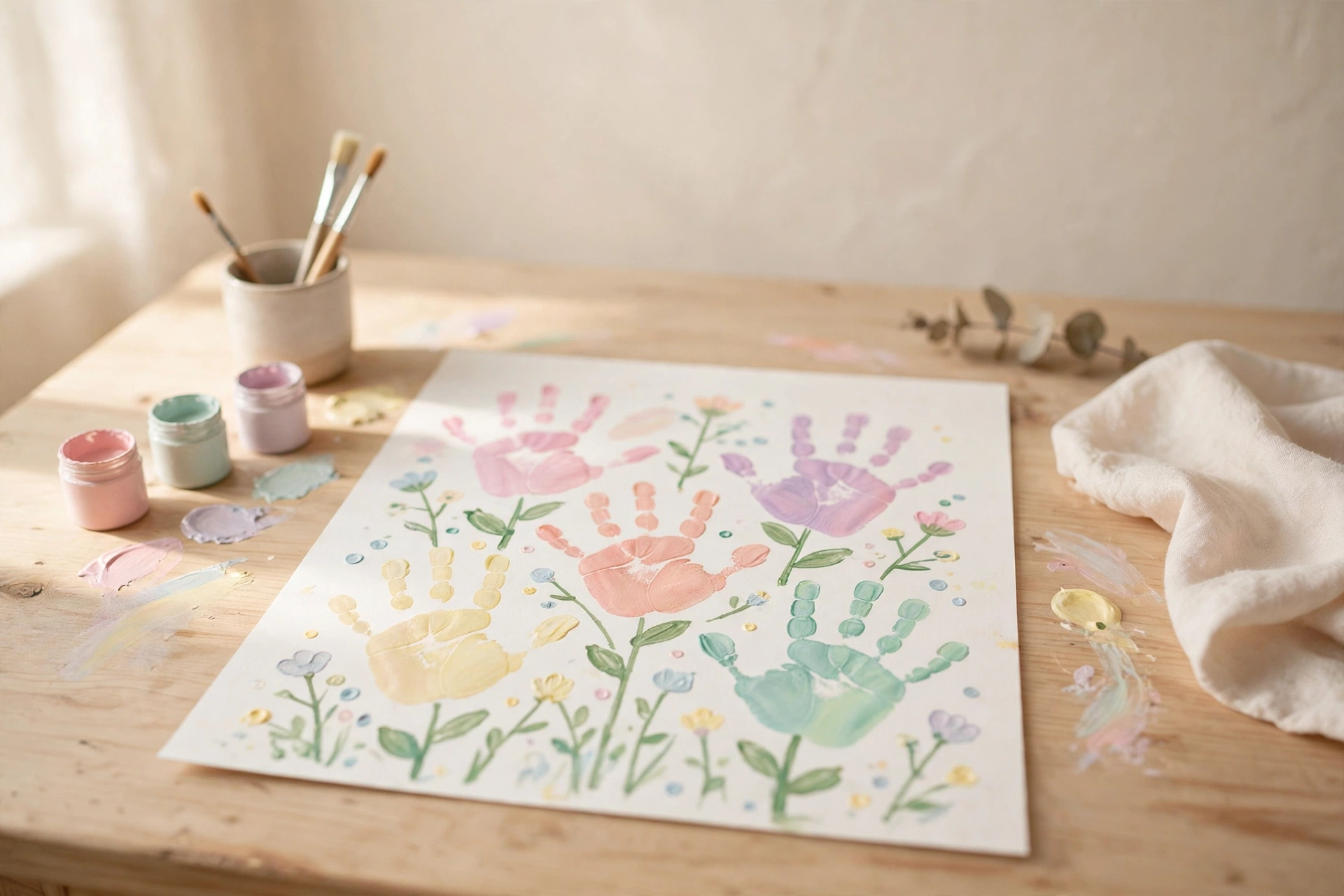
6. Handprint flower garden
Paint your child’s palm and fingers (washable paint) and press handprints high on a big sheet of paper — each one is a flower head. Add painted green stems and leaves below, grass strokes along the bottom, and fingerprint bees and butterflies in the sky if the artist insists. A whole row of prints becomes the garden wall of the week. Choosing where each flower goes, and keeping stems under heads, is planning and spacing sense, and an open-hand press is calmer hand control than a brush for many children. Aprons on and hands washed straight after — paint is for paper, not for tasting, and if pollen or real flowers bother your child, this painted garden is the fully indoor answer.
7. Seed planting in clear cups
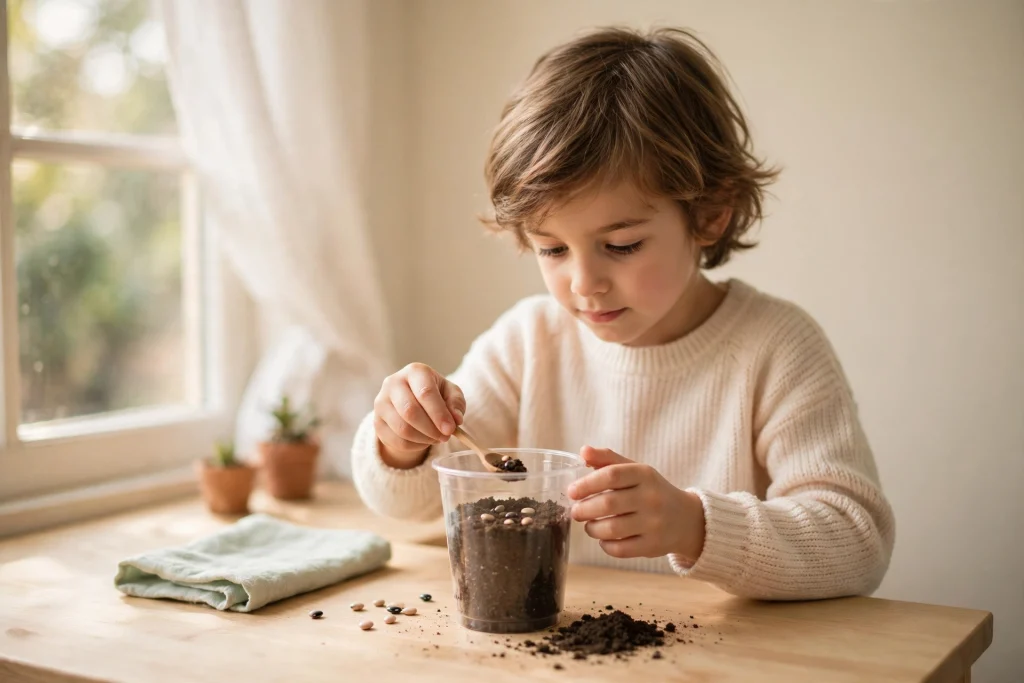
The heart of the week. Line a clear plastic cup with damp paper towel, tuck two or three big bean seeds between the towel and the cup wall where they can be seen, and stand the cup on a windowsill. Keep the towel damp, not flooded. Within days your child can watch the root creep down and the shoot climb up — real roots, visible, growing. Draw the cup each day and compare: measuring with eyes and drawings is first science recording. Two safety rules, said plainly and kept: the beans are planting material, not snacks — seeds are never eaten, and seed planting is table work with an adult, away from younger children who still mouth everything. And hands get washed after touching soil and compost, every time.
8. Egg-carton caterpillars
Cut a strip of bumps from a cardboard egg carton (an adult does the cutting), and your child paints it caterpillar green — or rainbow, at the artist’s discretion. Add pipe-cleaner antennae, drawn or firmly glued eyes, and a name. Park the caterpillar beside the bean cup so the two spring stories grow side by side: later in the week, a paper chrysalis can appear around it, and by Friday a paper butterfly (two handprint wings) takes its place — the life cycle, told by the craft shelf. Segment by segment painting is brush control, and painting in a chosen order is planning.
9. Blossom-tree painting
Draw or paint a simple tree — brown trunk, bare branches — on a big sheet. Then the blossom: dip cotton buds (or the base of a clean plastic bottle, or a scrunched tissue) in pink and white paint and dab clusters all along the branches until the tree blooms. Dabbing, lifting, placing each cluster is wrist control and patience, and standing back to decide where the tree “needs more spring” is a child doing composition. Blossom falls, of course: a few petals dabbed on the ground under the tree make the picture honest. Real blossom walks are lovely, but for a child with hay fever this painted tree carries the whole idea indoors, sneeze-free.
10. Paper kites and ribbon wind dancers
Spring wind, made visible. For wind dancers: tie three or four ribbon or crepe-paper streamers to a stick or a wooden spoon, and take them outside (or to a doorway breeze) — run and they stream behind, stand still and they tell you if the air is moving at all. For a simple paper kite: fold a sheet of paper into a basic diamond, staple or tape on a string tail with paper bow ties, and fly it running on a breezy day — it will not soar like a shop kite, and that is fine; it flutters, dips and rises, and your child made it. Watching what wind does to ribbon and paper is weather science you can hold, and running with a tail streaming is pure spring joy. Keep kite string short and in your child’s hand only, never around a neck.
Learn and discover
The thinking set: the season itself is the teacher here — things grow in an order, petals come in numbers, and the weather keeps changing its mind.
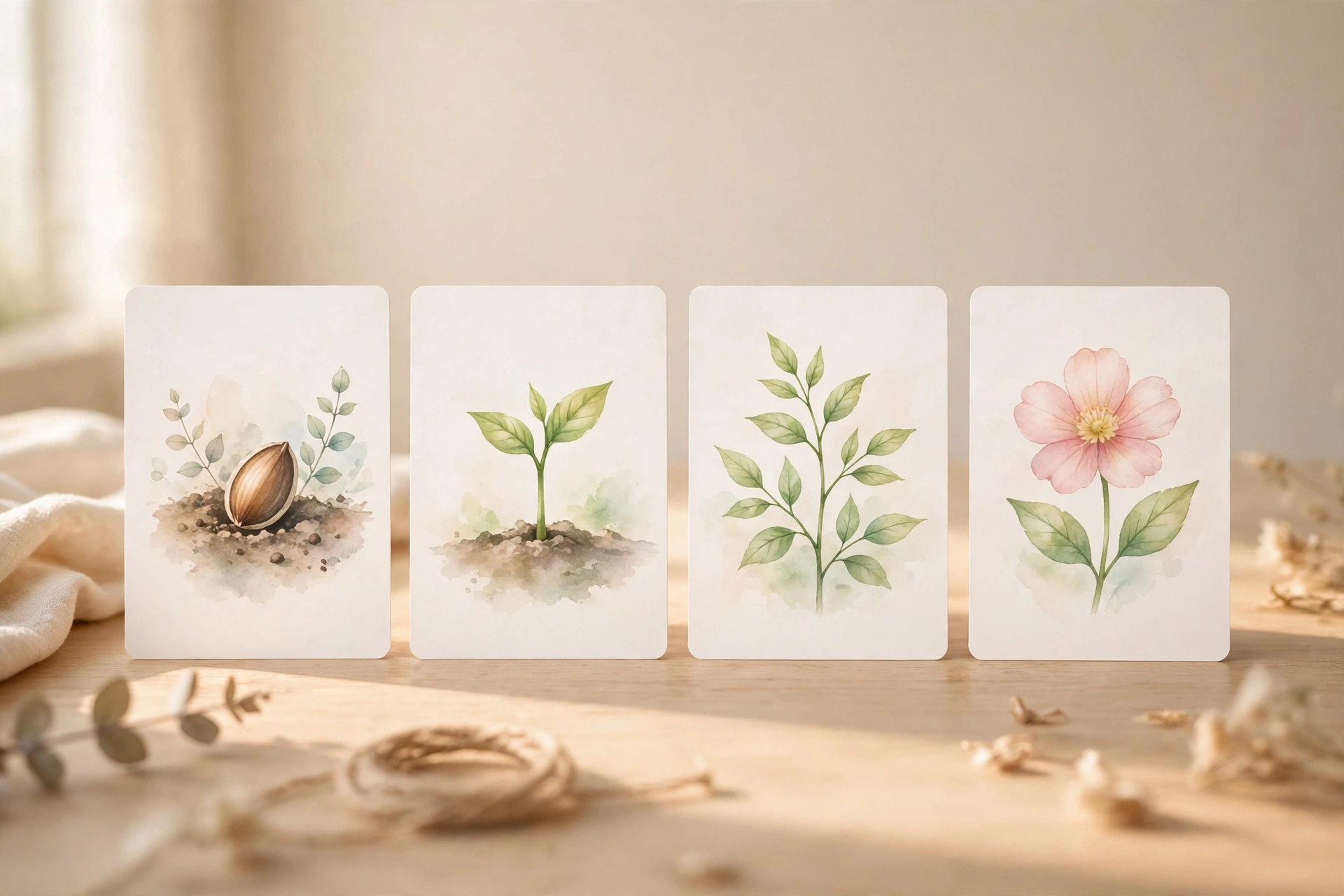
11. Life-cycle ordering cards
Make or draw two sets of cards. The bean set: seed → sprout → plant with leaves → plant with flowers. The butterfly set: egg → caterpillar → chrysalis → butterfly. Shuffle a set, and your child lays the cards in order and tells the story as it grows: “First the seed sleeps…” Then mix both sets together, or hide one card and ask what is missing. Ordering four pictures into a true sequence is early science and story structure in one game — beginnings, middles and ends — and a child who can order the butterfly’s story has understood change itself. Point at the bean cup and the egg-carton shelf as you play: the real exhibits are already in the room.
12. Count the petals and the eggs
Two counting games with spring dressing. Petals: collect fallen petals on a walk (or cut paper ones), line them under a drawn flower and count as you stick — how many petals does our flower get? Five? Six? Make three flowers and compare: most, fewest, same. Eggs: a toy bird’s nest (a bowl with a scarf or shredded paper), and eggs (balls or scrunched paper) to count in and out — the bird lays two, then one more hatches… wait, one more is laid: how many now? Counting real objects, touching each once, is one-to-one correspondence, and petals laid under a flower show a number you can see, which is how number sense actually starts. No real birds’ nests, ever — nests in hedges belong to the birds, watched from a distance.
13. Spring weather chart week
Draw a simple chart: seven boxes for the week, and three sticker or drawing choices — sun, cloud, rain (a rainbow earns a bonus box of its own). Every morning, your child is the weather watcher: look out of the window together, check the sky, look at the garden or the street, and mark the day. By Friday, count the week: how many rainy days? More sun or more cloud? What did spring do this week? Recording the same thing daily, then reading the pattern back, is a child’s first data — and a daily job with a chart on the wall is responsibility with a very low failure rate. Pair it with the rain-and-sun game (activity 5) whenever the day’s mark needs acting out.
14. Sort the garden
Gather a basket of garden and not-garden things — real or pictures, toys welcome: a stone, a leaf, a feather, a stick, a flower, a toy car, a shell, a pinecone, a spoon that wandered in. Two hoops or two boxes: “It grows” and “It doesn’t grow”. Your child sorts, and says the reason for each: the leaf grows on the tree; the stone just sits; the feather grew once, on the bird — a genuinely arguable case, and arguing it kindly is the learning. Sorting by a rule you can say out loud is classifying, the same thinking science runs on, and the feather debate teaches that some answers need “it depends” — an advanced idea in a garden basket.
15. Smell-and-match herb pots
Two or three small pots or cups of taste-safe herbs — mint and basil are the friendly starters — each one paired with a matching covered cup holding a few leaves of the same herb. Your child sniffs a cup, then sniffs the pots to find its match: eyes can help at first, then try it with eyes closed for the real game. Talk about the smells — fresh, sweet, like toothpaste, like pizza. Smell is the most neglected sense in early learning, and matching by nose alone is concentration of a very pure kind. The rules: herbs washed before the game, an adult leads it, tasting only happens if you offer a washed leaf as a taste on purpose — and any herb a child is not meant to eat stays out of the game entirely.

Turn it into a theme week
Spread the fifteen across five days, two or three a day, and plant the beans on Day 1 — they need the whole week to perform:
- Day 1 — Planting day: plant the bean cups (7) first so growth starts today, do the grow-like-a-seed movement story (1), and lay out the life-cycle cards (11) to meet the story the cup will tell.
- Day 2 — Garden colour: handprint flower garden (6), blossom-tree painting (9), and the puddle-jump course (2) — indoors on paper puddles if the day is dry.
- Day 3 — Creepy-crawlies: egg-carton caterpillars (8), count the petals and the eggs (12), and the butterfly flutter dance (3) once the caterpillars are dry.
- Day 4 — Weather watchers: start the spring weather chart (13) — catch up the week’s first boxes together — sort the garden (14), and play the rain-and-sun freeze game (5) on the day’s own weather.
- Day 5 — Spring finale: baby-animal parade (4), paper kites and ribbon wind dancers (10) if the breeze agrees, the smell-and-match herb pots (15), and a ceremony at the bean cup: measure the shoot against Monday’s drawing and marvel properly.
Short on time? Three days still works — pick one activity from each section per day, but keep the bean planting on the first day whatever else moves. Through the week, the chart grows on the wall, the bean grows on the sill, and the caterpillar shelf changes — the theme teaches by things visibly growing, which no other season does for free. Families in a flat: every garden here is a windowsill, a wall chart and a painted tree — the full week runs happily without a single square of soil of your own (see the questions below).
Finish the week with printables
After five days of spring play, some preschoolers ask for a spring page of their own to colour or trace — and that request is the perfect moment for paper. FIMS Schools has free printable preschool and kindergarten worksheets, including first tracing and colouring pages: free preschool and kindergarten worksheets. A flower colouring page or two to close the week is plenty — the play was the learning; the printable is the souvenir.
Read next
- Preschool Theme Activities — every theme week in one place: pick next week’s theme here
- 15 Farm Theme Activities for Preschoolers — the season’s other favourite: a week down on the farm
- 30 Activities for 3 Year Olds — everyday play for the younger end of preschool
Spring theme questions parents ask
We’re in a flat with no garden — can we still do a spring theme?
Yes — completely. The bean grows in a cup on a windowsill, not in a bed; the flower garden and the blossom tree are paint; the weather chart only needs a window and a daily look outside; and one short walk — a street tree in blossom, a park border, fallen petals on a pavement — and your flat has had the whole season. Windowsill cups and walks genuinely count: spring is a thing that happens to light and air as much as to gardens.
How long do bean seeds take to grow?
Honestly: the first change is underground and invisible for a few days — which is exactly why the clear cup matters, because the root is the first show. Kept damp on a bright sill, a bean usually shows its root within about three to five days and a shoot within about a week or so, then grows visibly day by day. Some beans are slow and the odd one never starts, which is why the page plants two or three per cup: plant extras, celebrate whoever grows, and treat a no-show bean as a science result, not a failure — gardeners meet both every year.
What if my child has hay fever or a pollen allergy?
Take the theme indoors and lose almost nothing: the painted handprint garden and blossom tree were designed for exactly this, the bean cup grows inside, the weather chart works through a window, and the herb game uses washed, taste-safe leaves at a table. On high-pollen days, swap the petal collecting and garden sorting for paper versions (cut petals, picture cards) and keep walks short or after rain, when the air is clearer. Follow your own doctor’s advice for your child, as always — this page simply keeps a full spring week available on the indoor setting.