
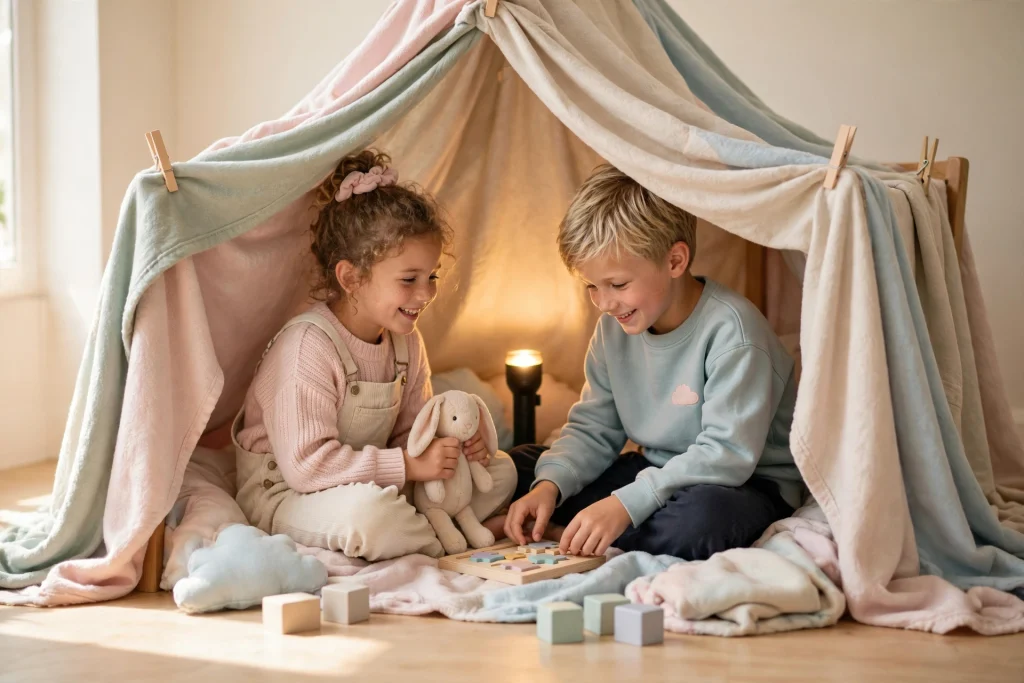
Short answer: Camping theme preschool activities turn your living room into a campsite: a blanket-fort tent, a torch-and-paper campfire, star counting and backpack games — 15 indoor ideas for ages 3–5, no real fire and no trip needed.
Quick facts
- Ages: 3–5 years
- Theme: camping theme — an indoor camp at home or in a classroom corner
- Theme week: 3–7 days — one theme, dipped into a little each day
- Cost: free — blankets, cushions, torches and ordinary household things
- Screen-free: yes — every activity on this page
Move and play
The active set: building the camp, exploring it in the dark-that-isn’t, and wearing everyone out in true camping style. One rule before anything is built: the campfire in this camp is paper and torchlight — there is no real fire, and no candles, anywhere in this theme.
1. Pitch the tent
Drape blankets over a sofa, a clothes airer or a row of chairs to make a tent, weight the edges with cushions, and crawl in with a torch and a story. Let your child help plan it: where is the door, who sleeps where, what goes inside? Building the shelter is the game — planning, draping, fixing what slides off, and testing whether everyone fits. Keep the build stable: chairs that cannot tip, nothing heavy resting on top, and an adult does the high draping. A fort that falls down is funny once; a fort built well is a headquarters all week.
2. Torchlight treasure hunt
Dim the room a little (curtains closed is plenty — it never needs to be fully dark), hand over a torch, and hunt: hide soft toys, “lost” camp objects or picture cards around the room for your child to find by torchlight. Finding by a moving beam of light is scanning and focus work, and remembering where things were hidden is memory practice. Torch rules from the start: the beam points at the floor and the walls, never at faces, and the battery cover stays screwed shut — an adult checks it before the hunt begins.
3. Bear-hunt obstacle trail
Lay out a camping trail across the room and go on a bear hunt together: step carefully over the fallen logs (cushions in a line), cross the river (a blue blanket — wobble across without “falling in”), creep around the tall trees (chairs or standing cushions), and tiptoe past the bear’s cave (the fort — shhh). Chant the journey as you go and let your child lead the second time round. Sequencing the trail is memory work, and balancing, stepping and creeping in one game is whole-body coordination.
4. Sleeping-bag roll races
No sleeping bags? Rolled-up blankets or duvets work just as well. Lay two “bags” on a clear stretch of floor, and the racers wriggle inside and roll — or caterpillar-crawl — to the finish cushion. Heads stay out and faces stay clear at all times, the rolling lane stays empty of furniture, and this is a floor game for short bursts, never a sleeping arrangement. Rolling and wriggling in a bundle is glorious core-strength and body-awareness work disguised as the silliest race of the week.
5. Campfire freeze dance
Stand the tissue-paper campfire (activity 6) in the middle of the floor, switch on some music, and everyone dances around the “fire” like happy campers at a singalong. When the music stops: freeze, hands warming at the flames. Anyone caught mid-wiggle tends the fire next round. Listening for the stop and holding a pose is self-control practice, and circling a pretend campfire together is the heart-of-camping feeling — with flames that are perfectly safe to dance around.
Make and create
Five makes that build the campsite itself: the fire, the tent pictures for the wall, and the kit every camper needs.
6. Tissue-paper campfire
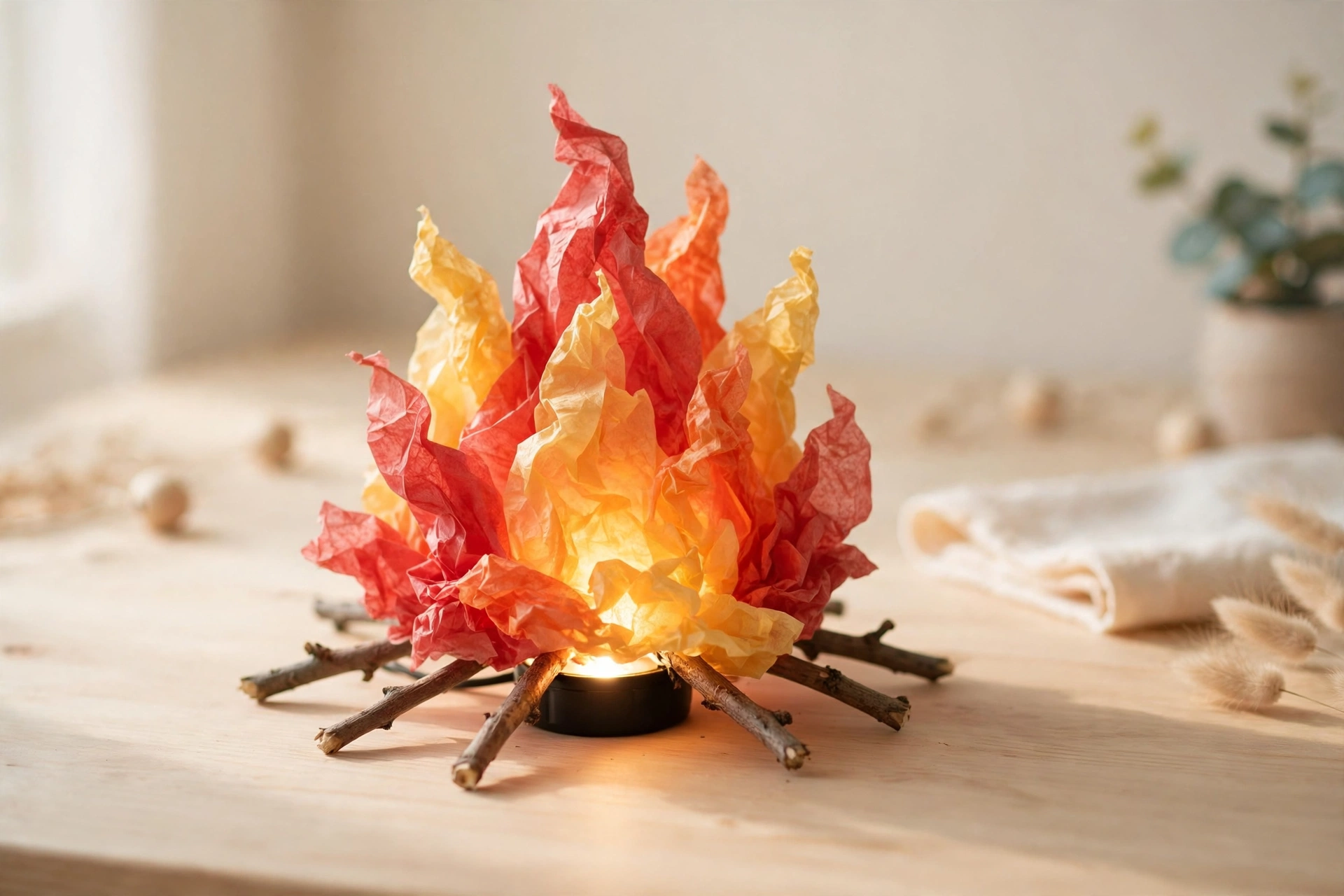
This is the campfire for the whole week, so make it a good one: arrange cardboard tubes or rolled brown paper as logs in a star, stand scrunched flames of red, orange and yellow tissue paper in the middle, and lay a torch underneath or behind so the paper flames glow. It looks magical in a dim room — and it is completely cold. Say it plainly to your child and to yourself: this is the only kind of fire this camp ever has; real flames, candles and matches are not part of the theme, ever. The made fire then stars in the freeze dance, the story circle and every evening of theme week.
7. Tent picture collage
Cut big triangles of coloured paper or fabric and let your child build a campsite picture: triangle tents in a row, a circle moon, cotton-wool stars, a tissue-paper campfire in the middle. Glue, arrange, rearrange. Choosing where each tent stands is early composition, and cutting triangles (with child scissors, at the table, with you beside them) is hand-strength work. A row of these along a wall makes a very proud campsite gallery.
8. Leaf-and-stick nature crowns
Collect fallen leaves, petals and small sticks from the garden or a walk — fallen things only, nothing picked from living plants, and hands washed afterwards. Stick the best finds onto a wide strip of masking tape (sticky side out) worn as a bracelet, or onto a card crown: a nature crown for the chief camper. Choosing, arranging and pressing each piece is fine-finger work, and talking about what each find is — which tree, which colour — is nature vocabulary growing without a lesson in sight.
9. Cardboard-tube binoculars
Two cardboard tubes, taped or glued side by side, a strip of paper around them to decorate, and a string long enough to wear — tied by an adult, and taken off for rough play. Every camper needs binoculars: spot “birds” (pictures hidden around the room), watch the “stars”, scan the trail before the bear hunt. Making a tool and then using it in the game is early engineering with a story attached — and looking at the world one small circle at a time is focus practice.
10. S’mores pattern snack-building
The classic campfire snack, rebuilt as a pattern game — adult-led from start to finish. On a plate, your child builds “s’mores” in a pattern: cracker, banana slice, cracker, banana slice… or a pretend version with cardboard crackers and felt banana for pure play. Before you begin, check every ingredient against your child’s allergies and swap freely (rice cakes, apple slices, soft pear all pattern beautifully); food is built and eaten sitting down, at the table, with an adult right there. Repeating a pattern and predicting what comes next is early maths you can eat.
Learn and discover
The thinking set: packing, counting, dressing for the weather, reading animal tracks, and telling the campfire story.
11. Pack the backpack
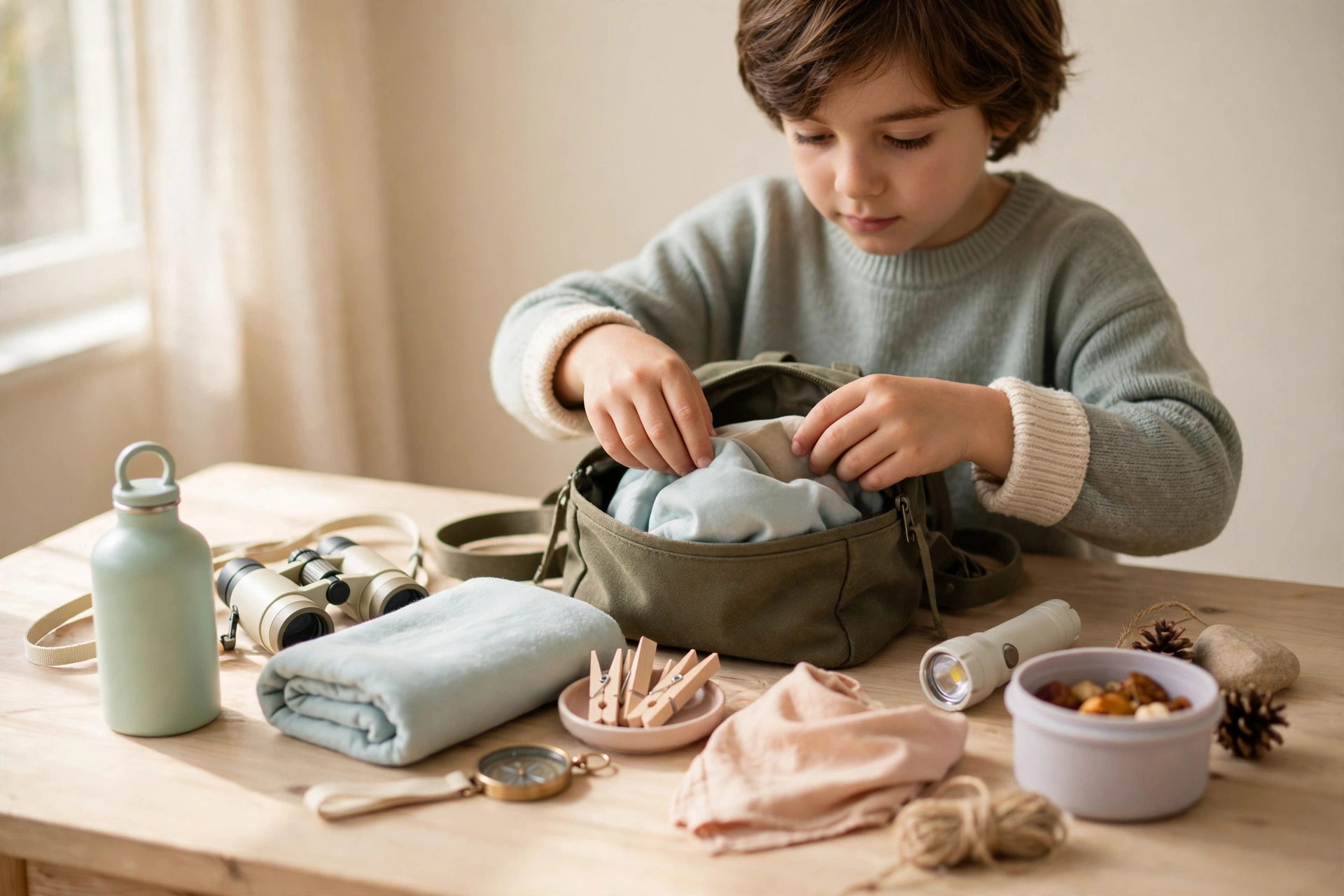
Put a small backpack in the middle and a pile of real objects around it: a hat, a water bottle, a torch, a spoon, a cuddly toy, a book, a slipper, a saucepan. Sort together: what does a camper really need in the bag, and what stays home? Pack the yes pile, weigh the bag (“could you carry this up a hill?”), and unpack one mistake on purpose for a giggle. Sorting by “needed or not” — and being able to say why — is classifying, the same thinking maths and science run on, and every camper decision is a little piece of reasoning out loud.
12. Count the stars
Stick glow-in-the-dark stars, or silver star stickers, on a dark sheet of paper or card — your night-sky chart. In the dim room, torch in hand, count the stars together: count them all, count only the big ones, find five and then find five more. Then lie under the real chart (tape it low on a wall or hold it up) and “stargaze”. Counting a scattered set, and keeping track of which ones are already counted, is one-to-one correspondence with the loveliest scenery in maths.
13. Dress the paper camper
Draw or print a simple paper camper figure and a set of paper clothes: sun hat, raincoat, boots, warm jumper, shorts. Each morning of theme week, look out of the window together — real weather watch — and dress the camper for today: “Sunny! What does our camper wear?” Choosing clothes for the weather is early science (observing, matching conditions to choices) and a gentle daily routine that runs the whole week by itself. Yesterday’s outfit versus today’s is a first weather chart, without anyone calling it one.
14. Animal tracks matching cards
Make or draw simple track cards: a bird’s three toes, a dog’s paw, a duck’s webbed foot, a bear’s big pad — two of each. Spread one set face-up around the “trail” and let your child match the second set to the tracks they find, then guess: whose footprints are these, and where was that animal going? Matching shapes exactly is visual discrimination — the same skill early reading runs on — and the guessing is storytelling in disguise.
15. Campfire story circle
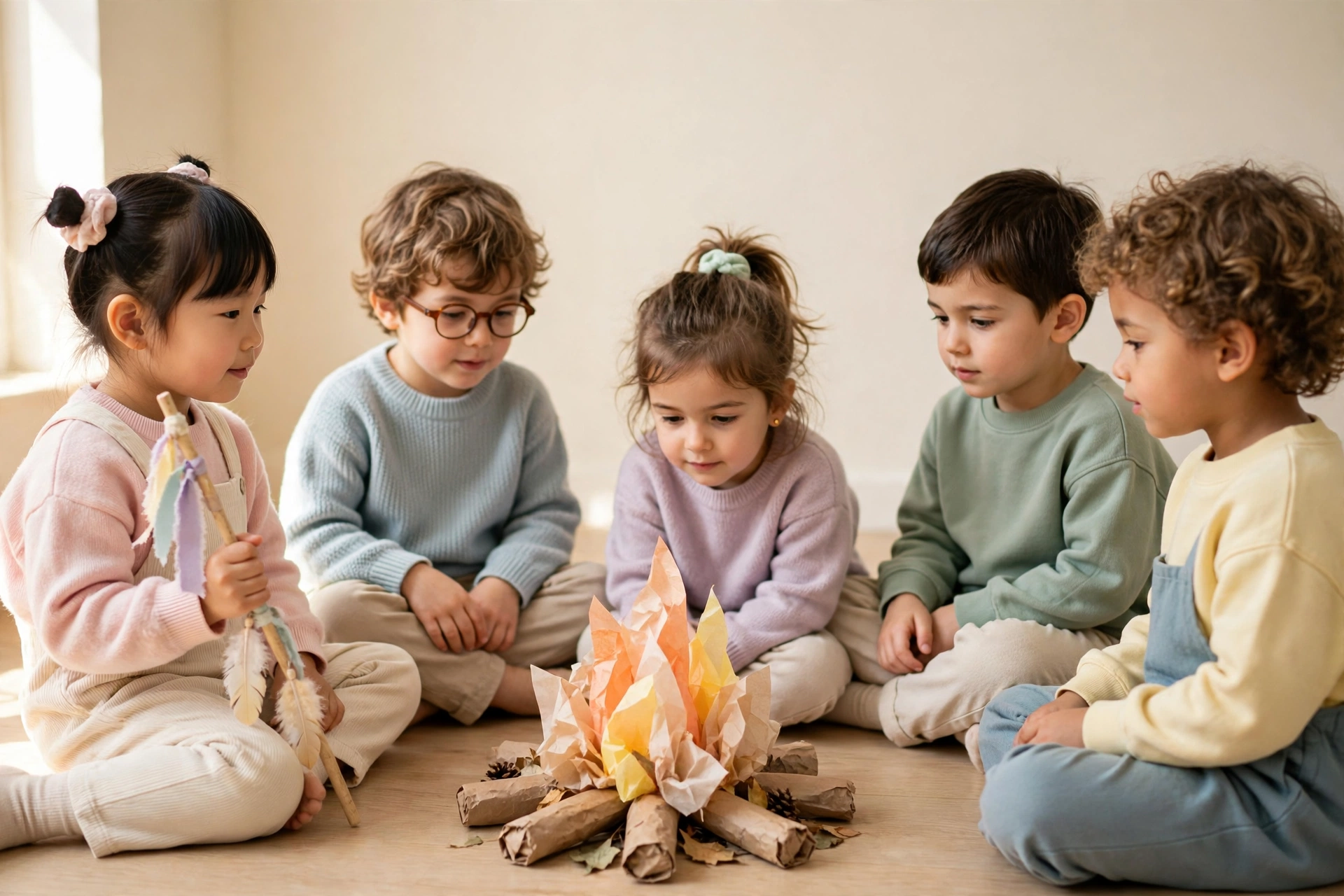
End the camp days the way real campers do: sit in a circle around the tissue-paper campfire, torch glow on, and tell a story in turns. One person holds the talking stick (a decorated cardboard tube works beautifully) and adds a sentence; the stick passes, and the next camper adds the next piece. “One night, a little bear heard a noise outside his tent…” Stories built turn by turn are listening, memory and language practice of the richest kind — and a child who cannot be interrupted while holding the stick learns the group’s kindest rule: every voice gets its turn.
Turn it into a theme week
Spread the fifteen across five days, two or three a day, and build the camp once — it stays up all week:
- Day 1 — Pitch camp: build the tent (1), make the campfire (6), and pack the backpack (11) for the “trip”.
- Day 2 — Trail day: the bear-hunt obstacle trail (3), binoculars for the trail (9), and animal tracks to spot along it (14).
- Day 3 — Making day: tent collage (7), nature crowns from a garden hunt (8), and the first weather watch — dress the paper camper (13).
- Day 4 — Campfire day: s’mores pattern building (10), count the stars as the room dims (12), and the first story circle round the fire (15).
- Day 5 — Camp party: torchlight treasure hunt (2), sleeping-bag roll races (4), freeze dance round the campfire (5), and a last story to close the camp.
Short on time? Three days still works — pitch the tent on day one, and pick one activity from each section per day after that. The whole camp fits in one corner of one room: one blanket fort is the tent, the trail and the cave, and the paper campfire stands in the middle. And if the weather is kind and you have a garden, the trail and the treasure hunt move outside happily — the fire, of course, stays paper wherever it goes.
Finish the week with printables
After five days of camping play, some preschoolers ask for a page of their own to colour or trace — and that request is the perfect moment for paper. FIMS Schools has free printable preschool and kindergarten worksheets, including first tracing and colouring pages: free preschool and kindergarten worksheets. A tent or campfire colouring page to close the week is plenty — the play was the learning; the printable is the souvenir.
Read next
- Preschool Theme Activities — every theme week in one place: pick next week’s theme here
- Farm Theme Preschool Activities — another full theme week: animals, tractors and farmyard play
- 30 Activities for 4 Year Olds — everyday play for the middle of the preschool years
Camping theme questions parents ask
How do we do a “campfire” safely indoors?
With paper and a torch — that is the whole trick, and it is a good one. Scrunch red, orange and yellow tissue paper into flame shapes, stand them among cardboard-tube logs, and lay a torch underneath or behind so the flames glow. It looks like firelight, it feels like a campfire gathering spot, and it is completely cold and safe. Keep it as a firm house rule for the theme: no real flames, no candles and no matches are part of indoor camping, ever — the pretend fire is not a compromise, it is the game.
Can this work in a small flat or a classroom corner?
Yes — one blanket fort is the whole camp. Drape a blanket over two chairs or a sofa end and that single fort serves as the tent, the bear’s cave and the story-circle den; the tissue-paper campfire stands in front of it, and the obstacle trail runs in a loop around whatever floor you have. Everything on this page was written for ordinary rooms: if you can fit a blanket and a ring of cushions, you can fit this theme.
What if my child is scared of the dark parts?
Then there are no dark parts — “night” in this camp is pretend and always optional. Keep the lights on and close the curtains only if your child wants the torch game to feel special; a torch hunt works in a lit room too, just a little less glowy. Let your child hold the torch (holding the light is holding the power), stay inside the fort’s doorway yourself, and stop any game the moment it stops being fun. Confidence built gently, at your child’s pace, is the whole point — the camp waits for the camper, never the other way round.