
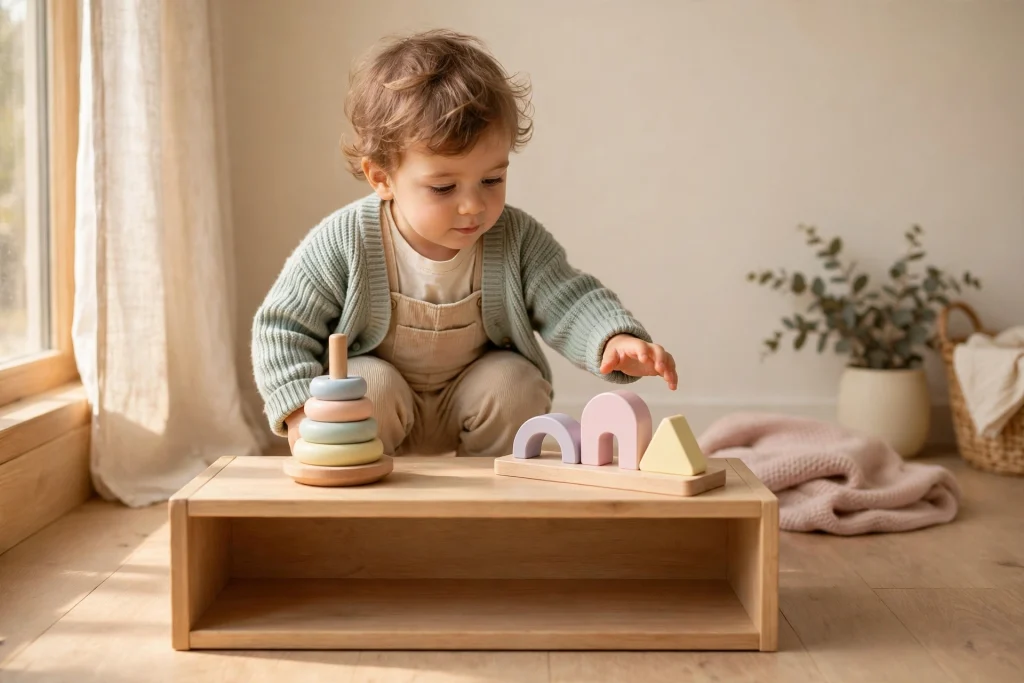
Short answer: knowing how to choose Montessori toys comes down to three tests — real materials, one clear job, and a size that fits small hands. Skip anything that plays by itself.
Quick facts
- Ages: 1–5 years
- Cost: free/household up to simple wooden toys
- Screen-free: yes — every idea on this page
- The idea: one toy, one clear job
What “Montessori toy” actually means
Walk into a shop or search online and the word “Montessori” is stuck on almost anything wooden — and on plenty of plastic, too. There is no official stamp and no certifying body for toys, so the label alone tells you very little. What the word is meant to point at comes from the Montessori approach to young children: give a child real things, sized for their hands, that invite them to do something real — pour, stack, thread, sort, match — and then get out of the way.
So a Montessori-style toy usually has four marks. It is made of real materials — wood, metal, fabric, glass or ceramic where safe — because real materials have weight, texture and honest feedback: a dropped wooden block sounds and feels different from a dropped plastic one. It has one clear purpose: the child can see what the toy is for, and can tell by themselves whether it worked — the puzzle piece fits or it does not. It is child-sized, light enough and small enough for small hands to manage alone. And it contains no batteries doing the work: no lights and songs performing while the child watches. The toy invites the child’s own action; the child is the one who makes something happen.
One more idea sits underneath all four marks: respect for the child’s concentration. A good toy does not interrupt, reward with noise, or rush the child to the next exciting thing. It waits. A toddler may stack and topple the same tower twenty times in an afternoon, and a well-chosen toy simply allows that — deepening the skill with every repeat, until the child walks away satisfied and done. When you are choosing, it is worth picturing that quiet, busy repetition: the toys that invite it are almost always the right ones.
That is genuinely all the theory you need. The rest of this page turns it into seven checks you can run in a shop, at a market stall, or over a hand-me-down box in about ten seconds each. If you are new to the approach itself, our Montessori for toddlers guide shows what it looks like in a real home, and our Homeschooling hub gathers the rest of our gentle home-learning guides.
The 7 checks before you buy or borrow
1. Does it do one thing clearly?
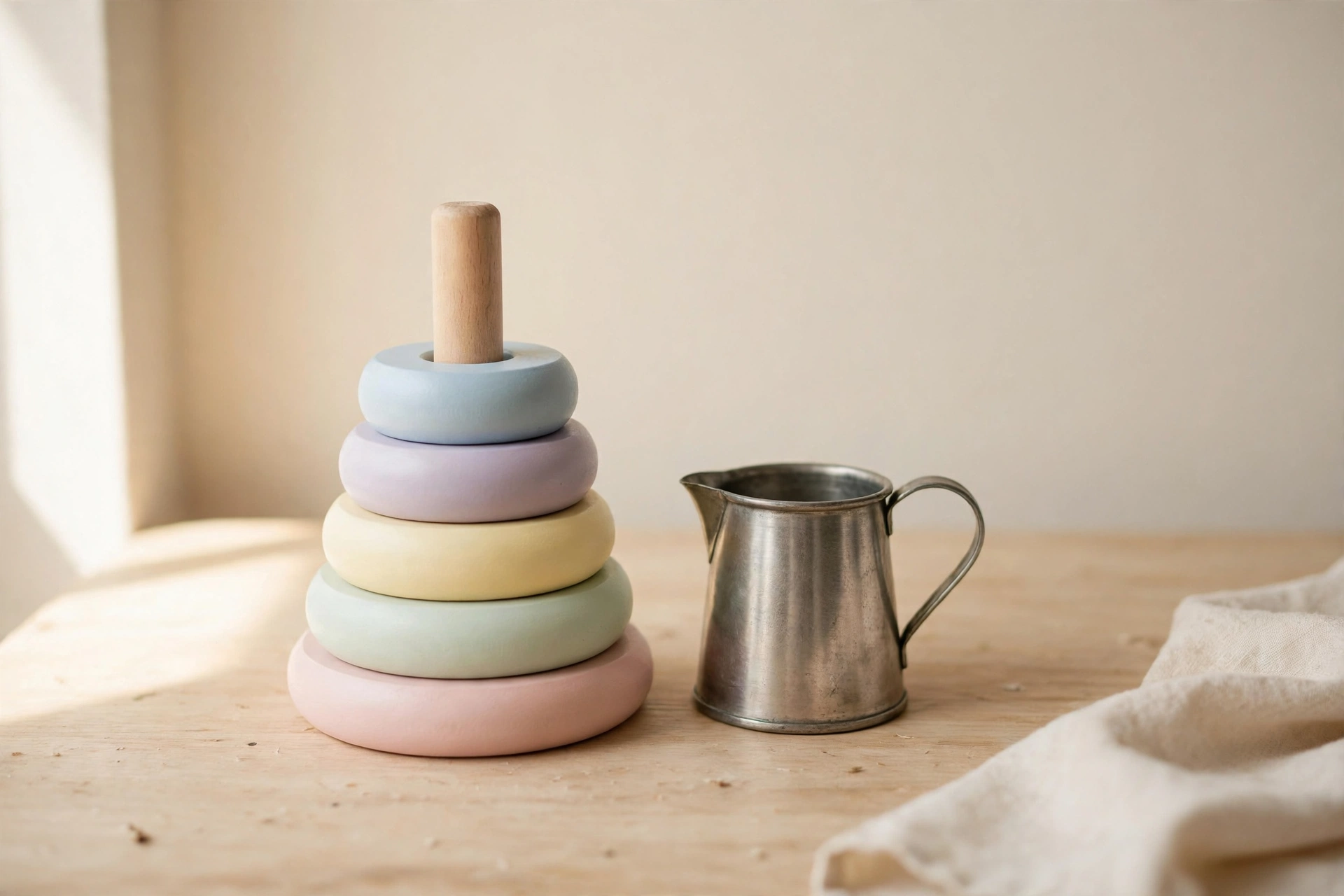
Pick the toy up and ask: can a small child see what this is for? A stacking tower stacks. A shape sorter sorts. A toy that is simultaneously a phone, a piano, a steering wheel and a light show asks the child to watch, not to do. One clear job also means the toy can tell the child the truth: the ring will not fit on the wrong peg, and that honest “not yet” is where the learning lives — no adult verdict needed.
2. Is it made of real materials?
Run a hand over it. Wood, metal, cotton and wool feel different from plastic in ways a young child registers deeply: weight, warmth, texture, sound. Real materials also tend to last — a wooden puzzle can serve three children and still be handed on. Plastic is not banned from a Montessori home (a plastic jug in the bath is a fine pouring toy), but if the choice is equal, choose the material that gives the child’s senses more to learn from.
3. Does the child do the work — or do the batteries?
Press the button, if there is one. If the toy then sings, flashes and performs while your child sits back, it is entertainment, not a tool for learning. The toys that build concentration ask the child to supply the action: the ball rolls because small hands posted it, the tower rises because small hands stacked it. A good test in the shop: if the batteries ran out, would the toy still work perfectly? If yes, it passes this check with room to spare.
4. Is it the right size for small hands?
A toy a child cannot lift, carry or grip alone will always need an adult inside the play — and the whole point is work the child can own. Look for things a toddler can carry in two hands, knobs chunky enough for a whole fist or an early pincer grip, and pieces big enough to be safe and satisfying. Too big is as unhelpful as too small: a giant abacus nobody can move will be furniture, not a toy.
5. Does it match what your child is practising right now?
The best toy meets a skill that is just emerging: posting and dropping for a baby who drops everything, pouring for the toddler emptying every cup, threading for the 3 year old drunk on “I did it myself”. Watch first, buy second — a week of noticing what your child repeats for fun tells you more than any age label on a box. A toy bought for the child you have, at the stage they are in today, gets used daily; a toy bought for a future stage waits in a cupboard, quietly expiring.
6. Can it grow with them?
Some toys are one-trick: the button is found, the sound is made, the interest is over. Others open up as the child grows — blocks become towers, then houses, then cities; a set of nesting bowls is a stacking game at 1, a sorting game at 2 and a pretend-shop till at 4. You do not need every toy to last for years, but a shelf built mostly from open-ended things stretches further, costs less over time, and keeps surprising the same child.
7. Is it safe — and can it be mended?
Last, the practical check. For under-3s, pieces must be too big to be a choking hazard, finishes must be non-toxic, and anything with strings or cords stays short and supervised. Run a finger along edges for splinters and sharp seams. Then ask the unfashionable question: if a piece breaks, can it be glued, sewn or replaced — or does the whole toy go in the bin? Simple toys made of real materials usually pass both halves of this check; complicated electronic ones usually fail the second.
Great “toys” you already own
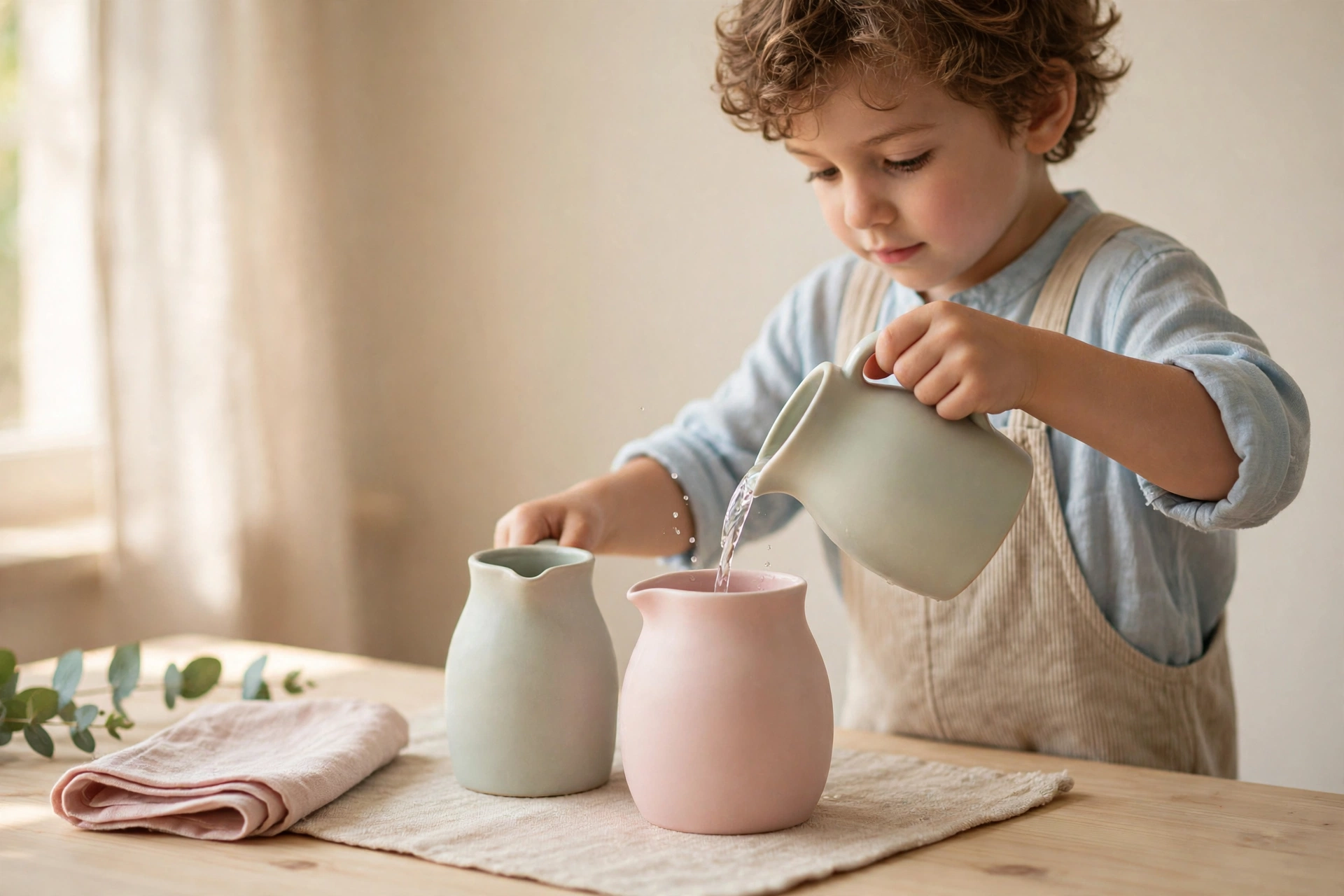
Here is the quiet secret of Montessori homes: some of the best “toys” were never sold as toys at all. In the kitchen: a small jug and cup for pouring (start with dried lentils or rice before water), nesting bowls, a set of measuring spoons, tongs for moving cotton balls or pasta from bowl to bowl. In the laundry: chunky pegs and a basket to peg them onto, socks to match into pairs, a small cloth for wiping and folding. From nature: big smooth stones, large shells and sturdy sticks for stacking, sorting and carrying — collected together on a walk, washed, and kept big enough to be safe for mouthing ages.
Each of these passes all seven checks: real materials, one clear job, child-sized, no batteries, and matched to skills toddlers practise obsessively anyway. They also cost nothing, which matters more than the toy industry would like you to know. Keep them in a small basket or tray on a low shelf, just a few at a time — presented simply, ordinary things become the toys children return to most.
By age — what usually fits
Children vary, sometimes by a lot, so read these as neighbourhoods, not deadlines. The right question is never “what should a 2 year old have?” but “what is my child trying to do this month?”
Ages 1–2: posting, stacking and pushing
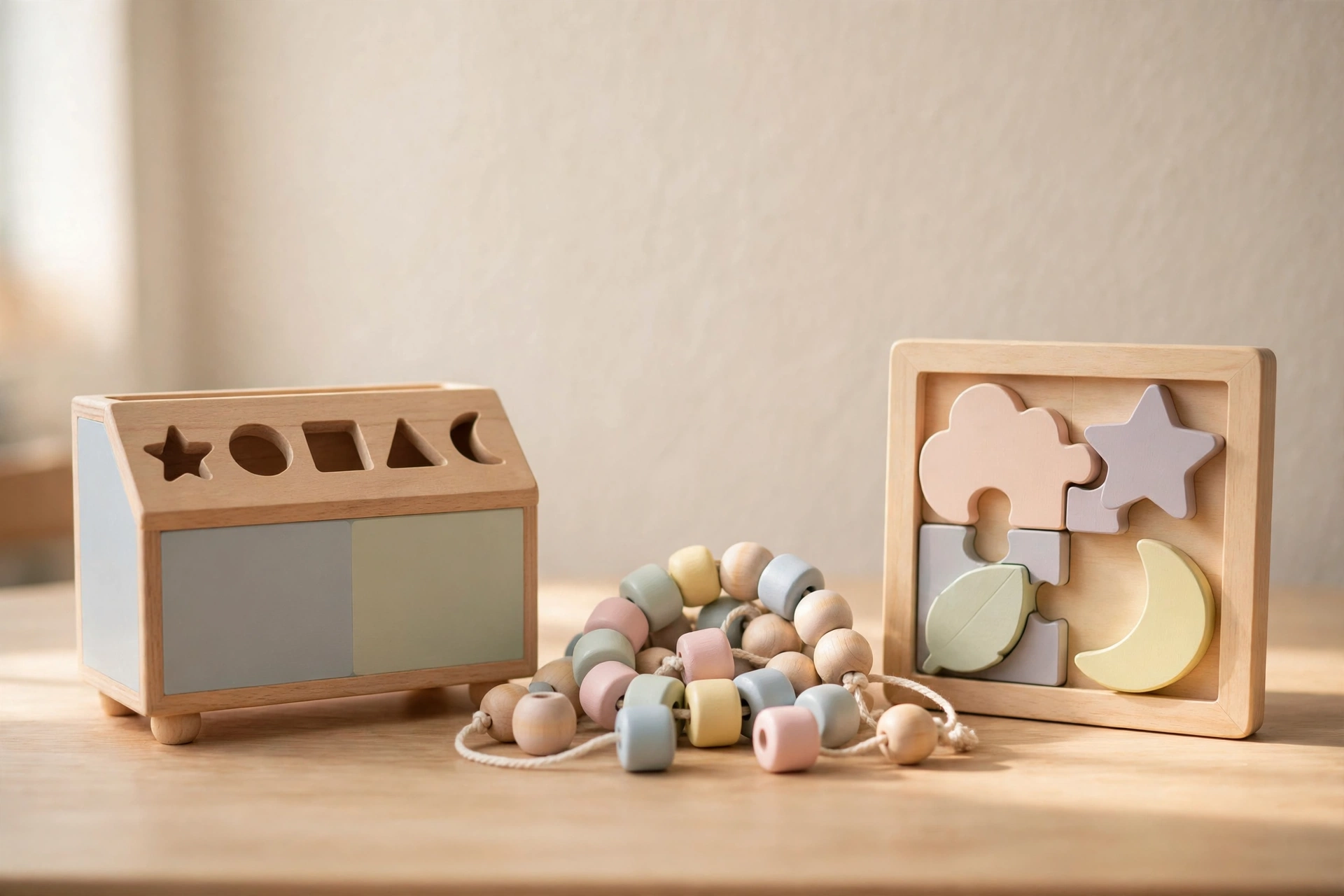
The first year’s great works are putting things in and taking them out, knocking down and building up, and moving everything from place to place. Posting boxes, big stacking rings, nesting cups, a sturdy push-along toy and balls of every size all fit this stage. Expect repetition that looks mindless and is anything but — each repeat is the skill being wired in.
Ages 2–3: pouring, threading and first puzzles
Now hands want finer work: pouring between jugs, threading a few very big beads on a stiff lace, peg puzzles with chunky knobs, simple two- and three-piece puzzles, and lots of transporting, sorting and matching. Practical life shines here too — a small broom, a cloth, a watering can for one beloved plant.
Ages 3–5: real tools and longer projects
Older preschoolers stretch toward real work and longer concentration: dressing practice with real clothes (buttons, zips, buckles on their own coats), sorting and classifying sets, child-safe first tools with close supervision, more demanding puzzles, and simple construction that stays up for days. The toys get fewer and the projects get longer — a sign the earlier shelves did their job.
What to skip
Two things, mainly. The first is the flashing, singing, all-in-one plastic toy that plays by itself: it passes none of the checks, turns your child into an audience, and usually loses its charm within the week. The second is subtler — too many toys at once. A room full of toys looks generous, but young children play more deeply with less: fewer choices, each one visible, each one complete. When everything is out, everything gets dumped and nothing gets finished.
The Montessori answer is toy rotation: keep a small selection — perhaps six to ten things — on a low shelf, and store the rest away. Every week or two, swap a few items. The returned toys are greeted like old friends, concentration stretches, and tidying up becomes a job a small child can actually do, because everything has a place and the places are few. Rotation also tells you the truth about your shelf: the toy nobody notices missing is the toy to pass on.
Read next
- Homeschooling — our hub for gentle home learning, including the full Montessori section
- Montessori for Toddlers — what the approach looks like at home for ages 1–3, with nothing special to buy
- Fine Motor Activities for Toddlers — 15 playful ways to build the hand skills every good toy practises
Frequently asked questions
Do Montessori toys have to be expensive wooden ones?
No. Wood is common in Montessori-style toys because it is durable, honest to the senses and repairable — not because a rule demands it, and certainly not because price is a virtue. Some of the best items on this page are already in your kitchen. A modest wooden toy that passes the seven checks beats a costly set that fails them, and borrowed, second-hand and hand-me-down toys pass exactly the same checks as new ones.
How many toys should be out at once?
Fewer than feels natural — for most toddlers and preschoolers, somewhere around six to ten choices on a low shelf works well, with the rest stored for rotation. Every child differs, so watch the play, not the number: if toys are mostly being tipped out and wandered away from, there are too many out; if one or two are used deeply and returned to, the shelf is about right.
Can a tablet game ever be “Montessori”?
Honestly: the label is used very loosely in marketing, and an app is almost never what this page means by a Montessori toy. A screen cannot offer real materials, real weight or real consequences — the dropped virtual block teaches nothing about gravity — and most apps are designed to perform for the child, which fails the third check outright. If you use apps at all, treat them as screen entertainment, judged by your family’s screen rules — not as part of the toy shelf.