
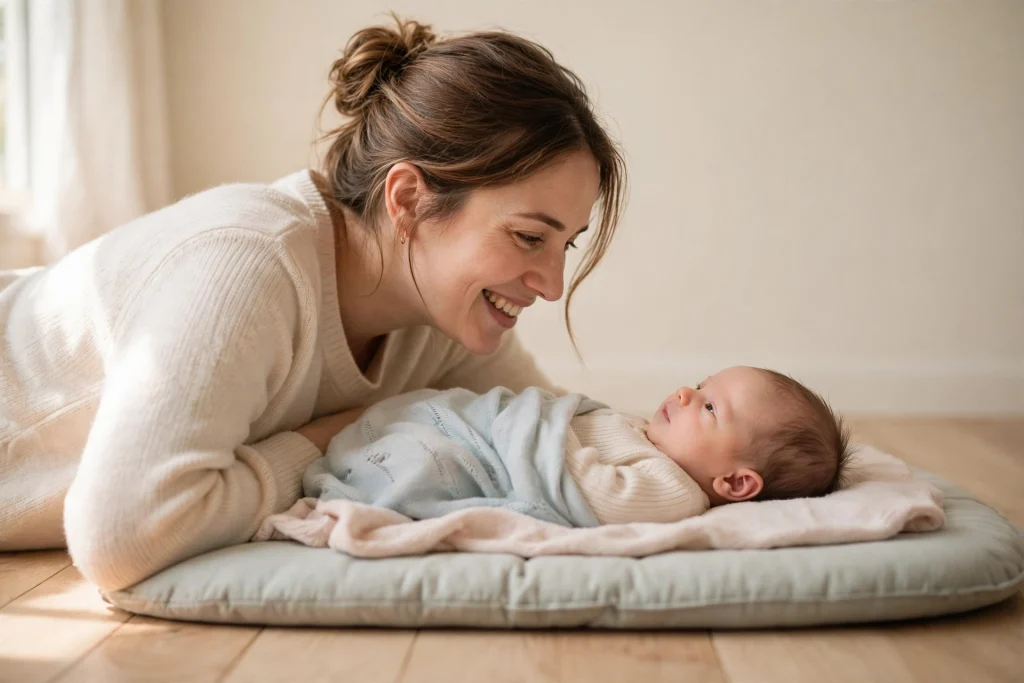
Short answer: These 10 gentle 1 month old activities need nothing but you — your face, your voice and your arms — because one month is the looking-and-listening month: all free, calm and screen-free.
Quick facts
- Ages: 1 month
- Cost: free — just you
- Screen-free: yes — every idea on this page
- Skills: looking, listening and bonding
What to expect at 1 month
At one month, your baby’s world is small, close and mostly made of you. Feeding and sleeping take up nearly the whole day, and awake moments are short — a calm, alert quarter of an hour is a big play window at this age. Your baby sees best at about a forearm’s distance: your face, held close, is clear while the far side of the room is a gentle blur. Expect flailing arms and legs, tightly fisted hands, sudden startles, and lots of intense staring — staring is hard work and real learning for a newborn. Your baby knows your voice already and will turn towards it. Towards the end of the month, some babies begin to answer a smile with one of their own.
The information on this page is general information for parents, shared for learning and activity ideas. It is not medical advice, and it does not replace the guidance of a qualified professional. Every child develops at their own pace — if you have any concern about your child’s development, please talk to a qualified doctor or child-development professional.
Faces and voices
A newborn’s favourite toy is a face — yours — and their favourite sound is your voice. This first set is just the two of you, face to face, which is precisely what a one-month-old brain is built for.
1. Face-to-face talking
Hold your baby in your arms or lay them on a mat and lean in close — about a forearm’s length from their face, where they see you best. Talk slowly, in the soft, singsong voice that comes naturally, and pull gentle faces: big smile, raised eyebrows, open mouth. Then pause. Watch your baby study you; even a tiny mouth movement or a held gaze is your baby answering.
2. High-contrast picture looking
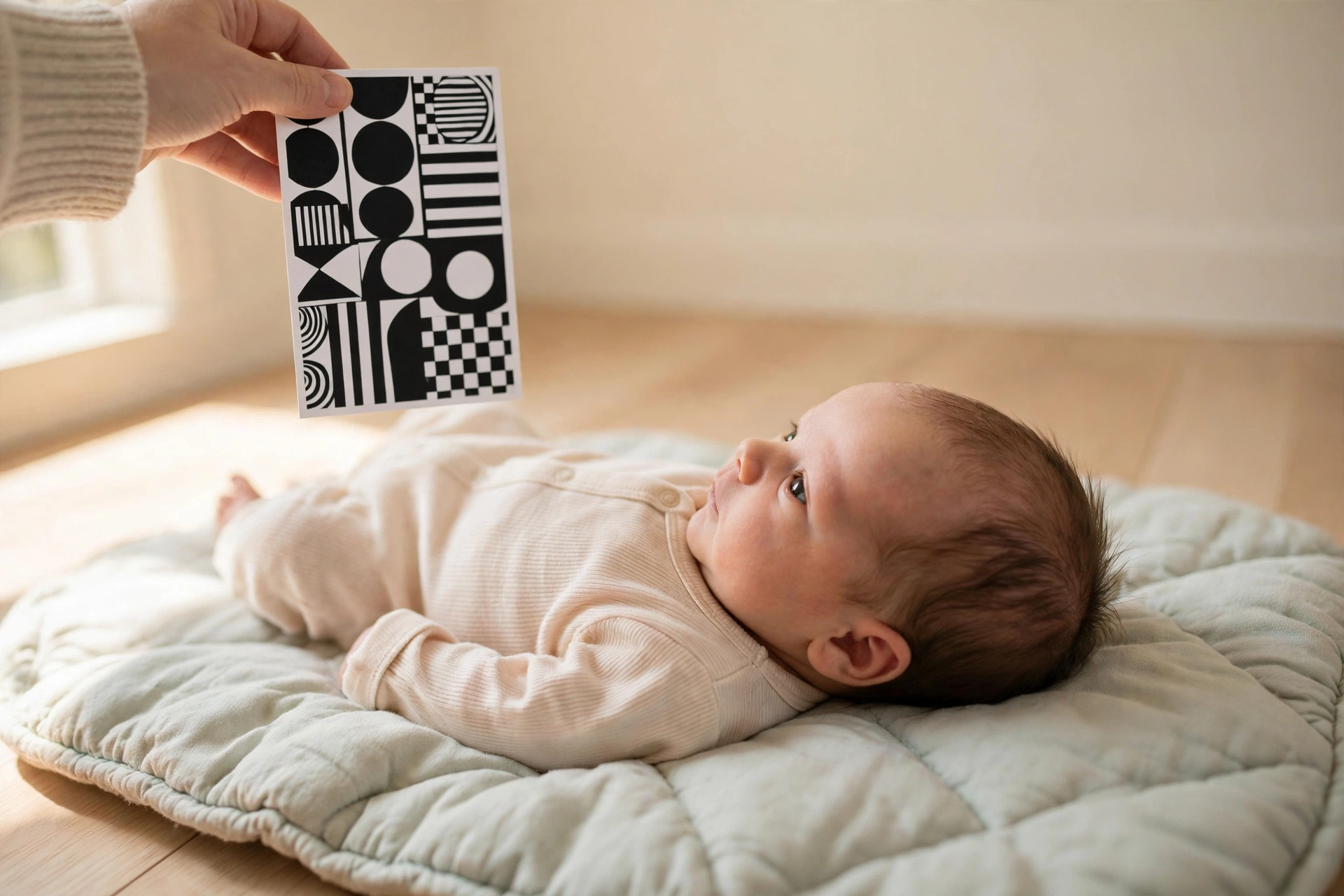
Newborns see bold patterns far more clearly than soft colours, so black-and-white is the colour scheme of the month. Hold up a simple high-contrast picture — thick black stripes, a bold checkerboard, a big black circle on white card — about a forearm’s length away. Let your baby lock on and stare for as long as they like.
3. Slow tracking
Once your baby can fix on your face or a contrast card, move it very slowly from the middle towards one side — just a few centimetres at first. Your baby’s eyes, and soon their head, will try to follow. Keep the movement slow and the distance short, try both directions, and stop while your baby is still interested.
4. Singing and humming time
Sing the same two or three songs again and again — during feeds, changes and cuddles. Repetition is the point: your baby is learning the tune of your voice, and familiar sounds are comforting in a world that is still brand new. Humming works just as well, and a low, quiet hum against your chest lets your baby feel the song as well as hear it. To your baby, you are the world’s best singer already.
5. Chat back to early sounds
Between the crying, one month olds make small sounds — grunts, sighs, little coos and throaty gurgles. Treat each one as a sentence. Answer it: “Oh really? Tell me more.” Then wait. Your baby may not reply yet, but the speak-pause-speak rhythm is the shape of conversation, and your baby is absorbing it from the very first month.

Gentle movement and first tummy time
Movement at one month is tiny and slow: a held sway, a kick, a brief lift of the head. This set builds the neck, back and leg strength everything later depends on — in moments, not marathons.
6. Chest-to-chest tummy time
Recline back on cushions or in an armchair, well supported, and lay your baby tummy-down on your chest, face to face. Your heartbeat, warmth and face are all right there, which makes this the friendliest first tummy time of all. Your baby will push and lift their head in small efforts to see you — real neck-strength work.
7. First floor tummy time
A few times a day, in a calm awake moment, lay your baby tummy-down on a firm, flat mat on the floor and get down in front of them. A minute or two is plenty at first — build up slowly across the weeks, always stopping before your baby gets upset. A small rolled towel under the chest can help a baby who finds the flat floor hard work. Tummy time is for awake time only, with you right there.
8. Gentle hand holding and massage
Your baby’s hands spend most of the month in tight little fists. Gently stroke each hand open, let your baby grip your finger — the grasp is automatic and surprisingly strong — and softly massage tiny hands and feet with slow, light strokes. Many babies find this deeply calming, especially in the fussy evening hours. Stop if your baby pulls away or cries; short and sweet is the rule.
9. Slow sway and listening walks
Cradle your baby in your arms, head fully supported, and sway slowly side to side or rock gently as you walk around your home. Name what you pass and what you can hear — the kettle, the rain, a door, the washing machine. To you it is a dull commentary; to your baby it is a guided tour of their new world, in their favourite voice.
10. Gentle leg cycling
At nappy-change time, with your baby on their back on a safe, flat surface, gently move their legs in a slow cycling motion, as if pedalling a tiny bicycle. Go slowly, never force a leg straight, and turn it into a song if you like. The gentle movement can also help shift the wind that makes newborns squirm after feeds.
Staying safe at 1 month
- Support your baby’s head and neck at all times — a one month old cannot hold their head up yet, so one hand is always under it when you lift, carry or sway.
- Play only in awake, calm moments. If your baby is sleepy, hungry or crying hard, the activity is over — feeding and cuddling come first, always.
- Tummy time is awake-time play only, on a firm, flat surface, with you right there. For sleep, your baby goes down on their back, every time.
- Keep the sleep space completely empty: no pillows, toys, loose blankets or cot bumpers.
- Keep faces and pictures at a gentle distance — about a forearm’s length — and keep bright lights and sudden loud sounds away from your baby’s face.
Read next
- Baby Activities — Simple Play Ideas for 0–12 Months — the whole first year, month by month
- Activities for 3 Month Old — Batting, Grasping and Longer Tummy Time — a little further along, when batting and grasping begin
- When Do Babies Say Their First Word? — a gentle guide to babbling, first words, and how everyday talk helps them along
Activities for 1 month olds — questions parents ask
How much should a 1 month old “play”?
Far less than you might think — and it does not need scheduling. At one month, play is a few calm minutes here and there inside the ordinary day: a face-to-face chat after a feed, a song at a nappy change, a minute of tummy time on your chest. If you talk to your baby and hold them close, you are already doing it.
My baby cries during tummy time. Is that normal?
Yes — very normal. Lying on the tummy is genuinely hard work for a newborn, and many babies protest about it at first. Keep it very short and very often: a minute counts. Try it on your chest instead of the floor, get your face down at your baby’s level, and always stop before the protest becomes real crying. It almost always gets easier as your baby grows stronger. If your baby’s movement ever worries you, mention it to your doctor or health visitor.
Do newborns need toys?
No. Everything a one month old needs for play is already in your home: your face, your voice, your arms. If you want one “toy”, make it a simple black-and-white picture card — bold contrast is the one thing a newborn’s eyes are built to enjoy. This month, you are the toy, the entertainment and the whole world.