
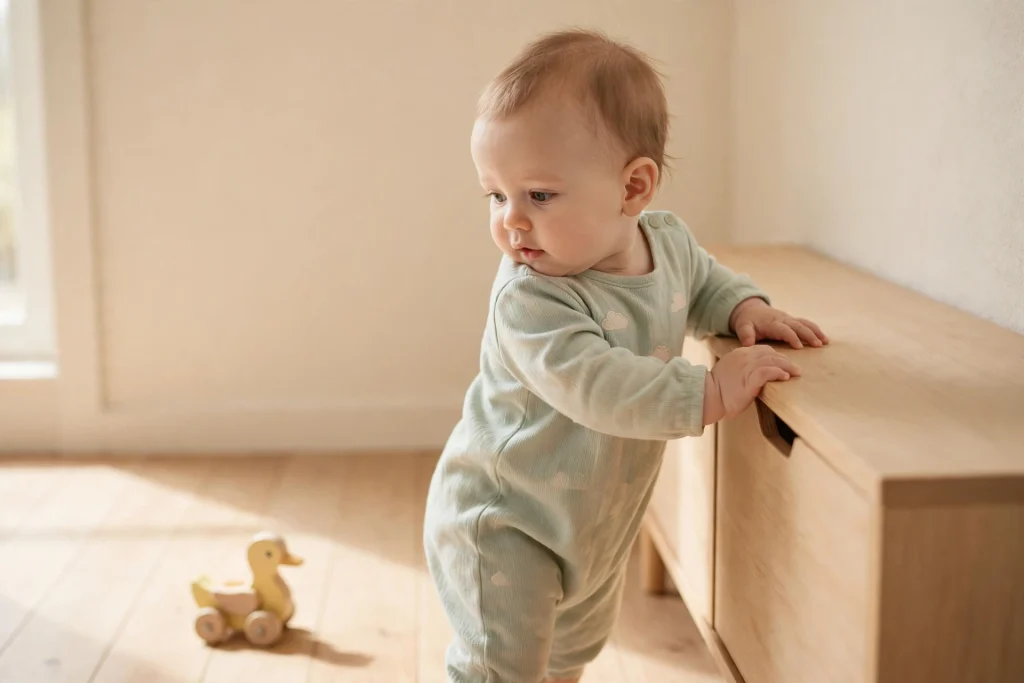
Short answer: These 12 activities for 10 month old babies use things you already have — cruising games, pushing, posting and first-words play — all free, safe and screen-free. Ten months is the almost-toddler month.
Quick facts
- Ages: 10 months
- Cost: free — ordinary household things
- Screen-free: yes — every idea on this page
- Skills: standing, pushing, pincer grip and first words play
What to expect at 10 months
Around ten months, the world tilts upright. Many babies are pulling to stand, cruising sideways along the furniture, and lowering themselves back down with a bump and a grin — a few stand alone for wobbly seconds or take a first step, while others are in no hurry at all. Fingers have had their big upgrade: the pincer grip — thumb and first finger working together — picks up the tiniest crumb on the floor: wonderful for play, and worth watching like a hawk. Your baby understands far more than they can say: familiar words get instant reactions, pointing becomes a whole communication system, and babbling now has the tunes and rhythms of real sentences. Waving bye-bye, clapping on cue and shaking the head “no” are all arriving. And everything — everything — still goes to the mouth first.
The information on this page is general information for parents, shared for learning and activity ideas. It is not medical advice, and it does not replace the guidance of a qualified professional. Every child develops at their own pace — if you have any concern about your child’s development, please talk to a qualified doctor or child-development professional.
Standing and pushing
Standing changes the view — and the games. Line up stable furniture, clear the floor, keep landings soft, and let your baby travel.
1. The cruising obstacle line
Arrange your sturdiest furniture — sofa, heavy chairs, a solid low table — in a line with small gaps between the pieces, and put a favourite toy at the far end. Your baby cruises piece to piece, then has to bridge each little gap: a stretch, a sidestep, sometimes a brave reach across to the next handhold. Push-test every piece first — anything that wobbles, slides or tips does not join the line. Stay within arm’s reach the whole way.
2. Push-wagon laps
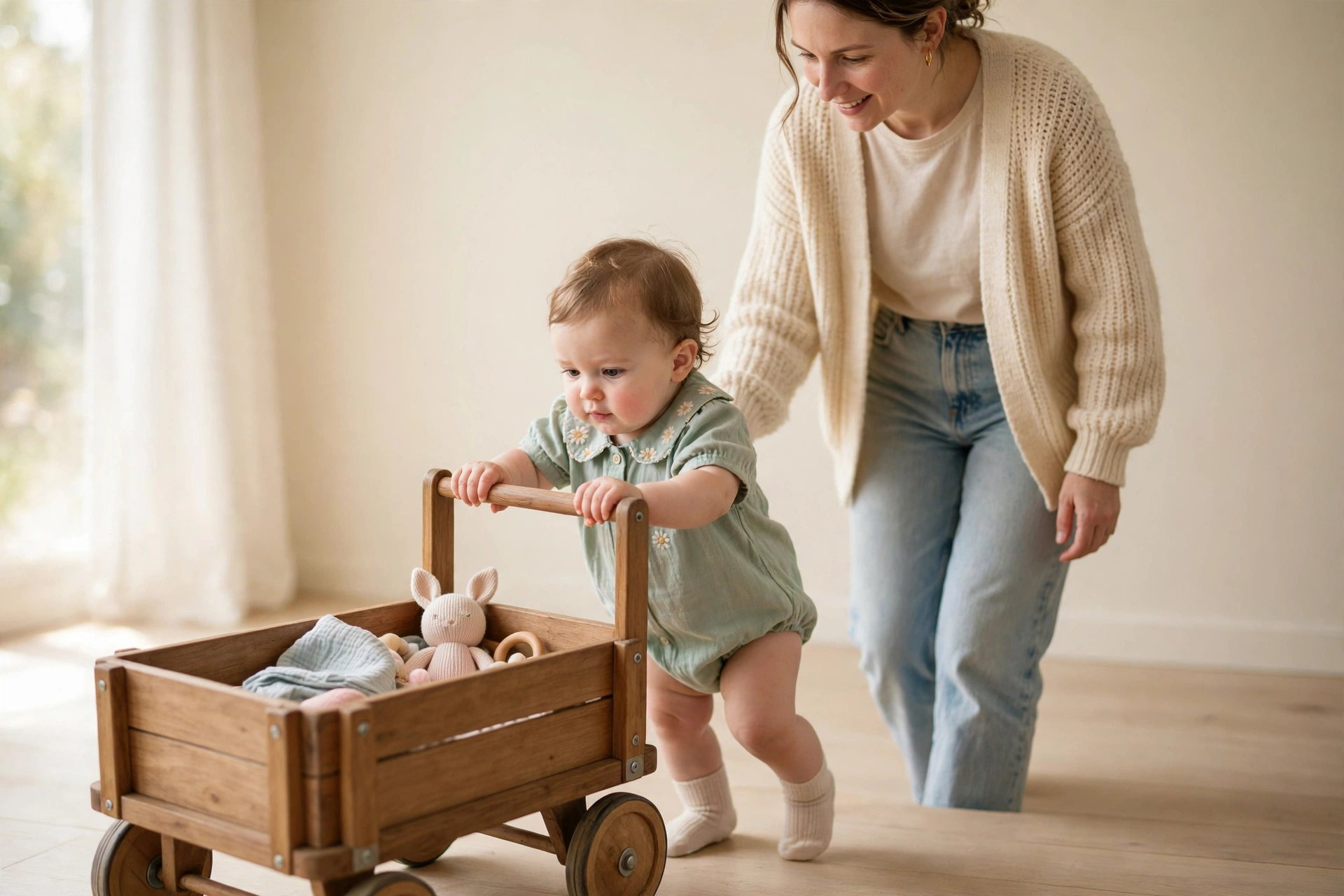
A sturdy push-along wagon or a heavy box weighted with books turns cruising into travelling: your baby holds on, pushes, and walks the length of the room behind it. Choose something solid that will not tip backwards or run away too fast — a flimsy pusher that shoots forward is worse than none. Walk alongside, and expect a lot of proud collapsing at the finish line.
3. Stand-and-drop posting
Stand your baby at a low, stable table or the sofa edge with a box beside them and a few big objects to post through a wide slot in its lid (an adult cuts the slot). Standing to play works legs and balance the whole time, and posting at standing height is a step up from the sitting version — reach up, line it up, let it drop, listen for the clunk. Big objects only, as always.
4. Fill-and-dump bucket runs
Give your baby a handled bucket or basket and a few big, light things to carry — soft blocks, rolled socks, a rubber ring. Fill the bucket in one corner, carry or push it across the room holding the furniture, dump it out, and start again. Filling, carrying and dumping is a whole postal service run by one small person — serious strength and planning work.
5. Roll-back-and-forth ball game
Sit on the floor facing your baby — who may sit, kneel or hold the sofa — and roll a big soft ball gently into their hands. At ten months the return game gets real: many babies now push the ball back on purpose and wait for their turn. This is your baby’s first true ball game, and the waiting-and-watching is turn-taking, the deep root of conversation.
6. Stand-up water pouring
Set a shallow tray of warm water on a low, stable surface your baby can stand at — an upturned step stool, a low table, or a washing-up bowl on the floor for a kneeling version — with two plastic cups. Pouring from cup to cup at standing height mixes balance with glorious splashing. You stay within arm’s reach every second, and the water goes away the moment the game ends.
Clever fingers and first words
Thumb and finger are a team now, and words are bubbling just under the surface. This set feeds both — the picking-up and the pointing, naming and copying.
7. Pincer snack-time play
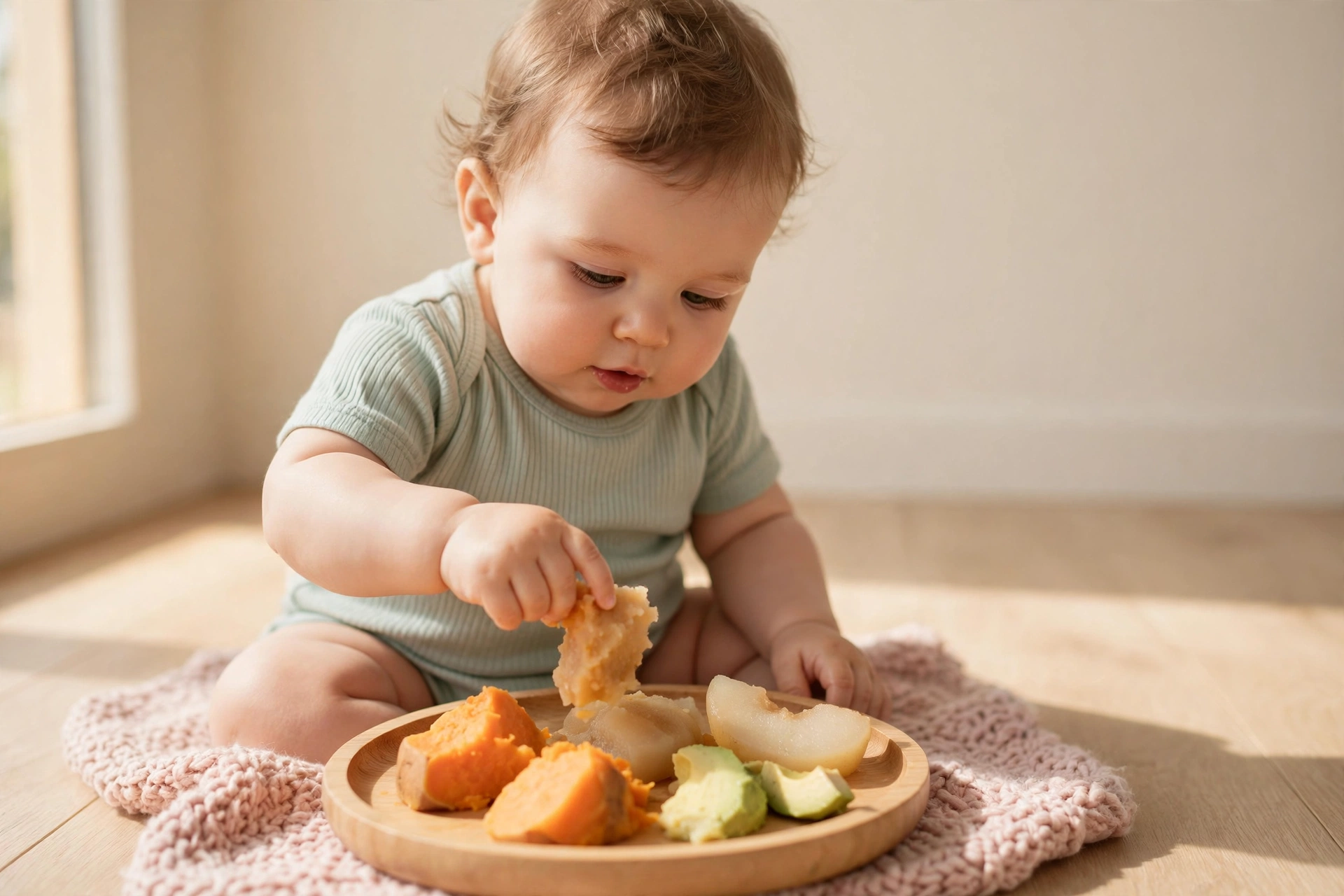
At snack time, scatter a few big, soft pieces of finger food on the tray — pieces of banana, soft-cooked vegetable sticks, large pasta shapes — and let your baby practise the pick-up: thumb, finger, aim, mouth. It is the pincer grip’s favourite workout, done sitting down, strapped in and watched throughout. Keep pieces big and soft, and treat it as play at the table, not a race to eat.
8. First puzzle with big knobs
Offer a simple puzzle of two or three big pieces with chunky knobs to grab — or make the home version: big shapes hidden under a cloth, lifted out one at a time. Lifting a knob piece out is easy joy; getting it back in takes turning, trying and turning again, which is problem-solving at exactly the right size. Adult-made big pieces only — nothing that could fit inside a cardboard toilet-roll tube.
9. Where’s the sound?
Shake a sealed, taped-shut shaker (an adult makes it and checks the seal before every use) and hide it nearby — behind a cushion, under a cloth, just round the chair leg. Then ask: “Where’s the sound?” Turning towards a noise, searching for it and finding it is listening, memory and movement in one small mystery. Start easy; being found quickly is the fun.
10. Pointing-and-naming walks
Carry or cruise your baby slowly around the room, the garden or the street and follow their finger: whatever gets pointed at gets named, clearly and cheerfully — “lamp”, “cat”, “bus”. Your baby is building a word collection on purpose now, and pointing is how they place their orders. Pause and let them look as long as they want; the naming works best at baby pace.
11. Waving, clapping and copying games
Practise the social big three: waving bye-bye (to people, toys, the cat, departing buses), clapping along to songs, and copying games — you pat your head, they pat theirs. Copying is how babies rehearse everything social, and ten month olds are champion copycats. Keep a running game through the day: every goodbye gets a wave, every success gets a clap.
12. First scribbles
Tape a big sheet of paper to the floor or a low table, hand over one thick, chunky crayon, and let your baby make their first marks: dots from banging, lines from sweeping the whole arm. Sit right there throughout — crayons are for paper, but a 10 month old will absolutely taste-test one — and put the crayon away when drawing ends. Two proud minutes is a masterpiece at this age.
Staying safe at 10 months
- Babies explore with their mouths — offer only big, clean, washable things that cannot break or come apart.
- Nothing small: the pincer grip now picks up the tiniest crumb and coin, and if it could fit inside a cardboard toilet-roll tube, it is too small for a baby.
- Water is only ever for splashing and pouring while you are holding your baby or within arm’s reach — never leave a baby alone with water, not even for a second.
- Cruise and stand only along furniture that is heavy and stable — push-test it first. Keep stairs behind a closed door or a safety gate, and move dangling cords, cables and tablecloths (and everything on them) out of reach.
Read next
- Baby Activities — Simple Play Ideas for 0–12 Months — the whole first year, month by month
- Activities for 9 Month Old — Cruising, Posting and Hide-and-Find — the stage just before this one, first cruising and posting games
- 25 Activities for 1 Year Olds — a peek at the toddler year ahead, for when the first steps turn into real walking
Activities for 10 month olds — questions parents ask
How long will a 10 month old play at one activity?
A little longer than before — five to ten happy minutes is common now, especially for standing, posting and carrying games. Play still comes in bursts between feeds, naps and nappy changes, and following your baby’s lead beats any schedule. When the cruising heads off in a new direction, the activity has changed rather than ended.
My baby is not standing or cruising yet. Are these activities still OK?
Yes. Babies reach standing in their own time — some are cruising at nine months, others are happily crawling, rolling and sitting-playing well past ten, and both are normal ways to grow. Use the sitting and floor versions of these games, keep offering chances to pull up with you beside them, and remember the floor strength built now is exactly what standing is made of. If your baby’s movement ever worries you, mention it to your doctor or health visitor.
Do I need special toys for any of this?
No — look at the lists again: furniture to cruise along, a sturdy box, cups, a bucket, a ball and one chunky crayon. The things worth choosing carefully: anything offered for mouthing or picking up must be big, clean and impossible to break apart, because that clever pincer grip finds everything. Your floor, checked and cleared, is still the best toy of the month.