
Short answer: These 12 activities for 3 month old babies build on what your baby is learning now — holding that head up, batting, grasping and chatting back — all free, safe and screen-free. Three months is when play wakes up.
Quick facts
- Ages: 3 months
- Cost: free — ordinary household things
- Screen-free: yes — every idea on this page
- Skills: batting, first grasping and head control
What to expect at 3 months
Around three months, the sleepy newborn stage gives way to a much more awake, interested baby. On their tummy, most 3 month olds now push up on their forearms and lift their head high and steady for longer stretches — and turn it to follow you. Hands are the big story this month: they are opening more, coming together in the middle, finding the mouth, and starting to swipe and bat at things that dangle. Smiles are social now — your face and voice are still the favourite entertainment — and cooing has real back-and-forth in it. If you are wondering what to occupy a 3 month old with, the honest answer is short bursts of exactly this: looking, chatting, reaching and floor time, fitted between feeds and naps. Some babies even surprise everyone with a first roll from tummy to back towards the end of the month; many wait longer, and that is fine too.
The information on this page is general information for parents, shared for learning and activity ideas. It is not medical advice, and it does not replace the guidance of a qualified professional. Every child develops at their own pace — if you have any concern about your child’s development, please talk to a qualified doctor or child-development professional.

Tummy time and looking
Three months is when tummy time gets serious — and when looking becomes a game in its own right. Little and often is the rule: a few minutes at a time, several times a day, with you down at your baby’s level.
1. Longer tummy time with a rolled towel
Roll a hand towel and tuck it snugly under your baby’s chest, with their forearms resting over it, so their head and shoulders get a helpful lift. Get down face-to-face, talk, sing and pull your best faces — your encouragement is the whole game. Build the minutes up gradually, and always stop while it is still going well.
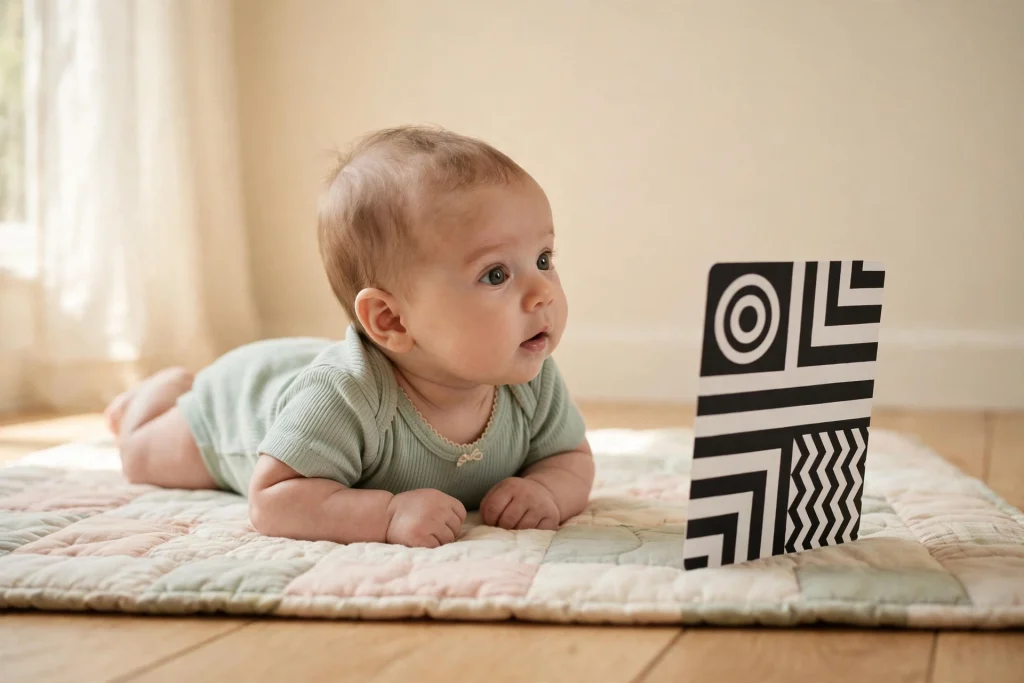
2. High-contrast tracking
Prop a black-and-white card or bold-patterned picture about a forearm’s length from your baby’s face — that is still the distance they see best. Move it slowly out to one side, pause, and let those eyes follow; then back, and the other way. At three months the head often joins the chase. Slow, simple and fascinating to them.
3. Mirror time on the tummy
Place a baby-safe mirror against the wall or a low pile of cushions at floor level, where your tummy-time baby can see it. Babies this age are captivated by the “other baby” — expect fixed stares, smiles and an extra effort to lift the head higher for a better look. Use a shatterproof baby mirror or a polished metal sheet, never household glass.
4. Texture touch in tummy time
Lay two or three squares of very different fabric under your baby’s hands during tummy time — smooth cotton, bumpy towelling, a silky scarf, a crinkly cloth square. Run fingers and palms over each one and name the feeling: soft, rough, smooth. Propped up like this, hands are free to explore while the neck gets its workout.
5. Cycling songs
For a gentle break between tummy sessions, lay your baby on their back and cycle the legs softly — one, then the other — while you sing a bouncy song or count the “pedals”. Add little arm movements in and out, in time with the music. Never force a joint: movements stay small, slow and easy. Babies often repay this one with big kicks.
6. Bath-time kicking splash
Support your baby securely in warm bath water — one hand under the head and shoulders, a firm hold the whole time — and let those legs discover kicking. Kicks make splashes, splashes get watched, and the whole bath becomes a game. Keep it short and comfortably warm, with your attention fully on your baby, every second.
Batting, grasping and chatting
Hands start joining in properly this month: swiping becomes batting, batting becomes reaching, and a light toy placed in the palm suddenly gets held. This set builds on all of it — plus the chatting that ties it together.
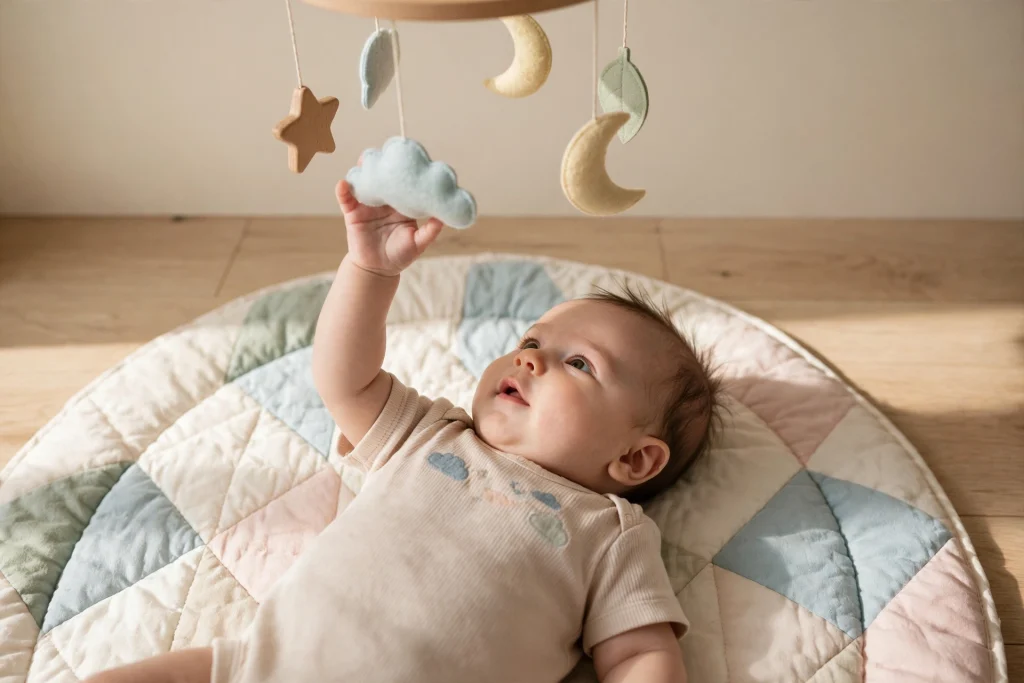
7. Dangling toy batting practice
Lay your baby on their back under a play gym with one or two soft toys dangling low enough to touch the backs of their hands and forearms. The first swipes are accidents; the tenth is on purpose. Reaching up against gravity is serious shoulder and arm work. Tie every hanging toy on securely, keep strings short, and pack the gym away at sleep time.
8. First rattle grasping
Choose the lightest rattle or soft ring you have and rest it against your baby’s palm — at three months, fingers will often close around it. Let them hold, wave and drop it as often as they like; the drop is part of the lesson. Big, light and washable is the rule, and anything that fits through a toilet-roll tube stays out of the game.
9. Hand-watching and hand-clasping games
Babies this age study their hands like new inventions. Hold your baby facing you and gently bring their two hands together at the middle — clap them softly, let them clasp their own fingers, and watch the fascination. Mittens are put away this month, if you ever used them: bare hands learn faster — and they are free to find each other, and that interesting mouth.
10. Kicking gym
Lie your baby on their back in front of toys arranged at foot height — a scarf draped over your toes-level hands, soft bells tied to a frame above their feet, or toys lined along the end of the mat — and let the kicking begin. Contact brings noise, movement and delighted repeat kicks: leg strength and cause-and-effect in one game. Everything stays securely fastened, you stay beside them, and the setup comes down when play ends.
11. Cooing conversations
When your baby coos, answer — copy the sound back, add a word or two, then pause and wait. At three months these little chats have real turns in them: your baby listens, replies, and listens again. Face-to-face on your lap or the mat gives the clearest view of your mouth. It looks like nothing; it is the foundation of language.
12. Scarf pull-down peekaboo
Hold a light, breathable scarf up between you and your baby, let it float for a second, then pull it down with a big smile — peekaboo! Three month olds light up at the reveal, and the watching between builds early anticipation. You stay in charge of the scarf at all times; light fabric only, never left over the face, and it goes back in the drawer when the game ends.
Staying safe at 3 months
- Babies explore with their mouths — offer only big, clean, washable things that cannot break or come apart.
- Nothing small: if it could fit inside a cardboard toilet-roll tube, it is too small for a baby.
- Water: bath play happens only while you are holding your baby securely, with a hand on them the whole time — never leave a baby alone with water, not even for a second.
- All play happens on a mat on the floor. Never leave your baby on a sofa, bed or changing table — wriggling and first rolls start without warning now, so keep one hand on your baby on any raised surface.
- Tie dangling toys on securely and keep every string and ribbon short — nothing loops around a baby’s neck, ever — and take the play gym down at sleep time.
Read next
- Baby Activities — Simple Play Ideas for 0–12 Months — the whole first year, month by month
- Activities for 6 Month Old — Sitting, Splashing and Exploring — a peek at what comes next: sitting up, splashing and two-handed play
- When Do Babies Say Their First Word? — a gentle guide to babbling, first words, and how everyday talk helps them along
Activities for 3 month olds — questions parents ask
How long will a 3 month old play at one activity?
In short bursts — often just two to five minutes before your baby needs a change of view, a feed or a sleep, and that is completely normal. Awake windows are still short at three months. Several little moments across the day add up to plenty. Looking away, fussing or a big yawn is your baby’s way of saying “enough for now”.
My baby still hates tummy time. Are these activities still OK?
Yes — most babies protest tummy time at first, and the head-lifting strength it builds arrives in its own time. Keep sessions short and often, use the rolled towel for support, and try tummy time on your chest while you lean back if the floor version ends in tears. Stop while it is going well rather than after it falls apart. If your baby’s movement ever worries you, mention it to your doctor or health visitor.
Do I need special toys for any of this?
No — look at the lists again: a towel, fabrics from the cupboard, a scarf, a light rattle, and cards you can draw yourself with a thick black marker on white card (bold stripes, circles and checkerboard squares are perfect). High-contrast pictures and sturdy board books made for babies are the only things worth choosing carefully. Your face, your voice and a clear patch of floor do most of the work at three months.