
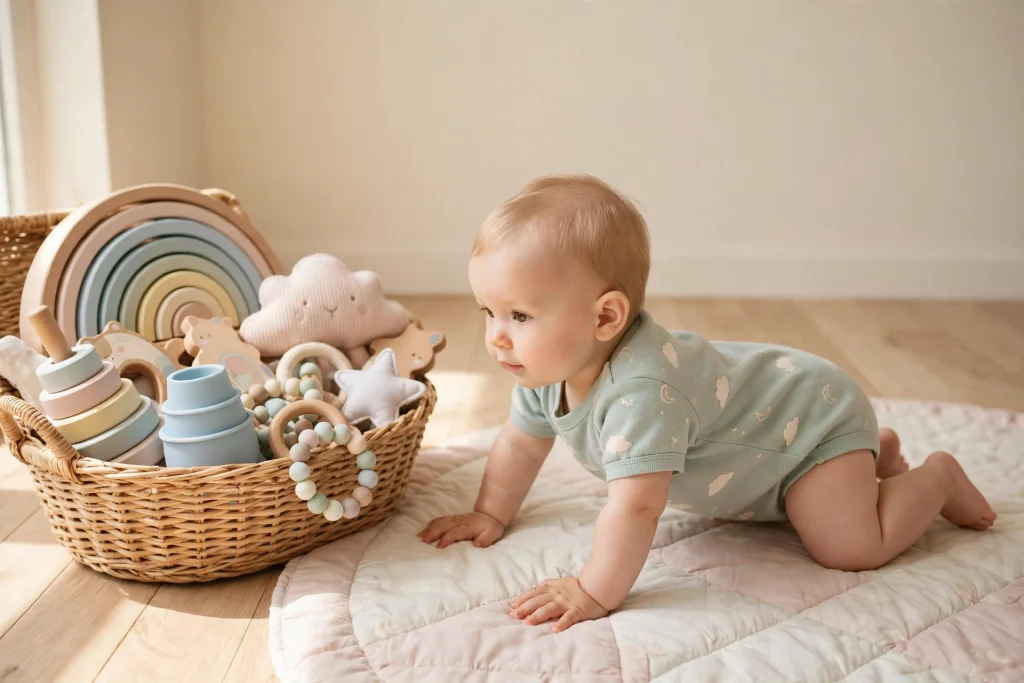
Short answer: Activities for 8 month old babies start with the explorer month: these 12 activities turn your floor into an adventure — crawl trails, cushion climbs, treasure baskets and splashing — all free, safe and screen-free.
Quick facts
- Ages: 8 months
- Cost: free — ordinary household things
- Screen-free: yes — every idea on this page
- Skills: crawling, exploring and early problem-solving
What to expect at 8 months
Around eight months, most babies are sitting steadily without their hands — which frees those hands for serious exploring. Many are on the move: crawling on hands and knees, commando-crawling on their tummy, scooting on their bottom, or rolling everywhere they want to be — all of them count. Some are pulling up on the furniture or cruising a step or two along the sofa. Hands are cleverer now: your baby rakes things towards themselves, bangs two objects together, and is starting to pick up smaller pieces with a thumb-and-fingers grip. Babble grows tuneful strings (“ba-da-ma-ba”), your baby knows their own name, and they have worked out that things still exist when they cannot see them — which is why hidden toys are suddenly fascinating. Strangers may get a suspicious stare this month; that wariness is a healthy sign of how well your baby knows you. And everything still goes to the mouth first, so the floor check matters more than ever now your baby can travel to find things.
The information on this page is general information for parents, shared for learning and activity ideas. It is not medical advice, and it does not replace the guidance of a qualified professional. Every child develops at their own pace — if you have any concern about your child’s development, please talk to a qualified doctor or child-development professional.
On the move
Your baby has transport now, and the whole room is the destination. Clear a safe crawl zone, get down there with them, and let the journeys begin.
1. Crawl-to-the-toy trail
Lay three or four favourite toys in a loose trail across the mat, each one a short crawl beyond the last, ending with the best-loved toy of all. As your baby reaches each stop, celebrate, then let them spot the next. Move the trail a little further apart over the days — distance is the challenge, and arriving is the prize.
2. Cushion mountain climb
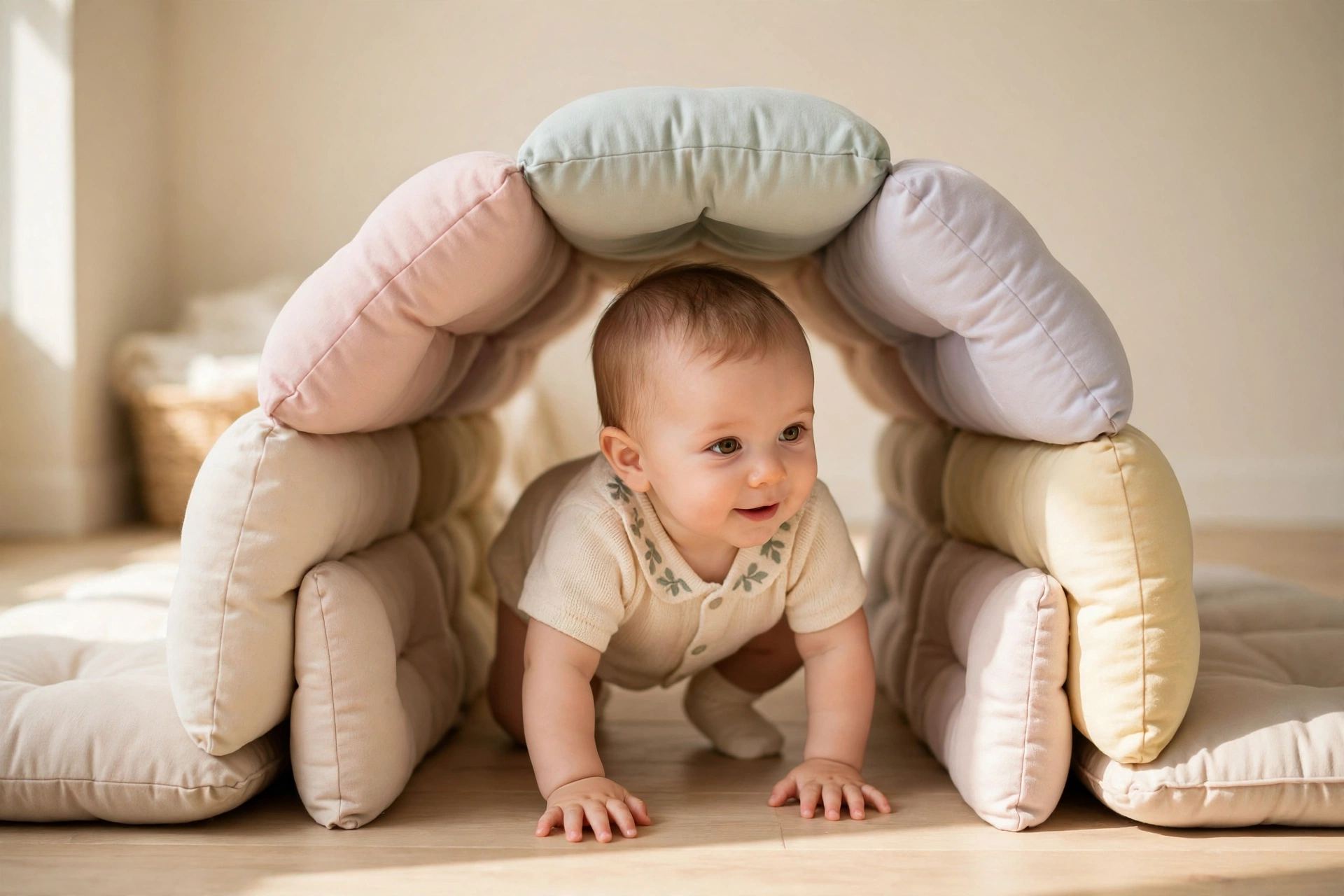
Build a low mountain of sofa cushions and pillows on the floor and sit your baby at its base with a toy at the top. Climbing over soft, wobbly ground works arms, legs and balance harder than flat crawling — and the slide down the other side is pure joy. Stay right beside the mountain, spotting every climb; soft and low is the whole point.
3. Tunnel crawl
Open out a big cardboard box at both ends, or drape a blanket over two chairs, and sit at the far end calling and waving. Crawling through a short tunnel to reach your face is irresistible for most 8 month olds — and ducking, judging the space and pushing through builds real body awareness. Keep the tunnel short enough that your baby can always see the light (and you) at the end.
4. Rolling ball chase
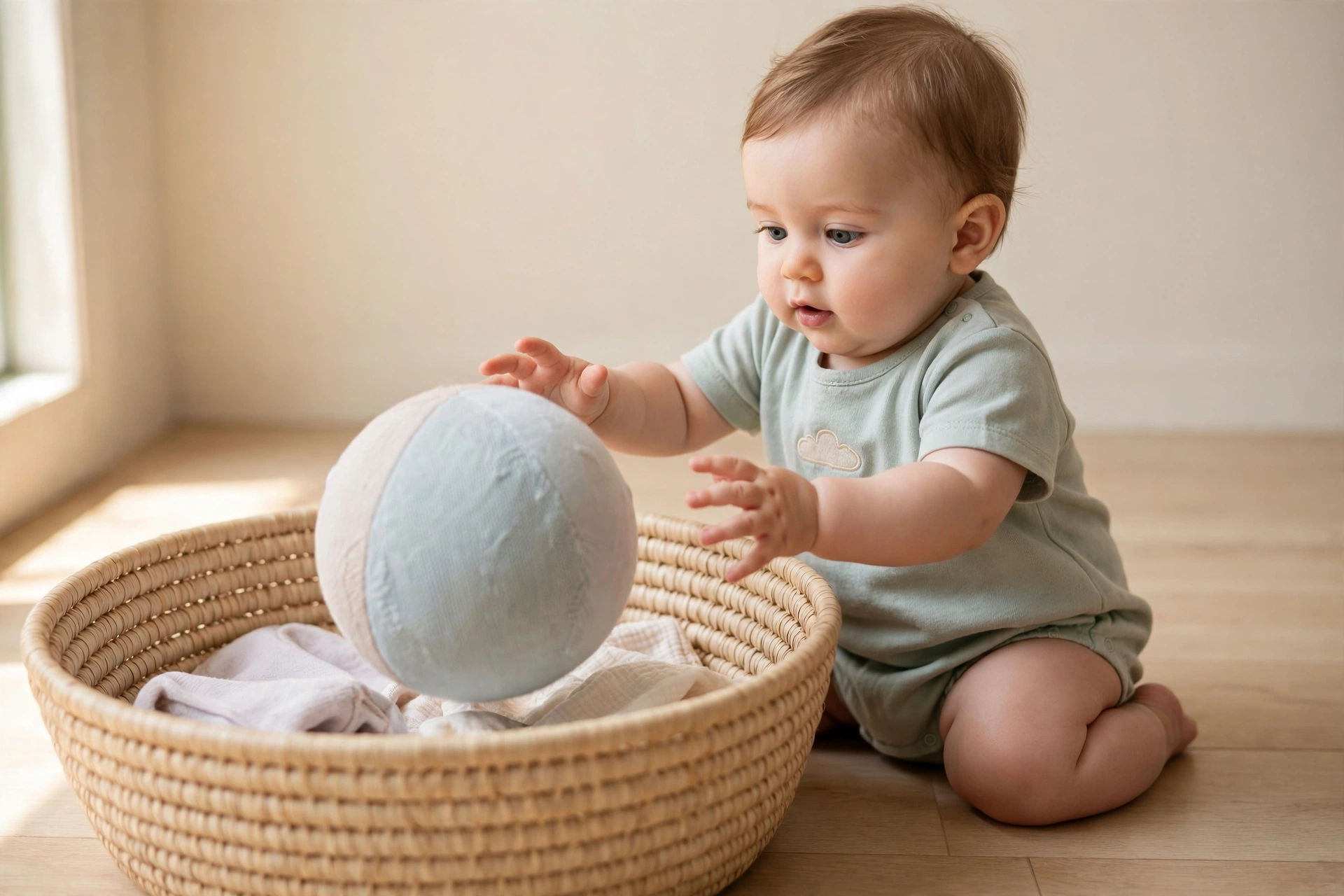
Sit a few feet away and roll a big, slow ball gently past your baby — close enough to chase, slow enough to catch. Mobile babies will set off after it with total determination; when they catch it, roll it from a new direction and go again. Choose a ball too big to mouth and soft enough to land on. This simple chase is crawling practice with a storyline.
5. Hide-and-find hunt
While your baby watches, tuck a favourite toy halfway under a cloth, then under a cushion, then behind your back — “where’s it gone?” Eight month olds are just learning that hidden things still exist, and whipping the cloth away themselves is a genuine discovery, every single time. As the month goes on, hide more of the toy and let the searching — and the crawling to check the next spot — do the work.
6. Collect-and-fill crawl
Scatter four or five big, soft objects — soft blocks, rolled socks, a rubber ring — around the mat, with an empty box in the middle. Show your baby: crawl out, grab one, bring it back, drop it in the box. Fetch, carry, drop, cheer, repeat. It is emptying-and-filling play with a journey attached, and the box filling up is a trophy your baby built themselves.
Hands, senses and sounds
Sitting tall with busy hands, your 8 month old is ready for baskets to raid, things to drop, cups to bang and long chats in babble.
7. Treasure basket exploring
Settle your baby sitting beside a basket of big, clean, mouth-safe objects with different textures and weights: a wooden spoon, a crinkly cloth, a soft brush, a metal whisk, a rubber ring. Mobile babies raid rather than receive — expect everything pulled out, examined, tasted and dropped before one winner is chosen. Swap a few objects every few days so the basket keeps its surprises. Big and washable only, as always.
8. Drop-and-watch games
From the high chair or your lap, offer safe objects one at a time and let your baby do the science: drop it, watch it fall, look at you, wait for the return. This month your baby is testing gravity on purpose — I let go, it falls, it makes a sound — and the peek over the tray edge to check where it landed is object permanence in action. You are the retrieval service; the repetitions are the learning.
9. Bang-and-stack cups
A set of stacking cups works three jobs at 8 months: bang two together like cymbals, knock down every tower you build, and — late in the month, maybe — stack two wobbly cups with total concentration. Add a ball too big for the smallest cup and let your baby discover it fits the biggest one. Cheap, washable, and good for a year of play.
10. Water splash and pour
On a towel on the floor (or in the bath with you), give your baby a shallow bowl of warm water, a cup for pouring and something that floats. Splashing, patting the surface and watching water pour from the cup is first-class sensory play. You stay within arm’s reach the whole time — water play happens with you, every second, and the bowl is emptied the moment the game ends.
11. Copy-cat sounds and babble chats
When your baby babbles “ba-ba-ba”, answer with the same sounds back, then add one of your own and wait. These back-and-forth chats — your baby’s first real conversations — teach turn-taking, listening and the tunes of speech. Do it face to face on the floor, in the high chair, at nappy changes. Your baby does not care whether the chat makes sense.
12. Board books with pointing
Board books get interactive now: your baby turns the thick pages (sometimes three at once), pats the pictures and may start pointing at a favourite with one determined finger. Name what they point at, make the animal noises, and read the same favourites again and again — repetition is how the words go in. Choose sturdy books made for babies, and retire any that are peeling or torn.
Staying safe at 8 months
- Babies explore with their mouths — offer only big, clean, washable things that cannot break or come apart.
- Nothing small: if it could fit inside a cardboard toilet-roll tube, it is too small for a baby — and your baby can now travel to find the small things.
- Water is only ever for splashing while you are holding your baby or within arm’s reach — never leave a baby alone with water, not even for a second.
- Do a floor sweep every day before floor play: coins, buttons, batteries, older children’s small toys and pet food all move out of reach first — a crawling baby finds what a glance misses.
- Clear the crawl zone: pull dangling cords and cables up out of reach, move cleaning bottles and medicines behind closed doors, and check furniture edges and corners your baby could pull up or topple against.
Read next
- Baby Activities — Simple Play Ideas for 0–12 Months — the whole first year, month by month
- Activities for 6 Month Old — Sitting, Splashing and Exploring — the stage just before this one, sitting games and first splashing
- 25 Sensory Activities for Toddlers — gentle sensory ideas; many also suit older babies, with you close by
Activities for 8 month olds — questions parents ask
How long will an 8 month old play at one activity?
Still just a few minutes on one thing — but the day now holds many more play moments, because your baby can get to the play themselves. Follow their lead: when the crawling heads off in a new direction, the activity has changed rather than ended. Several floor-play sessions across the day, mixed with chats, songs and book time, add up to plenty.
My baby is not crawling yet. Are these activities still OK?
Yes. Babies find their own ways to move — some crawl early, some bottom-shuffle, some roll everywhere, and some spend longer sitting and exploring with their hands first. Tummy and floor play in these activities builds exactly the strength moving takes. Offer the chances daily, keep it fun, and if your baby’s movement ever worries you, mention it to your doctor or health visitor.
Do I need special toys for any of this?
No — the lists above are cushions, boxes, cups, baskets and kitchen things. The two things worth choosing carefully are the same as ever: sturdy board books made for babies, and anything offered for mouthing — big, clean, washable and impossible to break apart. Your floor, cleared and safe, is the best toy of this month.