
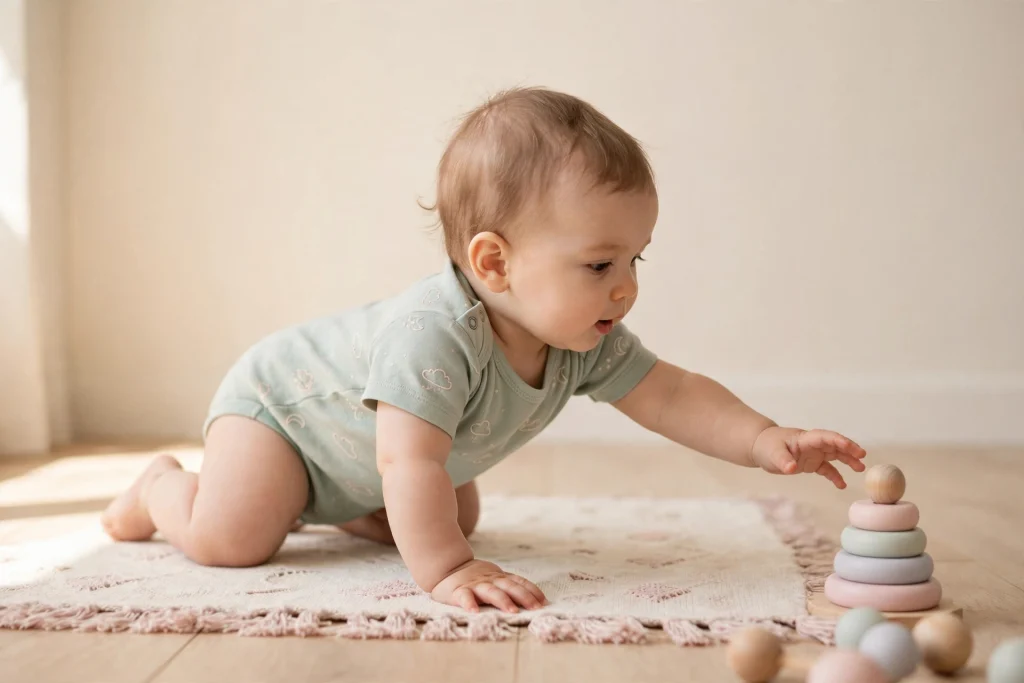
Short answer: These 12 activities for 7 month old babies build rocking, reaching and babbling skills with things you already have — free, safe and screen-free. Seven months is the almost-moving month.
Quick facts
- Ages: 7 months
- Cost: free — ordinary household things
- Screen-free: yes — every idea on this page
- Skills: pre-crawling strength, reaching and early babbling
What to expect at 7 months
Around seven months, many babies are on the verge of moving. Yours may be getting up on hands and knees and rocking back and forth — the warm-up act for crawling — or may already be shuffling, pivoting or rolling to get around. Sitting is steadier now, often without hands for support, which frees those hands for serious work: passing toys hand to hand, raking at small things, and banging two objects together for the noise. Babbling gets chattier and more varied, your baby probably recognises their own name, and peekaboo lands better than ever because your baby is learning that hidden things still exist. A touch of wariness with new faces can appear now too — all normal, and everything still goes to the mouth first.
The information on this page is general information for parents, shared for learning and activity ideas. It is not medical advice, and it does not replace the guidance of a qualified professional. Every child develops at their own pace — if you have any concern about your child’s development, please talk to a qualified doctor or child-development professional.
Rocking and reaching
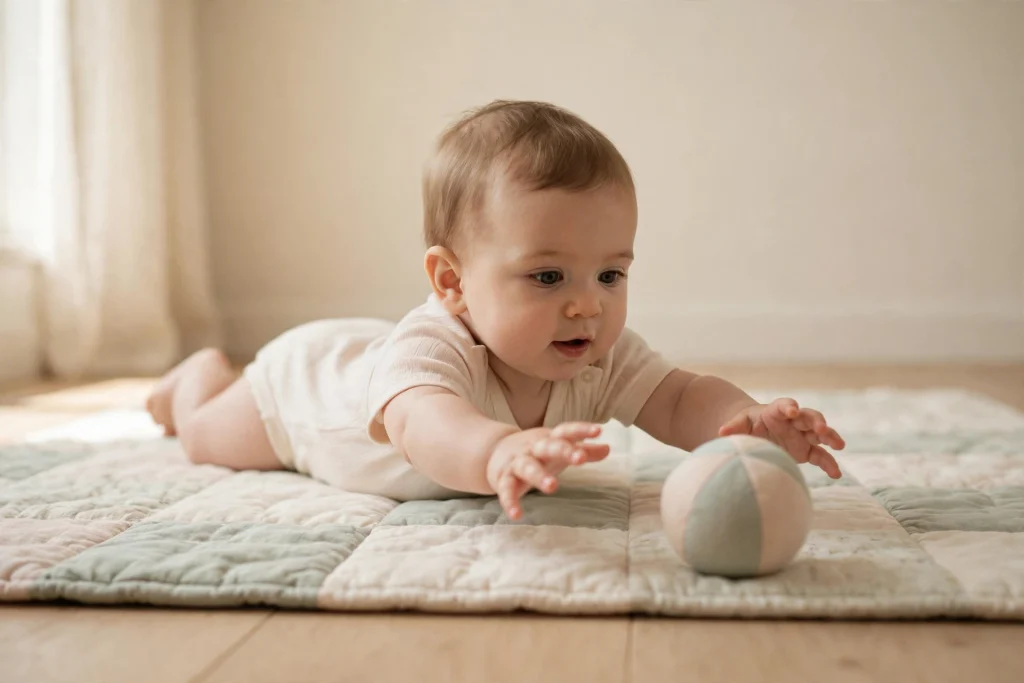
Crawling rarely arrives all at once — it is built piece by piece, out of rocking, reaching, rolling and lunging. This set strengthens every piece of it, on a soft mat, with you right there cheering.
1. Rocking practice on hands and knees
Set your baby on a mat and place a favourite toy just ahead of them, then let them find the hands-and-knees position and rock — forwards, backwards, forwards again. That rocking is not a failed crawl; it is the exact strength and balance work crawling is made of. Get down beside your baby and rock along with them: copycat motivation is powerful at seven months.
2. Reach-and-lunge games
Lay your baby on their tummy and put one beloved toy just beyond their grasp — close enough to want, far enough to work for. Watch the stretch: arms reaching, body pivoting, sometimes a surprise lunge that actually lands it. Move the toy a little to the left, then the right, so both sides get a turn. The almost-got-it stretch is the whole workout.
3. Rolling relay
Rolling is real transport now, so make it a game with a destination. Place a soft ball on one side of the mat and encourage your baby to roll over and fetch it — then put it on the other side and roll back again. Some babies roll in one direction only at first; the relay gently practises both. Celebrate every arrival like a finishing line.
4. Sitting balance reaches
Sit your baby on the mat with a cushion behind them and place toys at different angles — front-left, front-right, and one slightly to the side. Reaching out and across the body while staying upright is serious core and balance practice, and twisting to grab is how sitting turns into the pivot that starts a crawl. Stay close: the wobbles are frequent, and the landings should be soft.
5. Rolling-cylinder chase
Roll something slow across the mat — a rolled-up towel or a soft foam roller works well — and let your baby pivot, roll or scoot after it. Cylinders roll in a gentle arc, which keeps the chase interesting without the prize escaping too fast. Roll it a short way at a time and let your baby win often. This is crawling practice disguised as a hunt.
6. Supported standing bounce
Hold your baby securely under the arms, standing on your lap or on the floor with feet flat, and let them push down and bounce for a few seconds. Those little leg pushes build the strength standing will soon need. Keep it brief and bouncy, stop the moment the legs tire, and always keep your baby fully supported — at seven months, you are the furniture.
Banging, dropping and babbling
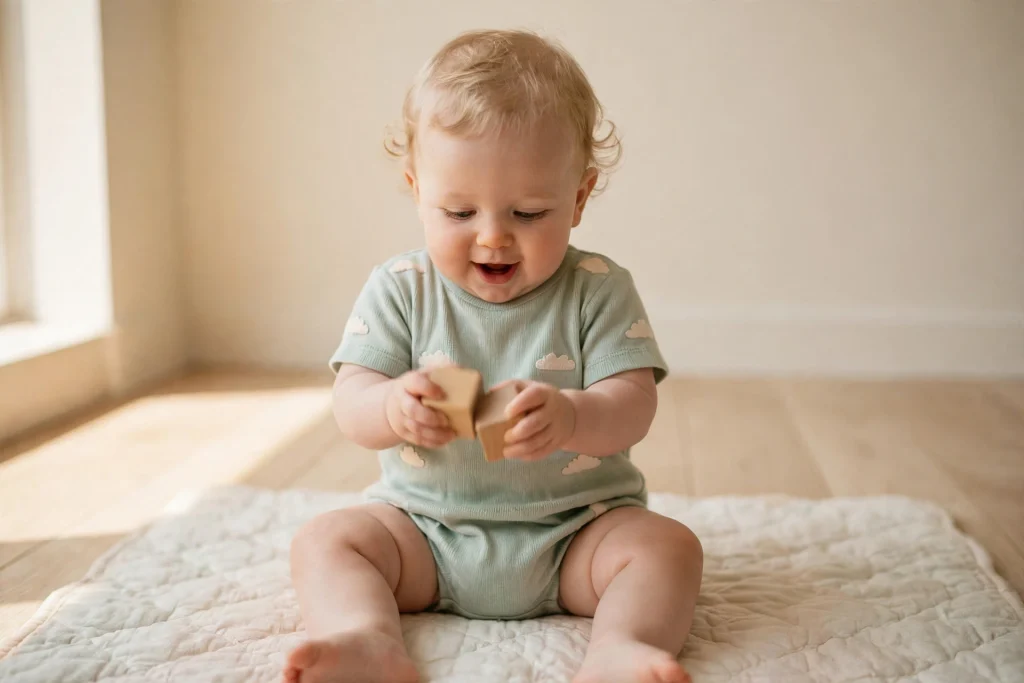
Hands and voice are the other big story this month. Your baby can hold one thing in each hand, has strong opinions about noise, and is discovering vanished toys still exist — this set feeds all three.
7. Bang two things together
Put a wooden block in each of your baby’s hands and tap your own two blocks together in the middle, where they can copy you. Banging two objects together at the midline is a real seven-month skill — both hands, both sides of the brain, one joyful crash. Offer pairs that sound different (wood on wood, a spoon on a tin) and let your baby run the concert.
8. Drop-it games
Seat your baby on the floor with a low tray beside them, or in the highchair with you right there, and hand over safe, unbreakable things to drop. Down they go — and your baby watches, listens for the landing, and looks at you: again. Dropping on purpose is a baby science experiment in cause, effect and gravity. Your job is the cheerful returning; it is part of the game, not a chore.
9. Find the hidden toy
While your baby watches, half-hide a favourite toy under a cloth so one corner peeks out, and let them pull the cloth away and find it. Over the week, hide a little more of it each time, until the toy vanishes completely and your baby still goes hunting. This is object permanence — the understanding that gone is not the same as gone forever — arriving through play.
10. Water cup pouring
At the splash tray or in the bath, give your baby a plastic cup and show them how it fills and tips. At seven months the “pouring” is mostly enthusiastic tipping — water out, cup in the mouth, cup banged on the side — and all of it is learning. Help them scoop, let them tip, and keep yourself within arm’s reach for every second: water play at this age happens with you, always.
11. Sing-and-clap copy games
Clap a slow, simple pattern — clap, clap, pause — and watch your baby’s hands. Many seven month olds try to copy, or answer with banging, waving or a delighted shout. Sing the action rhymes and clap on the beat, then stop and leave a gap for your baby’s “turn”. This copy-and-answer rhythm is music, memory and early turn-taking in one.
12. Babble conversations
When your baby babbles, answer — seriously, as if they have just made an excellent point. “Ba-ba-ba” gets a proper reply from you, then a pause while your baby takes their turn. Face to face, at their level, this is a real conversation in every way that matters. Name what you are both looking at as you chat. These exchanges are the root system of first words.
Staying safe at 7 months
- Babies explore with their mouths — offer only big, clean, washable things that cannot break or come apart.
- Nothing small: if it could fit inside a cardboard toilet-roll tube, it is too small for a baby.
- Water is only ever for splashing and pouring while you are holding your baby or within arm’s reach — never leave a baby alone with water, not even for a second.
- Do a daily floor check before floor play: coins, buttons, batteries, pet food and older siblings’ small toys all move out of reach first — crawling practice covers more ground every day.
- Expect the lunge. Babies roll and stretch further than you think, and reach things that were “safely” out of range last week — keep play on the floor and never leave your baby alone on a bed, sofa or changing table.
Read next
- Baby Activities — Simple Play Ideas for 0–12 Months — the whole first year, month by month
- Activities for 6 Month Old — Sitting, Splashing and Exploring — the stage just before this one, if your baby is still in sitting-and-reaching mode
- When Do Babies Say Their First Word? — a gentle guide to babbling, first words, and how everyday talk helps them along
Activities for 7 month olds — questions parents ask
How long will a 7 month old play at one activity?
Usually just a few minutes at a time — and that is plenty. Babies this age play in short bursts between feeds, naps and nappy changes, and little play moments across the day add up. When your baby looks away, flops down or starts to fuss, that activity is finished for now; bring it back later and it will feel brand new.
My baby is not rocking or crawling yet. Are these activities still OK?
Yes — completely. The range of normal here is wide: some babies crawl at six months, some shuffle at nine, and some skip crawling altogether and go straight to pulling up. The tummy, rolling and reaching games in Section 1 build exactly the strength movement grows from, whatever order your baby chooses. If your baby’s movement ever worries you, mention it to your doctor or health visitor.
Do I need special toys for any of this?
No — look at the lists again: blocks, a towel, a cup, a cloth, a tray of water. Babies this age are mostly playing with you — your face, your voice and your cheerful fetching of dropped things. The one thing worth choosing carefully is still books: sturdy board books made for babies stand up to the banging and mouthing that are part of reading at this age.