
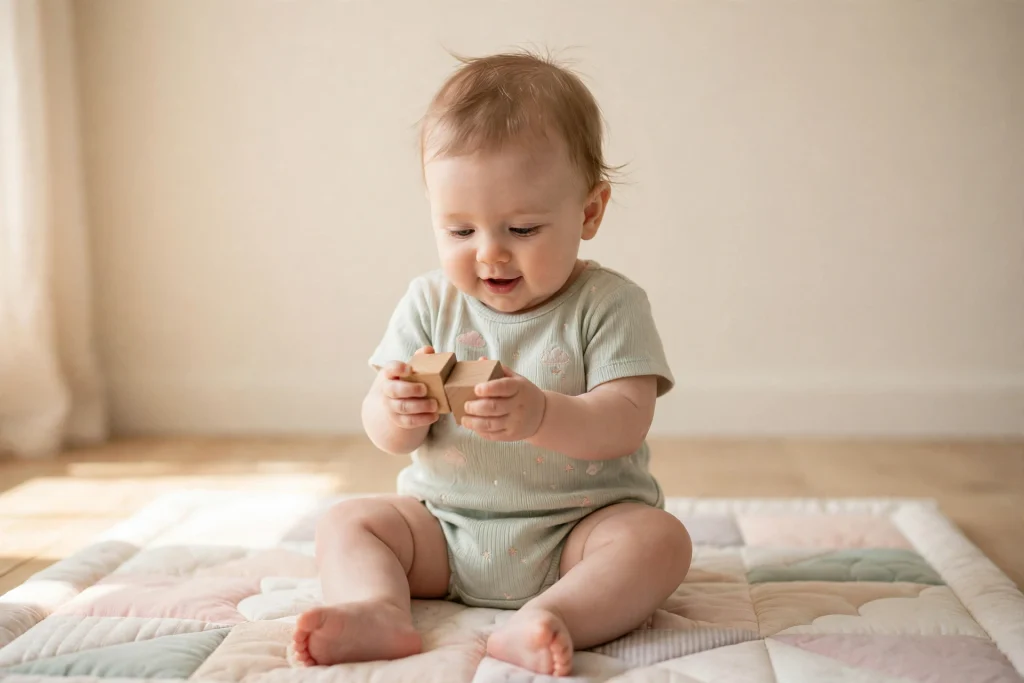
Short answer: Activities for 6 month old babies start with the sitting-up month: these 12 activities use things you already have — sitting games, gentle water play, textures, sounds and first rhymes — all free, safe and screen-free.
Quick facts
- Ages: 6 months
- Cost: free — ordinary household things
- Screen-free: yes — every idea on this page
- Skills: sitting, sensory play and first-weaning-age exploring
What to expect at 6 months
Around six months, the floor becomes a whole new world. Many babies are sitting with support — and briefly on their own, propped on their hands — and rolling in both directions. Hands work as a team now: your baby grabs with purpose, passes toys from hand to hand, rakes at small things and shakes anything that might possibly make a noise. Babbling grows chains of sounds (“ba-ba-ba”), familiar faces get the biggest smiles, and everything — everything — still goes to the mouth first. Many families also begin first tastes around this age, so holding, squishing and exploring food while you watch becomes a kind of play too. Sitting may still be wobbly and topples are normal; a soft mat and a parent close by are the standard setup this month.
The information on this page is general information for parents, shared for learning and activity ideas. It is not medical advice, and it does not replace the guidance of a qualified professional. Every child develops at their own pace — if you have any concern about your child’s development, please talk to a qualified doctor or child-development professional.
Sitting and reaching play
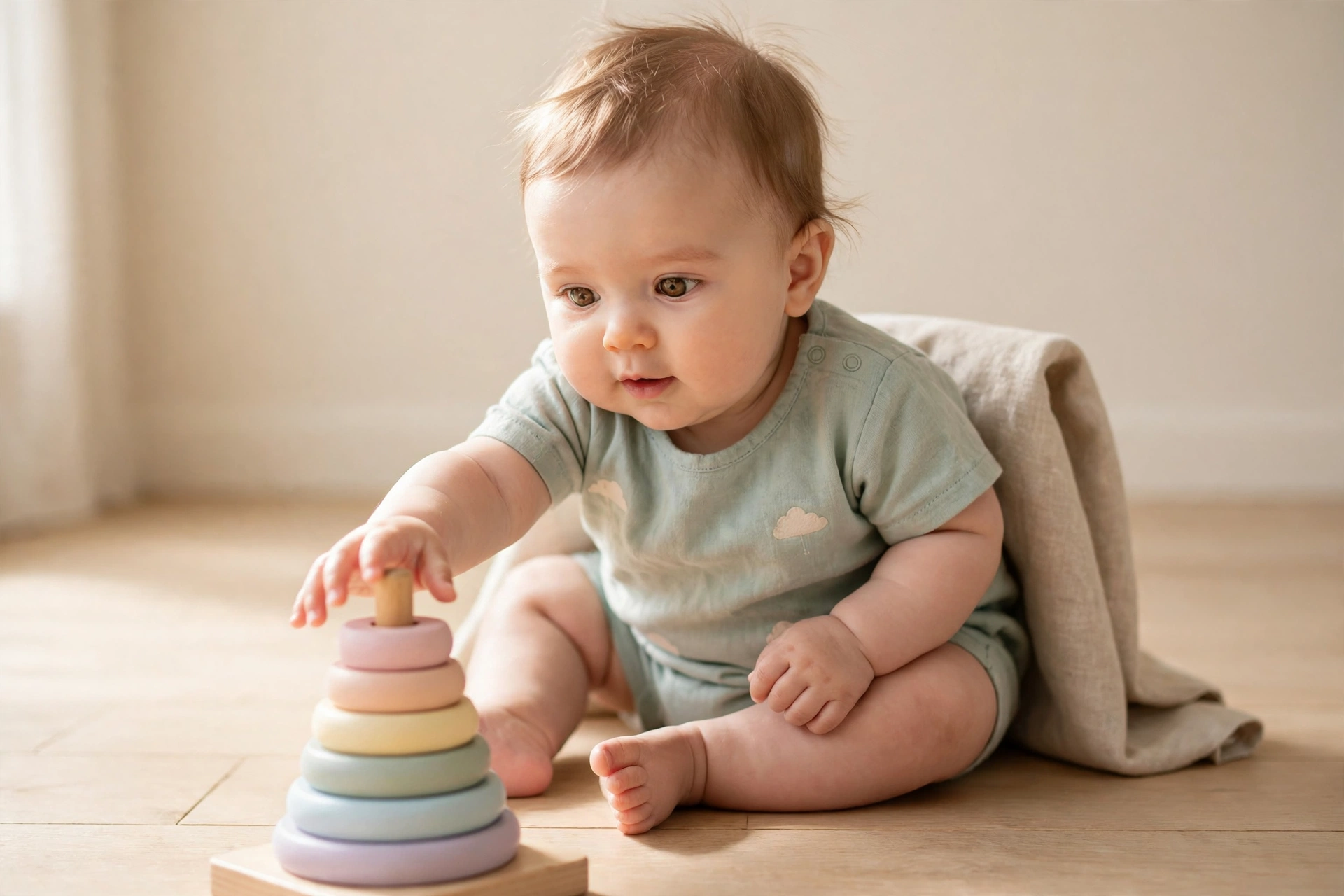
Sitting frees both hands, and that changes every game. Set your baby on a soft mat with cushions behind for soft landings, stay close, and let those hands get busy.
1. The sitting toy arc
Sit your baby on a mat with a cushion behind and one at each side, then arrange four or five favourite toys in a wide arc in front — near the knees and just within reach. Reaching forwards, sideways and across the body while staying upright is serious tummy-and-back strength work. Swap the toys every few minutes to keep the reaching going.
2. Tummy pivot challenge
Not all play is upright. Lay your baby on their tummy and place one beloved toy just out of reach, off to one side. Most 6 month olds push up on straight arms and pivot in a slow circle to line up with the prize — wonderful shoulder and core practice. Move the toy to the other side and go again, and finish while they are still winning.
3. Roll-the-ball exchanges
Sit facing your baby, both of you on the floor, and roll a big soft ball slowly into their lap. At six months the return “roll” is more of a happy two-handed push — catch it, celebrate it, and roll it back. This back-and-forth is your baby’s first real turn-taking game, the same give-and-take that conversation is built on.
4. Mirror play, sitting up
Prop a baby-safe mirror against the wall or a pile of cushions at your seated baby’s eye level. They will pat the “other baby”, grin at them and lean in for a closer look — sometimes with an open-mouthed kiss. Peek out from behind the mirror and pop back in for the giggle. Use a shatterproof baby mirror or a polished metal sheet, never household glass.
5. Cup tower knock-down
Stack three or four big plastic cups or clean food tubs into a tower within your sitting baby’s reach — and let them do the obvious. Knocking a tower down teaches cause and effect better than almost anything: I swipe, it crashes, everyone cheers. Build it again and again; the rebuilding is your job this month, the demolition is theirs.
6. Peekaboo scarf pull
Drape a light scarf over your face (or your baby’s, for just a second) and let your baby grab and pull it away themselves. Six month olds are moving from watching peekaboo to doing it — and the pull is great reaching and grasping practice. Light, breathable fabric only, and the scarf goes away with you when the game ends.
Senses, water and words
Six month olds learn through mouths, ears and splashing hands. This set feeds the senses — and your baby’s growing love of sounds, songs and your voice.
7. Bang-bang drum
Turn a sturdy pot or mixing bowl upside down in front of your seated baby and offer a wooden spoon. Some babies bang with the spoon, some with both flat hands, all of them with enormous seriousness. Drumming builds arm control and a joyful sense of “I made that happen”. Keep sessions short — your ears are also part of this household.
8. Water splash tray
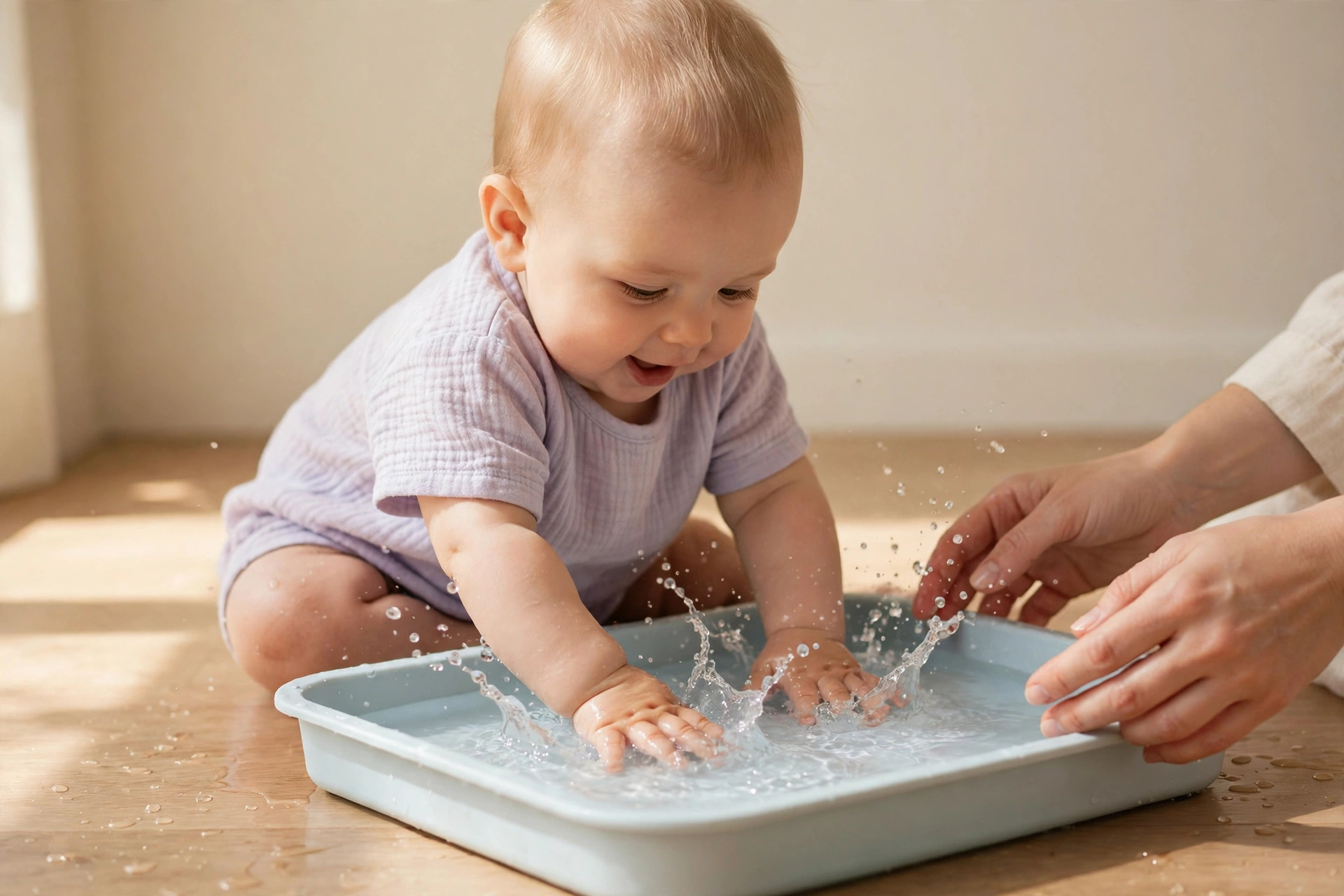
Pour a shallow layer of warm water into a baking tray or washing-up bowl on a towel on the floor, sit your baby securely at its edge — held firmly or between your knees — and let both hands splash. Add a floating cup or a clean sponge to squeeze. You stay within arm’s reach the whole time: water play at this age happens with you, every second.
9. Texture treasure basket
Fill a basket with big, clean, mouth-safe objects of different textures: a wooden spoon, a smooth pebble too big to fit in the mouth, a crinkly cloth, a soft brush, a rubber ring. Sit your baby beside it and let them pull things out, turn them over and taste-test each one. Once first foods have started, a big, soft piece of finger food to hold, squish and explore while you watch joins the collection beautifully.
10. Shake-and-listen shakers
Half-fill a small plastic container with dry rice, screw the lid on and tape it firmly shut (an adult makes these, and checks the seal before every use). Shake it beside your baby, then hand it over: rattle, pause, listen. Two shakers of different weights sound different — your baby is already comparing. Any container that looks worn or loose goes straight in the bin.
11. Board book time
Offer a chunky board book and let your baby run the show: holding it, turning the thick pages with a whole-hand swipe, patting the pictures and chewing the corner — all of it counts as reading at six months. Name what they pat (“duck!”) and keep sessions baby-led; two happy minutes is a full chapter at this age. Choose sturdy books made for babies, and retire any that are peeling or torn.
12. Rhymes with actions
Sing the old action rhymes — the ones with clapping, bouncing and a tickle or a lift saved for the last line. Six month olds quickly learn to expect the best bit: watch for the grin and the wriggle before the tickle lands. That anticipation, plus your singing voice and eye contact, is language learning in its happiest form. Your baby does not care whether you can sing.
Staying safe at 6 months
- Babies explore with their mouths — offer only big, clean, washable things that cannot break or come apart.
- Nothing small: if it could fit inside a cardboard toilet-roll tube, it is too small for a baby.
- Water is only ever for splashing while you are holding your baby or within arm’s reach — never leave a baby alone with water, not even for a second.
- Do a quick floor check before floor play: coins, buttons, batteries, older children’s small toys and pet food all move out of reach first.
Read next
- Baby Activities — Simple Play Ideas for 0–12 Months — the whole first year, month by month
- 24 Activities for 18 Month Olds — a peek at what comes after the first year, for when walking and words really take off
- When Do Babies Say Their First Word? — a gentle guide to babbling, first words, and how everyday talk helps them along
Activities for 6 month olds — questions parents ask
How long will a 6 month old play at one activity?
Usually just a few minutes at a time — and that is plenty. Babies this age play in short bursts between feeds, naps and nappy changes, and several little play moments across the floor-time parts of the day add up to a lot. When your baby looks away, arches or starts to fuss, that activity is finished for now; bring it back later and it will feel brand new.
My baby is not sitting yet. Are these activities still OK?
Yes. Every baby reaches sitting in their own time, and plenty of healthy 6 month olds still need full support. Use more cushions, lean your baby back against your body while you sit together on the floor, and lean on the tummy and floor activities in Section 1 — strength built there is exactly what sitting is made of. If your baby’s movement ever worries you, mention it to your doctor or health visitor.
Do I need special toys for any of this?
No — look at the lists again: pots, cups, scarves, spoons, a sponge, a mirror, a tray of water. The one thing worth choosing carefully is books: sturdy board books made for babies stand up to the chewing and page-swiping that are part of reading at this age. Everything else is already in your kitchen cupboards.