
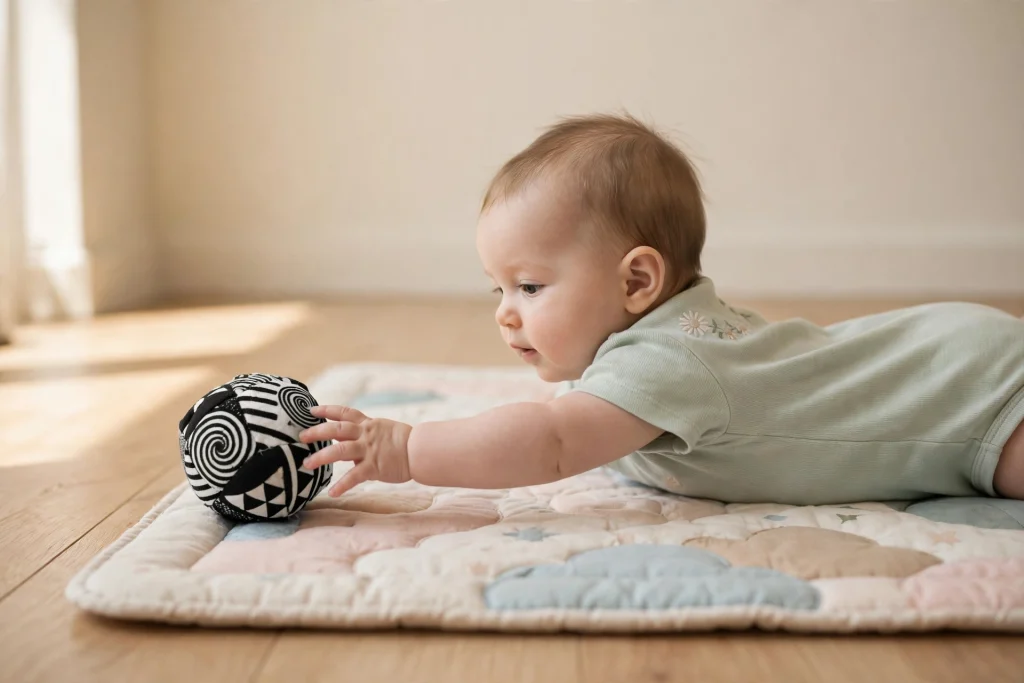
Short answer: Infant activities are simple baby play: your face, your voice, and safe things to look at, reach for and kick against. This page walks the whole first year — pick your baby’s month below for play ideas matched to exactly where they are.
Quick facts
- Ages: 0–12 months
- Cost: free — you and ordinary household things
- Screen-free: yes — every idea on this page
- Skills: sensory, movement and bonding through play
How baby play grows in the first year
Babies learn the same way all year — through their senses, through repetition, and most of all through you. What changes is what their body can do. Play follows the body: when babies can only look, looking is the game; when they can roll, rolling is the game. Here is how the year unfolds, in four gentle stages.
0–3 months — the sleepy sensory world. Newborns play in short bursts between feeds and sleeps. Their world is close-up: your face about a forearm’s length away, your voice, high-contrast patterns, gentle touch, and short moments of tummy time on a firm surface while you are right there. Talking and singing back to their coos is a real conversation — and real play.
4–6 months — reaching and rolling. Hands open up and the world becomes grabbable. Babies bat at dangling toys, grab their feet, push up strongly in tummy time and start rolling — usually tummy to back first. Peekaboo appears, giggles arrive, and everything grabbed goes to the mouth for inspection. Play is reaching, shaking, splashing and rolling practice.
7–9 months — the sitting, crawling world. Sitting frees both hands, so toys can be banged, passed and dropped (dropping is an experiment, honestly). Many babies are rocking, crawling or shuffling by now; babbling turns into long, chatty strings, and familiar people become very important. Play means exploring safely: things to crawl after, knock down and post into boxes.
10–12 months — cruising and first steps. Babies pull up on furniture and cruise along it sideways, and some take first wobbly steps before their first birthday — others wait a while longer, and that is fine too. Fingers get clever: pointing, clapping, waving, and picking up small bits of finger food with thumb and finger. Play is movement with a purpose — pushing, stacking, filling and emptying.
The information on this page is general information for parents, shared for learning and activity ideas. It is not medical advice, and it does not replace the guidance of a qualified professional. Every child develops at their own pace — if you have any concern about your child’s development, please talk to a qualified doctor or child-development professional.
A quick word on safety
Staying safe while you play
- Babies explore with their mouths — offer only big, clean, washable things that cannot break or come apart.
- Stay within arm’s reach at all times; play happens with you, not just near you.
- Nothing small: if it could fit inside a cardboard toilet-roll tube, it is too small for a baby.
- Water is only ever for splashing while you are holding your baby — never leave a baby alone with water, not even for a second.
Baby activities by month
Every month of the first year brings something new to play with. Choose your baby’s month — each page has simple activities matched to that stage, plus a gentle “what to expect” for the month.
1 Month Old Activities — Your brand-new baby plays by looking and listening: faces close up, gentle talking, high-contrast pictures and the first short tummy-time moments. This page keeps everything calm and cosy.
2 Month Old Activities — Smiles arrive, and cooing turns into little conversations. Play this month means face-to-face chats, tracking slow-moving toys together, songs, and happy kicking games on a mat.
3 Month Old Activities — Hands discover the world: batting, swiping and the first real grasps. Longer, stronger tummy time, dangling toys to hit, and plenty of chat back and forth fill this busy month.
4 Month Old Activities — Reaching, grabbing and the first rolls. Toys worth kicking at, rattles to shake, mirrors to charm, and lots of supervised floor freedom — this month is all about the grab.
5 Month Old Activities — Rolling both ways and passing toys from hand to hand. Peekaboo becomes hilarious, feet become favourite toys, and sitting with support opens up a whole new view.
6 Month Old Activities — Sitting up changes everything: two free hands for banging, splashing and exploring. Simple sitting, water and texture play for the half-year mark.
7 Month Old Activities — Rocking on hands and knees, babbling in long strings, and reaching for toys just out of reach. Crawling practice disguised as games — plus dropping, banging and first clapping.
8 Month Old Activities — On the move — crawling, shuffling or commando-style — and determined to explore. Safe floor adventures, cushion tunnels, and treasure baskets to empty and refill.
9 Month Old Activities — Cruising along the furniture, pointing at everything and waving bye-bye. Posting games, stacking to knock down, and hide-and-find play for this curious, mobile stage.
10 Month Old Activities — Standing tall and, for some babies, the first solo steps. Pushing toys, filling and emptying, simple posting play and early words — activities for the almost-toddler.
Also helpful for the first year
- 24 Activities for 18 Month Olds — a peek at what comes after the first year, for when walking and words really take off
- 25 Sensory Activities for Toddlers — gentle sensory ideas; many also suit older babies, with you close by
- When Do Babies Say Their First Word? — a gentle guide to babbling, first words, and how everyday talk helps them along
Baby activities — questions parents ask
How much play does a baby need?
Less than you might fear — and it is woven into the day rather than scheduled. Short bursts add up naturally: a few minutes of face-to-face chat here, some floor time there, a song during a nappy change. Follow your baby: when they look away, yawn or fuss, playtime is over for now. Feeding, changing and cuddling are already full of play — you are not behind.
Do I need baby classes or special toys?
No. The best first-year equipment is your face, your voice and a safe patch of floor. A few simple things — a soft ball, something that rattles, a scarf for peekaboo, some black-and-white pictures — can cover months of happy play. Classes can be a lovely outing for you, and meeting other parents matters too — but your baby does not need them to thrive.
What if my baby doesn’t enjoy tummy time?
Very common — many babies grumble about it at first. Keep it short and often: little and often beats one long battle. Try it on your chest while you lean back, get down at your baby’s eye level, place a rolled towel under their chest for support, and stop while it is still going well. It usually gets easier as babies grow stronger. If tummy time — or anything about your baby’s movement — worries you, mention it to your doctor or health visitor.