
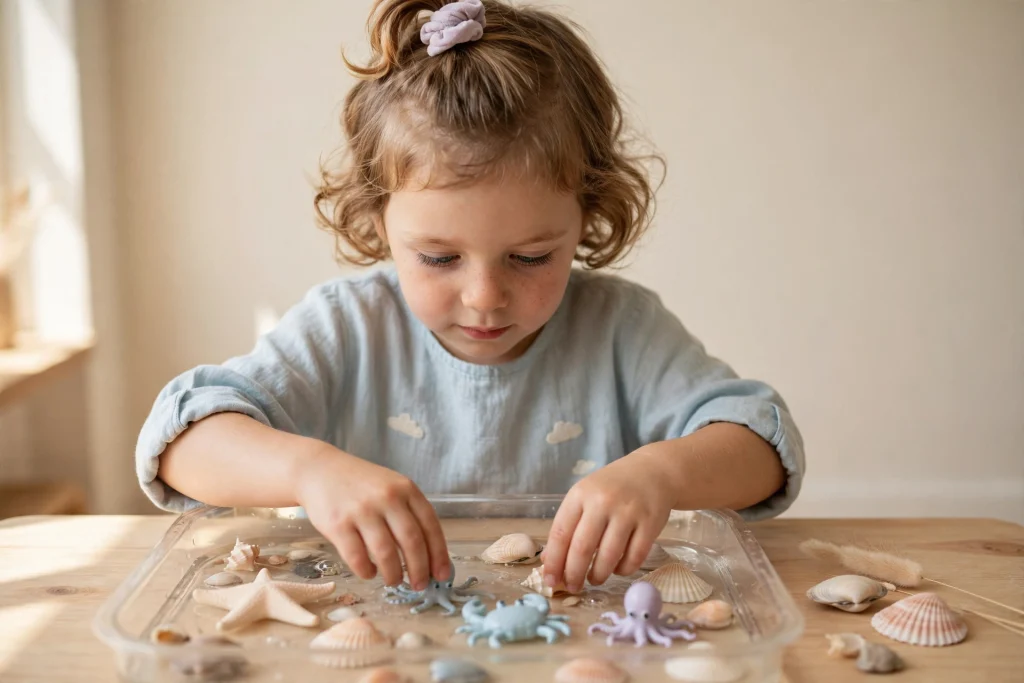
Short answer: Ocean theme preschool activities take ages 3–5 under the sea without leaving home: crab walks, a bottled ocean, shell sorting and floating-and-sinking science — fifteen activities of splashy, mostly dry, pretend play.
Quick facts
- Ages: 3–5 years
- Theme week: 3–7 days — one theme, dipped into a little each day
- Cost: free — ordinary household things
- Screen-free: yes — every activity on this page
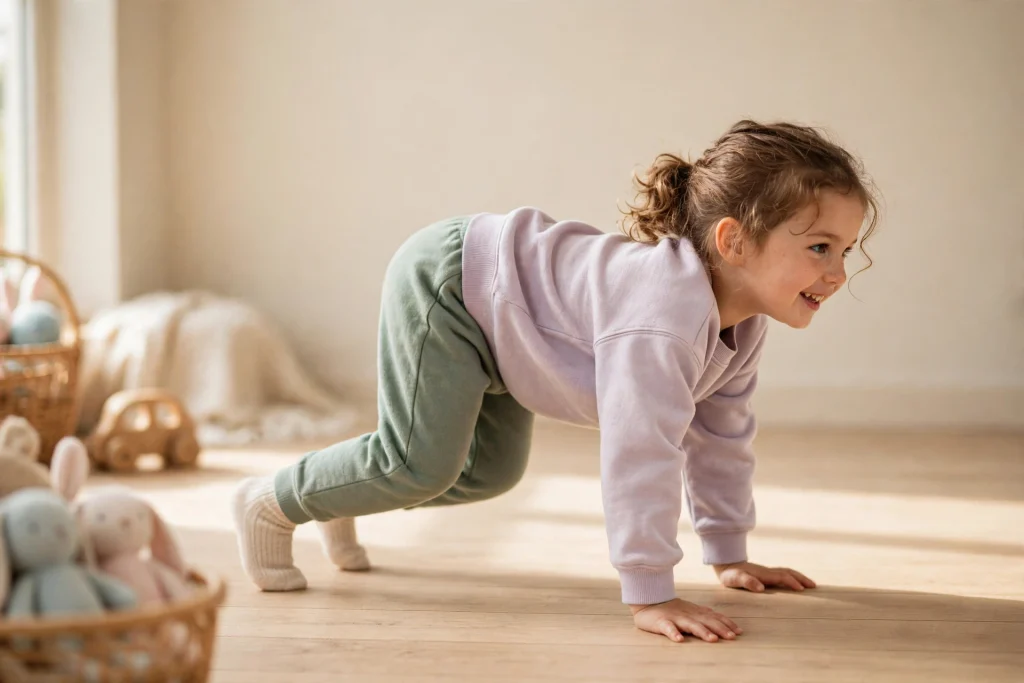
Move and play
The sea never sits still, and neither does this first set: gliding, scuttling, floating and splashing — the energy-burning part of the week.
1. Sea creature action swims
Make a small set of action cards together — a shark, a crab, a jellyfish, a starfish, a turtle — drawn or cut from magazines and glued to card. Take turns drawing one and everyone moves: glide like a shark (arms together, slow swoops), scuttle sideways like a crab, drift and bob like a jellyfish, stretch out stiff like a starfish. Copying each creature’s movement builds body awareness and control, and remembering which move belongs to which animal is a memory game riding along for free.
2. Under-the-sea obstacle swim
Build a course along the ocean floor: swim under a blue sheet “wave” held low (or draped over two chairs), weave around cushion “rocks”, wriggle through a hoop “sea cave” and finish stretched out on a towel “beach”. “Swim” it with big slow arm strokes, then go again as a different creature — a careful turtle, a speedy dolphin. Sequencing the stations is memory work, and ducking, weaving and crawling in one loop is whole-body coordination.
3. Magnetic fishing game
Draw and cut out paper fish, slip a paperclip onto each one, and scatter them in a dry “sea” — a blue blanket or a big shallow box. The rod is a stick or wooden spoon with string tied on and a magnet on the end. Your fisher catches one fish at a time and names its colour or counts each catch into a bucket. Magnets and paperclips are small parts, so this is a sit-together game: check the magnet is firmly attached before you start, fish at the table with you, and put the whole set away the moment the game ends.
4. Wave freeze dance
Play music and everyone moves like the sea — gentle swaying waves, bigger rolling waves, stormy crashing waves on a crash of the music. When the music stops, freeze as a shell: curled up small, still and silent on the sand. Anyone caught mid-sway becomes the next wave-master. Listening for the stop and holding a curled pose against every giggle is self-control practice dressed up as the silliest game of the week.
5. Beach-ball waves
A beach ball (or any light ball) and two pairs of hands. Keep the ball up together, counting each pat aloud — how high can the count climb before the ball touches the “sea”? For a calmer round, sit opposite each other, legs wide, and roll the ball back and forth as rolling waves, speeding up and slowing down on the words “stormy!” and “calm…”. Counting volleys is early maths, and keeping a light ball in the air takes gentle, judged strength — harder than it looks.
Make and create
Five makes that fill the walls with the sea — and every one of them is fingers-and-scissors practice wearing a costume.
6. Paper-plate sea turtle
A paper plate (or a circle of card) is the shell: draw or stick on a pattern of shapes, then glue on a paper head and four flippers around the edge. A fish is the easy variation — plate body, triangle tail, one big eye. Lining up the shell shapes is pattern sense, positioning the flippers is body-plan thinking, and a whole row of turtles along the wall is the week’s gallery. Talk while you make: real turtles swim with those flippers and lay eggs in the sand.
7. Ocean in a bottle
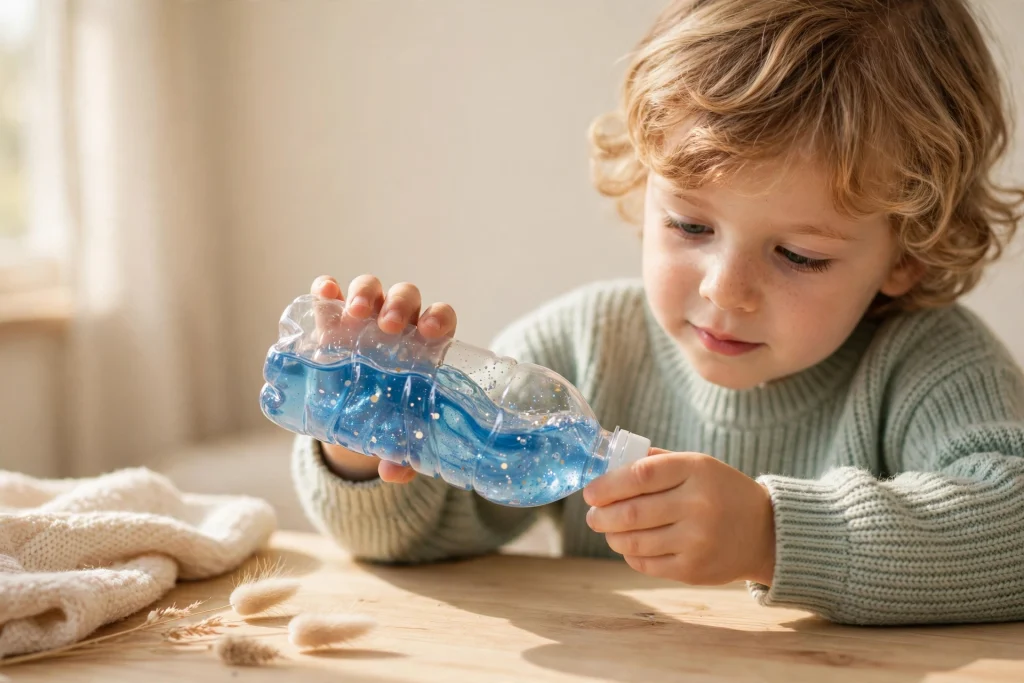
Half-fill a clear bottle with water and a drop or two of blue food colouring, then top it up with cooking oil, leaving a small gap at the neck. Now the adult-only step: an adult dries the rim, runs strong glue around the inside of the cap and screws it on tight — this bottle is never opened again. Tip it slowly and the ocean rolls: blue waves that never mix, calming to watch and perfect for quiet time. Sealed properly it lasts the whole theme and beyond; check the cap before each use.
8. Handprint octopus and fish
Paint your child’s palm and fingers with washable paint and press down on paper, fingers spread: the prints are an octopus (palm for the head, fingers for the wiggly legs) — and a good moment to count the legs and discover that a hand only makes five, so a real octopus needs three more drawn on. Turn a sideways print into a fish with a drawn tail and eye. Aprons on, and wash hands straight after — paint is for paper, not for tasting.
9. Shell and pebble patterns
Lay out real shells and smooth pebbles if you have them — a beachcombing collection, or a handful from a garden centre — and build with them: shell, pebble, shell, pebble patterns, spiral pictures, a shell family sorted biggest to smallest. No shells at home? Cut shell shapes from card together and decorate them with crayon swirls; the pattern work is identical. Shells stay on the table, played with beside you — small ones are never mouth toys — and hands get washed after real beach finds.
10. Foil fish collage
Cut a big fish shape from card, then cover it with scales: overlapping circles of kitchen foil, shiny sweet wrappers or silver paper, glued row over row from tail to head. Add a button or drawn eye and hang it where the light catches it — a fish that actually shimmers. Overlapping the rows in order is sequencing and fine finger work, and pressing each scale flat takes real hand strength. Foil edges are handled by an adult if you cut your own; bought foil shapes need no cutting at all.
Learn and discover
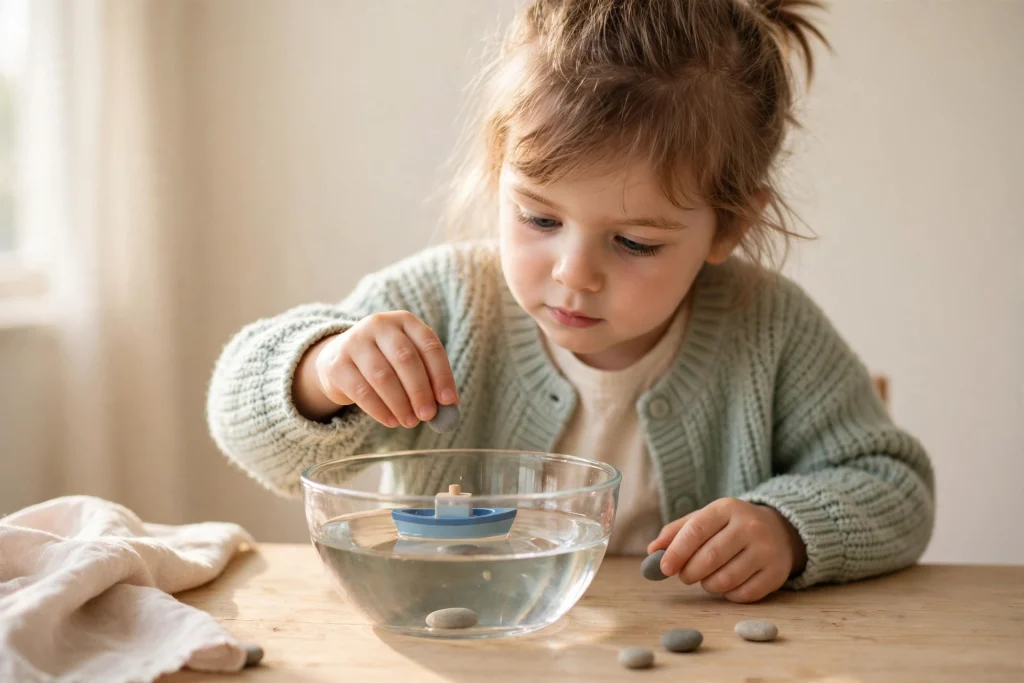
The thinking set: testing, counting, sorting and pouring — the parts of the seaside that turn into science and maths without anyone noticing a “lesson”. Two of these use water, so the week’s firmest rule lives here: water play always has an adult right beside it, and a child is never left alone with water — not a tray, not a bowl, not for a moment.
11. Float or sink?
The star of the week. Fill a bowl or washing-up tub with water and gather testers: a leaf, a pebble, a cork, a spoon, a shell, a plastic fish, a coin. For each one, your child first predicts — holds it up and declares “float!” or “sink!” — then tests it in the water, then sorts it into two trays: floated, sank. Being wrong is the best part (“the big shell floated?!”), because a surprise is a question, and questions are where science starts. An adult stays at the bowl the whole game, and the water is tipped away when the lab closes.
12. Sea creature counting
Count the sea, one creature at a time. How many legs on the octopus picture — can your child count all eight? How many arms on the starfish? Then fill a blue cloth or tray “sea” with toy or paper fish and count them in and out of the water, one to ten: “five fish swimming — one swims away — how many now?” Counting real things you can touch and move is one-to-one correspondence with a story attached, and the octopus makes eight feel like an adventure instead of a worksheet.
13. Sorting shells by size and shape
Tip out the shell collection (real, or your card shells from activity 9) and sort them three ways: by size into big and small, by shape into swirly and flat, by feel into smooth and bumpy. Then line the biggest family up in order, smallest to largest — a shell staircase. Sorting by a rule, changing the rule and sorting again, is classifying: the same thinking maths and science run on. If your family takes the theme to a real beach one day, collecting a pocketful of shells together is the loveliest homework there is — hats and sunscreen on, and stay within arm’s reach at the water’s edge.
14. Ocean sensory water tray
A shallow tray or washing-up bowl of water, a few drops of blue colouring if you like, and in go the toy sea creatures, shells, a small jug, a funnel and a sieve. Your child scoops, pours, fishes creatures out with the sieve and makes it rain through the funnel. Pouring between containers is volume and hand control before those words exist, and water play calms busy minds like almost nothing else. Shallow water still counts as water: you stay right there for the whole tray, sleeves rolled up together, and the tray is emptied the minute play moves on.
15. Ocean story basket and “Who lives where?”
Fill a basket for a favourite sea story: the book, plus props — a toy fish, a shell, a little boat. Read together, your child holding up the matching prop at each page. Then spread out toy or picture animals, sea and land mixed together, with two homes: a blue cloth sea and a green cloth shore. Sort them — fish, crab, whale to the sea; dog, cow, cat to the land — and argue the interesting ones (a turtle visits both; a penguin swims but cannot fly). Knowing where a creature lives, and being able to say why, is early science with opinions attached.
Turn it into a theme week
Spread the fifteen across five days, two or three a day, and the theme does the teaching by repetition:
- Day 1 — Into the sea: sea creature action swims (1), paper-plate turtles (6), and the story basket to finish (15).
- Day 2 — Splash science: float or sink? (11), the sensory water tray (14), and beach-ball waves to dry off (5).
- Day 3 — Making day: the ocean in a bottle (7), handprint octopus (8), and the wave freeze dance (4).
- Day 4 — Seashore day: shell patterns (9), sorting shells (13), and sea creature counting (12).
- Day 5 — Ocean party: the obstacle swim (2), fishing championships (3), foil fish hung up to shimmer (10), and the bottle’s waves to calm down at the end.
Short on time? Three days still works — pick one activity from each section per day. Two threads run under the whole week, so they are worth saying once more: pretend water does most of the week’s work, and real water always comes with an adult attached — bowls and trays are emptied when play ends, and no child plays at water alone, even shallow water, even for a minute. Everything else is shells, paper and imagination.
Finish the week with printables
After five days under the sea, some preschoolers ask for an ocean page of their own to colour or trace — and that request is the perfect moment for paper. FIMS Schools has free printable preschool and kindergarten worksheets, including first tracing and colouring pages: free preschool and kindergarten worksheets. A sea creature colouring page or two to close the week is plenty — the play was the learning; the printable is the souvenir.
Read next
- Preschool Theme Activities — every theme week in one place: pick next week’s theme here
- Activities by Type — more play ideas organised by kind
- 15 Pet Theme Activities for Preschoolers — last week’s favourite: a pretend vet clinic, paw-print art and pet counting games
Ocean theme questions parents ask
Do we need a trip to the beach for an ocean theme?
No — the whole week is written for home: pretend seas, paper shells and a bowl of water carry every activity. A real beach day is a beautiful bonus if one is easy for your family, not a requirement; if you do go, treat it as theme homework — collect a few shells for activities 9 and 13, keep hats and sunscreen on, and stay within arm’s reach of your child in the water.
How do I keep water play safe at home?
Three habits cover almost everything: an adult stays right beside any water play from start to finish — children are never left alone with water, even a shallow tray, even for a moment; the water is shallow to begin with (a washing-up bowl or tray, not a bath); and every bowl and tray is emptied the second the game ends. The ocean in a bottle is the one make that stays full — which is exactly why an adult seals it with glue, and why you check the cap before each use.
We have no shells — can we still do the shell activities?
Yes, completely. Cut shell shapes from card or thick paper together, decorate them with crayon swirls and patterns, and activities 9 and 13 work exactly the same — the sorting, patterning and ordering are the learning, not the shell itself. Smooth garden pebbles and large bottle tops make good stand-ins too. If real shells join the house later, give them a rinse, keep them as table toys beside an adult, and wash hands after handling beach finds.