
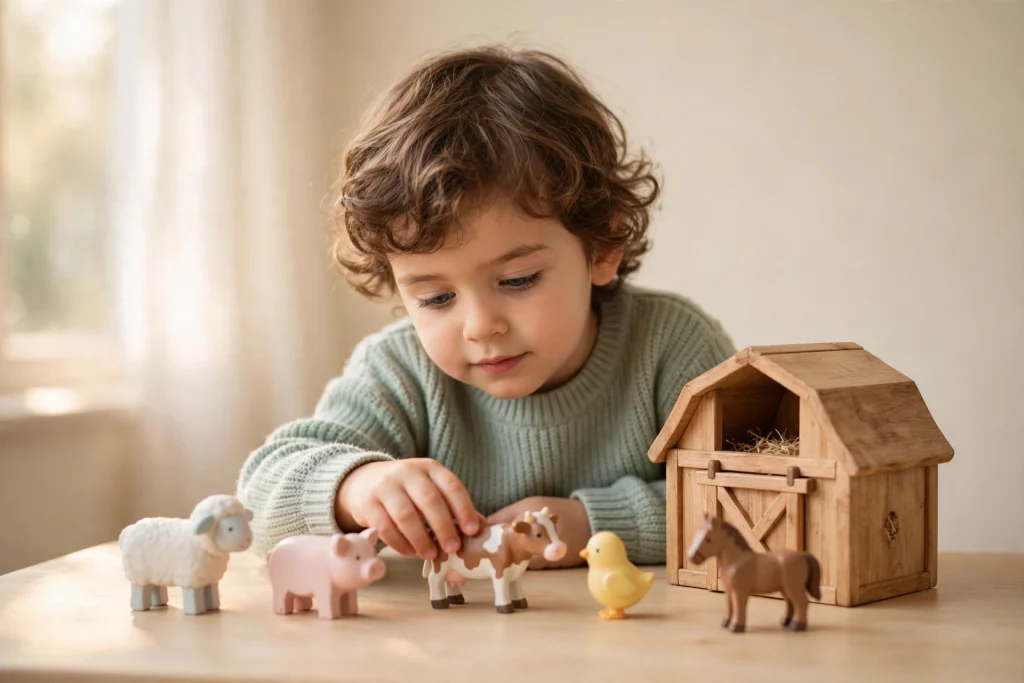
Short answer: Farm theme preschool activities run on toy animals and imagination: animal parades, cotton-wool sheep, egg hunts and a pretend farmer’s market — fifteen activities for ages 3–5, no farm visit needed.
Quick facts
- Ages: 3–5 years
- Theme week: 3–7 days — one theme, dipped into a little each day
- Cost: free — ordinary household things and toy farm animals
- Screen-free: yes — every activity on this page
Move and play
A farm is awake and moving from sunrise — galloping, waddling, pecking and hauling. This first set borrows all of that energy, and it is the part of the week that wears everyone out happily.
1. Farm animal movement parade
Call a farm animal and everyone moves the way it does: duck waddle (knees bent, tiny steps, elbows flapping), horse gallop with a clip-clop tongue-click soundtrack, hen peck (bend from the waist and bob for corn), pig snuffle-and-roll on the mat, and the cow’s slow, heavy plod home. Your child leads the parade and picks the next animal; you copy, hooves and all. Copying how different bodies move builds body awareness and core strength — and the guessing version (“whose feet sound like this?”) adds listening and thinking on top.
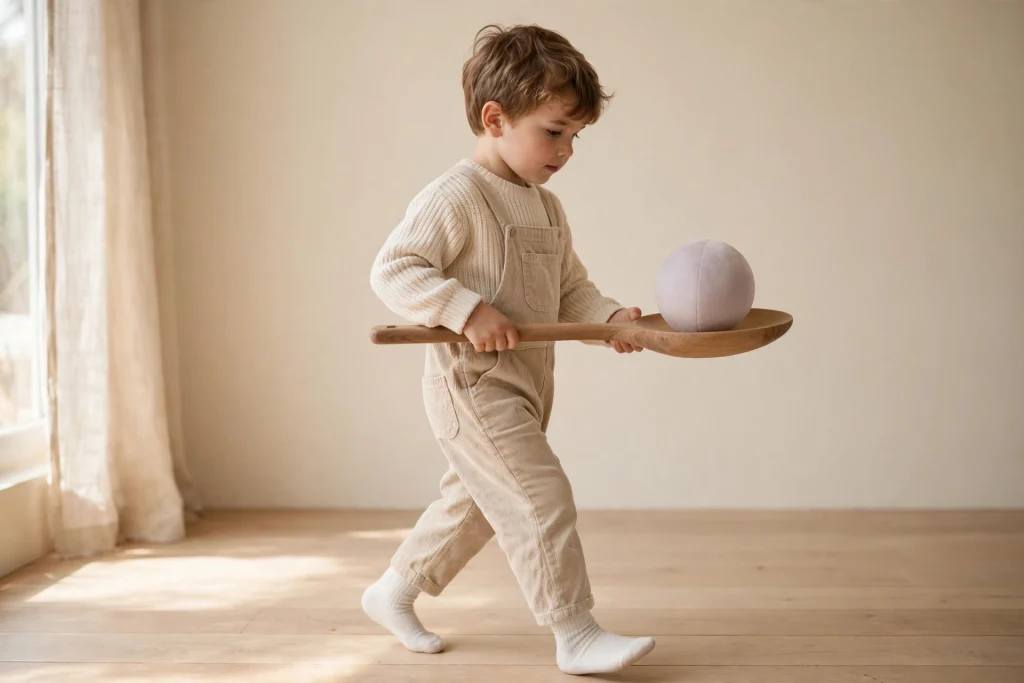
2. Egg-and-spoon walk
The gentle farm version: a soft ball or a potato balanced on a big spoon — real eggs are welcome only if you fancy the splat. Mark a short course around two cushions and back. If the “egg” drops, freeze, count slowly to three, pick it up and walk on. Eyes down, steps slow, whole body concentrating: this is balance and patience practice, and racing yesterday’s time turns it into a game against yourselves instead of each other.
3. Hay-bale obstacle course
Cushions and sofa seats become hay bales to climb over and stack; a blue blanket is the muddy puddle to jump across; a row of boxes makes the fence to step over; and everyone ducks low through the “barn door” (under a table or a held-up blanket). Finish by delivering a toy animal safely to the barn. Running the course forwards, then from memory, is sequencing work — and rebuilding a collapsed bale stack is a first engineering job.
4. Farmer’s chores relay
Set up the morning rounds as three stations: carry the bucket (light, or empty for the youngest farmers) across the yard, “feed” the animals by scooping pretend feed into each bowl, then hunt the hens’ corner and collect the eggs into the egg box. Count the eggs in with a cheer, tip the feed out, and the next farmer starts. Real jobs, done in order, at speed: this is responsibility, counting and turn-taking rehearsed as a race.
5. Scarecrow freeze dance
Music on: everyone dances around the field like animals at a harvest party. Music off: freeze as a scarecrow — arms out wide, head tipped, straw-hat face on, one leg wobbling just slightly. Anyone caught mid-sway becomes the next music master. Listening for the stop while your whole body wants to keep dancing is self-control practice, and holding a scarecrow pose against the giggles is harder than it looks.
Make and create
Five farm makes that fill the walls, stock the barn and end the week with a puppet show — every one of them fingers, scissors and glue practice in disguise.
6. Paper-bag farm animal puppets
A paper lunch bag becomes a farm animal: the folded flap is the mouth, and stuck-on or drawn ears, snout, beak or horns do the rest — a pig, a cow, a chick and a horse make a fine cast. Draw the eyes (or glue them on firmly), give each puppet a voice, and keep them safe for the Day 5 show. Talking through a puppet is language practice with the pressure off, and inventing what the pig says to the horse is early storytelling.
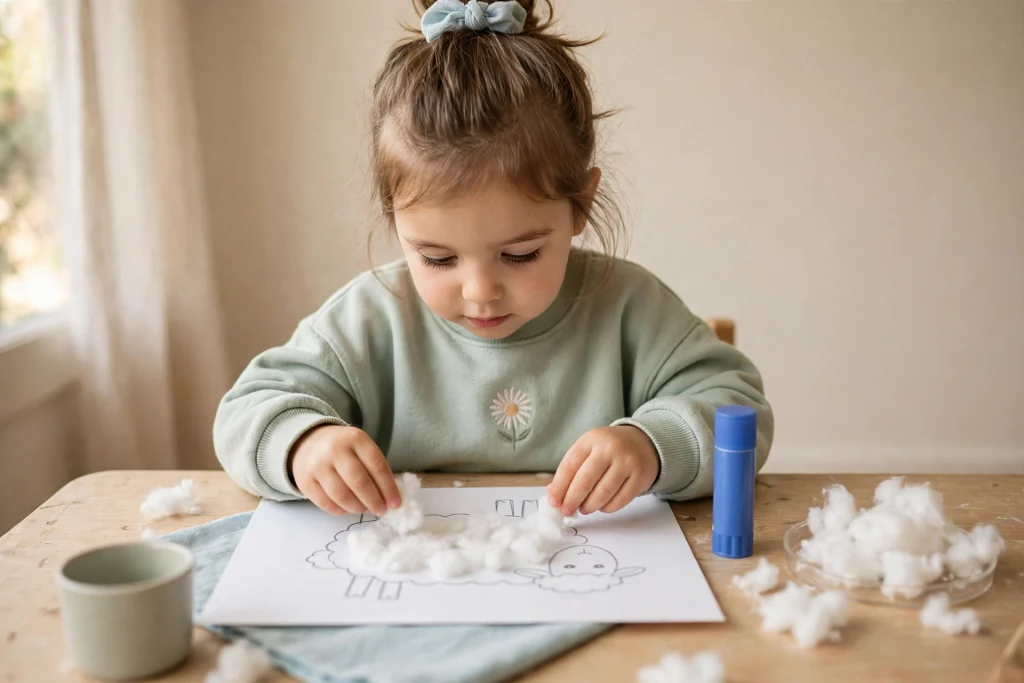
7. Cotton-wool sheep
Draw or print a chunky sheep outline on card. Your child spreads glue inside the body and presses on cotton-wool balls, pulled apart a little first for extra fluff — ten balls, twenty balls, count them on together. Add a dark paper or drawn face and legs, and the sheep joins the wall flock. Pinching, pulling and pressing cotton wool is serious finger exercise, and a line of finished sheep in different sizes makes a lovely counting row. Cotton wool is for gluing, not for mouths — keep it at the table.
8. Handprint farm animals
Washable paint and a hand make a whole farmyard: a yellow handprint with fingers pointing down becomes a chick (draw on an eye, a beak and stick legs); a handprint with fingers spread wide is the rooster’s tail behind a drawn body; fingertips alone stamp the cow’s splodges. Paint goes on hands, hands go on paper, and hands get washed properly as soon as printing is done — paint is for paper, never for tasting. Big, bold and personal: no two handprint animals are ever the same.
9. Cardboard barn build
A big cardboard box turns into the week’s barn: an adult cuts the wide doors, and your child paints it red, glues on a hayloft of yellow paper strips, and fences a yard with card strips or sticks. Inside go stalls for the toy animals — one per family. Building a home for the farm is planning, fitting and fixing-what-falls play, and the finished barn becomes the stage for the market, the vet corner and the puppet show all week long.
10. Vegetable printing
An adult cuts the stamps: a potato halved and carved with a simple star or circle, a chunky carrot end for dots, a corn cob rolled for texture. Dip in washable paint and print rows of “vegetables” into a brown-paper garden, or a whole field of printed flowers. One important farm rule: once a printing piece has been in paint, it is a tool, not a snack — keep a separate plate of fresh veg for actual nibbling, and let an adult do every bit of the cutting. Printing in rows, choosing what comes next, is pattern sense growing quietly.
Learn and discover
The thinking set — and its star is the biggest idea of the week: food does not start at the shop. Counting, matching, sounds and a market stall carry it all.
11. Where does food come from?
Lay out animal cards or toy animals, and a basket of food pictures or play food: milk, an egg, a woolly jumper, honey, cheese, bread. Your child matches each food to its giver — cow gives milk, hen gives eggs, sheep gives wool for the jumper, bees give honey, wheat gives bread. Say a thank-you to each animal as its match lands; gratitude is part of the lesson. Matching a product to its source is classifying and cause-and-effect in one game, and it changes how a child sees every meal afterwards.
12. Egg collecting counting hunt
Hide ten “eggs” — balls, plastic eggs or scrunched paper balls — around the hen-house corner of the room or garden. Your child collects them in a basket, counting aloud as each one lands: one egg, two eggs… all the way to ten. Then count them out again into the egg box, four here, six there: which pile has more? Hunting makes counting a treasure game, touching each egg as it is counted is one-to-one correspondence, and recounting the same eggs in new groups quietly teaches that the total stays the same.
13. Farm sounds and baby animals game
Make the sound — “mooo” — and your child names the animal and its baby: the cow’s baby is a calf, the hen’s is a chick, the sheep’s is a lamb, the pig’s is a piglet, the horse’s a foal, the duck’s a duckling, and the goat’s baby is a kid — just like them, which never fails to delight. Swap roles and let your child make the sounds for you to guess, babies included. Sound play, new vocabulary and memory all grow here, and sorting animals into families is early classifying too.
14. Farmer’s market role play
Set up a market stall: toy or real washed vegetables and fruit in baskets, price labels from 1 to 5, a pot of play coins or pennies, and a bag for the shopping. Your child is the farmer: “Two carrots, please — that’s 3 coins.” Count the coins out together, count the carrots into the bag, and swap roles so the farmer gets to shop too. Counting out an exact amount for a price is one-to-one correspondence with a story attached, and the chatter across the stall is language practice of the best kind. If real produce is on the stall, it gets washed again before it is eaten.
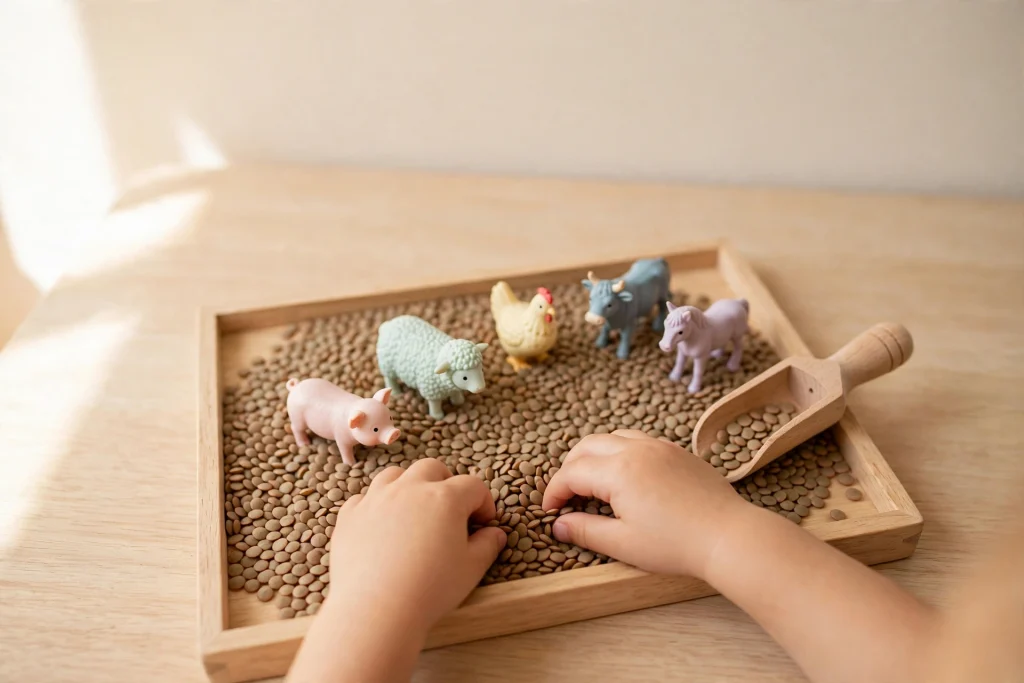
15. Sensory farm tray
Fill a shallow tray with dried lentils or oats as the field, add a scatter of straw (or shredded paper) for hay, fence one corner with sticks or blocks, and let the toy animals move in. Scoops, a jug and big tweezers turn it into work: dig the field, bury and find the animals, carry hay to the barn with the tweezers. Tray play stays at the table with an adult beside it — lentils are small and belong in the tray, not in mouths. A younger sibling who mouths everything gets their own taste-safe tray of oats and big pieces instead, side by side.
Turn it into a theme week
Spread the fifteen across five days, two or three a day, and the theme does the teaching by repetition:
- Day 1 — Down on the farm: the animal movement parade (1), the sounds and baby animals game (13), and the sensory farm tray (15) to settle into the theme.
- Day 2 — The busy farmer: the chores relay (4), the egg collecting counting hunt (12), and build the cardboard barn (9) — home base for everything after.
- Day 3 — Making day: cotton-wool sheep (7), handprint farm animals (8), and vegetable printing (10) for the market stall walls.
- Day 4 — Market day: where does food come from? (11), open the farmer’s market (14), and the egg-and-spoon walk (2) as the afternoon games.
- Day 5 — Farm show day: the hay-bale obstacle course (3), the paper-bag puppets perform in the barn (6), and the scarecrow freeze dance (5) closes the week.
Short on time? Three days still works — pick one activity from each section per day. And if the week ends with a real farm visit, so much the better: follow the farm’s own rules while you are there, keep an adult right beside your child, never feed or touch animals unless the farmer says it is fine — and wash hands well after any animal contact, and always before a snack. Back home, the toy farm carries the theme on for weeks.
Finish the week with printables
After five days down on the farm, some preschoolers ask for a farm page of their own to colour or trace — and that request is the perfect moment for paper. FIMS Schools has free printable preschool and kindergarten worksheets, including first tracing and colouring pages: free preschool and kindergarten worksheets. A farm colouring page or two to close the week is plenty — the play was the learning; the printable is the souvenir.
Read next
- Preschool Theme Activities — every theme week in one place: pick next week’s theme here
- Activities by Type — more play ideas organised by kind
- 15 Pet Theme Activities for Preschoolers — last week’s favourite: a week of pet play with a pretend vet clinic
Farm theme questions parents ask
Do we need to visit a real farm to do a farm theme?
No — toy animals, pictures and pretend play carry the whole week, and the learning (movement, making, counting, matching food to its source) is identical. A real visit is a lovely extra if one is easy: go by the farm’s own rules, stay right beside your child, touch or feed animals only if the farmer invites it, and wash hands well afterwards and before eating. City children who have “run a farm” in the living room all week often get the most out of the real thing.
What does a farm theme actually teach a preschooler?
More than it looks: where food comes from (the week’s big idea), animal names, sounds and baby-animal words, counting to ten with real objects, sorting and matching, and the first shape of responsibility — feeding, collecting, caring in the right order. Add the movement games for the body and the market stall for early money sense, and one cheerful theme has touched maths, language, science and social play without a single sit-down lesson.
How do I keep the sensory tray safe with a baby or toddler sibling around?
Run two trays side by side. The preschooler’s farm tray has the lentils, straw and small animals — played with at the table, adult beside them, pieces put away when play ends. The younger sibling gets a taste-safe mirror version: oats instead of lentils, big toy animals only, nothing that fits through a toilet-roll tube. Both children feel included, nobody feels singled out, and the mouthing stage passes safely at its own pace.