
Short answer: Transport theme preschool activities run on wheels, wings and water: tape-road cities, ramp races, a cardboard train you can sit in, and sorting everything into land, sea and air — fifteen activities, ages 3–5, no special kit.
Quick facts
- Ages: 3–5 years
- Theme week: 3–7 days — one theme, dipped into a little each day
- Cost: free — ordinary household things and toy vehicles
- Screen-free: yes — every activity on this page
Move and play
Things that go are made to move — and so are preschoolers. This first set is the week’s engine room: driving, racing, sailing, flying and stopping safely.
1. Tape-road city
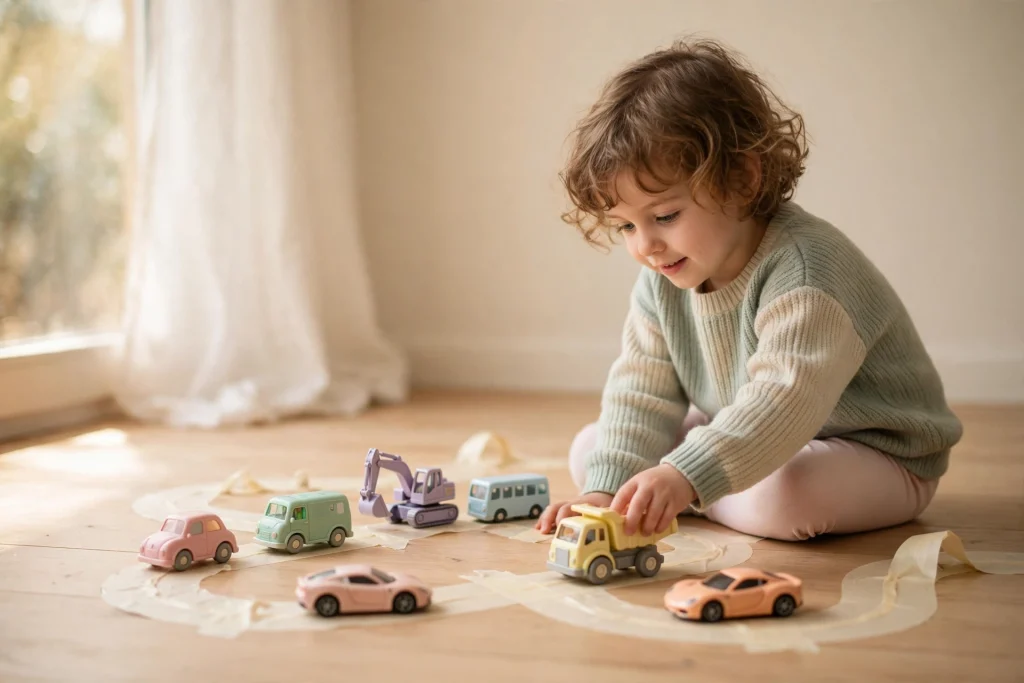
Stick masking-tape roads across the floor — a straight high street, corners, a roundabout around a cushion, a bridge over a book. Add cardboard-box buildings, a paper traffic light and a car park, then hand over the toy cars and let the city open. Building the roads is planning and problem-solving (how does the bus reach the shop?), and driving them is a whole world of pretend journeys, deliveries and small stories told in engine noises.
2. Ramp races
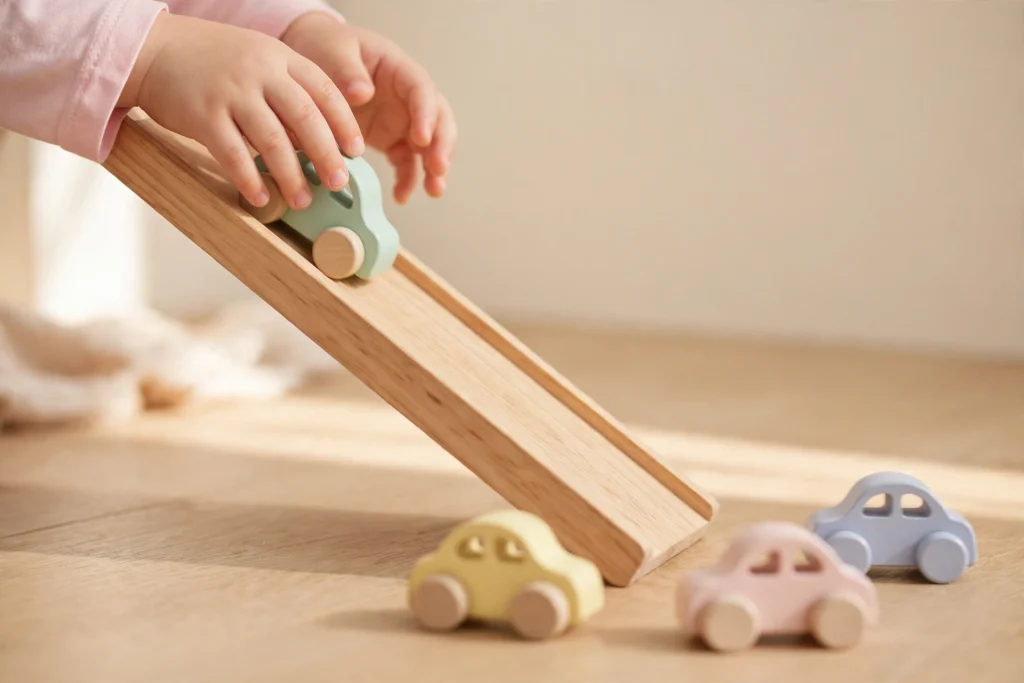
Prop one end of a long piece of card or a plank on a pile of books and race two toy vehicles down it. Whose rolls furthest across the floor? Mark the stopping spots with sticky notes, then swap vehicles, raise the ramp, or race a heavy car against a light one. Measuring “how far” with footsteps or sticky notes is early measurement with real suspense in it — and predicting the winner before each race is the beginning of testing an idea.
3. Blow-boat races
Float little boats — cork or bottle-top boats, folded paper boats, or a leaf with a paper sail — in the bath or a washing-up bowl of water, and blow them from one end to the other through a straw. First to the far shore wins. Gentle blowing is breath control, and watching what floats, sinks and tips is first science. Water rule, as always: an adult stays right there, and the water is emptied when the race ends.
4. Aeroplane arms run-and-fly
Outside, or down a clear hallway, mark a runway with chalk or tape. Your child is the plane: arms out wide, engine noises up, a run along the runway and a great leap into “flight” — then slow down, circle round and land gently on the spot you call. Take-offs and landings are whole-body movement with listening built in, and the landing instructions (“land on the blue mat”) turn it into a following-directions game too.
5. Traffic-light freeze game
Hold up a red card: everyone freezes. Green: everyone drives, walks or cycles on the spot. Amber (or yellow): slow motion. Start with you as the traffic light, then hand the cards to your child and let them catch you moving on red. Besides burning energy, this is a real road-safety seed planted early: red means stop, green means go — the first traffic rule every child meets, learned as a game long before it is needed at a kerb.
Make and create
Five makes that turn the junk box into a garage, a station and an airport — fingers, scissors and glue doing the building while the imagination does the driving.
6. Cardboard-box train or bus
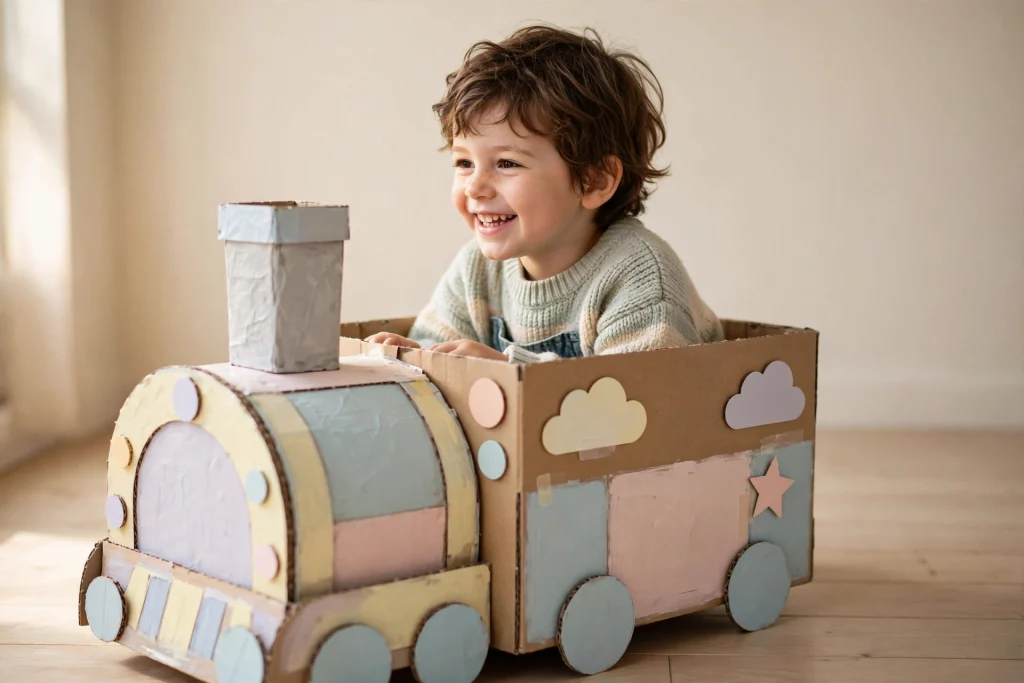
The week’s centrepiece: a big cardboard box (or two taped together) becomes a train or a bus your child can actually sit in. An adult cuts the door and windows; your child paints the outside, adds paper-plate wheels, a number on the front and a sign for the destination. Then it opens for service — passengers climb in, the driver calls the stops, and journeys are made all week. Big builds like this are planning, decorating and pretend play in one long, proud project.
7. Junk-model vehicles
Save the clean boxes, tubes, bottle tops and egg boxes, and set up a vehicle workshop: a cereal box becomes a bus, a tube becomes a train chimney, bottle tops become wheels. Tape and glue hold the fleet together; your child decides what each one is and what it still needs. Junk modelling is real early engineering — choosing shapes, joining things that fall apart, fixing and improving — and a shelf of slightly wobbly homemade vehicles is a week’s work worth showing off.
8. Wheel printing
Dip the wheels of a toy car or truck in washable paint on a plate, then drive it slowly across a long sheet of paper. Tracks appear — straight lines, curves, crossings where two cars “meet”. Try different vehicles and compare the tracks: whose are widest? Which wheels leave two lines, and which leave wobbly ones? Printing with wheels mixes art with noticing and comparing, and a long track picture makes a wonderful road for the tape-road city. Aprons on, and cars get a wash at the end.
9. Paper aeroplanes
Fold paper planes together — you take the tricky folds, your child does the pressing-down and the decorating — then hold a flying show: whose plane flies furthest, whose does the best loop, whose lands on the mat? A tiny fold changed here and there sends the next flight differently, which is experimenting in its simplest form. Throw planes in open space, paper points away from faces, and let the pilot do the fetching — the retrieving is half the exercise.
10. Transport collage scene
On one big sheet, draw or paint three zones: a road along the bottom, the sea in the middle, the sky at the top. Your child cuts out (or you pre-cut) vehicles from magazines and catalogues, or draws their own, and sticks each one in its zone — cars on the road, boats on the water, planes and helicopters in the sky. Sorting pictures into land, sea and air while making the scene is the week’s big idea rehearsed with glue — and the finished poster is a map of everything they know about things that go.
Learn and discover
The thinking set: sorting, counting, listening and being in charge of the bus. This is where the theme quietly turns into maths, science and language.
11. Sort the vehicles — land, sea or air?
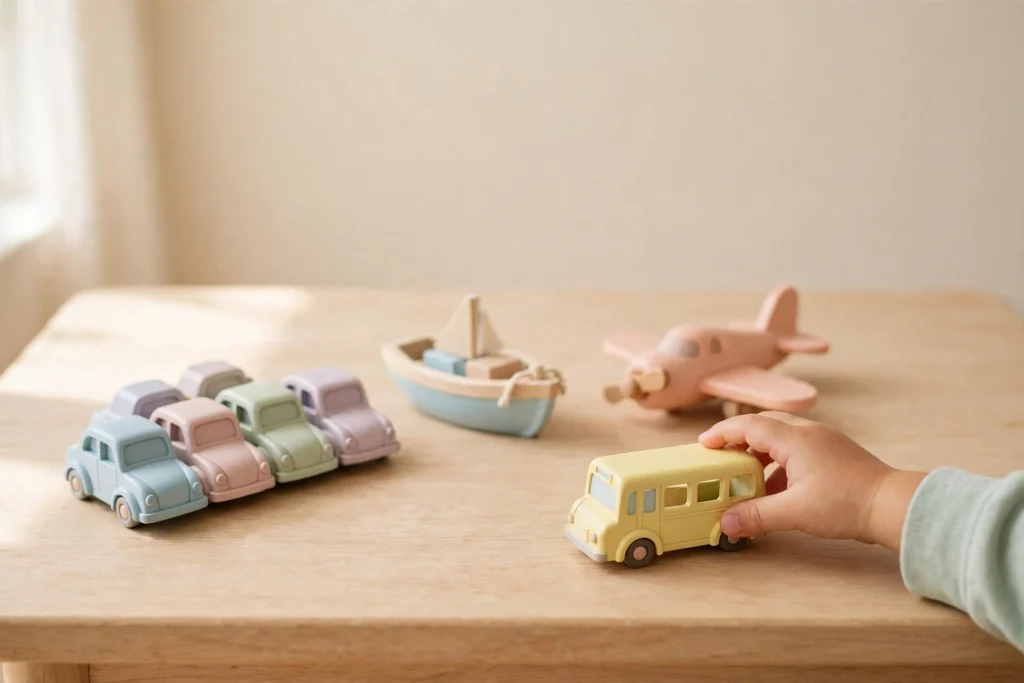
The star of the week. Lay out three zones — a road drawn on paper, a blue cloth or tray of water-coloured paper for the sea, a white sheet for the sky — and gather every toy vehicle and vehicle picture you own. Your child places each one where it travels: car, bus and bike on land; boat and ship on the sea; plane and helicopter in the air. Then the lively argument: where does a seaplane go? What about a hovercraft? Sorting by where something belongs, and saying why, is classifying — the thinking that maths and science are both built on.
12. Counting wheels
Park the toy vehicles in a row and count wheels: a bicycle has 2, a car has 4, a bus has more than anyone expected. Write or draw the numbers on little “parking tickets” and match each vehicle to its ticket. Then the hard questions: which vehicle has the most wheels? How many wheels on two cars together? Counting something real and interesting — and comparing the counts — is number sense with a story attached. Extend it outdoors: count the wheels on every vehicle that passes the gate.
13. Vehicle sound guessing game
Make the sounds and guess the vehicle: the train’s chuff and whistle, the fire engine’s siren, the boat’s foghorn, the plane taking off, the bicycle bell — ding! Take turns being the sound-maker, with eyes closed for extra difficulty. Or record real sounds on a walk and play “who am I?” back home. Listening closely and matching a sound to its source is attention and memory work, and the siren impressions alone will keep everyone busy.
14. All aboard — bus driver role play
Chairs in two rows, a steering wheel (a plate will do), paper tickets and a hat for the driver. The driver calls the stops, collects tickets or play coins, counts the passengers on and off, and announces “mind the doors”. Passengers practise waiting, paying, saying their stop and thanking the driver. Turn-taking, early money, counting and polite language all ride on this bus — and being the driver, in charge of the whole route, is a confidence ride like no other.
15. Story basket and map play
Choose a favourite transport picture book and fill a basket with its props: a toy bus, tickets, a little map, a driver figure. Read the story with the props appearing at their pages. Then draw a simple map together — your house, a wiggly road, the park, a friend’s house — and drive a toy car along the route, narrating the journey: “past the shop, over the bridge, stop at the park.” Following and telling a route is early geography, and retelling the journey in order is storytelling with a steering wheel.
Turn it into a theme week
Spread the fifteen across five days, two or three a day, and the theme does the teaching by repetition:
- Day 1 — On the road: build the tape-road city (1), print wheel tracks (8), and finish with the story basket and map (15).
- Day 2 — Fast and far: ramp race championships (2), paper aeroplane trials (9), and parking-ticket wheel counting (12).
- Day 3 — Making day: the big cardboard train or bus build (6), junk-model vehicles from the workshop box (7), and traffic-light freeze to finish (5).
- Day 4 — Water and sky: blow-boat races (3), aeroplane arms on the runway (4), and the land-sea-sky collage scene (10).
- Day 5 — All aboard: bus driver role play (14), the great vehicle sort-out (11) as the week’s finale quiz, and sound-guessing (13) to close.
Short on time? Three days still works — pick one activity from each section per day. One gentle extra for the week: a transport theme is a natural moment to practise real-world basics on an ordinary walk — holding hands, stopping at the kerb, and watching the traffic light together. A line or two, kindly, while you are out anyway; no lectures needed.
Finish the week with printables
After five days of driving, sailing and flying, some preschoolers ask for a vehicle page of their own to colour or trace — and that request is the perfect moment for paper. FIMS Schools has free printable preschool and kindergarten worksheets, including first tracing and colouring pages: free preschool and kindergarten worksheets. A car colouring page or a wiggly-road tracing page to close the week is plenty — the play was the learning; the printable is the souvenir.
Read next
- Preschool Theme Activities — every theme week in one place: pick next week’s theme here
- Activities by Type — more play ideas organised by kind
- 15 Pet Theme Activities for Preschoolers — last week’s favourite: animal walks, paw-print art and a pretend vet clinic
Transport theme questions parents ask
My child only ever wants to play with vehicles — is that enough “learning”?
Yes — a strong interest is the best teaching tool there is, and this page shows how much rides on it: sorting into land, sea and air is classifying; counting wheels is number sense; ramp races are measuring and predicting; the bus game is money, turn-taking and polite language. A child who is fascinated will play longer, repeat more and remember better than a child being marched through topics. Follow the interest — just keep quietly widening the road it travels on.
Is a transport theme a good time to teach road safety?
It is the perfect time, because the ideas are already in the child’s hands. The traffic-light game teaches red-stop and green-go as play; on real walks, the same game becomes stopping at the kerb, holding hands and looking and listening before crossing, with you doing the judging until they are much older. Keep it calm and matter-of-fact — a theme week plants the habits early, and habits practised as games tend to stick.
We have almost no toy vehicles — can we still run this theme?
Easily. The junk-model workshop (7) exists precisely to build the fleet: boxes, tubes and bottle tops become buses, trains and rockets, and making them is half the week’s learning. Pictures cut from magazines and catalogues cover the sorting and collage games, a cardboard box is the train, and fingers, feet and arms do the rest in the movement games. A transport theme is made of journeys, not of toys.