
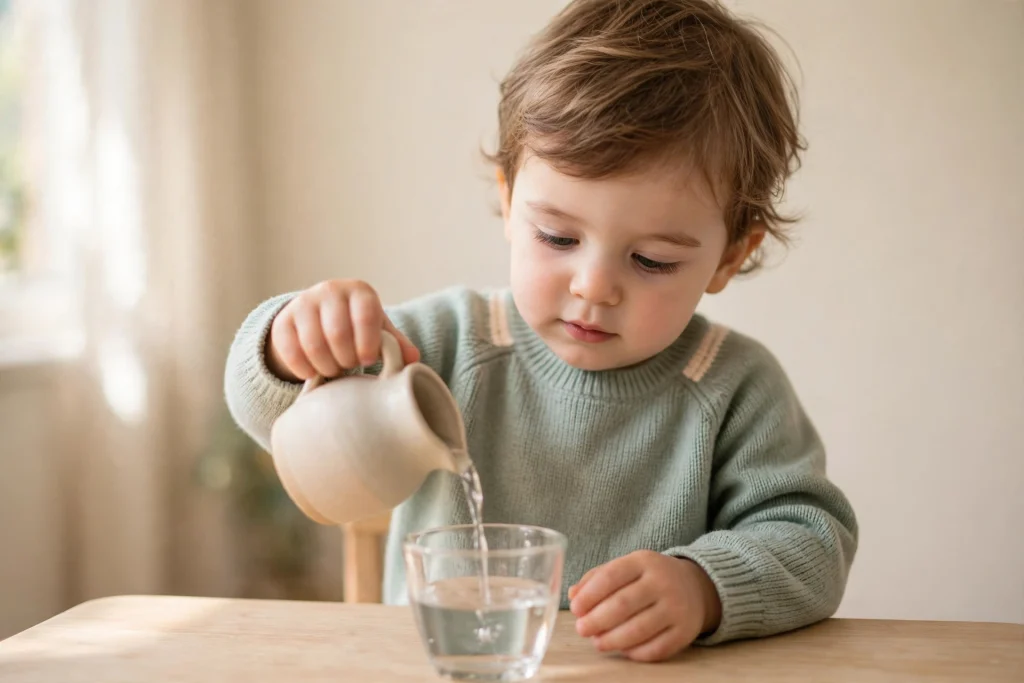
Short answer: Montessori toddler play at home means real little jobs, a calm corner where everything is reachable, and time to do things themselves — no special furniture or expensive sets, just your home arranged so your toddler can join in.
Quick facts
- Ages: 1–3 years
- Cost: free — uses what you already own
- Setup: one small shelf or corner
- Screen-free: yes — every idea on this page
- Things to buy: none
What “Montessori” means at toddler age
Strip away the jargon and Montessori for toddlers rests on a handful of simple ideas. Follow the child: watch what your toddler is drawn to right now — pouring, carrying, opening, wiping — and offer more of that, instead of deciding in advance what play should look like. Real tasks over pretend versions: a toddler would rather pour real water, sweep real crumbs and peel a real banana than push buttons on a toy kitchen. Real jobs teach real skills, and toddlers know the difference. Child-sized and reachable: things live low down, in small quantities, where little hands can fetch them and put them back without asking an adult. Order, routine and repetition: the same few activities in the same places, done again and again — repetition is not boredom at this age, it is how mastery feels from the inside. And freedom within safe limits: your toddler chooses what to do and how long to do it for, inside boundaries you set and guard.
One honest note before we start: FIMS Schools is not a Montessori school, and nobody here holds a Montessori certificate. Nothing on this page needs one. These are simply the Montessori ideas that work beautifully in an ordinary home, borrowed with respect — you do not need training, permission or a shopping list to use them.
Set up a simple Montessori corner
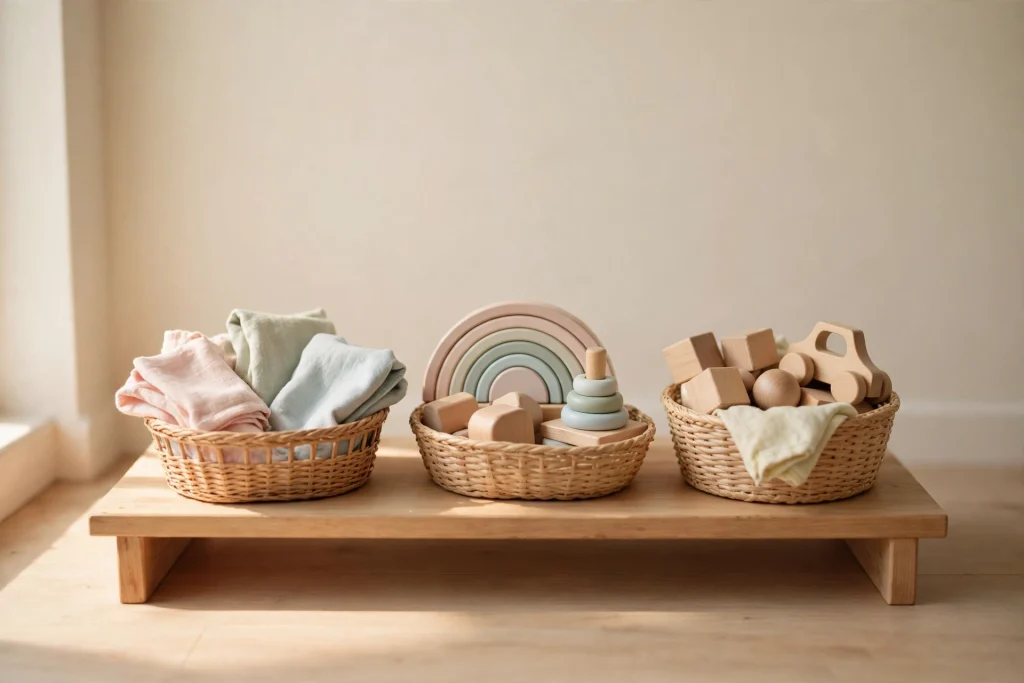
The famous “Montessori room” is, at toddler age, really just one calm corner. Take one low shelf — or simply the bottom shelf of a bookcase your toddler can already reach — and put out just six to eight activities at a time, each in its own basket, tray or bowl so it looks like one complete, inviting job. Everything sits where your toddler can take it down and carry it alone. A small rug or mat on the floor marks the workspace: the activity happens on the mat, and when it is finished, it goes back on the shelf. That tiny routine — fetch, work, return — is the heartbeat of the whole approach. Keep the rest of your activities in a cupboard and rotate one or two every week or two; an old activity returning after a break feels brand new. If it is easy, add one or two child-height touches nearby: a hook at toddler height for a coat or apron, and a sturdy step stool at the sink. That is the whole room. No special furniture, nothing to order.
Practical life — real jobs for little hands
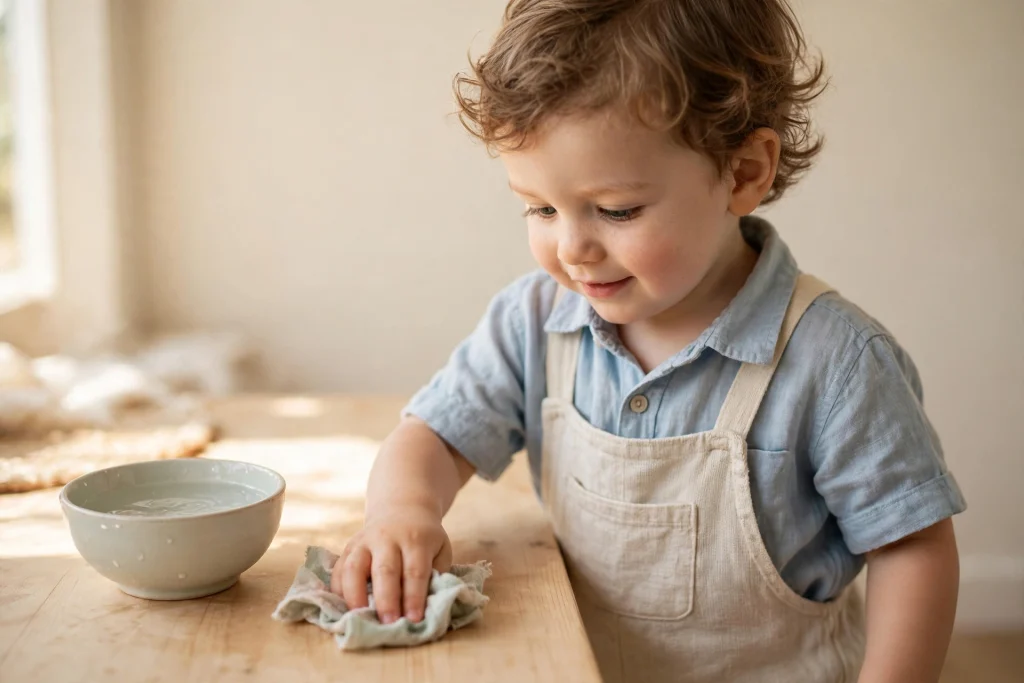
“Practical life” is the Montessori name for the real work of the household — and it is where toddlers shine, because helping is what they want most. These eight jobs use only what your kitchen and cupboards already hold.
1. Pouring their own water
Give your toddler a small jug — half-filled at first — and a cup, on a tray to catch the spills. They pour, drink, and pour again. Start with dried lentils or rice poured between two jugs if water is too exciting, and keep a small cloth beside the tray so wiping up is part of the job from day one. Few activities hold a toddler’s concentration like pouring, and the steady hand it builds is the same one that will one day hold a pencil.
2. Washing hands and face by themselves
A sturdy step stool at the sink, soap where little hands can reach it, and a small towel on a low hook turn hand-washing from something done to your toddler into something they do. Show the sequence slowly — sleeves up, water, soap, scrub, rinse, dry — then let them run the whole routine. A small mirror at their height makes face-washing its own quiet pleasure.
3. Shoes and coat practice
Keep your toddler’s shoes and coat in one reachable spot by the door, and let getting ready be their job, even when it is slow. Velcro shoes and big zips are toddler-manageable; for coats, teach the flip trick — coat laid on the floor, arms in the sleeves, flip it over the head — and watch the pride. Ten unhurried practice minutes at home save a hundred rushed ones at the door.
4. Sweeping up with a small brush
Give your toddler a small hand brush and a dustpan — or tape a square on the floor and show them how to sweep the crumbs into it. Toddlers sweep with total seriousness and variable accuracy, and both are fine. The real lessons are aiming, persistence and the deep satisfaction of a visible before-and-after.
5. Wiping up spills — part of the game
In a Montessori home, a spill is not a disaster; it is the next activity. Keep a small cloth where your toddler can fetch it, and when water escapes — it will — hand over the cloth instead of jumping in yourself. Wiping in circles, wringing the cloth into the sink and hanging it back up is a complete little work cycle, and a toddler who can fix a spill stops fearing mistakes.
6. Helping with snack
Toddlers can do real food work: carrying unbreakable plates to the table, washing fruit, and peeling a banana once you have started the skin. A child nearer 3 can slice a soft banana or spread soft cheese with a blunt table knife, sitting at the table with you right beside them. Food they have prepared themselves gets eaten with remarkable enthusiasm.
7. Carrying things carefully
Watch a toddler carry a cup of water across a room with two hands and total focus — that is the exercise. Give carrying real purpose: fetch the napkins, carry the book to the reading chair, bring the spoon to the table. Start light and unbreakable, and let the loads grow with their confidence. Carrying builds balance, coordination and the care that fragile real things deserve.
8. Watering one plant
Claim one sturdy houseplant as your toddler’s own. A small jug, a set day (or a dry-soil check together), and the job is theirs: fill, carry slowly, pour gently at the base, wipe any drips. Caring for a living thing is a toddler-sized lesson in responsibility, and checking “their” plant becomes a small daily ceremony.
Hands, senses and quiet focus
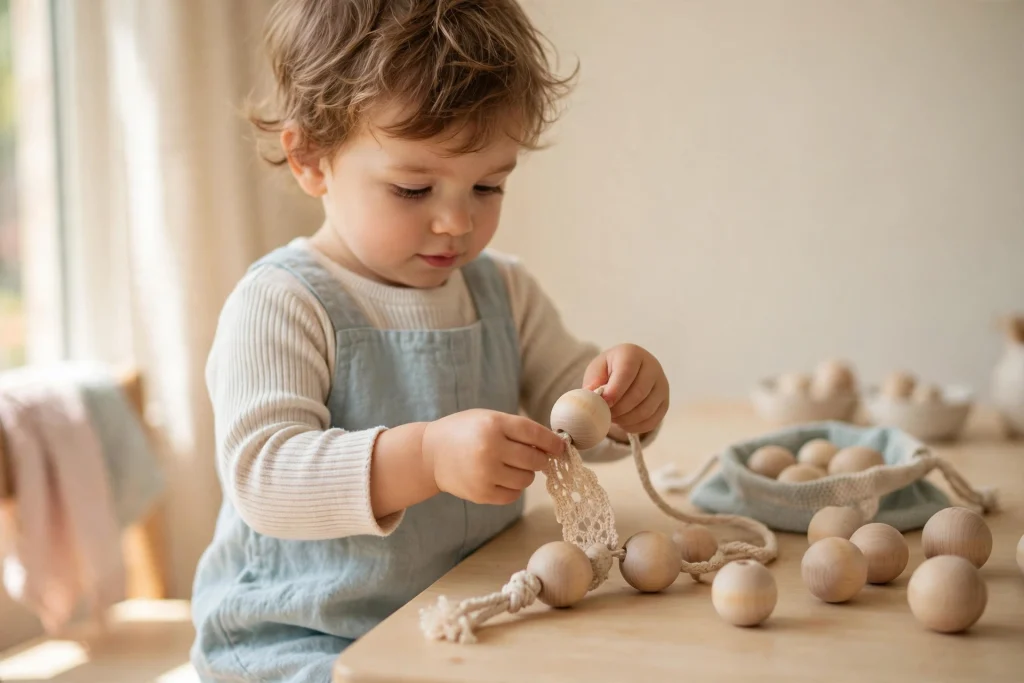
Alongside the real jobs, a Montessori shelf holds a few simple activities for the hands and senses — one skill at a time, beautiful in their plainness, and chosen from things you already own.
9. Posting and sorting real objects
Cut a wide slot in the lid of a shoebox and let your toddler post big objects through it — wooden spoons, large lids, big smooth stones. For sorting, offer two bowls and a handful of real things that differ clearly: big shells here, pinecones there. Posting and sorting feed the toddler urge to categorise the world, and the objects being real gives hands honest weight and texture to learn from.
10. The opening-and-closing box
Gather a collection of clean containers with different closures: a screw-top jar, a tin with a press-down lid, a box with a latch, a bottle with a big cap, a small zip pouch. Your toddler opens, closes, and opens again — sometimes for a very long time. Each closure is a different hand puzzle, and matching each lid back to its pot is a quiet first logic game. Choose containers with no sharp edges and check them before each use.
11. Threading big beads
Thread large wooden beads — the big kind, well bigger than a toilet-roll tube — onto a stiff lace, a pipe cleaner or a shoelace with a taped end. Your toddler pushes a bead on, slides it down, and reaches for the next; tipping them all off to start again is half the fun. Threading builds the two-handed coordination and concentration that later handwork is made of. Keep pieces big and thread together at the table.
12. A treasure basket of real things
Fill a low basket with safe, interesting real materials: a wooden spoon, a metal whisk, a big pinecone, a smooth stone, a piece of leather, a natural sponge, a shiny lid. Sit nearby and simply let your toddler take things out, mouth, bang, combine and examine them. Real objects tell the hands far more than plastic imitations do. Use the toilet-roll rule for every item — if it fits through the tube, it stays out of the basket — and refresh the collection now and then.
13. A small nature table
Keep one spot — the end of the shelf, a windowsill tray — for found nature: this week’s leaf, a feather, a shell, a smooth pebble, a conker in season. Your toddler handles the objects gently, and you name them and talk about where they came from. The collection changes with the seasons and the walks you take, which quietly teaches that the world changes too — and that interesting things are found, not bought.
14. Simple puzzles
A knob puzzle with three or four big pieces, or a simple two-piece matching puzzle, is perfectly sized for this age: take the pieces out, turn them, test them, and feel the satisfaction of the fit. Puzzles teach a toddler to persist through “it doesn’t work yet” — and to tidy up by completing the picture before the puzzle goes back on the shelf. If a puzzle frustrates, put out fewer pieces and let one stay in place as a hint.
15. Pouring with a funnel
On a tray, set out dry lentils or rice, a jug, a bowl and a funnel. Your toddler pours the grains through the funnel, listens to them rain down, scoops them back and starts again — pouring, but slower, noisier and more precise. One honest caution: if your child is still in the mouth-everything stage, keep this as a together-at-the-table activity, swap the lentils for big dry pasta shapes, or save it for a few months from now.
What you do NOT need to buy
Search “Montessori toddler” and you will be offered a small fortune in special furniture, wooden sets and branded materials. Your toddler does not need them. You do not need a special shelf if a bottom bookshelf is free, special jugs when a small kitchen jug exists, dressing frames when a real coat is hanging by the door, or a set of matching wooden toys when the whisk, the spoon and the pinecone are already fascinating. The principles are the valuable part — real, reachable, one skill at a time, and time to repeat — and principles are free. If you ever do choose to add a toy, choose by those same principles rather than by a label: real materials where possible, one clear skill, and nothing that does the playing for the child with lights and noise.
As your toddler grows
Montessori at home grows up with your child: the corner becomes a small shelf of more varied work, and the real jobs get bigger. When your little one is nearer 3 to 5 and you would like a gentle structure for the week, our homeschool preschool curriculum lays one out in the same play-first spirit. And for the hand skills underneath everything on this page, our 25 Fine Motor Activities for Toddlers is the natural companion read.
Read next
- Start with the pillar: Homeschooling — gentle homeschool ideas for the early years
- Homeschool Preschool Curriculum — a free, simple plan for ages 3–5
- 25 Fine Motor Activities for Toddlers — the hands-skills companion to this page
Montessori toddler questions parents ask
What is Montessori in simple words?
Montessori is a way of setting up life so a young child can do real things by themselves. Instead of entertaining your toddler, you prepare a small space where everything is reachable, offer real activities — pouring, sweeping, sorting, helping — and then step back and let them repeat those activities for as long as they like. The adult’s job is to prepare and observe; the child’s job is to do.
Can I do Montessori at home without a Montessori school?
Yes — completely. The home ideas on this page need no school, no training and no special equipment: a low shelf or corner, a few real activities, and a toddler allowed to help with real life. Plenty of families use Montessori ideas at home alongside ordinary nursery or preschool, or entirely on their own. Start with one corner and one or two activities; the approach grows naturally from there.
Do I need to buy Montessori toys and furniture?
No. A low shelf you already own, a small jug, a brush, real household objects and a few found treasures from walks cover everything on this page. If you do choose a toy, pick by principle, not by label: real materials where you can (wood, metal, fabric), one clear skill at a time, simple enough that the child does the work, and nothing battery-driven that plays on the child’s behalf. A cheap toy that follows those rules beats an expensive one that doesn’t.
At what age can a toddler start Montessori activities?
From the moment your baby can sit up and reach, the first versions begin: a treasure basket to explore, one or two objects on a low shelf. Practical life grows step by step — carrying and pouring usually flower somewhere in the second year, and the jobs get more capable through age 3 and beyond. There is no correct start date; watch what your child is trying to do today, and offer the next real version of exactly that.