
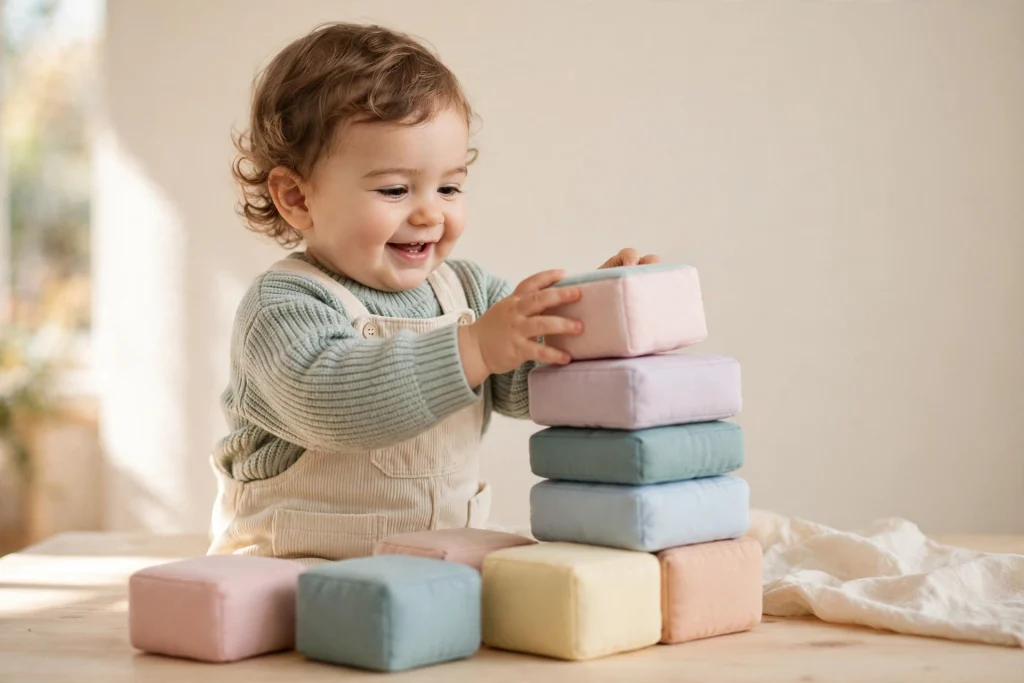
Short answer: The best activities for 1 year olds are the doing kind: pushing, posting, pouring, emptying and starting all over again — that is how one year olds learn. These 25 activities are built for small hands and short attention spans — all at home, all free, and all safe with you close by.
Quick facts
- Age: 1 year (12–24 months)
- Prep: mostly none — a few take two minutes to set up
- Cost: free, or ordinary household items
- Screen-free: yes — every activity on this page
- Supervision: always, within arm’s reach (see the safety note below)
What your 1 year old is learning
The year from one to two is a giant leap that happens in small daily steps. Many 1 year olds are taking first wobbly steps, and the rest are happily cruising along the furniture. Words are arriving too — a handful of real ones, plus plenty of confident pointing. Above all, this is the age of cause and effect: press it and it squeaks, drop it and it falls, put it in and tip it out again. Your toddler will copy everything you do, from stirring a pan to talking on the phone, and will want to put every object they meet into a container — and then, immediately, out again. The activities below are built for this stage.
A quick safety note. At this age, everything is explored with the mouth as well as the hands, so keep the toilet-roll test in mind: if an object fits through a toilet-roll tube, it is too small for your 1 year old. Choose big pieces and taste-safe materials, stay within arm’s reach for every activity on this page, and never leave your toddler alone with water — not even a shallow bowl.
The information on this page is general information for parents, shared for learning and activity ideas. It is not medical advice, and it does not replace the guidance of a qualified professional. Every child develops at their own pace — if you have any concern about your child’s development, please talk to a qualified doctor or child-development professional.
Move and explore — first steps and big movements
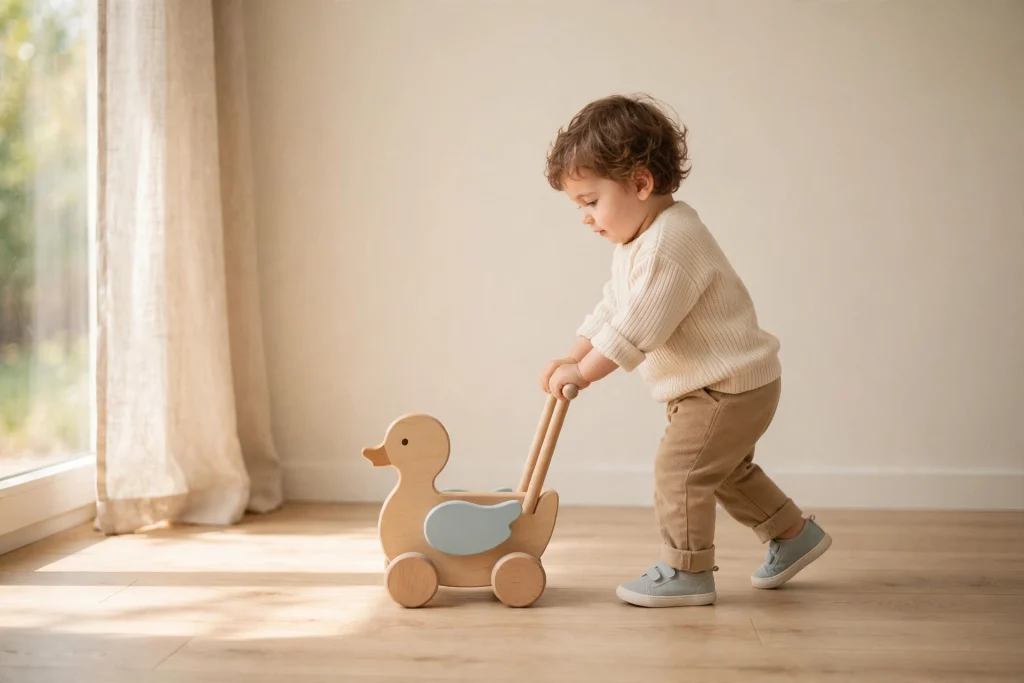
Short legs, big energy. These nine ideas practise new movement skills on safe ground, with you right there.
1. Push-along walking games
Give your toddler something sturdy to push — a solid push-along toy, or a small box weighted with a few books — and set up a “route” around the chair and down the hallway. Pushing while walking builds leg strength, balance and steering all at once. If your child is still cruising, push the route along the sofa instead.
2. Cushion mountain climb
Lay one or two big sofa cushions flat on the floor and let your toddler crawl and climb over them to reach a favourite toy on the other side. Keep the mountain low and stay right beside it. Climbing over soft, uneven surfaces is serious work for balance and leg strength.
3. Tunnel crawl
Open both ends of a large cardboard box, or drape a blanket over two chairs, and crawl through together — or send a ball through first and let your toddler go after it. Tunnels keep crawling playful — still a strength-building skill at one — and add a first taste of hide and seek.
4. Dance and freeze, baby version
Put on a favourite song and dance together — bounce, sway, clap, march on the spot. When the music stops, scoop your toddler up for a cuddle-freeze, then start again. Real freezing is far too hard at one; the fun is in the starting and stopping, and in copying your moves.
5. Roll and chase the ball
Sit or kneel a short distance away and roll a big, soft ball slowly towards your toddler — then let them crawl or toddle after it when it escapes. Fetch it together and roll it again. Chasing a ball that is just slightly out of reach is powerful motivation to move, and rolling it back is a first lesson in how games go back and forth.
6. Pull-toy parade
Tie a short ribbon or strap to a favourite toy on wheels and show your toddler how to pull it along on a parade around the room. Walking while looking backwards at the toy is a real balance challenge at one. Use a short strap, keep the parade supervised, and put the toy away afterwards — straps and cords are never for unattended play.
7. Sofa-cushion stepping stones
Lay three or four flat cushions in a line on the floor, close together. Hold both your toddler’s hands and help them step or crawl from cushion to cushion to reach you — or a teddy — at the end. The soft, slightly wobbly surface makes little feet and legs work harder than the flat floor does.
8. Barefoot texture walk
On a safe patch of ground — grass, a smooth path, a sandy corner, a bath mat indoors — let your toddler walk or crawl barefoot and feel the difference. Name what you feel together: soft, tickly, smooth, cool. Hold hands and check the ground first for anything sharp. New textures underfoot are a feast for the senses as well as the legs.
9. Hide and seek under cups
While your toddler watches, hide a toy under one of two big cups, shuffle slowly, and ask “where is it?” Lift, cheer, and hide it again. This simple game teaches a big idea — things still exist when you cannot see them — and the moment of finding never stops being thrilling at one.
Busy hands and senses — posting, pouring and making a happy mess
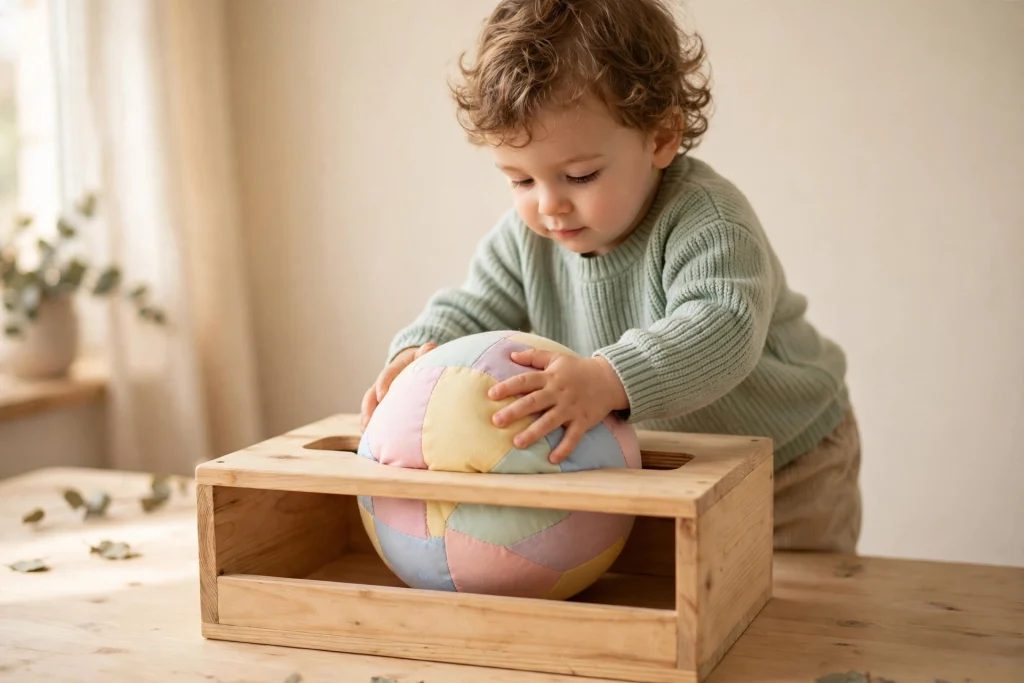
Several of these ideas work beautifully as table activities — set up at the table or on the highchair tray, they keep small hands busy while you cook or sit together nearby. For more ideas like these, our sensory activities for toddlers page is the bigger list.
10. Posting box
Cut a wide slot in the lid of a sturdy box or an empty tub, and give your toddler big balls, blocks or chunky pegs to post through it. Tip the lid off, take everything out, and post it all again. Posting is the perfect 1 year old loop — hand control, aim and cause and effect in one endlessly repeatable game. Choose pieces far too big to fit through a toilet-roll tube.
11. Stack it and knock it down
Build a small tower of big blocks, nesting cups or empty boxes, and let your toddler do the honours: push it over. Build again, slightly differently, and down it goes again. You are not failing at towers — the knocking down is the activity. It builds early ideas about balance and cause and effect, plus the patience to rebuild.
12. Sealed sensory bottles and bags
Fill a clear plastic bottle with water, big beads and a drop of food colouring, glue or tape the lid firmly shut, and let your toddler shake, roll and watch. A zip-lock bag of water and big foam shapes, taped flat to the table, works the same way. Check every seal before play and stop if anything leaks. Our sensory activities for toddlers page has many more sealed, taste-safe ideas like these.
13. Water pouring at the sink or bath
At bath time, or standing at a low sink with you, give your toddler cups, a small jug and a funnel to fill, pour and empty. Shallow water and big containers are plenty at this age. Water play builds hand strength and pouring control — and the golden rule never changes: a toddler is never left alone with water, even for a moment.
14. Big crayon scribble board
Tape a large sheet of paper to the table or floor, hand over two or three chunky crayons, and scribble together. At one, the marks themselves — and the power of making them appear — are the whole point. Keep crayons chunky and non-toxic, expect some to be tasted, and scribble alongside: copying yours is how your toddler learns to make theirs.
15. Big sticker peeling
Offer big, chunky stickers on a sheet of paper or the highchair tray, and let your toddler pat them down, peel them up and move them around. Peeling works the exact fingertip pinch that buttons and zips will need later. Use stickers that are big and thick, stay close while they play, and keep any sticker backing paper out of mouths.
16. Playdough pressing and poking
A ball of soft playdough is a whole activity at one: flatten it with a palm, poke holes in it with a finger, press a big block into it to leave a print. Our easy no-cook playdough recipe takes ten minutes and keeps for months. It is made from kitchen ingredients, but it is salty and not a snack — press and poke together, and wash hands afterwards.
17. Tearing paper
Save tissue paper, old wrapping paper and magazine pages for a tearing session: show your toddler how to grip and rip, then enjoy the sounds and the confetti. Tearing builds both hands working together — a skill scissors will need one day. Watch that torn pieces go on the floor and not into the mouth, and clear up together at the end.
18. Highchair tray oat play
Scatter a handful of rolled oats on the highchair tray or a baking tray, and add a spoon, a small cup and a toy car to push through them. Your toddler scoops, sprinkles, drives and — inevitably — tastes, which is exactly why oats are the right material: plain, taste-safe and easy to sweep up. Tray play like this is a first taste of the sensory-bin fun that fills the next two years.
First games and together time — simple games for 1 year olds
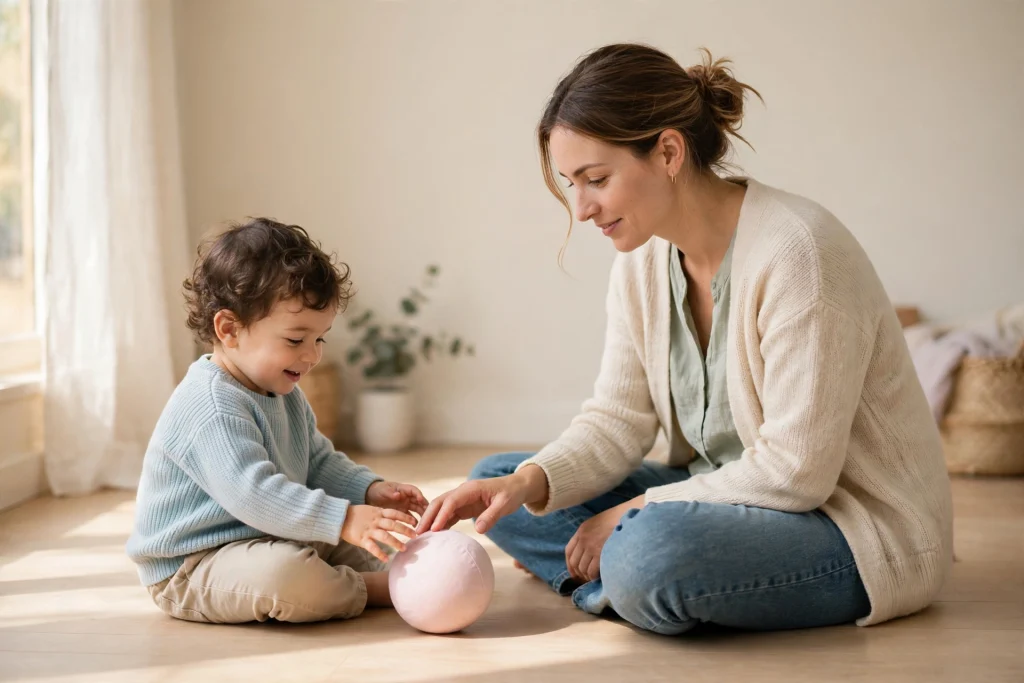
These seven are the first real games for 1 year olds: short, silly and built on taking tiny turns.
19. Peekaboo, five ways
Behind your hands, behind a scarf, popping out from behind a cushion, hiding a toy under a cloth, and the classic mirror version. Peekaboo never gets old at one because it rehearses the same big lesson as hide and seek — you disappear, and you always come back. Let your toddler pull the scarf away themselves as soon as they want the turn.
20. Rolling ball turn-taking
Sit on the floor facing each other, legs apart, and roll a big soft ball slowly back and forth between you. Wait for it, cheer the return roll, and add a count of “one, two, three… roll!” as your toddler grows. This is turn-taking in its simplest form — the seed of every game and conversation to come.
21. Action rhymes and singing games
Row, Row, Row Your Boat while rocking gently hand in hand; Pat-a-Cake with claps; This Little Piggy on toes. Songs with actions give your toddler words, rhythm and movements to copy all at once, and the tenth repetition is as beloved as the first. A two-song “concert” is a lovely calm moment before a nap.
22. Lift-the-flap book sharing
Choose sturdy board books with flaps, textures or mirrors, and read at your toddler’s pace — which usually means the same page, and the same flap, many times. Name the pictures, let them turn the pages (backwards is fine), and follow their pointing. This early, happy book handling is the real beginning of reading.
23. Copy-me pretend play
Hand your toddler their own version of what you are using — a toy phone while you are on yours, a spoon and bowl while you cook, a cloth while you wipe. Copying your everyday actions is how 1 year olds learn what things are for, and it grows into the pretend play that fills the next few years.
24. “Where’s the…?” pointing game
Look at a picture book or around the room together and ask: “Where’s the dog? Where’s the ball? Where’s Mummy?” Your toddler answers with a point, a pat or a look — all of which count. This game links words to things faster than almost anything else, and pointing is a milestone worth celebrating every time.
25. Fill and empty races
Set out a basket and a pile of big, safe objects — soft blocks, balls, rolled socks. Fill the basket together as fast as you can, tip it out, and race to fill it again. Time yourself with a silly countdown. Filling and emptying is never just mess-making at one; it is early maths, arm strength and the joy of a job finished, all in one basket.
A look ahead
One year olds change faster than any other age — the toddler who is cruising today will be running, talking and demanding “me do it!” very soon. When you are ready for the next stage, our 24 Activities for 18 Month Olds picks up right where this page leaves off, and our 30 Activities for 2 Year Olds is waiting right behind it.
Read next
- Activities by Age — activity ideas for every age, from babies to 5 year olds
- 24 Activities for 18 Month Olds — the next stage, when walking turns into running and climbing
- 30 Activities for 2 Year Olds — busy, active play for the year after that
Activities for 1 year olds — questions parents ask
What should a 1 year old be doing all day?
Mostly moving, eating, sleeping and exploring, with you nearby. A 1 year old’s day does not need a timetable of activities — it needs safe floor space, a few interesting objects to handle, meals and naps, and plenty of talking, singing and being read to. The activities on this page are short extras you can drop into the day whenever you have a spare ten minutes, not a schedule to keep up with.
How do I entertain a 1 year old at home?
You do not need to perform — you need to provide. A low cupboard or basket of safe household things to pull out (cups, lids, wooden spoons), cushions to climb, water to splash at bath time and containers to fill and empty will entertain a 1 year old better than a pile of toys. Rotate a few objects every few days so they feel new again, follow your toddler’s lead, and join in for short bursts rather than directing the whole show.
What activities help a 1 year old learn to walk?
Give lots of chances to practise the steps before walking: pulling up on sturdy furniture, cruising sideways along the sofa, and pushing something stable — a push-along toy or a weighted box — once your toddler is steady on their feet. Barefoot time on safe indoor floors helps little feet grip and balance. Children take first steps across a wide range of ages, each at their own pace; if you ever have a concern about your child’s development, a qualified doctor or child-development professional is the right person to ask.
How long can a 1 year old play with one activity?
Often only two to five minutes — and that is completely normal at one. Attention at this age is short, but learning comes from repetition: the same posting box, brought out day after day, teaches more than an hour of new activities would. Put things away without fuss when interest fades, and let your toddler, not the clock, decide when a game is finished.