
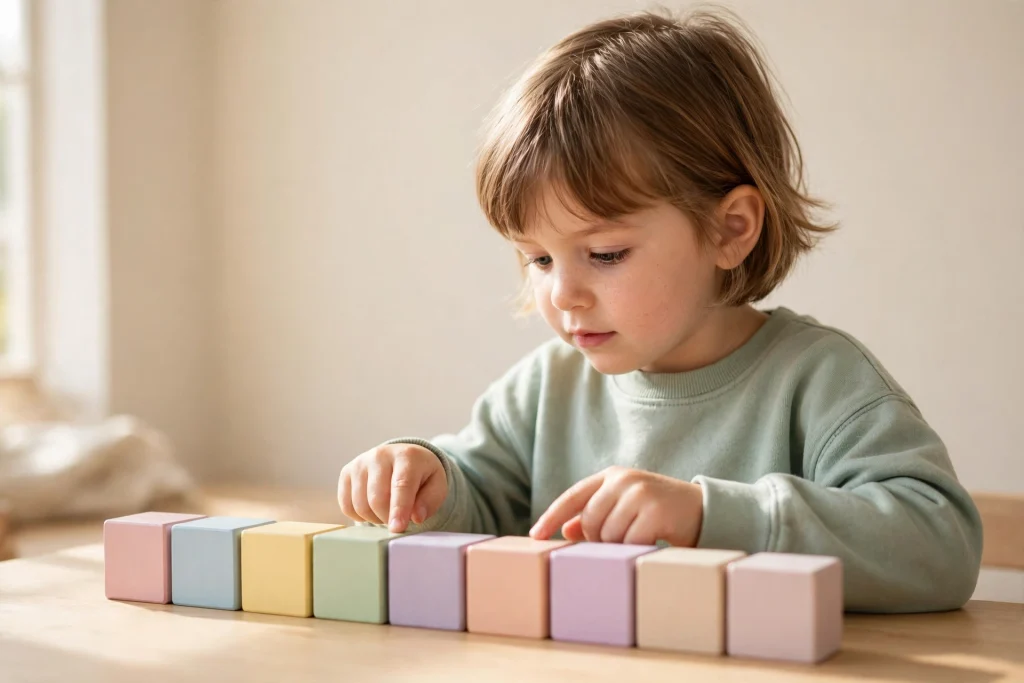
Short answer: The best math activities for preschoolers are not sums on paper — they are counting snacks, spotting patterns and sorting socks. These 25 play-first activities build real number sense for ages 3–5 with things you already have at home.
Quick facts
- Ages: 3–5 years
- Prep: mostly none — a few take two minutes
- Cost: free — ordinary household things
- Screen-free: yes — every activity on this page
What preschool maths really is
Before school, maths rarely looks like maths. It looks like counting the spoons onto the table, noticing that the stripe pattern on a jumper repeats, working out whose tower is taller and sorting the washing into piles. Those things — counting real objects, spotting patterns, comparing sizes and sorting into groups — are the whole foundation. Numbers on paper come later and land easily on top of them. Everything below builds that foundation through play, and each activity names the maths idea inside it, so you know what your child is learning while they play.
Counting and numbers
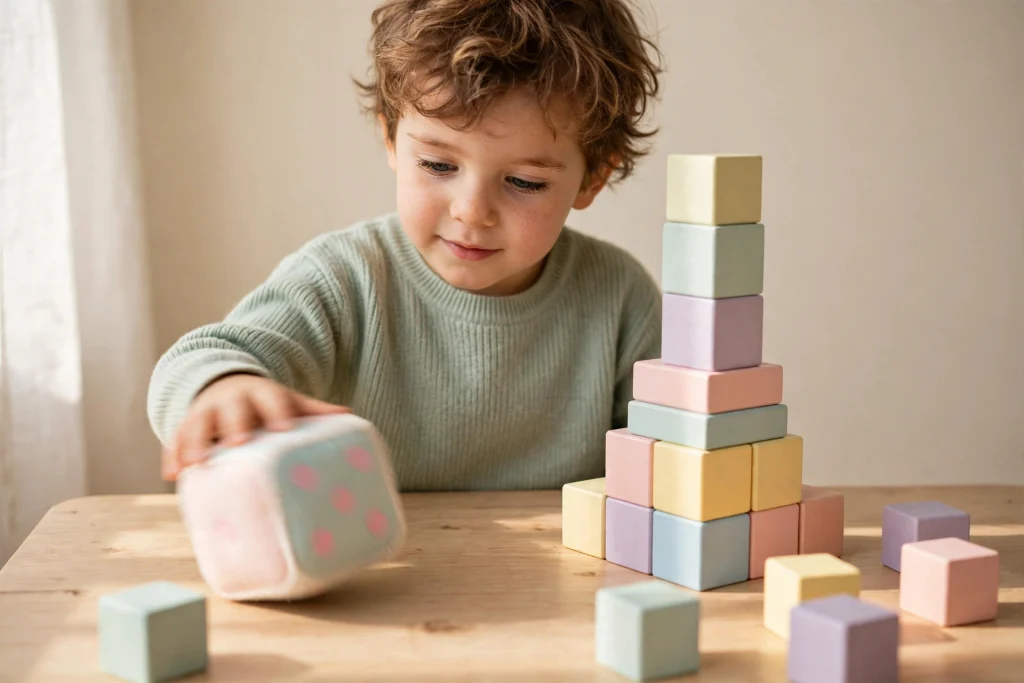
Counting is the first maths skill, and it is really three skills in disguise: saying the number words in order, touching one object for each word, and understanding that the last number said is how many there are. These nine games practise all three.
1. Count and fetch
Give your child a counting mission: “Bring me six spoons.” “Find me four cushions.” They collect the objects one by one, counting aloud as each one lands in the basket, and announce the final number like a score. Counting real things to carry is one-to-one correspondence in action — one object, one number word — and stopping at the target teaches that the last word said is the total.
2. Number hunt
Write the numbers 1 to 10 on sticky notes or cards and hide them around one room — one on the fridge, one under a cushion, one on the door. Your child hunts them down and sticks each one onto a simple number line you have drawn on paper, in order. Hunting makes numeral recognition a treasure game, and placing the numbers in a row builds the order of numbers without a single drill.
3. Snack counting
At snack time, count the pieces onto the plate together — five grapes, seven crackers — touching each one as you count. Then ask the magic question: “So how many are there?” Eating one and counting what’s left is early subtraction nobody notices. Cut grapes lengthways for under-5s; counting works just as well with crackers, berries or banana pieces.
4. Counting the stairs
Count the steps out loud every time you climb them together, then count back down. Count jumps, hops, claps and star jumps the same way. Repetition in real life is how the number sequence to 10, then 20, becomes automatic — and counting backwards down the stairs is a gentle first taste of numbers going the other way.
5. Roll and build towers
Roll a big dice, read the dots together, and stack that many blocks into a tower. Roll again and add that many more. Whose tower survives longest? How many blocks is it now? Dice dots teach children to recognise small amounts at a glance, without counting each dot, and “add that many more” is addition wearing a party hat.
6. Counting finger rhymes
Sing a counting-down rhyme — five little ducks, five speckled frogs — holding up one finger for each creature and folding a finger down at every verse. Your child sees the number shrink as the song goes on, which makes “one less” visible and concrete. Rhymes also lock the number order into memory the way songs always do: through rhythm and repetition.
7. Number tracing in a salt tray
Sprinkle a thin layer of salt or sand in a shallow tray. Write a number with your finger and let your child copy it, then shake the tray flat and start again. Add the matching quantity underneath: a 4 with four dots, four buttons, four strokes. Tracing gives the feel of numeral shapes with no pencil and no pressure, and pairing the symbol with the amount is the link that makes numbers mean something.
8. Pretend shop till
Set up a shop: toys or tins on a shelf, price labels from 1 to 10, and a pot of play coins or real pennies. Your child “pays” by counting out the matching number of coins; then swap roles and let the shopkeeper count the coins you hand over. Counting out an exact amount for a price is one-to-one correspondence with a purpose — and early money sense grows quietly alongside.
9. Counting the days
Put a simple calendar where your child can reach it. Cross off each day together, count the sleeps until something exciting, and keep a small weather tally: a mark for each sunny day, each rainy day. Counting forwards to an event builds the idea of numbers on a line, and the tally is a first chart — real data, collected by a small researcher.
Shapes, patterns and puzzles
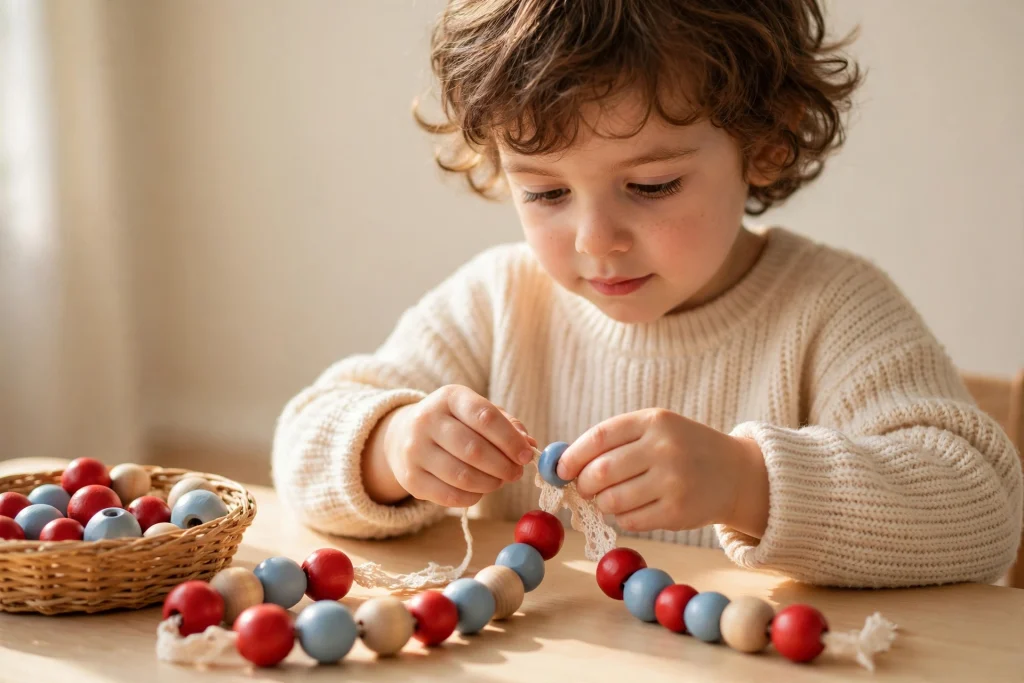
Patterns are the second pillar of early maths — the roots of times tables, algebra and music all start with “red, blue, red, blue… what comes next?” Shapes and puzzles build the spatial thinking that geometry will need.
10. Shape hunt indoors
Choose a shape of the day and hunt for it together: circles (clocks, plates, lids), squares (books, tiles), triangles (a folded napkin, a coat hanger), rectangles (doors, phones). Draw or tick each find on a list and count them at the end. Children who can spot shapes hiding inside real objects are learning what makes a shape that shape — the corners and edges, not just the picture in a book.
11. Pattern threading and clapping patterns
Thread big beads, buttons or pasta tubes onto a lace in a pattern — red, blue, red, blue — and let your child continue it, then invent their own. Do the same with sounds: clap, clap, stomp; clap, clap, stomp. Predicting what comes next is the heart of pattern work, and making up a pattern for you to copy is harder (and prouder) than following one. Use big beads only and thread at the table together.
12. Block building challenges
Set a small challenge: build a tower exactly five blocks tall; build a bridge a toy car can drive under; copy a model you build first. Challenges turn free building into problem solving — counting pieces, testing which shapes stack, and fixing what falls. It is also a first feel for symmetry and balance, long before those words appear.
13. Simple jigsaws
Move up to 12–24 piece interlocking puzzles with a picture your child loves. Find the corners and edges together, name what each piece shows, and let your child do the turning and testing. Fitting a piece means rotating it, comparing its shape to the gap and reasoning about part and whole — genuine mathematical thinking, sized for small hands.
14. Sponge shape printing
Cut kitchen sponges into a circle, a square and a triangle. Dip them in washable paint on a plate and print: first a row of one shape, then a printing pattern — circle, square, circle, square. Naming the shape as it stamps, and deciding what belongs next in the row, mixes shape recognition with pattern rules. Aprons on: this one is joyful, not tidy.
15. Fruit pattern skewers
Make an edible pattern: strawberry, banana slice, strawberry, banana slice, threaded onto a blunt skewer or straw. Your child says the pattern aloud, chooses what comes next, and counts the pieces before eating the lot. Patterns you can eat are patterns you remember — and counting your snack is one-to-one practice. Use only a blunt skewer with an adult’s hands in charge throughout, and cut round fruit lengthways for under-5s.
16. Matching pairs memory game
Lay out six to ten pairs of matching picture cards face down. Turn two over at a time; keep the pairs you find, and count your pairs at the end. Remembering where a card is hiding is working-memory exercise, and matching identical pictures is the earliest form of “these two are the same” — the classifying instinct maths runs on. Start with few pairs; add more as memory grows.
17. Paper shape tangrams
Cut one big square of card into a few simple pieces — two big triangles, a square, a smaller triangle or two (or use a toddler tangram set). Now build pictures: a house, a boat, a cat, a rocket. Pieces turn, flip and join in new ways, which teaches that shapes can combine to make bigger shapes — the seed of geometry — and copying a simple outline picture is a satisfying puzzle.
Measuring, sorting and comparing
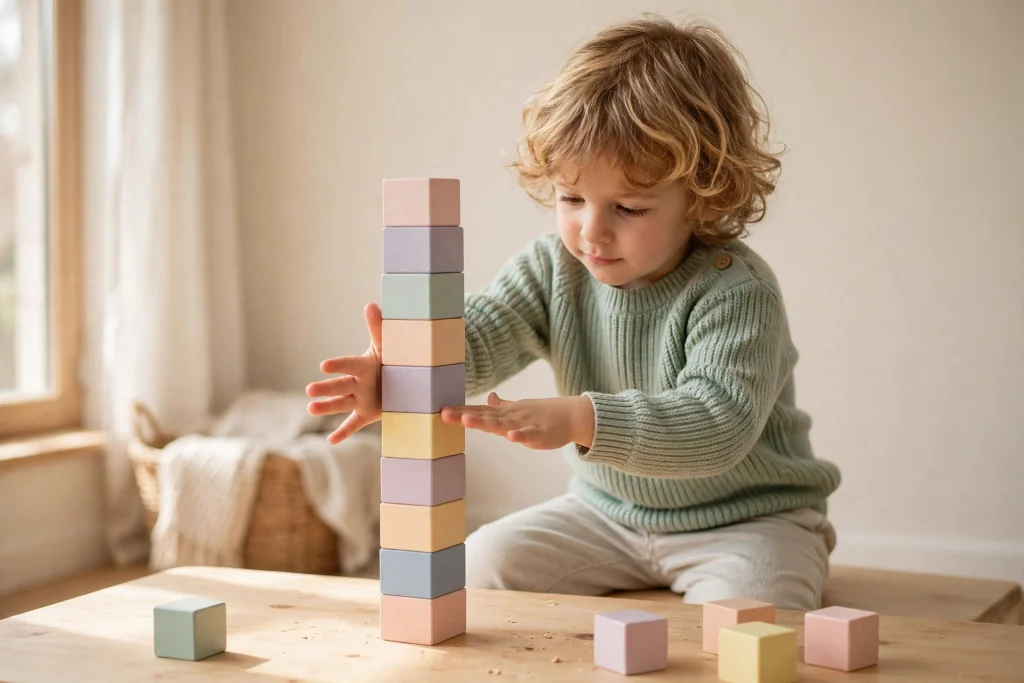
The third pillar is comparison: longer and shorter, heavier and lighter, more and less. Children build these ideas with their bodies and hands long before rulers and scales make sense.
18. Sort the laundry
Hand your child the clean washing and three baskets: one for each person, or one for tops, one for bottoms, one for socks. Matching the socks into pairs at the end is a job children take very seriously. Sorting by one rule — colour, person, type — and counting the pairs is classification and counting inside a real chore: exactly where maths belongs at this age.
19. Big and little treasure sort
Collect a basket of household treasures — spoons, boxes, balls, shoes — and two hoops or circles of string on the floor: big things in one, little things in the other. Then line one set up in size order, smallest to biggest. Deciding “big or little” about real objects builds comparison language, and ordering by size (small, medium, big) is the beginning of measurement itself.
20. Measuring with hands, feet and cubes
How long is the table? Walk your hand spans along it and count. How many of your child’s footsteps from the door to the sofa? How many cubes long is a book? Measuring with body units and blocks teaches what measuring is: counting equal units along a length. It also explains why the same table gives different numbers in grown-up hands and little ones — a famous and lovely maths conversation.
21. Full and empty water play
At the sink, the bath or a washing-up bowl, give your child cups, jugs and spoons of different sizes. Fill, pour, compare: which cup holds more? How many little cups fill the big jug? Full, half full and empty stop being words and become things they can see and test. Estimating first (“I think three cups”) and checking is the scientific habit in its first form — and as always with water, you stay right there.
22. Taller than me?
Build a tower, then measure it against things: is it taller than Teddy? Taller than the chair? Taller than you (lying down counts)? A piece of string cut to the tower’s height makes a record you can compare with tomorrow’s tower. Height comparison gives children taller, shorter and “the same as” — the vocabulary every measuring lesson at school will assume they know.
23. Kitchen scales weighing play
Let your child weigh toys and kitchen things on the kitchen scales: first guess — heavier or lighter than this apple? — then test. Line things up from lightest to heaviest. Watching the numbers or the needle move connects weight to number for the first time, and guessing before testing builds estimation, a skill school maths quietly relies on everywhere.
24. Order the day
Make or draw five simple picture cards: waking up, breakfast, playing, bath, bed. Mix them up and let your child put the day back in order, narrating as they go: first, next, then, last. Sequencing is maths as much as literacy — order matters, and ordinal words (first, second, third) are number words. Extend it with “what do we do after lunch?” and let them catch you putting a card in the wrong place.
25. More or less pouring game
Two identical cups and a jug of water (or dried lentils on a tray). Pour a lot into one cup and a little into the other: which has more? Then the trickier version — pour the same amount into a tall thin glass and a short wide bowl, and ask again. Judging more and less with the eyes, then checking by pouring back into matching cups, is how children build one of the biggest ideas in early maths: that the amount stays the same even when it looks different.
A gentle weekly rhythm
If you like a little structure, one tiny maths moment a day is more than enough: a counting game on Monday, a shape hunt on Tuesday, a building challenge on Wednesday, measuring or water play on Thursday, and your child’s favourite repeated on Friday. Ten playful minutes, fitted around ordinary life, covers everything on this page across a few weeks. If you would like a fuller gentle plan for the week, our homeschool preschool curriculum lays one out for ages 3–5.
Make it seasonal
The same games wear seasonal costumes. In autumn (fall), count fallen leaves and sort them big to little; at Thanksgiving, count out pumpkin seeds in tens; in winter, count cotton-ball “snowballs” into buckets and print snowflake patterns; at Christmas, thread bauble colours into patterns — red, gold, red, gold. Nothing new to buy or learn: just the seasons changing the counters.
From play to printables
Play is where preschool maths is really learned — but many 4 and 5 year olds start asking for “real” number pages of their own, especially with an older brother or sister at the table. When that day comes, FIMS Schools has free printable worksheets for preschool and kindergarten — counting, numbers and first patterns on paper: free preschool and kindergarten worksheets. A page or two at a time is plenty; the play stays the main event.
Read next
- More play ideas by kind: Activities by Type
- 30 Activities for 3 Year Olds — its counting games and first learning section pair well with this page
- 30 Activities for 2 Year Olds — counting starts even earlier than you think
Preschool maths questions parents ask
What maths should a preschooler know before school?
The helpful list is short and playful: count aloud to 10 and beyond, count a small group of objects by touching each one once, recognise a few written numbers, name basic shapes, compare things as bigger, smaller, more and less, and copy a simple pattern. Children arrive at these at very different speeds, and every one of them grows out of play like the games on this page — none needs drilling or flashcards to appear.
How do I teach numbers to a 4 year old at home?
Count real things, all day, in passing: steps, spoons, red cars, pages of the book. Play dice and board games, cook together and let your child count the spoonfuls, and keep a number hunt or two up your sleeve for rainy moments. Short, cheerful and woven into the day beats any sit-down lesson at this age. If a game stops being fun, stop the game — the counting will still be there tomorrow.
My child counts but skips numbers — is that normal?
Yes — very common, and a normal step on the way. Saying the number words in a perfect string (“one, two, four, seven…”) develops separately from counting objects one by one, and both wobble for a while before they settle. Keep counting together in games and routines, gently model the right order without making it a correction, and the sequence straightens out with practice. Children develop at their own pace in maths just as in talking and walking.
Do preschoolers need worksheets for maths?
No. Worksheets are an optional extra at this age, never the main course — counting, sorting, building and comparing in ordinary play is what builds number sense. Some children love a paper page and ask for one, and a few minutes with a counting or tracing page does no harm; that is what our free printable library is for. But a child who has played these games and never touched a maths worksheet is not behind — they have been doing maths all along.