
Short answer: The best activities for 2 year olds are short, active and easy to repeat — climbing cushions, throwing soft balls, pouring water, scribbling, simple sorting games. All 30 ideas below are free, screen-free and use things you already have at home.
Quick facts
- Age: 2 years
- Prep: mostly none — a few take two minutes to set up
- Cost: free, or ordinary household items
- Screen-free: yes — every activity on this page
- Supervision: an adult nearby at all times (see the safety notes in the activities)
What your 2 year old is learning
Two is a year of doing everything at full speed. Most 2 year olds are running, climbing on anything that stays still, kicking a ball and carrying objects around like small removal workers. Language is growing just as fast: single words are turning into two-word phrases like “more juice” and “daddy go”. Play is mostly parallel — your toddler plays happily beside other children rather than with them, and sharing is still hard. Expect big feelings, lots of “mine!” and “no!”, and endless copying of whatever the adults are doing. The activities below are built around exactly these skills.
The information on this page is general information for parents, shared for learning and activity ideas. It is not medical advice, and it does not replace the guidance of a qualified professional. Every child develops at their own pace — if you have any concern about your child’s development, please talk to a qualified doctor or child-development professional.
Run, throw and climb — active play for 2 year olds
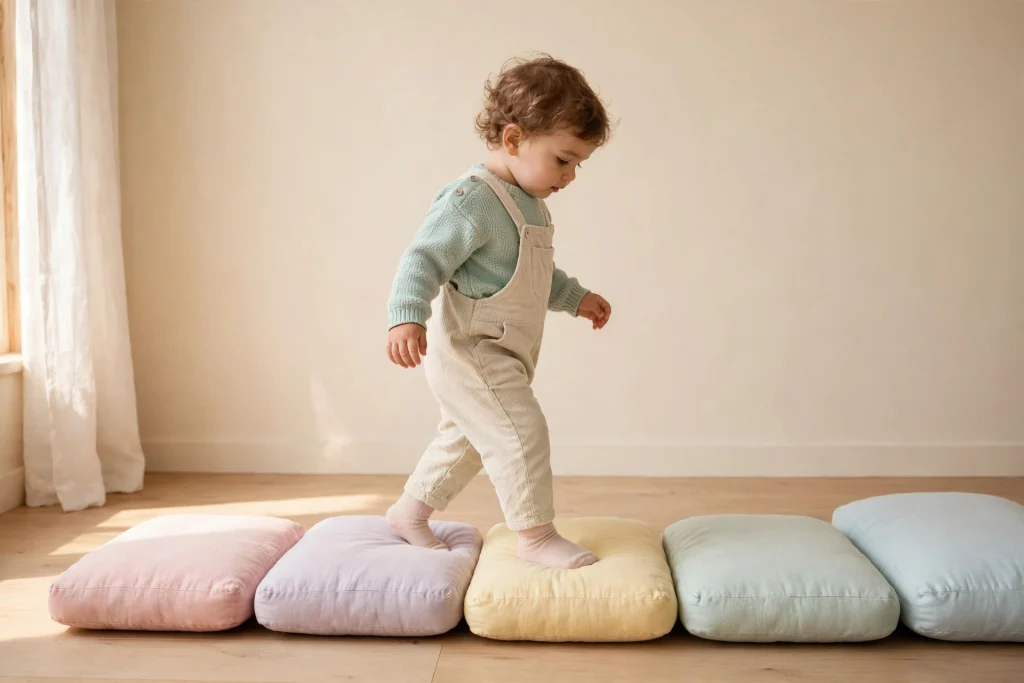
1. Cushion mountain climb
Lay three or four sofa cushions in a row on the floor and put a favourite teddy at the far end. Your toddler climbs over the wobbly “mountains” to rescue it. Climbing over soft, uneven surfaces builds leg strength, balance and confidence for real steps and playground equipment.
2. Bucket toss
Set a wide bucket, box or laundry basket a short step away and toss soft balls or rolled-up socks into it together. At two, standing close counts; moving back a step is a big achievement. Aiming, throwing and releasing on purpose builds arm control and hand–eye coordination.
3. Dance and freeze
Put on a lively song, dance together, and freeze when the music stops. Your 2 year old will bounce, spin, wave their arms and laugh at your frozen shapes long before they manage a real freeze. Starting and stopping with the music is early listening and self-control practice disguised as a party.
4. Jump the puddles
Cut or tape six big paper “puddles” on the floor in a loose path. Your toddler steps, hops or two-foot jumps from puddle to puddle — holding your hands at first is fine. Jumping with both feet is a brand-new skill at two, and landing practice builds strong legs and balance.
5. Tunnel crawl
Open both ends of a large cardboard box, or drape a blanket over two chairs, and let your toddler crawl through while you peek in from the other end. Add a ball or teddy to fetch from the middle. Tunnels encourage crawling — still valuable at two — plus problem-solving and giggly peek games.
6. Push and pull parade
Load a sturdy box or laundry basket with soft toys and let your toddler push it around the room, then pull it back to unload. Pushing something heavy is satisfying “big work” for a 2 year old — it strengthens the arms, legs and core.
7. Chase the bubbles
Blow bubbles outside, or in a room with a wipeable floor, and let your toddler chase, reach and pop them. Chasing something that floats away is pure motivation to move. Reaching up, squatting down and stamping on landed bubbles work the whole body. Keep the bubble mixture out of reach and wipe up spills promptly.
8. Simple obstacle path
Make a short path: step over a cushion, crawl under the table, walk around a chair, finish with a star jump or a big clap. Walk it together the first few times, then let your toddler lead. Following a sequence — even a three-step one — is early memory and planning practice, and the proud lap of honour at the end is the best part.
9. Roll-the-ball ramp
Rest one end of a cushion or a wide book on a low step to make a gentle ramp, and roll balls and toy cars down it. Your toddler chases, collects and returns them. Rolling and chasing build running confidence, and comparing how fast things roll is a first taste of cause and effect.
10. Animal walks
Call out an animal and move like it together: stomp like an elephant, waddle like a penguin, hop like a bunny, stretch tall like a giraffe. Keep each one to a few seconds and change often. Copying movements builds body awareness and listening skills, and naming the animals grows vocabulary.
Busy hands — sensory, craft and art activities
11. Playdough squish and stamp
Give your 2 year old a ball of soft playdough with a chunky rolling pin, plastic cookie cutters and a fork for patterns. Squishing, rolling and stamping strengthen the little hand muscles that later hold a pencil. Try our easy no-cook playdough recipe — it takes ten minutes. Watch closely: at two, everything still gets tasted, so keep pieces big and play together.
12. Water pouring station
Set two plastic jugs and a cup or two in a shallow tray, a washing-up bowl or the bath, with a small amount of water. Your toddler pours, fills, empties and starts again. Pouring builds wrist control and concentration, and water is endlessly calming. Safety first: stay right there the whole time, use only a little water, and empty the bowl as soon as play ends.
13. Big sticker pictures
Peel the backing off a sheet of large stickers, stick one corner of each down to get it started, and let your toddler press stickers all over a big sheet of paper. Peeling and pressing is real finger-strength work at two. Choose big stickers only — small ones are a choking risk and a frustration — and expect stickers on the table, clothes and possibly the cat.
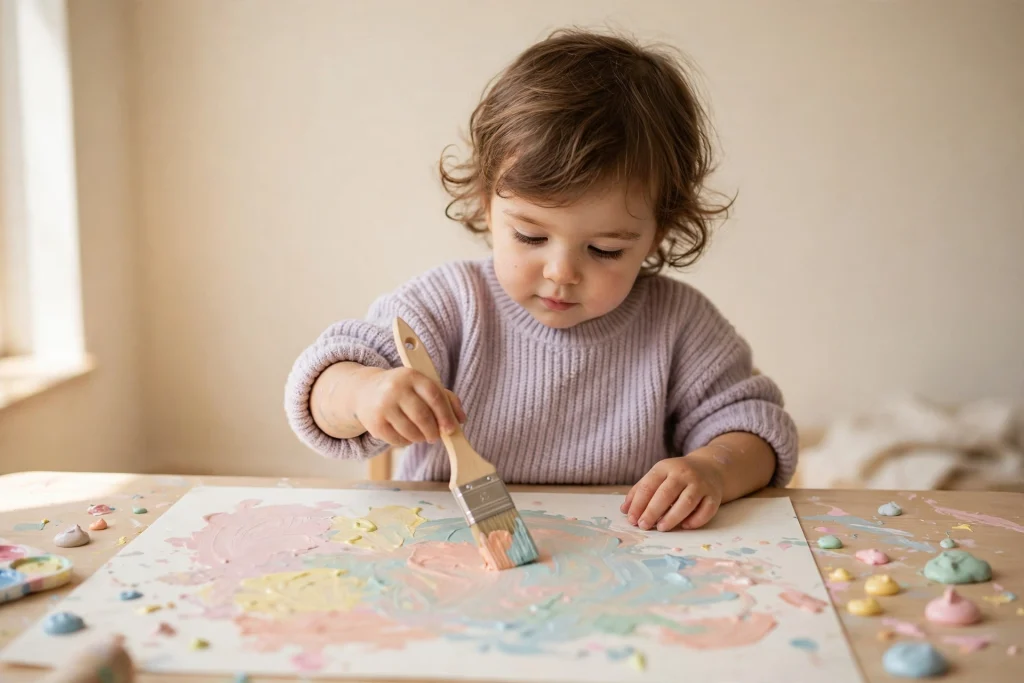
14. Mess-free paint bag
Put a few spoonfuls of washable paint inside a strong zip-lock bag, seal it well and tape the edges to the table or a highchair tray. Your toddler squishes, smears and draws patterns in the paint with their fingers — all the sensory fun, none of the mess. It is also a safe way to explore colour mixing at an age when everything goes in the mouth.
15. Sponge squeeze transfer
Put a bowl of water and an empty bowl side by side, with a bath sponge. Show your toddler how to dip the sponge, carry it across and squeeze the water out into the empty bowl. Squeezing is one of the best hand-strength builders there is, and the slow rhythm makes this a calming activity. Keep the water shallow and stay beside them.
16. Colour the big box
Sit your toddler inside a large cardboard box with a few chunky crayons and let them colour the walls around them. Being inside the picture is half the delight, and scribbling on a vertical surface is great for shoulder and arm strength. Scribbling is not “just mess” — it is the first stage of writing, and at two the goal is freedom, not staying in lines.
17. Oats scoop bin
Fill a tub or deep tray with dry oats and add cups, spoons, funnels and small containers. Your toddler scoops, pours, buries toys and finds them again — a full sensory workshop in one tub. Oats are a safer choice than rice at this age, but play together anyway: mouths will be tested. A mat underneath keeps clean-up to one shake outside.
18. Tear and stick collage
Give your toddler coloured paper to tear into pieces — tearing is a skill in itself at two — then spread a glue stick over a big sheet and let them press the pieces on wherever they like. There is no picture to get right; the tearing, sticking and pressing is the whole point, and it works the exact pinch grip children later use for pencils.
19. Pom-pom push posting
Cut a round hole in the lid of a clean tub and give your toddler large pom-poms to push through it, one by one. Pushing against slight resistance builds finger strength and focus, and the soft “pop” through the hole is deeply satisfying. Use pom-poms too big to be a choking risk, keep play on the table where you can see every piece, and put the tub away afterwards.
20. Ice rescue
Freeze a few waterproof toys in a bowl of water overnight. At playtime, tip the ice block into a tray and give your toddler warm water in a cup, a spoon and a little salt in your own hand to sprinkle. Melting, poking and splashing to “rescue” the toys introduces hot and cold, patience and cause and effect — a gift on a hot day. Stay close, as with all water play.
First learning and quiet time
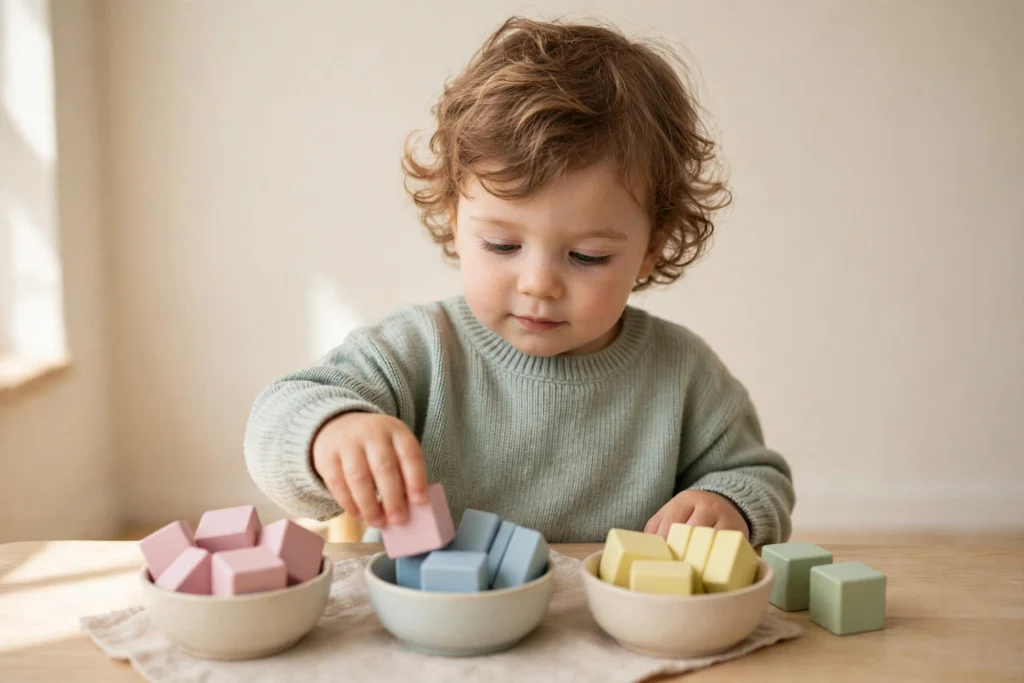
21. Cup colour sorting
Set out three or four cups or bowls in different colours and a basket of big objects — blocks, balls, socks — that match those colours. Your toddler drops objects in and you name the colours out loud. At two, sorting into “same” piles is real early maths, even when half the objects land by colour of the day: theirs.
22. Matching sock game
Take five or six pairs of clean, brightly patterned socks, mix them in a pile, and find the pairs together. Hold up one sock and hunt for “the same one”. Matching identical patterns is a first step towards noticing letters and numbers later, and a basket of socks is a quiet five minutes for you both. Hide a tiny toy under one sock for a surprise round.
23. Shape posting box
Use a shape sorter, or make one: cut a circle and a square hole in a box lid and offer one ball and one block. Your toddler turns the shapes over, tries the wrong hole, and eventually gets the triumph of the right one. At two, expect to help and to celebrate near misses — the experimenting is the learning, not the perfect fit.
24. First knob puzzles
Offer one or two chunky puzzles with big knobs and just two to four pieces — animals, vehicles or simple shapes. Take the pieces out together, name each picture, and let your toddler work on putting them back. Knob puzzles build the pincer grip and early problem-solving, and a finished puzzle, however small, is a real achievement at this age.
25. Pretend cooking
Give your toddler a pot, a big spoon, some wooden or plastic food — or dried pasta in a sealed tub for shaking — and cook together: stir, pour into cups, serve teddy. Pretend play at two copies real life, and “cooking” is what they watch you do most. Talking through what you are making grows words and early storytelling in the most natural way there is.
26. Teddy bear picnic
Spread a blanket, set out toy plates or real empty cups, and invite the teddies to a picnic. Your toddler pours pretend tea, offers pretend cake and puts the guests in a row. Arranging, serving and “feeding” others is early social learning — taking turns, caring for someone, and copying the routines of family meals.
27. Book basket quiet time
Keep a small basket of sturdy board books in a cosy corner. Sit together for a few minutes of looking, pointing and naming pictures — “where’s the dog?” — and let your toddler choose and turn the pages, even backwards. At two, book time is about talk and closeness, not finishing stories. Five happy minutes beats a forced fifteen.
28. Count everything out loud
Count the stairs as you climb them, the buttons as you fasten them, the spoons as you put them away — one to five is plenty at two. Your toddler will chant along with the rhythm long before the numbers mean anything, and that chanting is exactly how counting starts. Real things, real moments, no drills: numbers learned inside ordinary life stick best.
29. Cups hide and find
Show your toddler a favourite small toy, then hide it under one of three upturned cups while they watch. “Where did it go?” Lift, laugh, and repeat, moving slowly. At two this simple game stretches memory and attention a little further each week. Soon you can hide the toy while they cover their eyes — peek-a-boo’s grown-up cousin.
30. Sing-and-act songs
Finish the day with songs you sing together, no screen needed: “Head, Shoulders, Knees and Toes”, “If You’re Happy and You Know It”, “The Wheels on the Bus”. The actions are the activity — pointing, clapping, stamping and rolling hands builds coordination, rhythm and a surprising number of words. A toddler who “sings” two words per line is doing brilliantly.
A look ahead
Scribbling, stamping and all this busy-hands play is the real starting point for writing. When your child is a little older — or if an older brother or sister wants something of their own — FIMS Schools has free printable worksheets for preschool and kindergarten, from first pencil lines to letters and numbers: free preschool and kindergarten worksheets. No rush — at two, the scribbling is the work.
Read next
- Activities by Age — more activity ideas for every age from babies to 5 year olds
- 24 Activities for 18 Month Olds — the stage just before this one, if your toddler is a young two
Activities for 2 year olds — questions parents ask
What can I teach my 2 year old at home?
Teach through play, not lessons: colours and shapes by naming them in sorting games, counting by counting real things out loud, and words by talking, singing and looking at books together. Short, repeated, everyday moments teach more at two than any sit-down “learning time”.
How much screen time is OK for a 2 year old?
General guidance shared by child-health organisations is to keep screen time at this age small — around an hour a day or less, with gentle, slow programmes chosen by you and watched together so you can talk about them. The screen-free activities on this page are the easiest swap. If you ever have questions about your own child’s screen habits, your doctor or health visitor can advise for your family.
What are good activities for a 2 year old with lots of energy?
Start with section 1: cushion climbing, obstacle paths, bubble chasing and push-and-pull games use the whole body. Heavy work — pushing a loaded basket, carrying cushions — settles busy toddlers especially well. Follow active play with a calming activity from section 3 so the energy lands gently rather than crashing.
How long will a 2 year old play with one activity?
Usually five to fifteen minutes, sometimes only two — and that is normal and enough. Toddlers learn by returning to the same activity again and again across days, not by long sessions. Keep favourites out on rotation, put finished activities away without fuss, and let your toddler’s interest, not the clock, end the game.