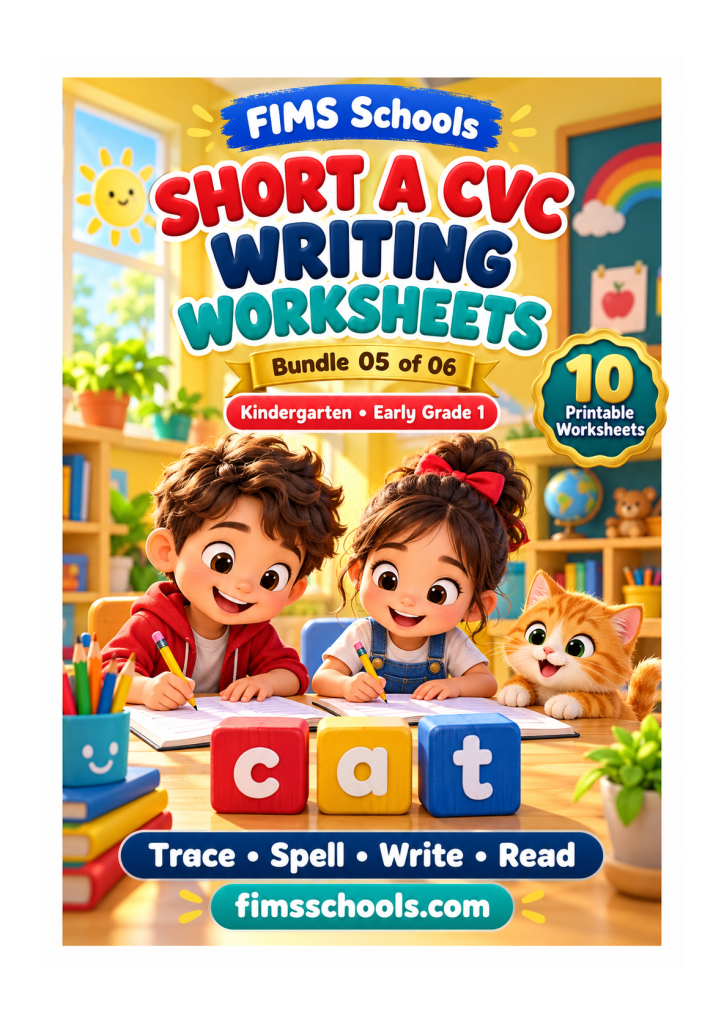
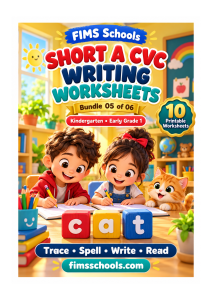
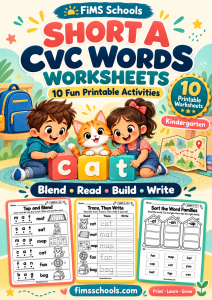
This collection of short a writing worksheets takes children from tracing their first CVC words to writing whole sentences with them. Across ten A4 worksheets, learners trace, copy and write words like cat, mat, fan and bag; spell independently in sound boxes; write word families; use the read–cover–write memory method; and finish by tracing, copying and composing real sentences such as “A cat is on a mat.” Every worksheet is free, with its own separate PDF.
Who is it for? Kindergarten and early Grade 1 children who can read short a words and are ready to write them. The bundle assumes blending is in place — if your child is still working on reading the words, begin with our Short A CVC Worksheets for Beginners and the blending collection, then return here. Within this bundle the support fades steadily: models to trace in Worksheet 1, first independent spelling in Worksheet 3, and unaided sentence writing by Worksheet 9.
What is included? These short a writing worksheets include trace-copy-write practice, finish-and-write completion, stretch-and-spell sound boxes, word-family writing for -at, -an and -ap, read-cover-write memory spelling, picture labelling, sentence completion, sentence tracing and copying, sentence building from word banks, and a four-part super review. Print on A4 paper at Actual Size (100%).
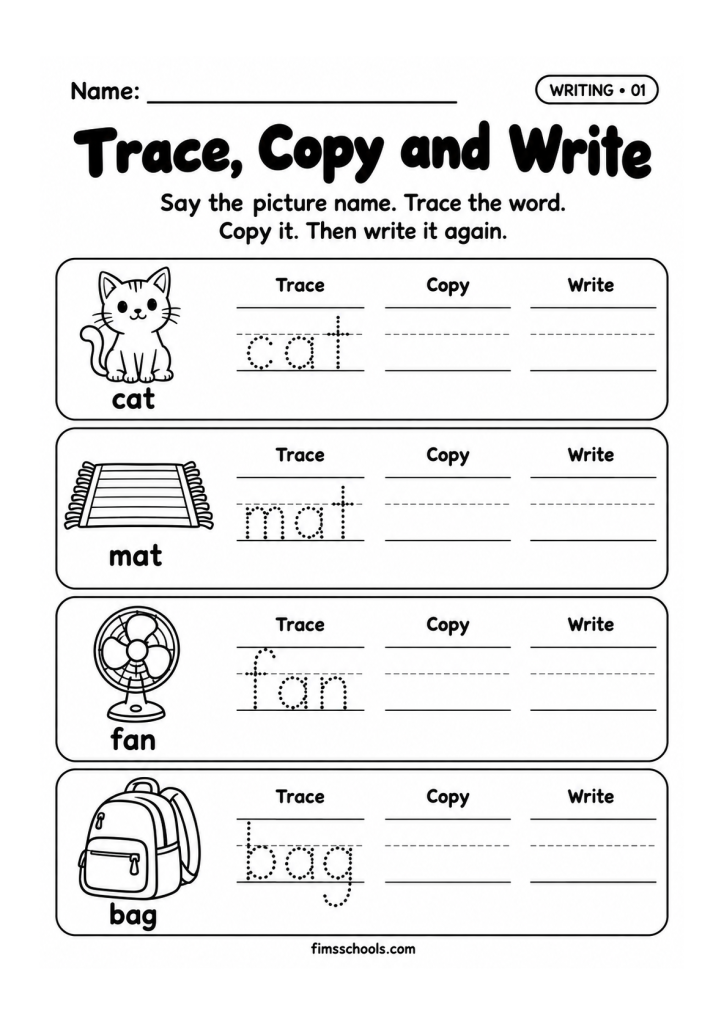
Worksheet 1: Trace, Copy and Write
Four picture words — cat, mat, fan and bag — each get a three-step row: trace the dotted word, copy it onto the guided lines, then write it a third time. The picture and the printed word under it confirm what is being written. Skill practised: letter formation and the habit of writing a word accurately more than once. Adult tip: have your child say the sounds quietly while tracing; writing and sounding together fixes spelling patterns faster.
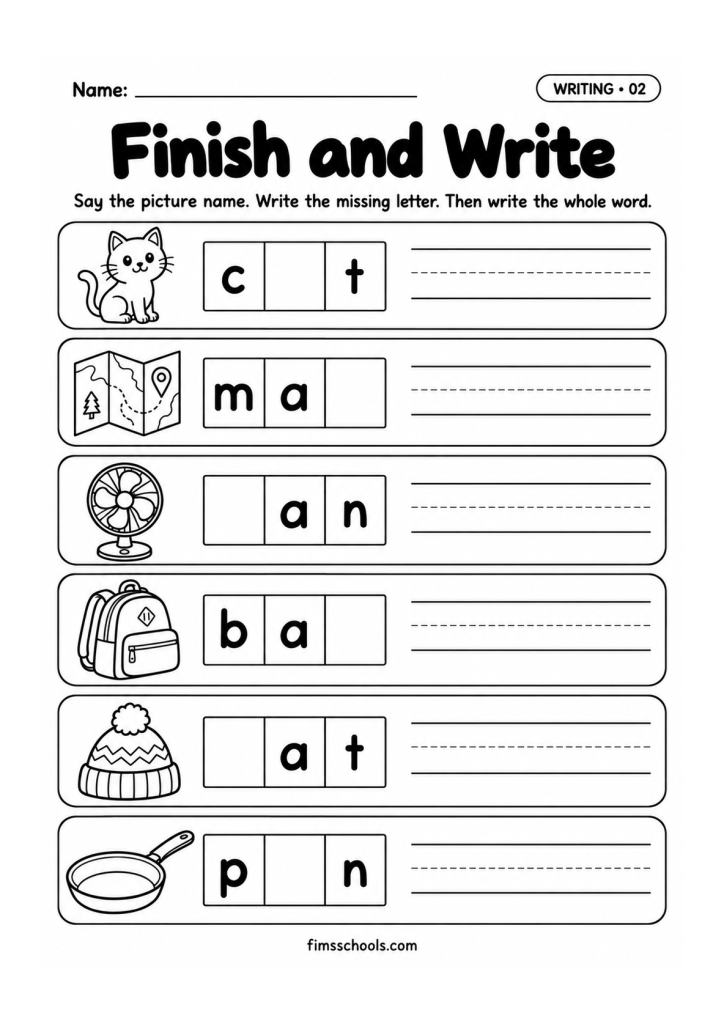
Each word is missing one letter — c_t, ma_, _an, ba_, _at, p_n — and your child writes the missing letter, then writes the whole word on the line: cat, map, fan, bag, hat and pan. The missing letter moves position from row to row, so beginnings, middles and endings all get attention. Skill practised: completing words and then producing them in full. Adult tip: saying the word slowly before writing helps your child hear which part is missing.
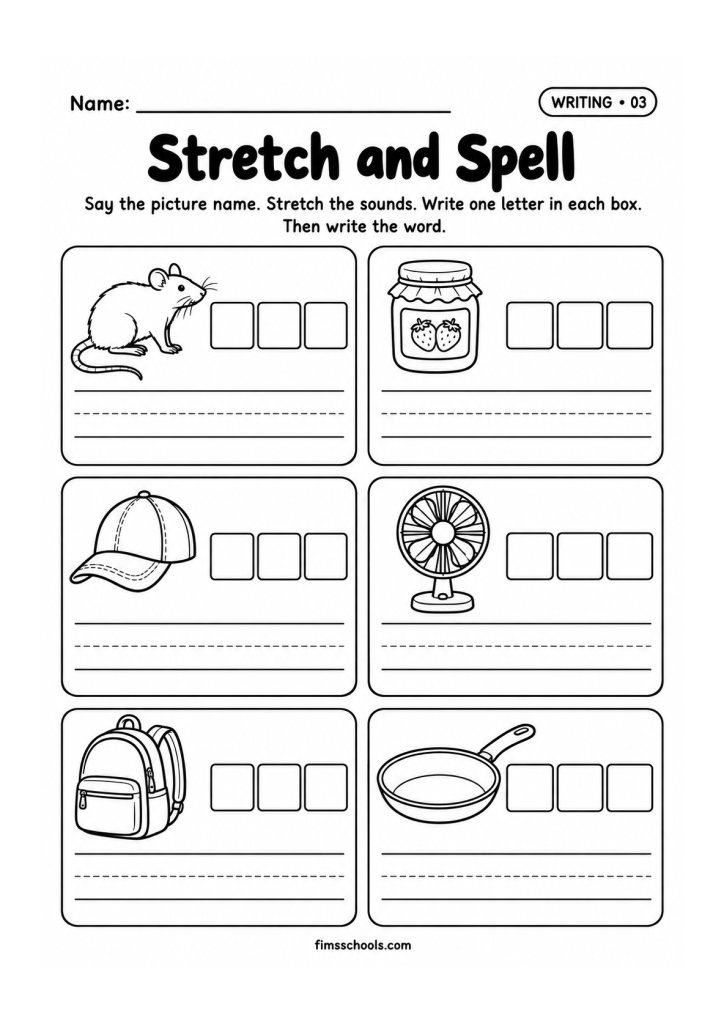
Six pictures — rat, jam, cap, fan, bag and pan — wait with three empty boxes each. Your child says the picture name, stretches it into three sounds, writes one letter per box, and then writes the whole word on the line below. Skill practised: independent spelling through sound segmentation, the core writing skill for CVC words. Adult tip: tapping a finger for each sound before writing keeps the count right.
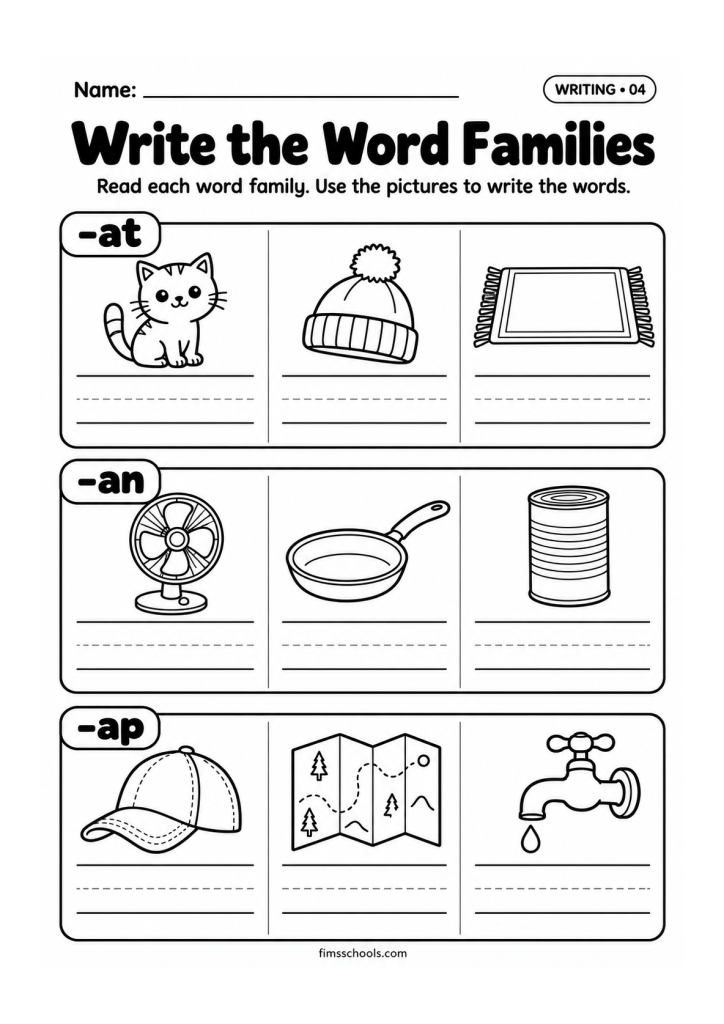
Three family groups organise the page: -at words from the cat, hat and mat pictures; -an words from fan, pan and can; and -ap words from cap, map and tap. Your child writes each pictured word on its guided lines inside the family it belongs to. Skill practised: writing words by family, noticing that only the first letter changes. Adult tip: afterwards, read down a family and underline the shared ending in colour.
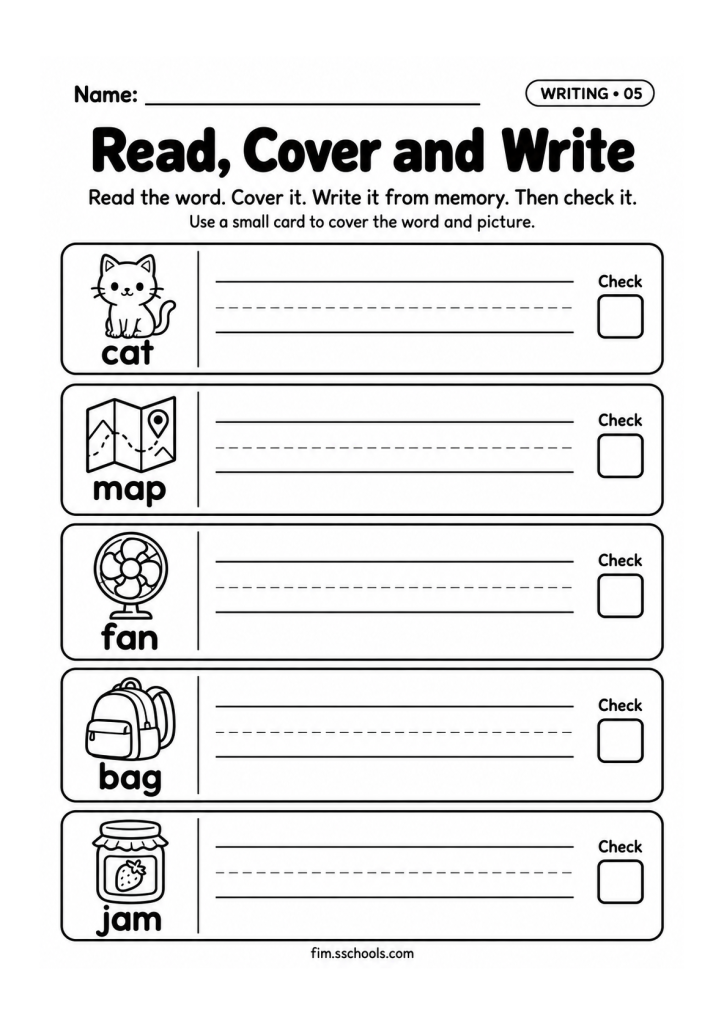
A classic memory method: read the word (cat, map, fan, bag, jam), cover it with a small card — the sheet suggests exactly that — write it from memory on the lines, then uncover and tick the check box if it matches. Skill practised: holding a word’s letter pattern in memory and writing it without copying. Adult tip: praise near-misses and let your child spot their own differences when checking — self-correction is the point of the method.
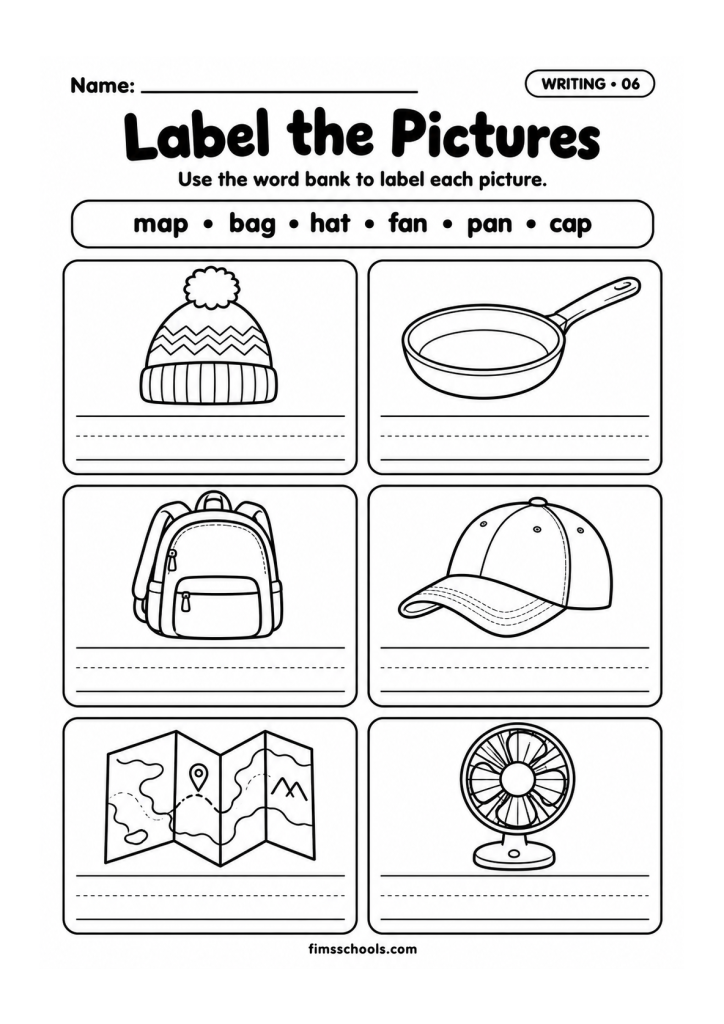
A word bank at the top — map, bag, hat, fan, pan, cap — must be matched to six pictures, and your child writes the correct label under each one. Choosing which word belongs where comes before the writing, so reading and writing work together. Skill practised: reading for meaning and writing single words accurately. Adult tip: crossing out each bank word once used is a helpful strategy to model.
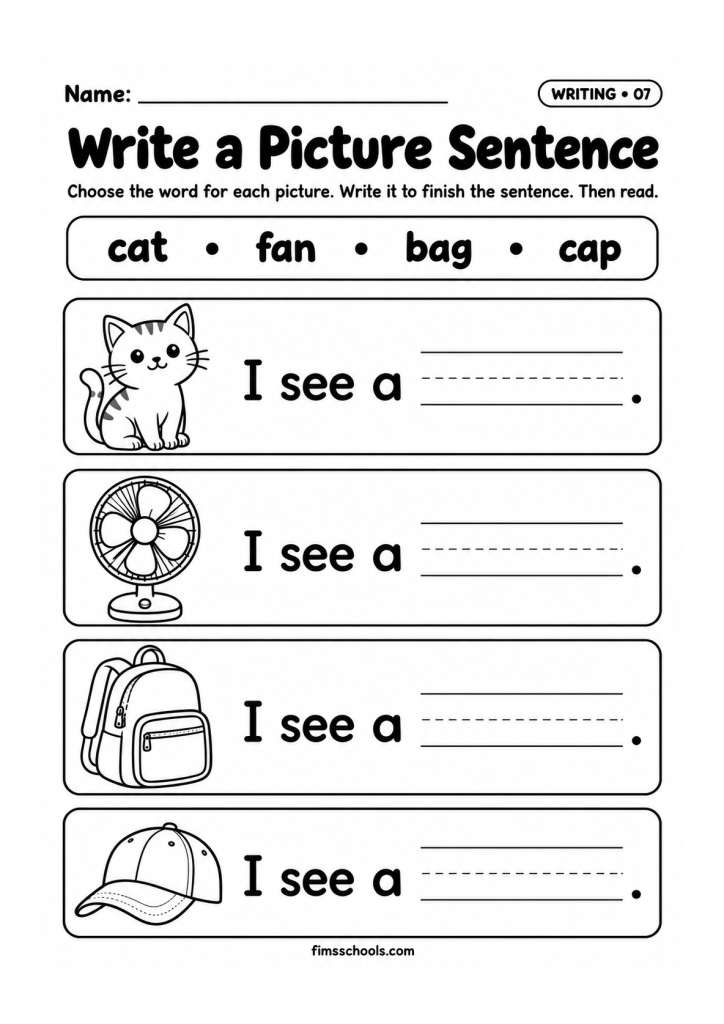
Four sentence frames read “I see a ___.” beside a cat, a fan, a bag and a cap picture. Your child chooses the right word from the bank at the top (cat, fan, bag, cap), writes it to finish the sentence, then reads the whole sentence aloud — the instruction on the sheet. Skill practised: first sentence writing, where the sentence frame carries the structure and the child supplies the key word. Adult tip: point at the full stop together; noticing end punctuation starts here.
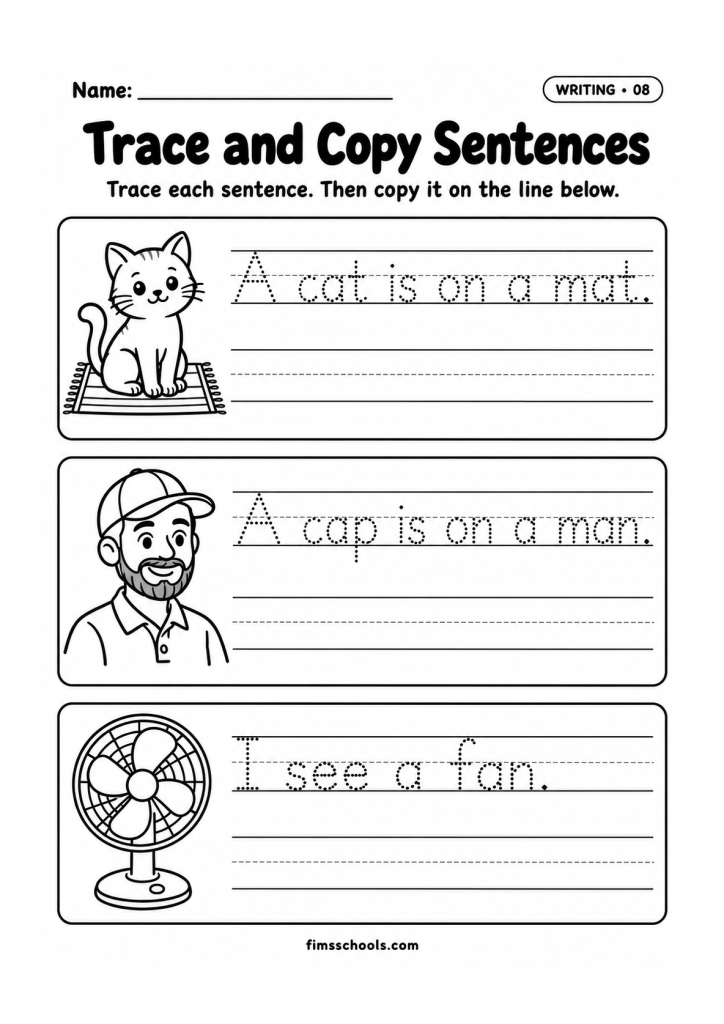
Three complete short a sentences are traced, then copied underneath: “A cat is on a mat.”, “A cap is on a man.” and “I see a fan.” Every word in them is decodable with short a knowledge plus the sight words A, I, is and on. Skill practised: sentence-level handwriting — word spacing, capitals and full stops — using words your child can also read. Adult tip: tracing first is the model; the copy underneath is where your child shows the same care independently.
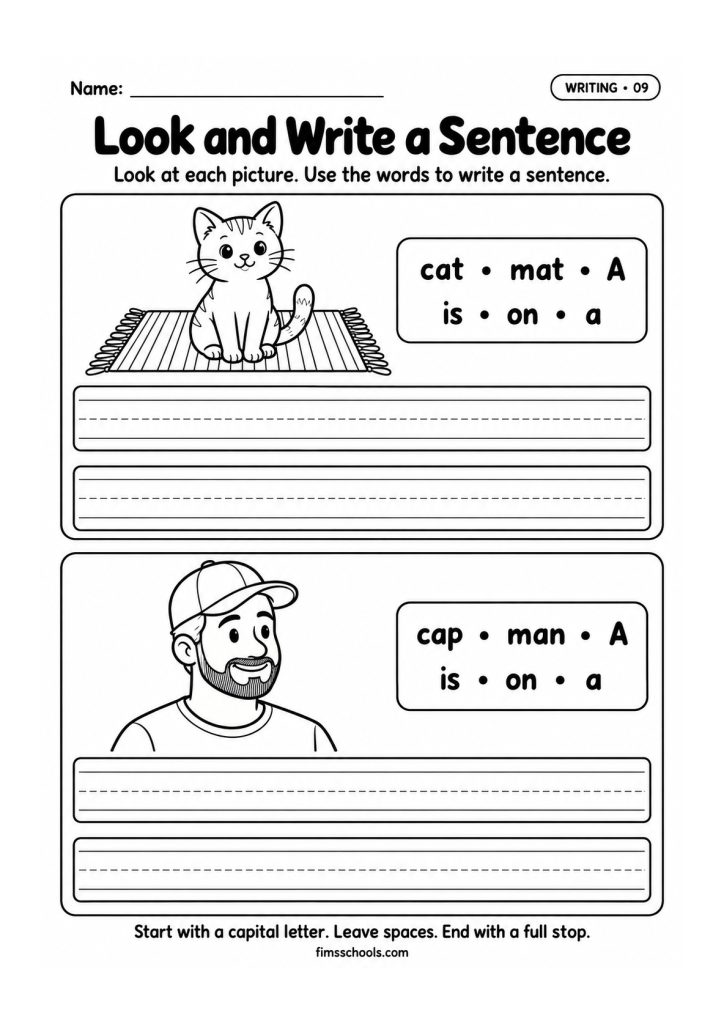
Two pictures come with jumbled word banks: cat, mat, A, is, on, a for the cat on the mat, and cap, man, A, is, on, a for the cap on the man. Your child arranges the words and writes the sentence — “A cat is on a mat.” — on the guided lines. A reminder strip at the bottom sets the success criteria: start with a capital letter, leave spaces, end with a full stop. Skill practised: composing a complete sentence, not just completing one. Adult tip: say the sentence aloud and count its words on fingers before writing.
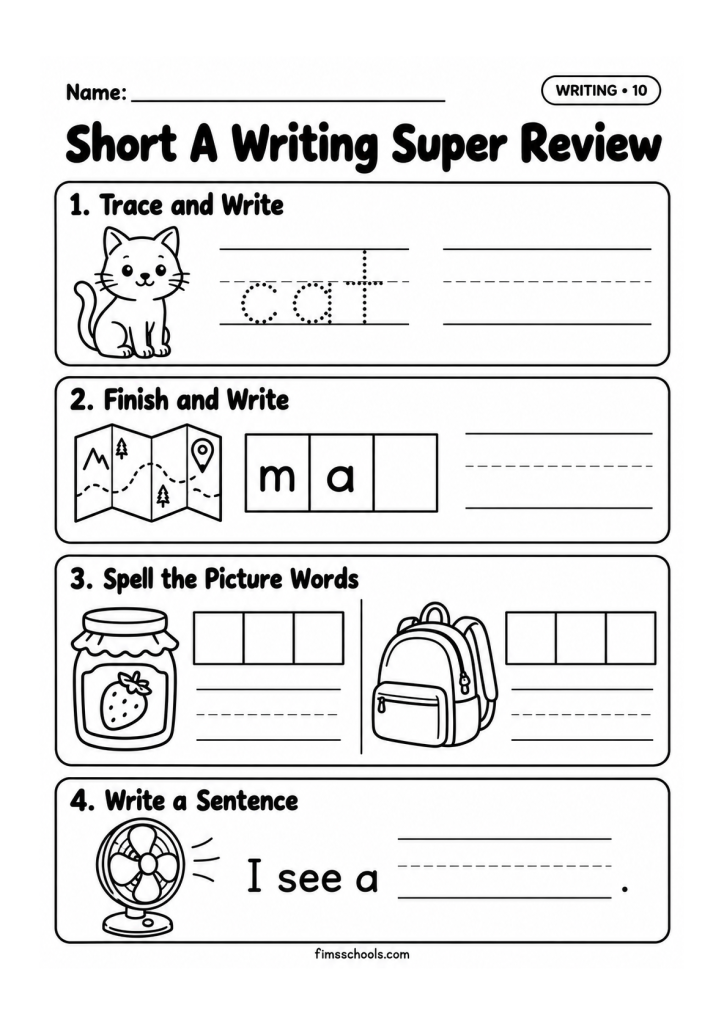
Four review parts revisit the bundle: trace and write (cat), finish and write the missing letter then the word (map), spell the picture words in sound boxes (jam, bag), and write a sentence completing “I see a ___” for the fan. Skill practised: a mixed review of tracing, completing, spelling and sentence writing. Adult tip: compare this page with Worksheet 1 — the growth in independence is easy to see and worth celebrating.
Say it, then write it. Sounding a word out before writing is the habit every sheet in this bundle is designed to build.
Short, frequent practice. Handwriting tires small hands quickly; one or two sheets at a time, with an optional 10 to 15 minutes per sitting, works well.
Use the check step. In Read, Cover and Write, the checking is the learning — let your child compare and correct their own work.
Printing. Each PDF is one A4 page — print at Actual Size (100%); choose Fit only if your printer clips edges.
Frequently Asked Questions
Are these short a writing worksheets free?
Yes. All ten worksheets are free to download and print, each as its own PDF under its preview below. No account or sign-up is needed.
What writing level do the sheets expect?
They begin with tracing dotted words, so a child who can hold a pencil and form most letters can start. By the final sheets, children write words from memory and compose a simple sentence with a word bank.
Which sentences will my child write?
The sentences use short a words and a few sight words: “A cat is on a mat.”, “A cap is on a man.” and “I see a fan.” — every sentence can also be read by a child who has worked through the earlier short a bundles.
What paper size should I use?
The worksheets are A4. Print on A4 paper at Actual Size (100%) for the cleanest result.
All FIMS Schools printables are provided for non-commercial personal and classroom use only. You may print copies for your own children or students. You may not resell, redistribute, re-upload or include the files in another collection. To share these resources, link to the original FIMS Schools article. All rights reserved.
Common Core Connections
Recommended level: kindergarten and early Grade 1 learners who can read short a words and are ready to write them. Prerequisites: blending and reading the words should be in place first (the beginner and blending collections); the bundle itself begins with tracing, so basic pencil control is enough to start. The connections below cover only the standards this collection’s activities genuinely practise, and the collection supports practice toward selected skills within each standard rather than covering any standard in full. The grade shown with each code is the grade of the standard itself, which is not always the same as the recommended learner level above. The sentence activities in Worksheets 7 to 9 also develop early sentence conventions — a capital letter to start, spaces between words and a full stop to finish — as a general writing outcome.
RF.K.3.b — Short vowel sound and spelling (Kindergarten)
This standard connects each of the five major vowels with its long and short sounds and their common spellings. This collection practises only the short a part of that standard: children use the link between the short a sound and the letter a while tracing, copying and spelling words in Worksheets 1 and 4.
L.K.2.c — Writing letters for sounds (Kindergarten)
This Language standard asks children to write a letter or letters for most consonant and short-vowel sounds. In this collection: Worksheet 3 (stretching a word into its sounds and writing one letter per sound box), Worksheet 5 (writing words from memory with the read-cover-write method) and Worksheet 6 (writing the correct label under each picture).
L.1.2.e — Spelling new words phonetically (Grade 1)
This Grade 1 Language standard asks children to spell words they have not been taught by using phonemic awareness and spelling conventions. In this collection: Worksheet 3’s unsupported sound-box spelling, Worksheet 9 (arranging a word bank and writing a complete sentence) and the spelling parts of Worksheet 10.