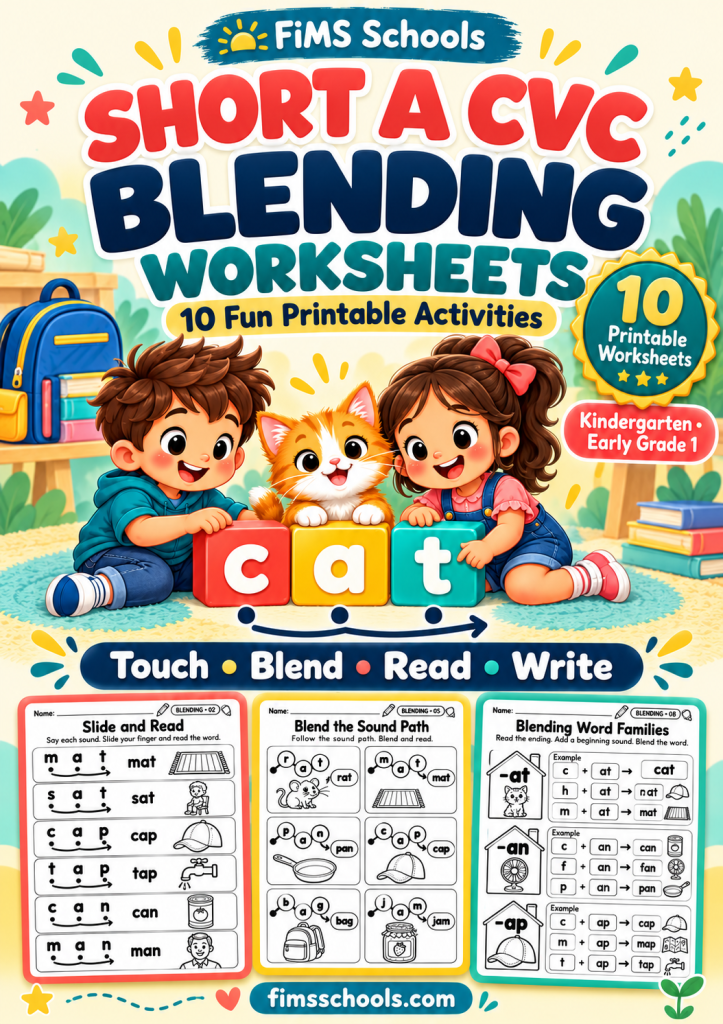
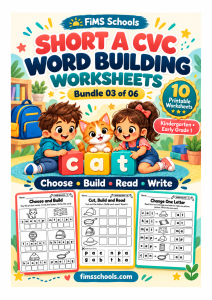
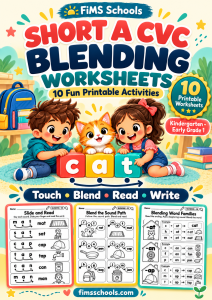
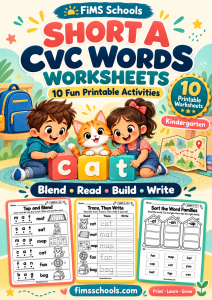
Blending — pushing letter sounds together until they become a word — is the moment reading clicks for beginners. This collection of short a blending worksheets practises that one essential skill in ten different ways, using the same friendly short a words throughout: cat, map, fan, bag, hat and pan. Children touch sound dots, slide along sound paths, join beginning sounds to word-family endings, and finish by blending words and drawing what they mean. Every worksheet is free, with its own separate PDF.
Who is it for? Kindergarten and early Grade 1 children who already know most letter sounds and are beginning to read three-letter CVC words. If your child is still learning to hear the short a sound itself, start with our Short A CVC Worksheets for Beginners collection first, then come back here for focused blending practice. Work through these sheets in order — the support (sound dots, printed answers, word-family chunks) is gradually reduced as your child grows in confidence.
What is included? Touch-and-blend reading, slide-and-read fluency rows, blend-and-match, beginning-sound plus word-family sums, a sound-path activity, blend-and-circle accuracy work, build-and-blend writing, word-family blending houses, blend-read-and-draw, and a four-part super review. All worksheets are A4; print on A4 paper at Actual Size (100%).
Worksheet 1: Touch and Blend
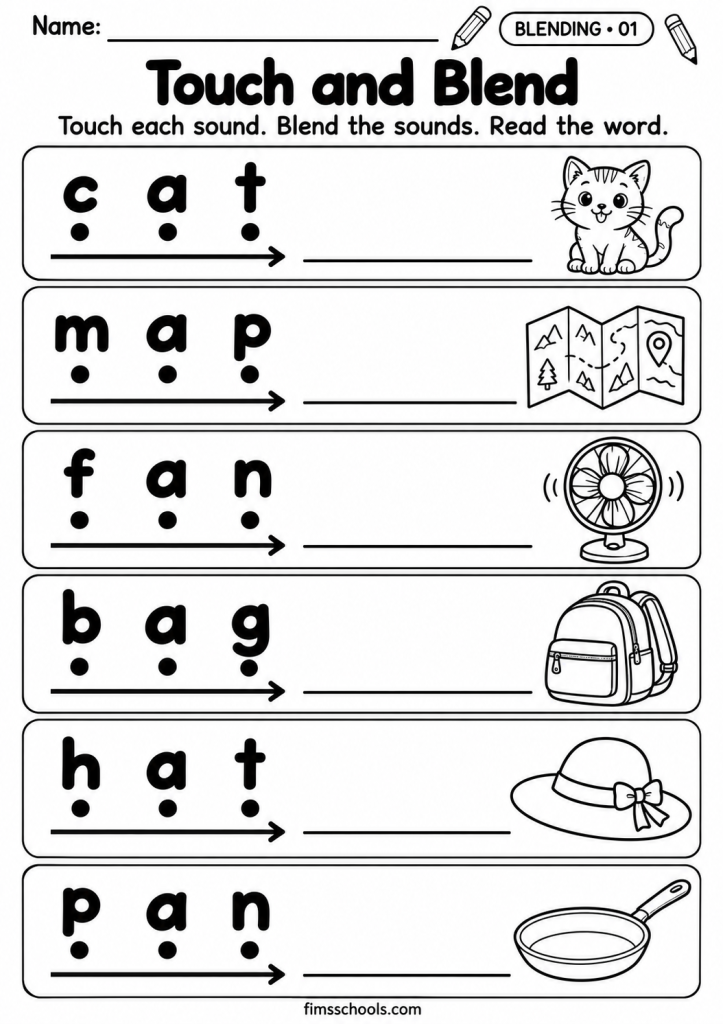
Each word is printed with a dot under every letter and a picture clue at the end of the row. Your child touches each dot, says that sound, then blends the sounds together and reads the word: cat, map, fan, bag, hat and pan. A writing line under each word lets them copy the word they have just read. Skill practised: blending three sounds into a word, the foundation of reading. Adult tip: model the first word yourself — touch, say, blend — then let your child take over.
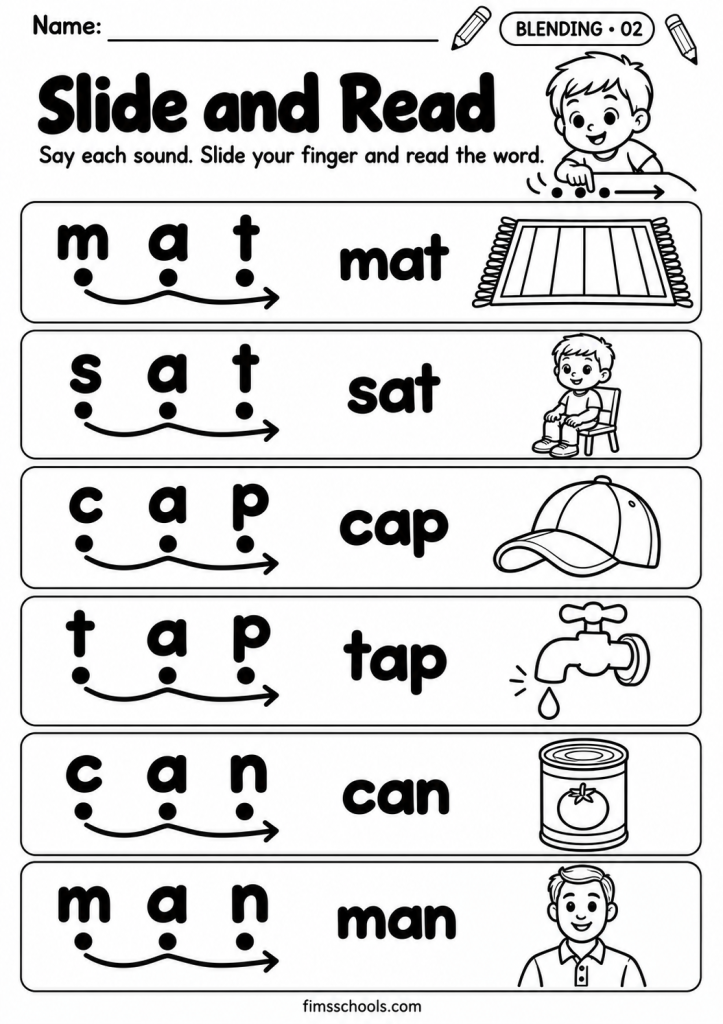
The same dotted letters appear here, but each row also prints the finished word — mat, sat, cap, tap, can and man — so your child can check their own blending. The instruction on the sheet says it all: say each sound, slide your finger along, and read the word. Repetition across rows builds speed without pressure. Skill practised: fluent blending, moving from slow sounding-out towards reading the whole word. Adult tip: on a second pass, challenge your child to read the printed word first and use the dots only if stuck.
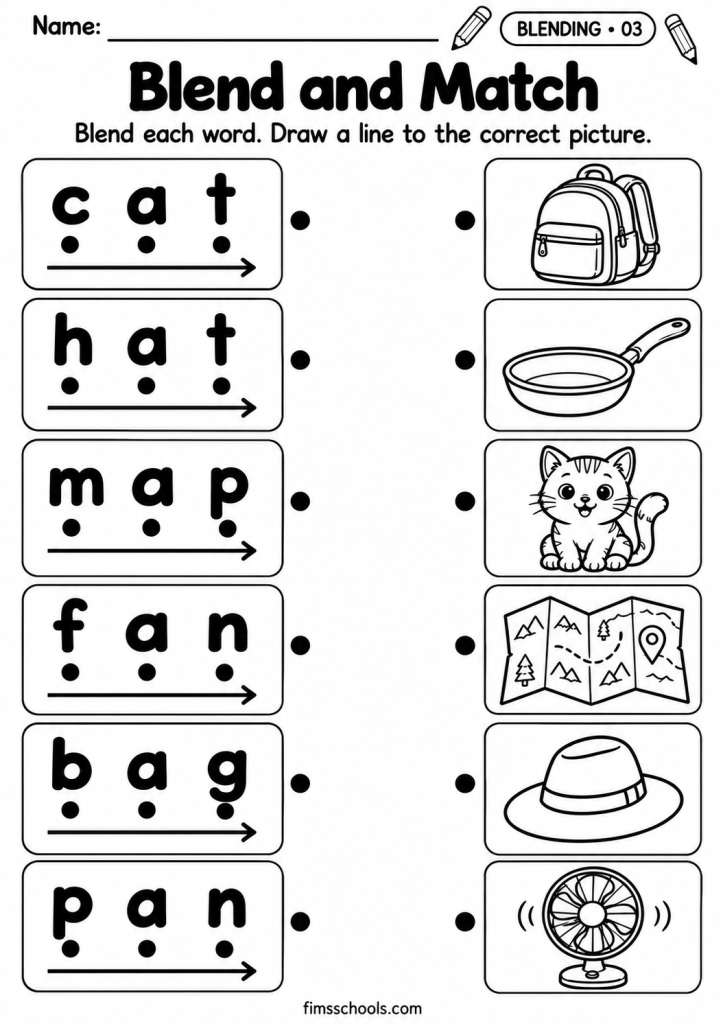
Six dotted words — cat, hat, map, fan, bag and pan — face six pictures in a jumbled order. Your child blends a word, finds the picture it names, and draws a line to join them. Because the words are not printed in ordinary form, the child must genuinely blend rather than recognise a familiar word shape. Skill practised: blending with comprehension — reading a word and understanding what it means. Adult tip: ask your child to say the blended word aloud before drawing each line.
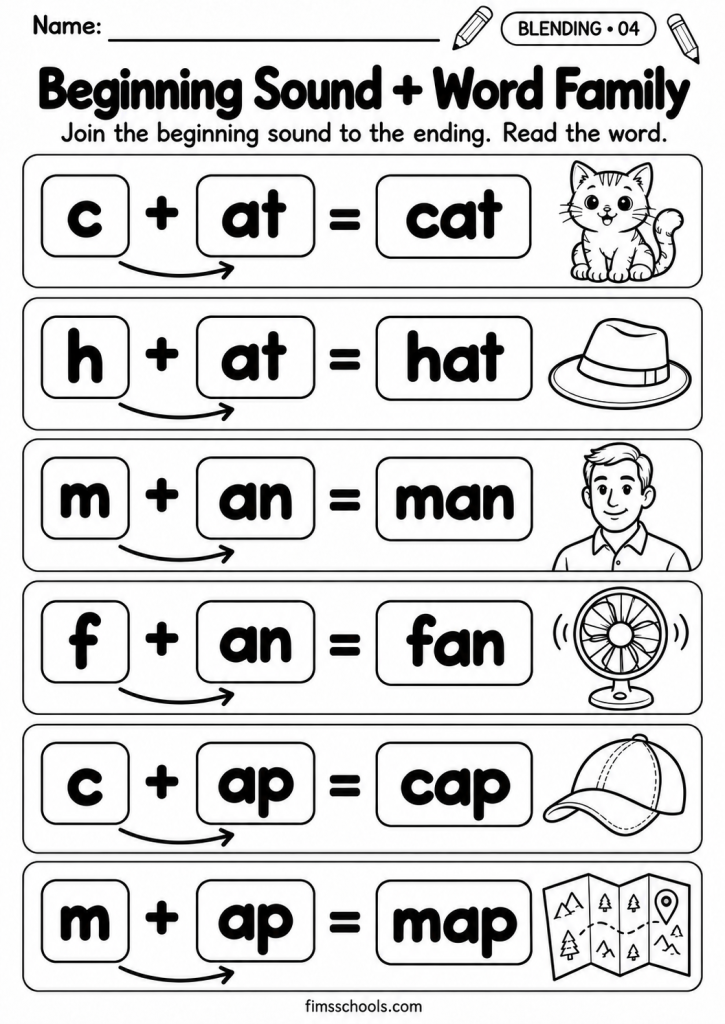
This sheet shows blending as a simple sum: c + at = cat, h + at = hat, m + an = man, f + an = fan, c + ap = cap and m + ap = map. Your child joins one beginning sound to a word-family ending and reads the word it makes, with a picture confirming each answer. Skill practised: onset-and-rime blending — the stepping stone between sounding out every letter and reading word families fluently. Adult tip: point out that only the first sound changes; the ending chunk stays the same.
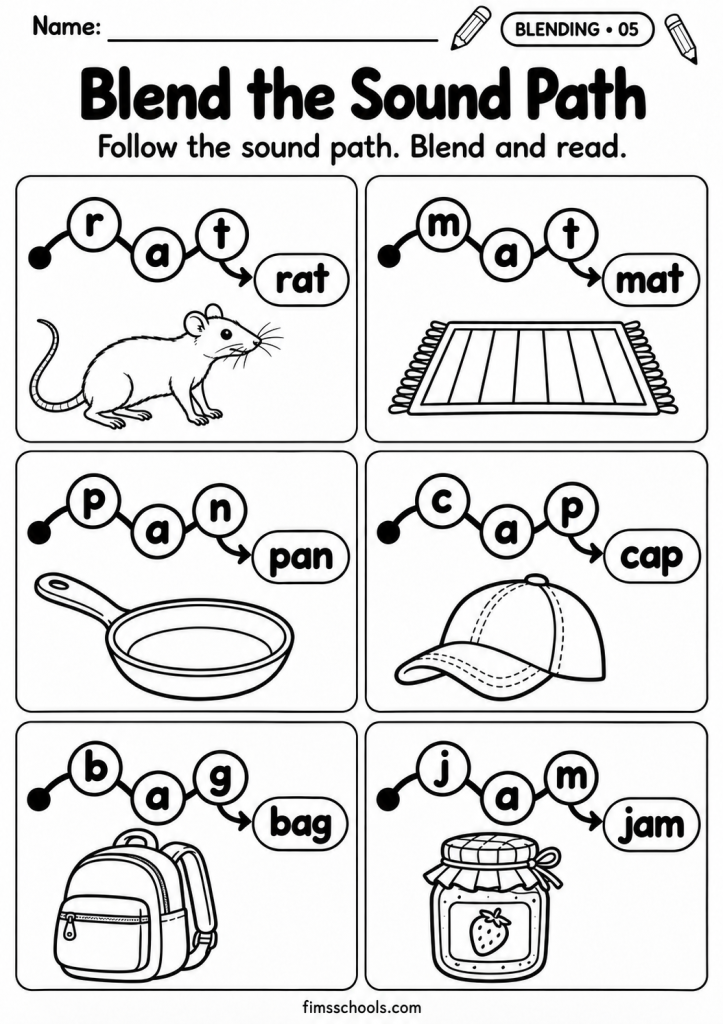
The three letters of each word are joined by a winding path: r-a-t leads to a rat, m-a-t to a mat, and so on through pan, cap, bag and jam. Your child follows the path with a finger, saying each sound as they travel, and blends the word at the end where the whole word is printed beside its picture. Skill practised: blending in sequence with left-to-right tracking. Adult tip: the path slows children down in a good way — it stops them guessing the word from the picture before blending.
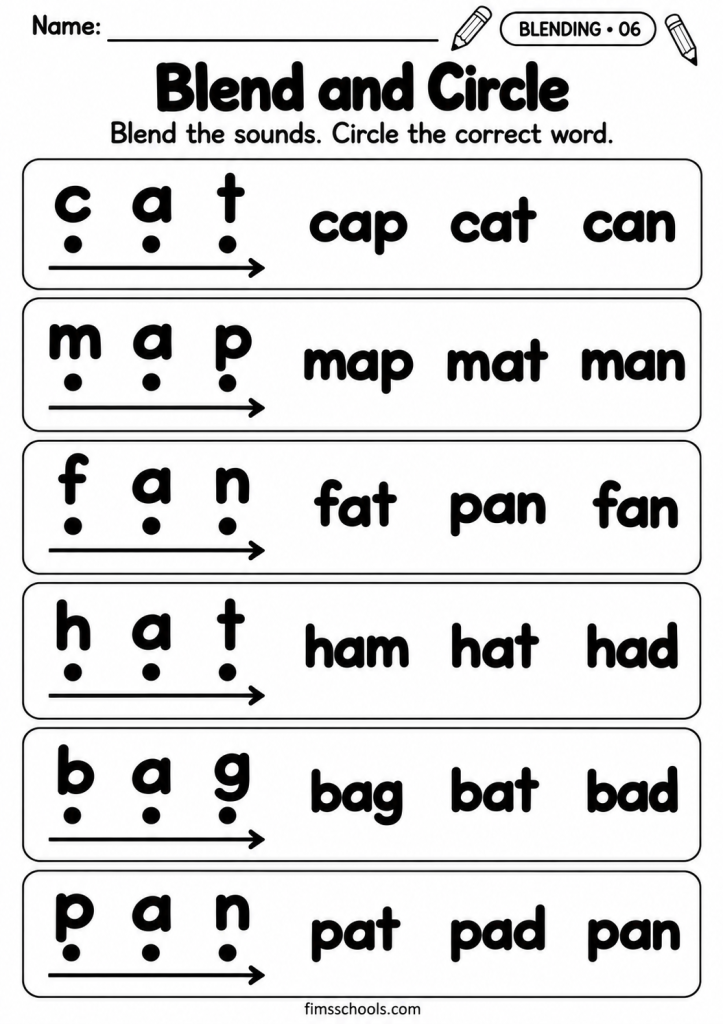
A dotted word sits above three printed choices: blend c-a-t, then circle cat from cap, cat and can. The choices are close — map, mat or man; fan among fat and pan; bag among bat and bad — so the final letter matters as much as the first. Skill practised: accurate blending and checking every letter, especially the last one. Adult tip: if your child circles a near-miss, blend both words aloud together so the difference can be heard.
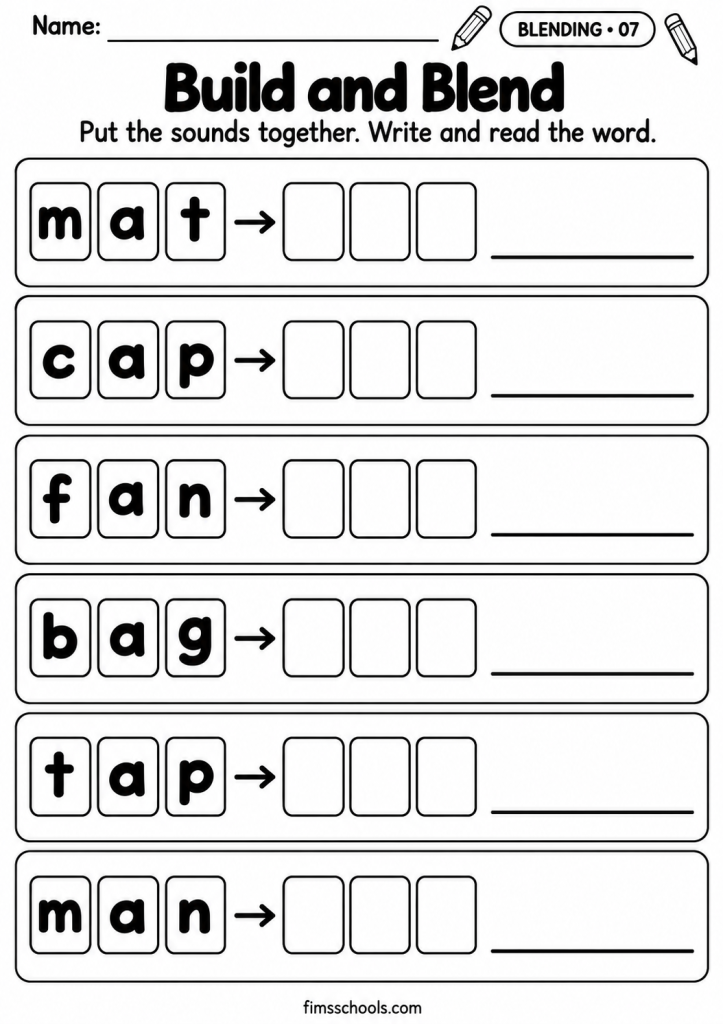
For each row, the three sounds are given — m-a-t, c-a-p, f-a-n, b-a-g, t-a-p and m-a-n — and your child writes the letters into three boxes, then writes the complete word on the line and reads it. Writing the word straight after blending it connects reading with spelling. Skill practised: blending plus early encoding — turning heard sounds into written letters in the right order. Adult tip: have your child say each sound as they write its letter, then blend the finished word once more.
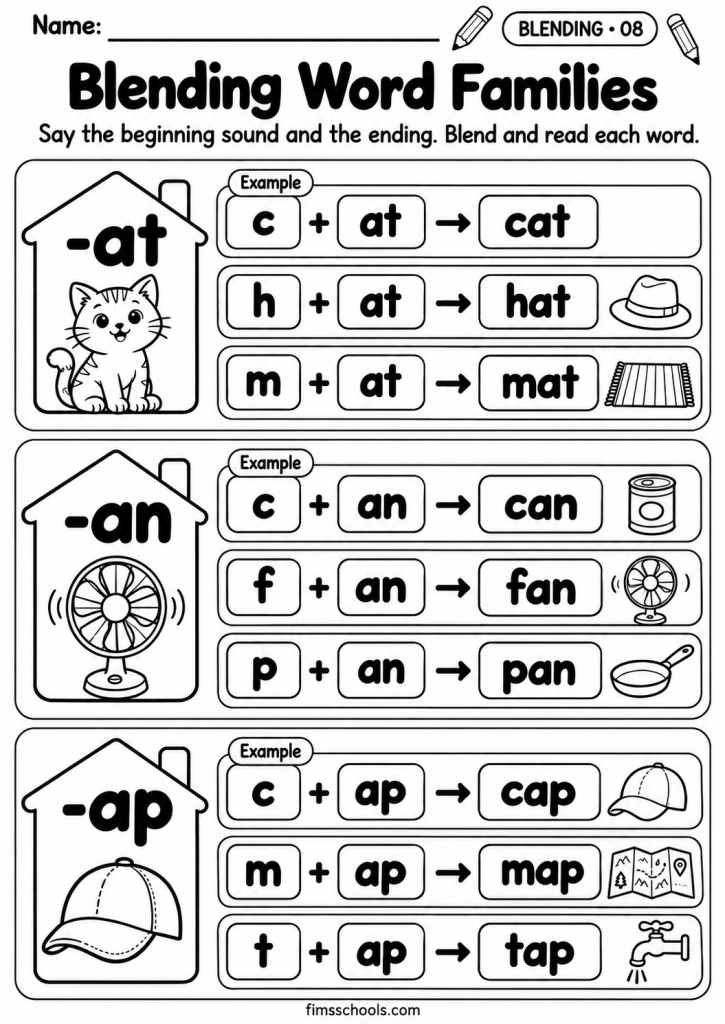
Three word-family houses organise this practice: the -at house (cat as the example, then hat and mat), the -an house (can, then fan and pan) and the -ap house (cap, then map and tap). Your child blends the beginning sound with each family ending and reads the word, with pictures confirming the -at and -ap rows. Skill practised: reading by word family, so one known ending unlocks several words. Adult tip: after finishing a house, read its three words in a row and enjoy the rhyme together.
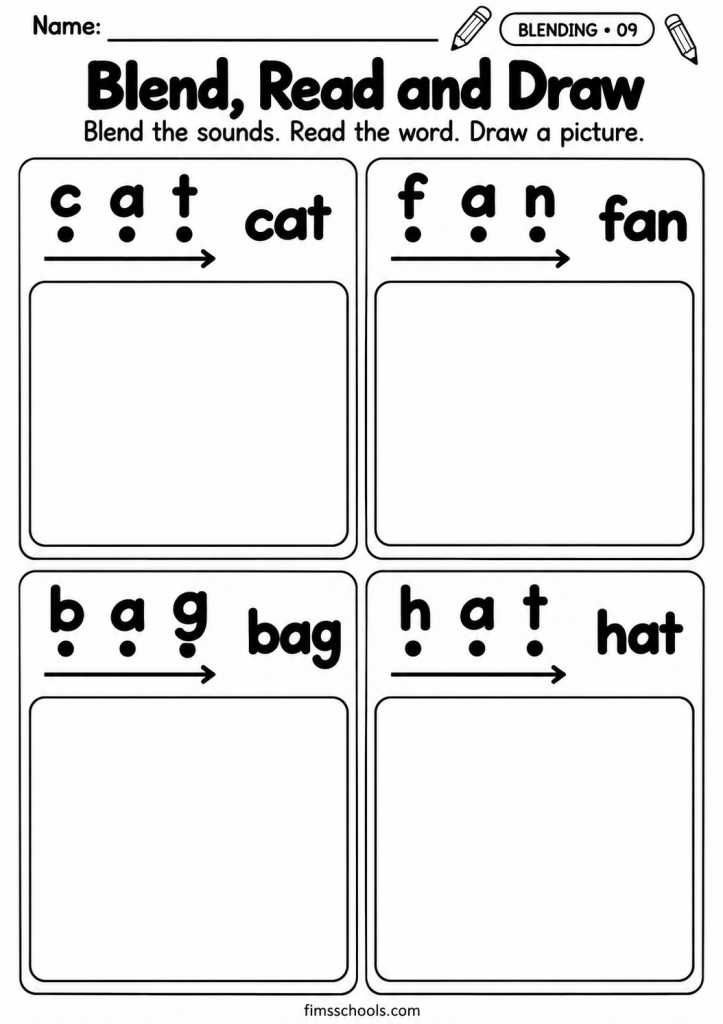
Four words — cat, fan, bag and hat — are blended from their dotted letters, read in their printed form, and then drawn by your child in the big empty boxes. Drawing the meaning proves the word was understood, not just decoded, and gives reluctant writers a creative reason to finish the page. Skill practised: blending, word reading and comprehension. Adult tip: let the drawing be fun and quick — a simple sketch is a complete answer.
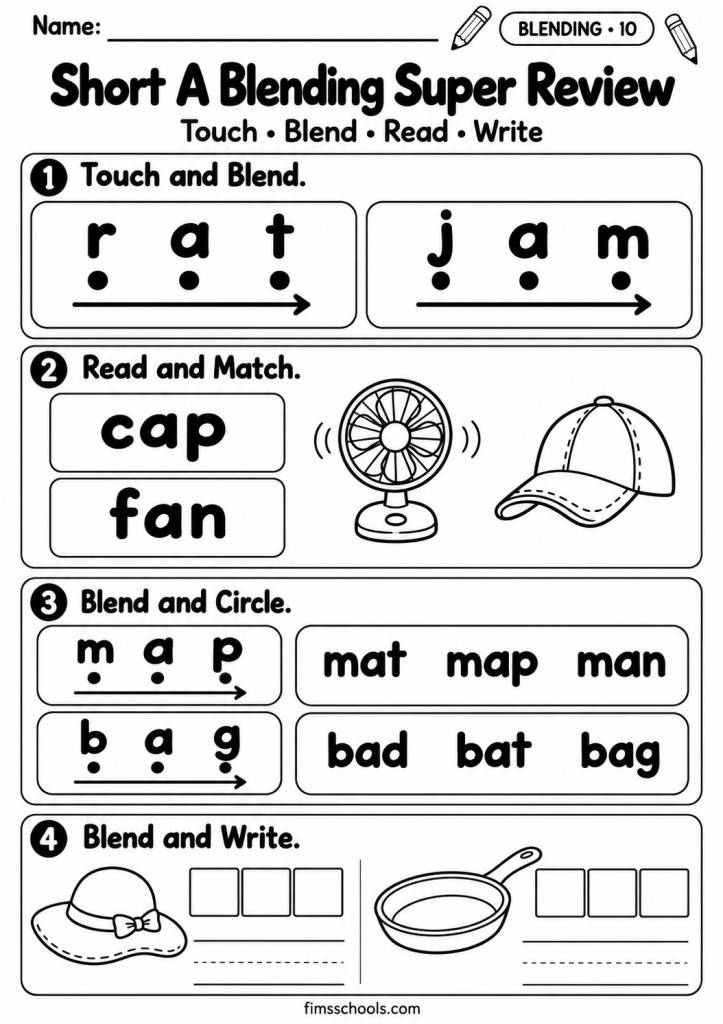
The final sheet reviews the whole bundle in four short parts: touch and blend (rat, jam), read and match (cap, fan), blend and circle (map among mat and man; bag among bad and bat), and blend and write from pictures (hat, pan). Use it after worksheets 1 to 9 to see which blending skills are secure. Skill practised: a mixed review of every blending task in this collection. Adult tip: any part that wobbles points you to the earlier worksheet worth one more practice run.
Keep sounds clipped. Say “c-a-t” with short, clean sounds; adding “uh” (“cuh-a-tuh”) makes the word impossible to hear.
Little and often. One or two worksheets at a sitting is enough; many adults find an optional 10 to 15 minutes works well for blending practice.
Use the dots. Touching one dot per sound slows guessing and builds the left-to-right habit every reader needs.
Printing. Each PDF is one A4 page — print at Actual Size (100%), and choose Fit only if your printer clips edges.
Frequently Asked Questions
Are these blending worksheets free?
Yes. All ten worksheets are free to download and print, each as its own PDF under its preview below. No account or sign-up is needed.
What should my child know before starting?
These sheets assume your child knows most letter sounds and is starting to blend them. If the short a sound itself is new, begin with the beginner collection linked in the introduction, which starts with a listening activity.
Which words are practised?
The set reuses a core group of short a CVC words — cat, hat, mat, sat, rat, cap, map, tap, can, fan, pan, man, bag and jam — organised around the -at, -an and -ap word families, so blending practice is never held back by unfamiliar vocabulary.
What paper size should I use?
The worksheets are A4. Print on A4 paper at Actual Size (100%) for the cleanest result.