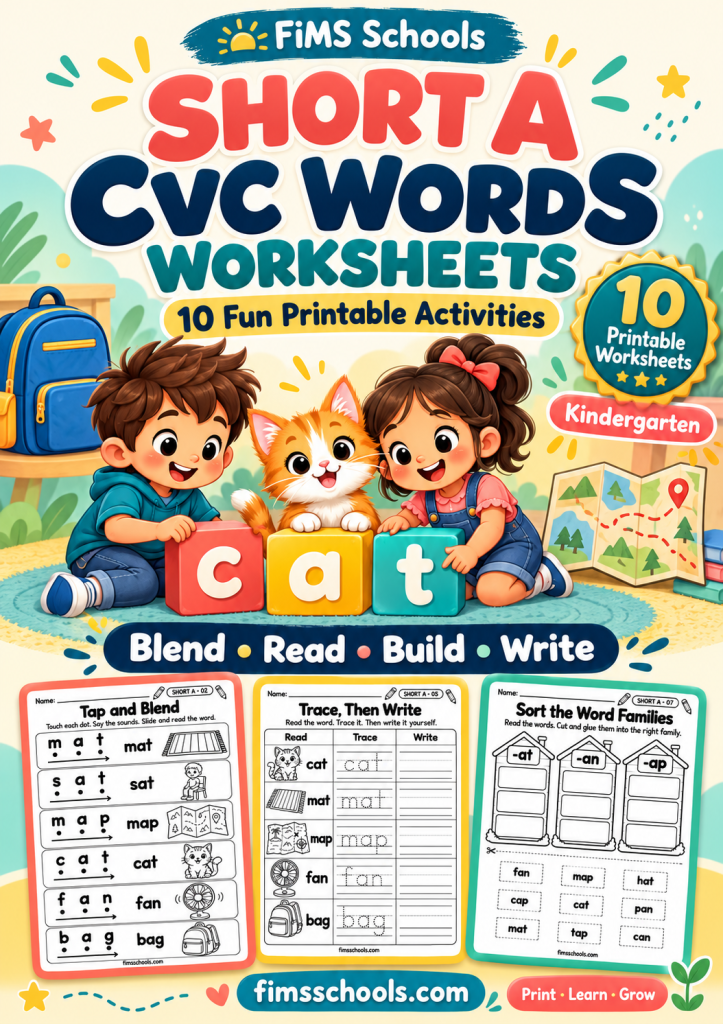
This collection of short a CVC worksheets gives beginners a complete first step into reading three-letter words. Across ten printable worksheets, children start by simply hearing the short a sound in words like cat, map and fan, then move step by step into blending sounds, reading whole words, building words with letter tiles, sorting word families and writing words on their own. Every worksheet is free, and every worksheet has its own separate PDF, so you can print only the pages you need.
Who is it for? Kindergarten children and early Grade 1 learners who are starting CVC (consonant–vowel–consonant) words. Worksheet 1 needs no letter knowledge at all — it is a listening activity an adult leads. From Worksheet 2 onwards, children will get the most from the set if they already know most letter sounds, because the sheets ask them to blend, read and write those sounds. Work through the sheets in order: the skills build gently from sound recognition to independent spelling.
What is included? Ten worksheets covering listening for the short a sound, tap-and-blend reading, read-and-match, missing middle sounds, tracing and writing, a cut-and-glue building activity, word-family sorting for -at, -an and -ap, careful word reading, sound-box spelling and a final super review. All of the worksheets are A4 size, so print them on A4 paper at Actual Size (100%) — nothing on these pages runs close to the edge, so Actual Size prints cleanly without clipping.
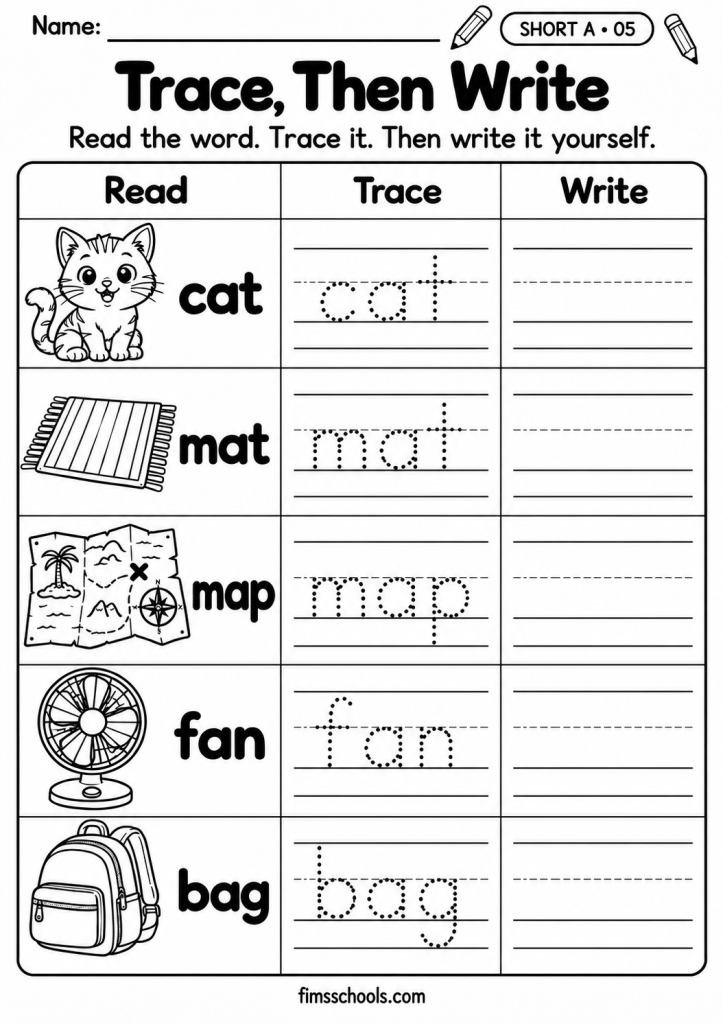
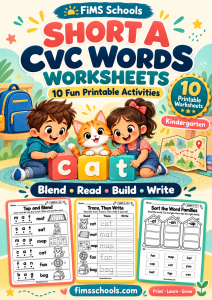
Worksheet 5: Trace, Then Write
For each picture — cat, mat, fan, map and bag — the word is first printed in dotted letters for tracing, with a blank writing line beside it. Your child traces the word while saying its sounds, then writes the same word alone on the line. Skill practised: correct letter formation and remembering the letter order of a word. Adult tip: tracing first builds the muscle memory; cover the dotted word for a real challenge once your child is confident.
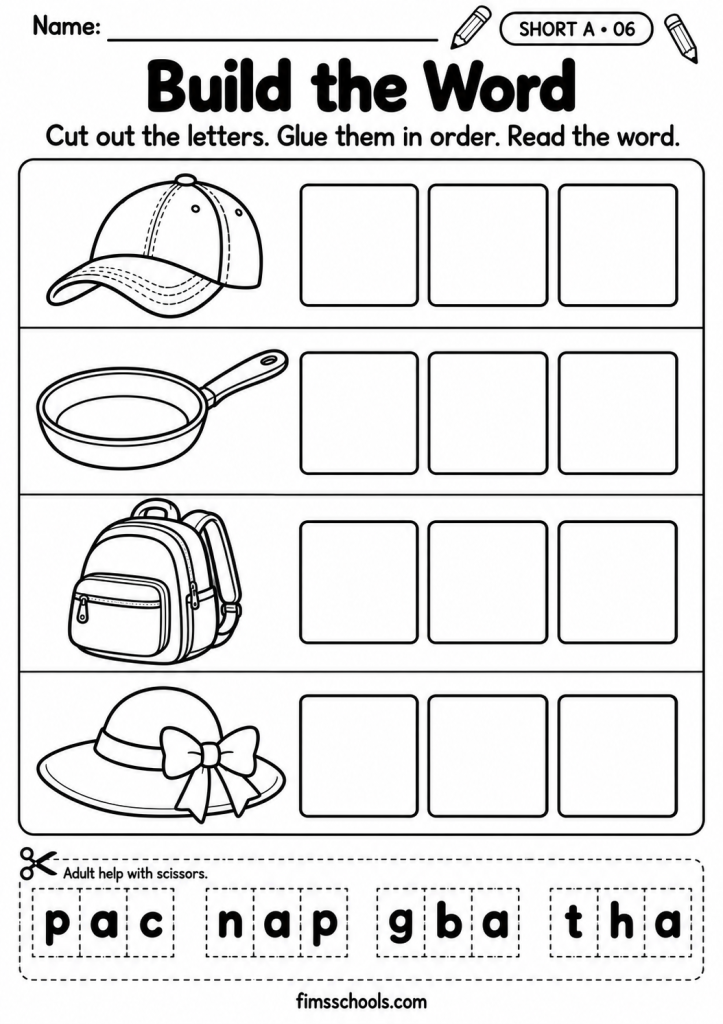
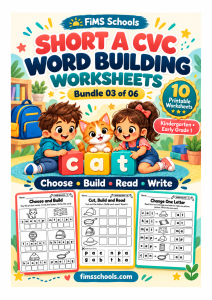
This is a hands-on sheet: letter tiles at the bottom are cut out and glued into the boxes to build the word for each picture — cap, pan, bag and hat. An “adult help with scissors” note is printed on the sheet itself. Skill practised: building and spelling words letter by letter, plus cutting and sticking fine-motor control. Adult tip: let your child arrange the tiles and read the word aloud before any glue is used, so mistakes are easy to fix.
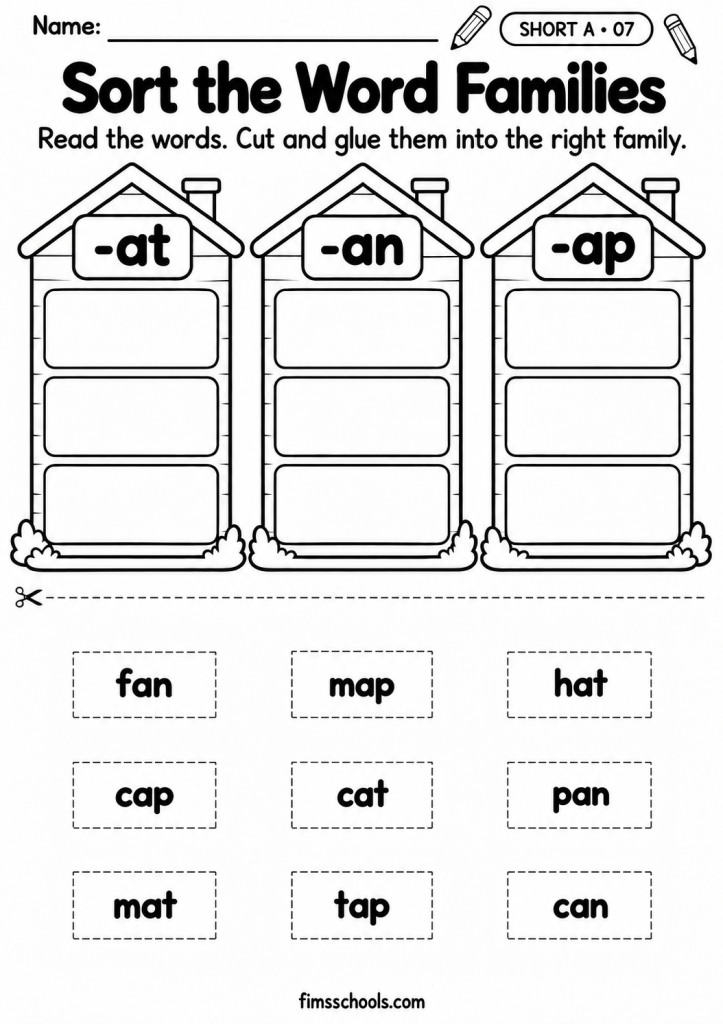
Nine word cards are sorted into three word-family boxes: the -at family (cat, hat, mat), the -an family (fan, can, pan) and the -ap family (cap, map, tap). Your child reads each word, listens to its ending, and glues or writes it in the matching family box. Skill practised: recognising word families and rhyming endings, which helps children read new words by analogy. Adult tip: read the finished families aloud together — the rhyming pattern is easy to hear.
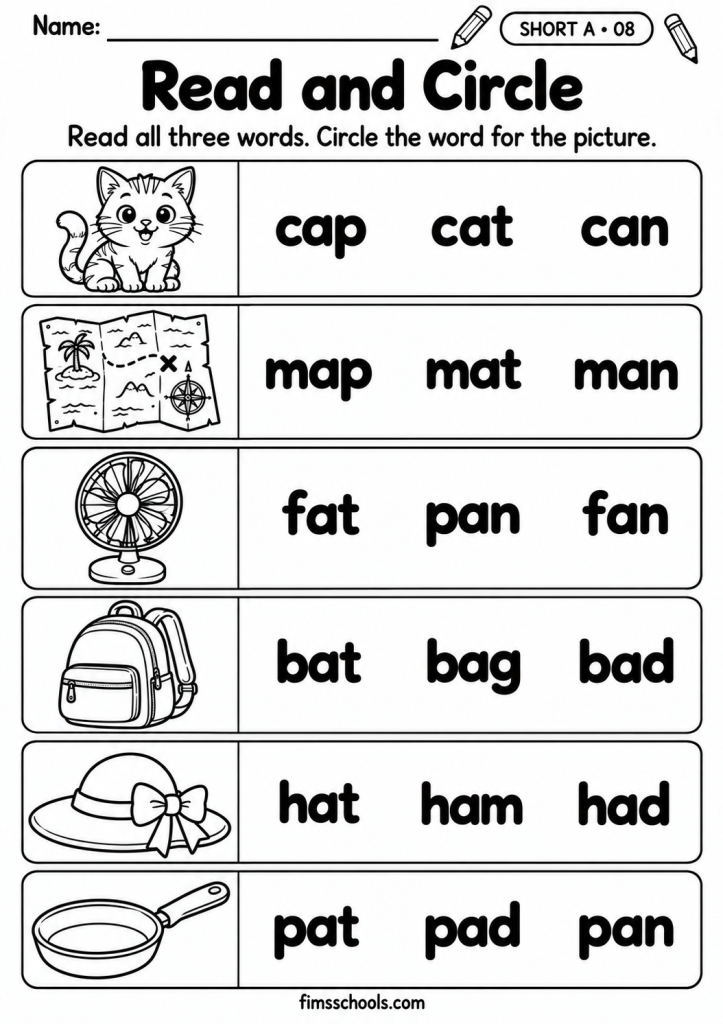
Each picture comes with three very similar words: for the cat picture, the choice is cap, cat or can. Your child must read every word carefully and circle the one that names the picture. Look-alike options make this a genuine reading check rather than a first-letter guess. Skill practised: accurate word reading, including checking the final letter. Adult tip: encourage your child to point at each letter as they read — most errors here come from the last letter.
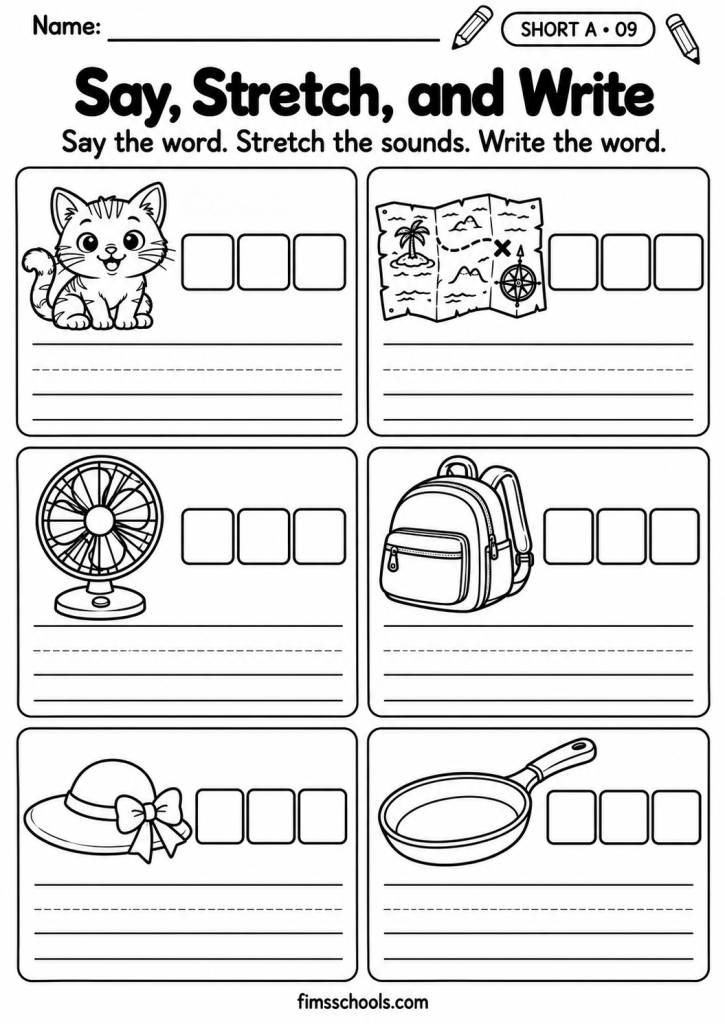
For every picture, three empty sound boxes wait below it. Your child says the picture name slowly, stretches it into its three sounds, and writes one letter in each box — for example j-a-m for the jam picture. The boxes give a clear structure for children who are beginning to spell without a word to copy. Skill practised: segmenting a word into its sounds and spelling it independently. Adult tip: tapping one finger per sound helps your child keep count before writing.
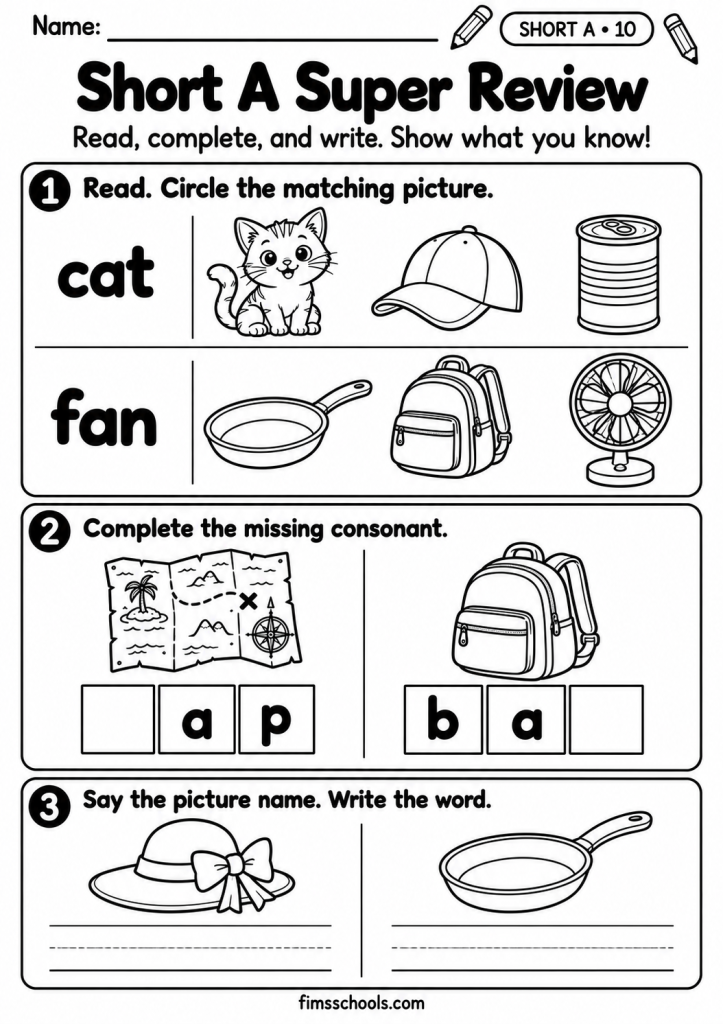
The final sheet brings the whole bundle together in three short parts: build the word for the picture (bag), read the word and trace it (map), and read and match (fan). Use it after worksheets 1 to 9 as a friendly check of everything your child has learned. Skill practised: mixed review of listening, blending, reading and spelling short a words. Adult tip: any part your child finds hard tells you exactly which earlier worksheet to revisit for another day of practice.
Work in order. The set is a progression: listening first, then blending and reading, then building, sorting and writing. Skipping ahead to the writing sheets usually makes them harder than they need to be.
Short, regular sessions work best. One or two worksheets at a time is plenty for most beginners; many families and classrooms find an optional 10 to 15 minutes per sitting is a comfortable length.
Say the sounds, not the letter names. When blending, use the letter sounds (“c-a-t”) so the spoken word can be heard.
Printing. Each PDF is a single A4 page. Print on A4 paper at Actual Size (100%); choose Fit only if your printer clips page edges.
Scissors note. Worksheet 6 is a cut-and-glue activity — an adult should help younger children with the cutting.
Frequently Asked Questions
Are these short a worksheets free?
Yes. Every worksheet in this collection is free to download and print. Each of the ten worksheets has its own PDF button under its preview, and no account or sign-up is needed.
What age and level are they for?
They are designed for kindergarten beginners and early Grade 1 children who are starting to read CVC words. The first worksheet is a listening activity that needs no reading; later worksheets build up to reading and spelling short a words.
Which words will my child practise?
The set works with the -at, -an and -ap word families and a core group of short a words: cat, hat, mat, sat, rat, fan, can, pan, van, cap, map, tap, bag and jam.
What paper size should I use?
The worksheets are A4. Print on A4 paper at Actual Size (100%) for the cleanest result.
Do I have to print all ten worksheets?
No. Each worksheet is a separate free PDF, so print the whole set in order, or choose only the skill your child needs to practise.
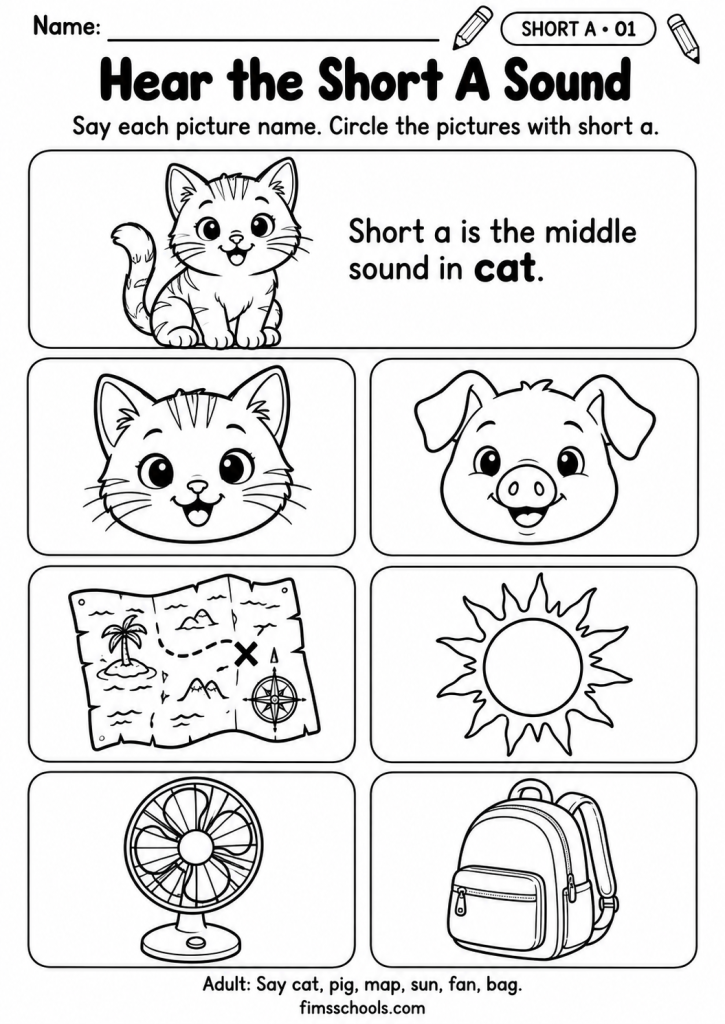
On this first sheet, your child simply listens. Six pictures are shown — a cat, a pig, a map, a sun, a fan and a bag — and the child circles only the pictures whose names have the short a sound in the middle. The pig and the sun are deliberate distractors: their middle sounds are different, so guessing by first letters will not work. An adult reads the short printed script aloud, which makes this sheet ideal before any reading is expected. Skill practised: hearing and identifying the short a vowel sound. Adult tip: say each picture name slowly and stretch the middle sound, for example “c-a-a-t”.
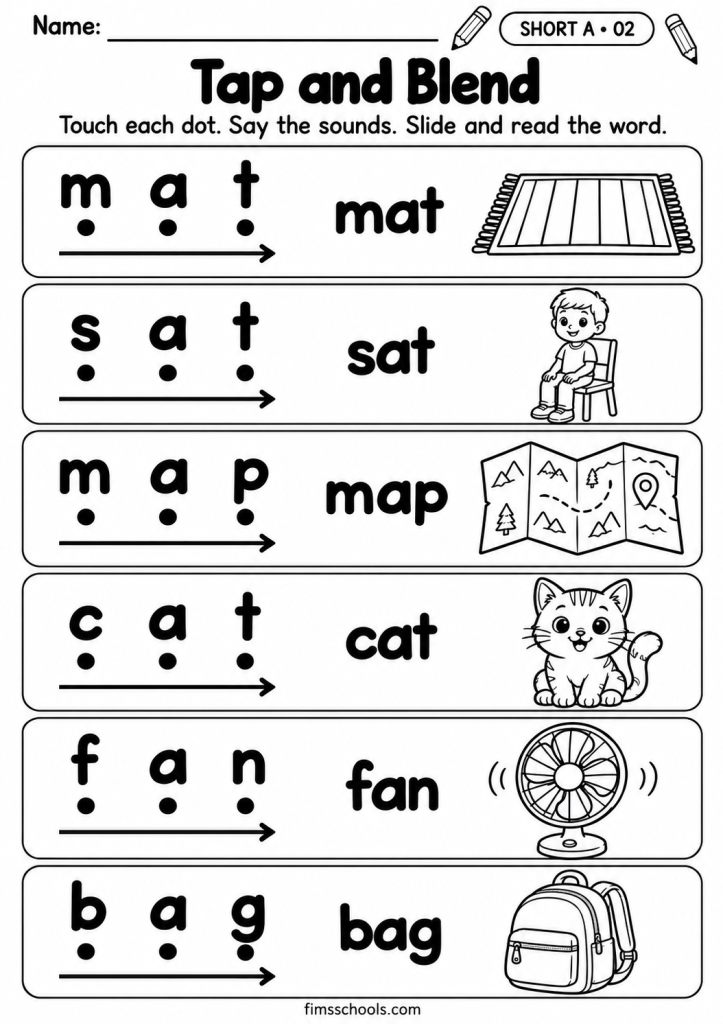
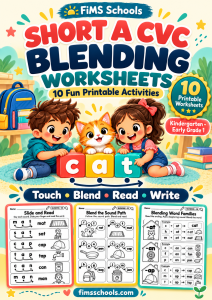
Each word is printed with a dot under every letter. Your child taps a dot, says that letter’s sound, then slides a finger along the word and blends the three sounds together: mat, sat, map, cat, fan and bag. The first letter of cat is printed as a dotted tracing letter, giving one gentle handwriting prompt inside a reading task. Skill practised: blending three sounds into a whole word — the core skill of early reading. Adult tip: keep the sounds short and clipped (“mmm-a-t”, not “muh-a-tuh”) so the word is easy to hear.
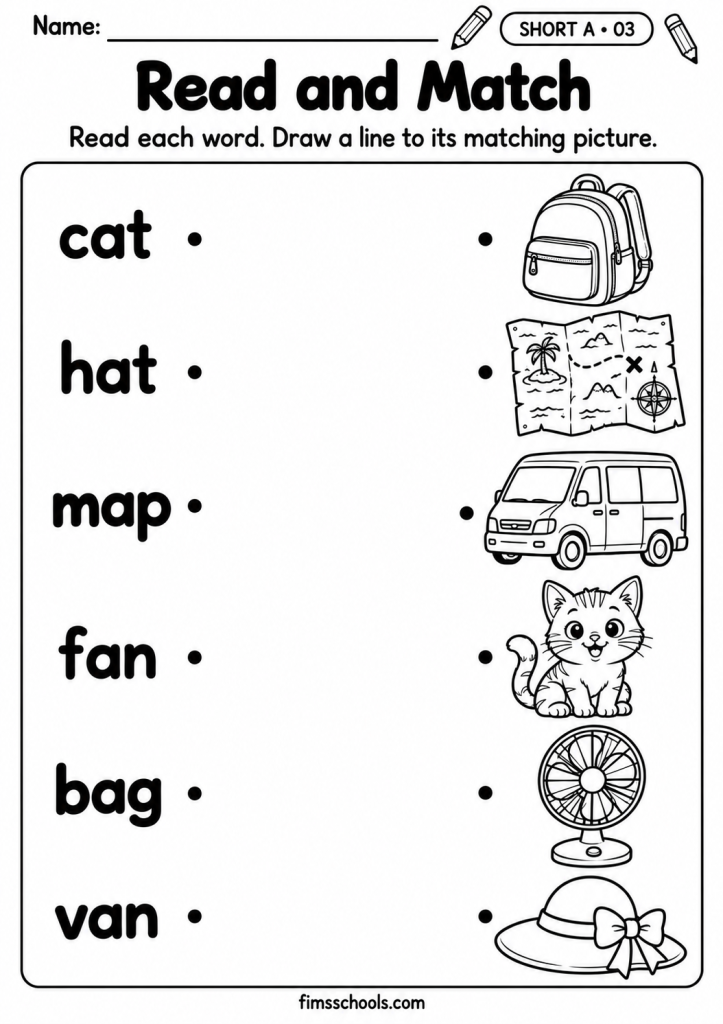
Six words — cat, hat, map, fan, bag and van — sit beside six pictures in a different order. Your child reads a word, finds the picture it names, and draws a line to join them. Because several words share the same ending, the child has to read the whole word rather than guess from the last two letters. Skill practised: reading short a CVC words and matching them to meaning. Adult tip: if a match goes wrong, ask your child to sound the word out again and check the first letter against the picture.
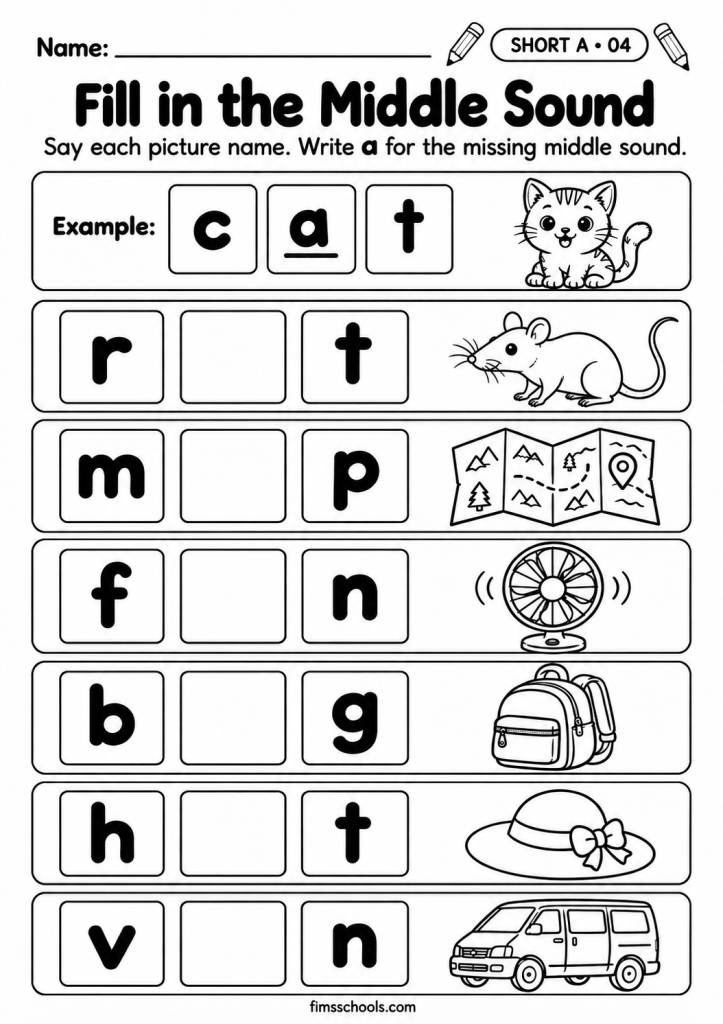
Every picture word on this sheet is missing its middle letter: r_t, m_p, f_n, b_g, h_t and v_n. Your child says the word, listens for the sound in the middle, and writes the letter a to complete rat, map, fan, bag, hat and van. Skill practised: identifying the vowel sound in the middle of a word and writing it — the first step towards spelling CVC words independently. Adult tip: stretch the word out slowly (“fff-a-a-a-n”) so the middle sound is easy to catch before writing.