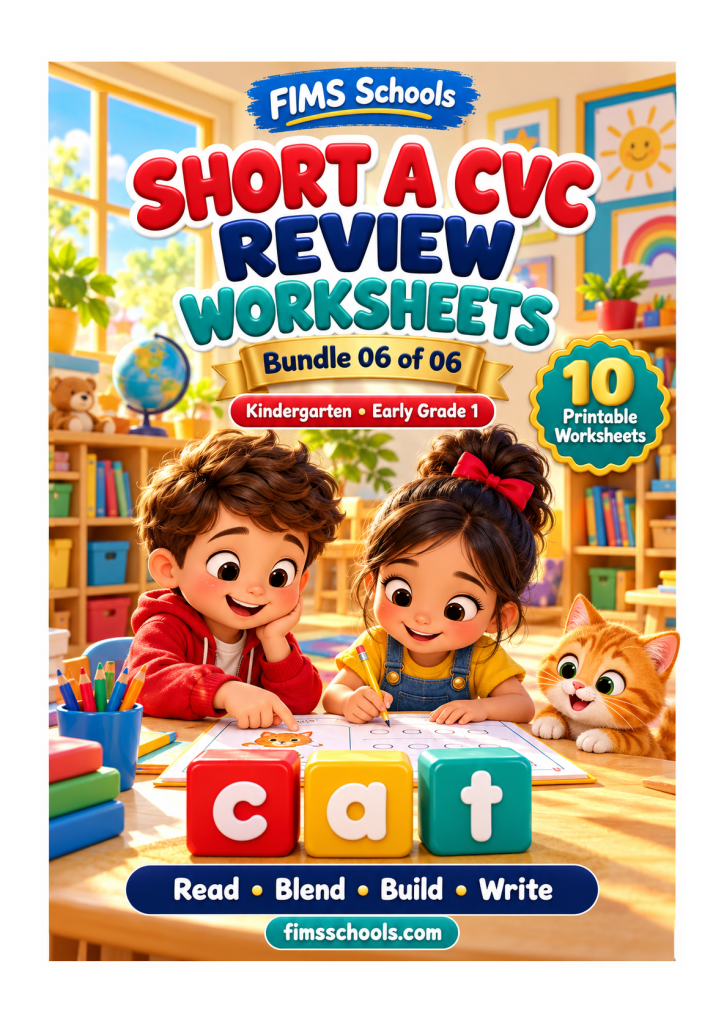
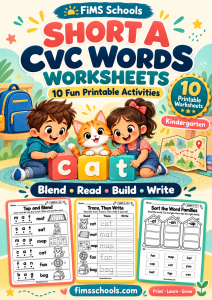
This collection of short a CVC review worksheets is the finishing step of the FIMS Schools short a course: ten worksheets that revisit every core skill — reading and circling the right word, checking beginning, middle and ending sounds, blending, unscrambling, word-family sorting, changing one letter, sentence reading, independent spelling and a final one-page check. Nothing new is taught here; the purpose is to confirm what your child can now do unaided with words like cat, map, fan, bag, hat and pan. Every worksheet is free, with its own separate PDF.
Who is it for? Kindergarten and early Grade 1 children who have completed beginner short a work — ideally the earlier FIMS Schools bundles (beginner foundations, blending, word building, puzzles and writing) or equivalent practice elsewhere. Used in order, these sheets work as a gentle end-of-topic review; used selectively, each sheet is a quick diagnostic for one skill. The final worksheet, My Short A Final Check, is designed to be kept as evidence of progress.
What is included? Read-and-circle word checks, a three-sounds check, blend-and-match, unscramble-and-spell, word-family sorting for -at, -an and -ap, change-one-letter chains, sentence-picture matching, look-spell-and-write, read-draw-and-write sentences, and the four-part final check. All worksheets are A4; print on A4 paper at Actual Size (100%).
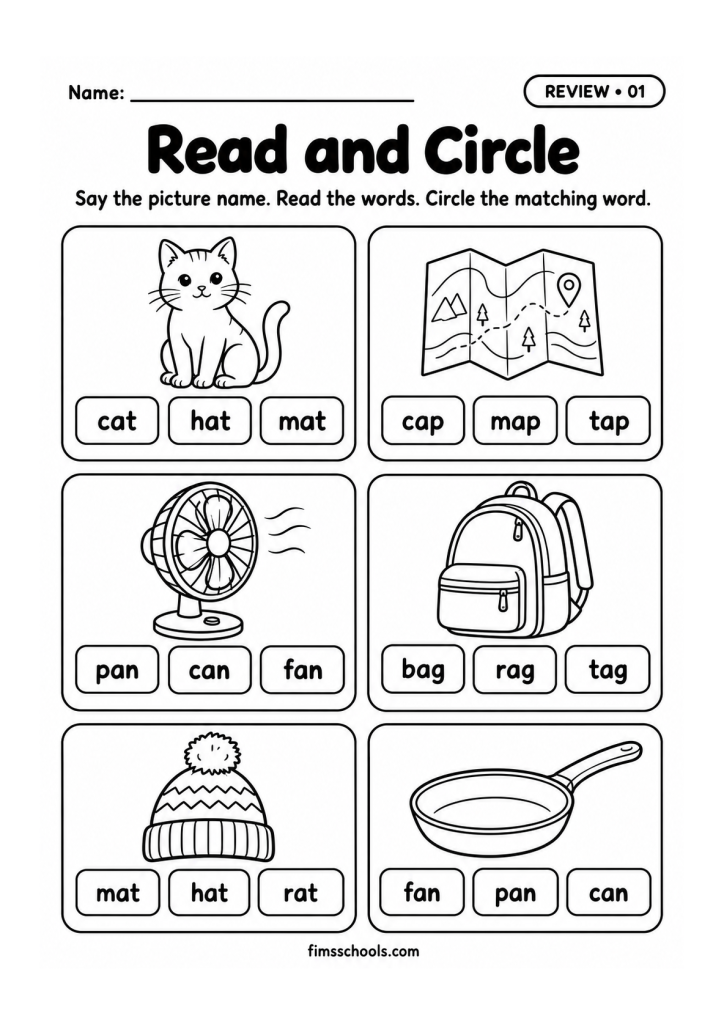
Worksheet 1: Read and Circle
Six pictures each carry three word choices: the cat picture offers cat, hat and mat; the map offers cap, map and tap; and so on through fan, bag, hat and pan. Your child reads all three words and circles the matching one. Skill practised: accurate word reading under light time-free pressure — a readiness check for the whole bundle. Adult tip: this sheet doubles as a quick diagnostic; note any word family that causes hesitation.
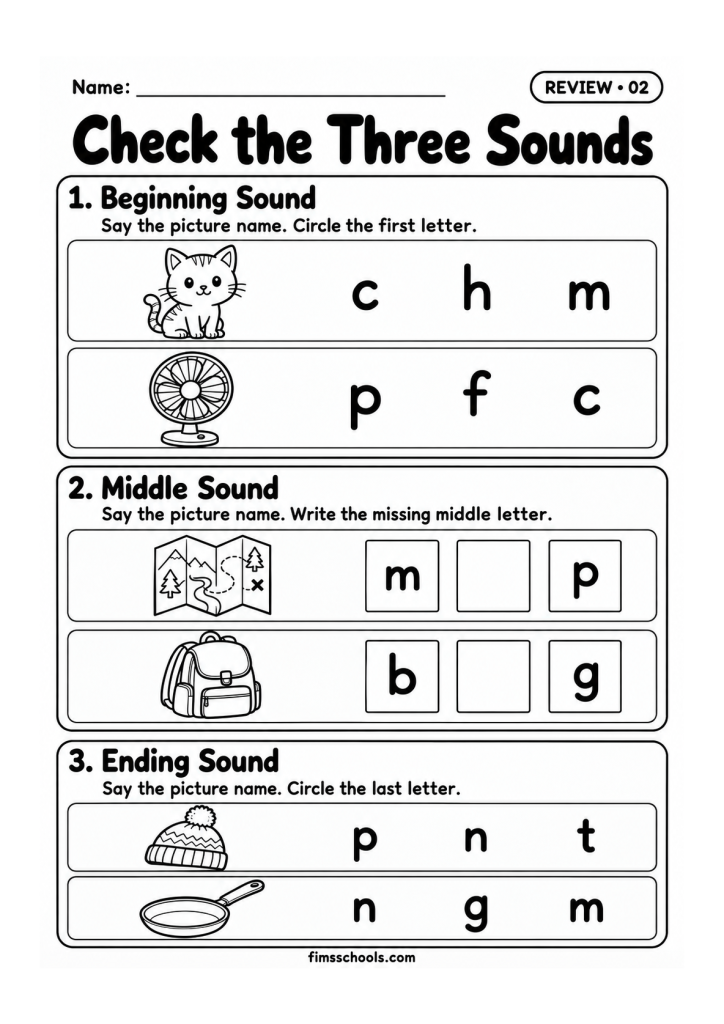
Three mini-checks in one page: circle the first letter (cat from c/h/m; fan from p/f/c), write the missing middle letter (m_p for map; b_g for bag), and circle the last letter (hat from p/n/t; pan from n/g/m). Skill practised: hearing sounds at the beginning, middle and end of words — the complete sound map of a CVC word. Adult tip: stretching each word slowly makes each position’s sound easier to isolate.
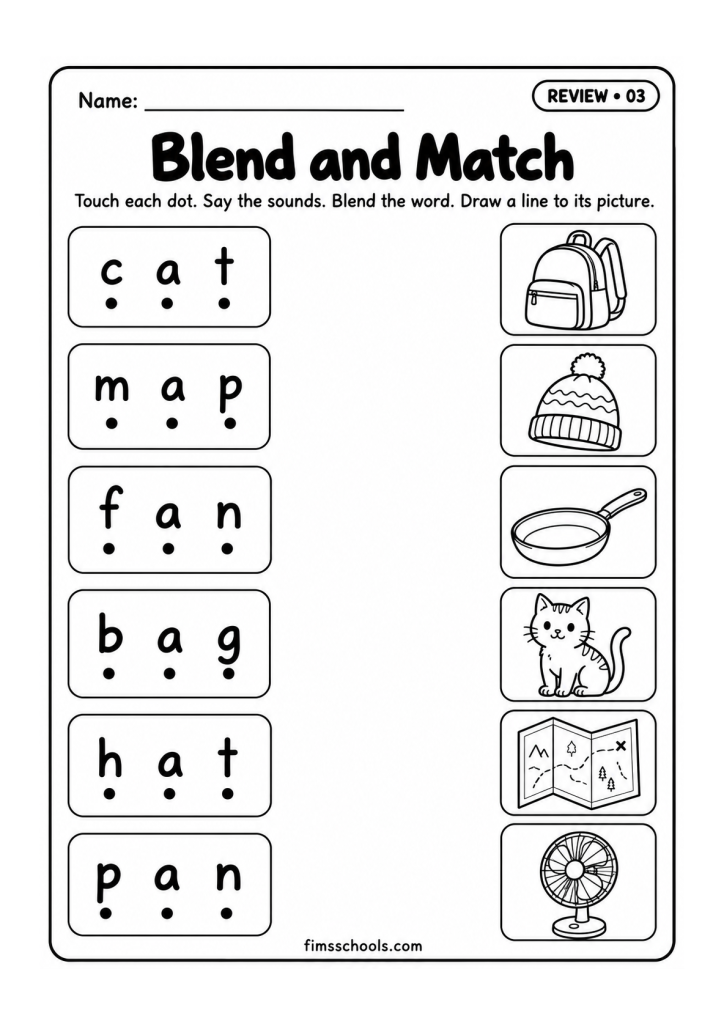
Six dotted words — cat, map, fan, bag, hat and pan — are blended and matched to their pictures by drawing a line. The dots keep the sounding-out habit in place while the matching checks meaning. Skill practised: blending with comprehension, reviewed. Adult tip: ask your child to predict the picture before blending; being wrong occasionally makes the check meaningful.
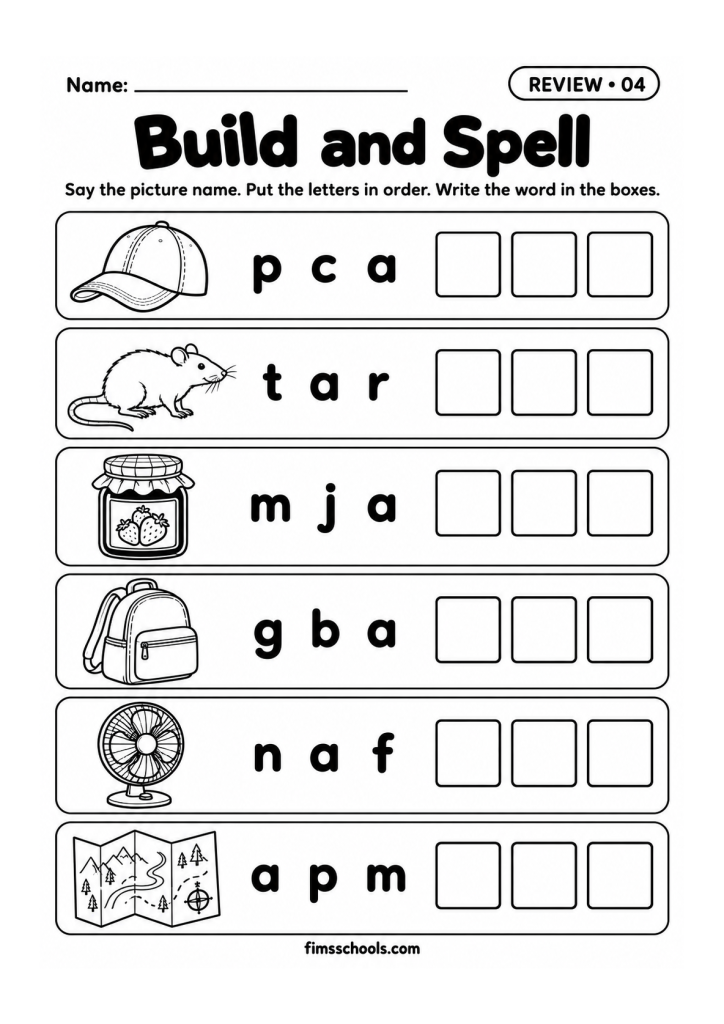
Each picture arrives with jumbled letters: p-c-a for the cap, t-a-r for the rat, m-j-a for jam, g-b-a for bag, n-a-f for fan and a-p-m for the map. Your child unscrambles them and writes the word in the boxes. Skill practised: spelling through letter sequencing, reviewed from the word building bundle. Adult tip: saying each jumbled set aloud first usually reveals the word.
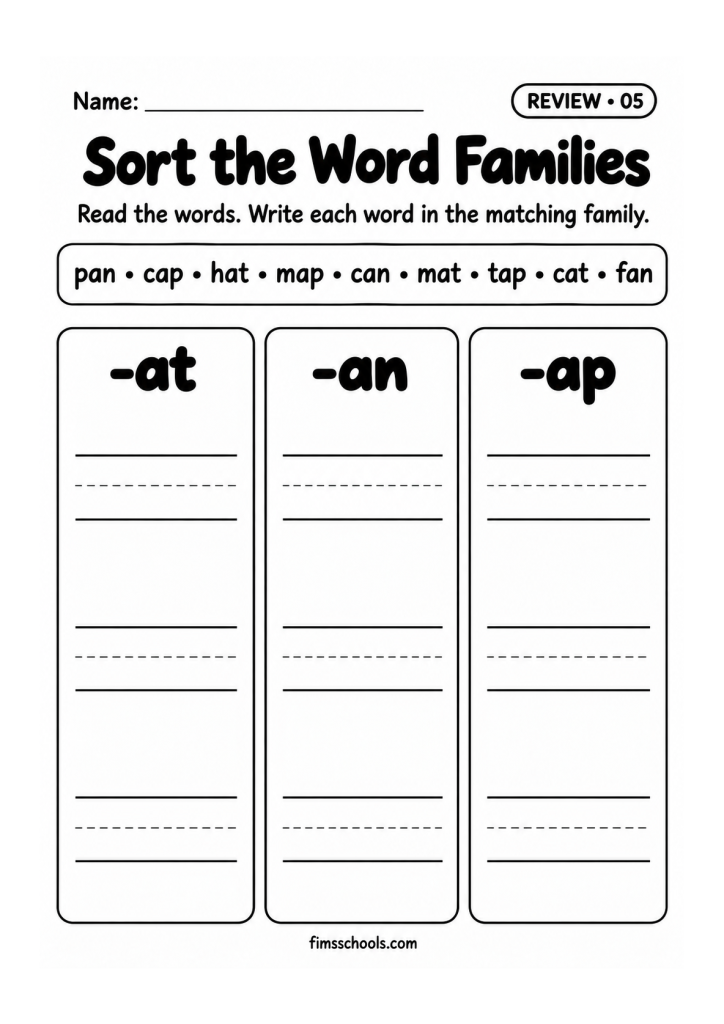
Nine words are listed at the top — pan, cap, hat, map, can, mat, tap, cat and fan — and your child writes each into the correct family column: -at, -an or -ap, three words each. Skill practised: word-family recognition and accurate word writing. Adult tip: reading a finished column aloud shows the rhyming pattern that makes families memorable.
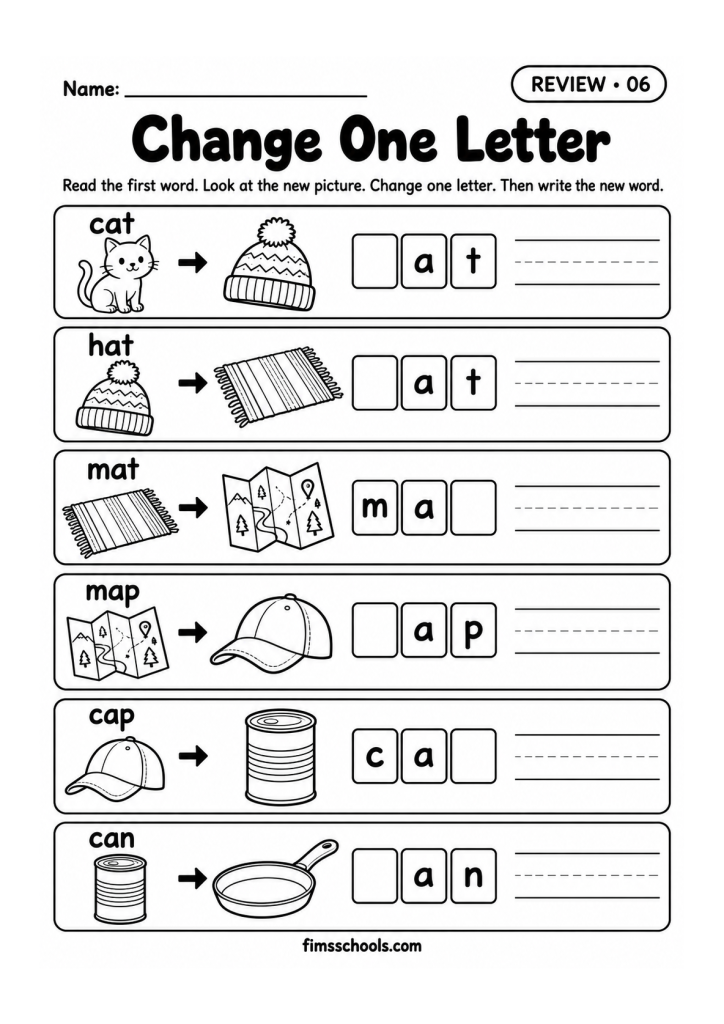
A familiar chain returns: cat to hat, hat to mat, mat to map, map to cap, cap to can and can to pan. Some letters are pre-printed as support; your child changes one letter per row and writes the new word in full. Skill practised: letter substitution and word transformation, reviewed. Adult tip: this is the same chain as the word building bundle — finishing it faster and independently is visible progress.
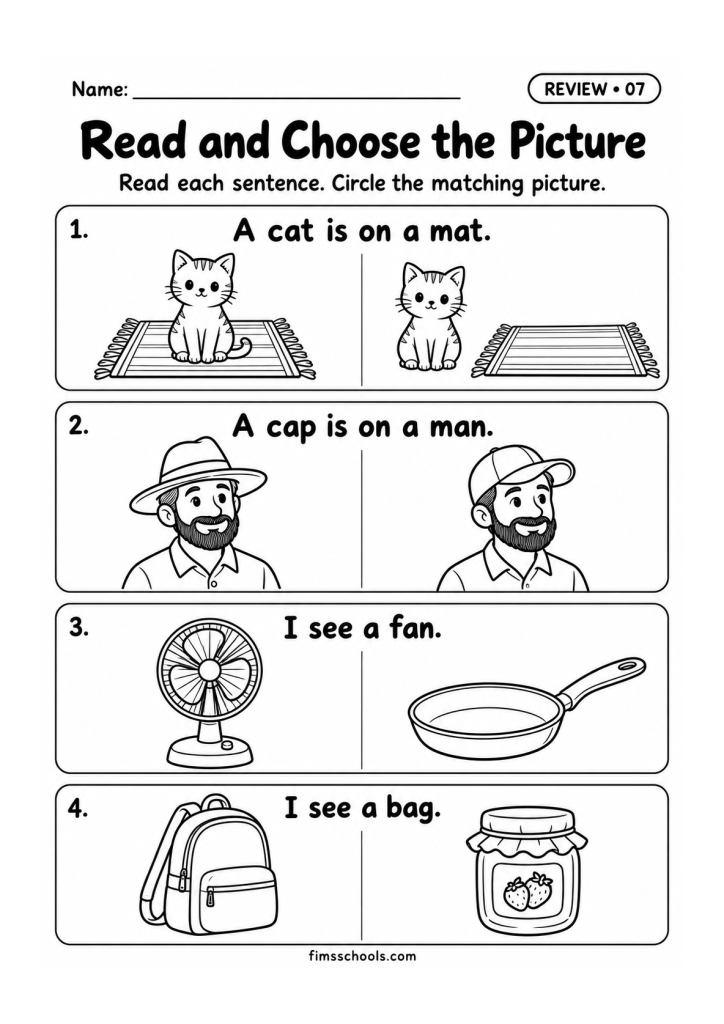
Four sentences — “A cat is on a mat.”, “A cap is on a man.”, “I see a fan.” and “I see a bag.” — each sit above two pictures, and your child circles the picture the sentence describes. The wrong option is always plausible (a cat beside an empty mat; a fan beside a pan), so real reading is required. Skill practised: sentence comprehension. Adult tip: have your child point to the words in the sentence that decided the answer.
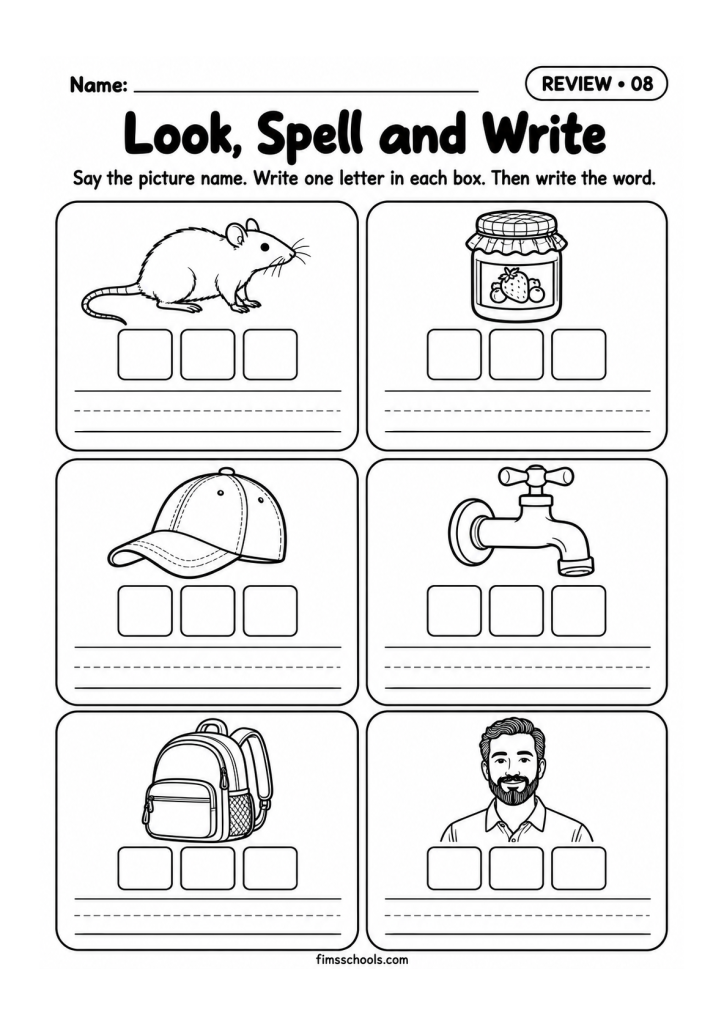
Six pictures — rat, jam, cap, tap, bag and man — have empty sound boxes and a writing line. Your child segments each word into its three sounds, writes the letters in the boxes, then writes the whole word. Skill practised: independent spelling, reviewed from the writing bundle. Adult tip: no word bank is provided on purpose; this is the honest check of spelling independence.
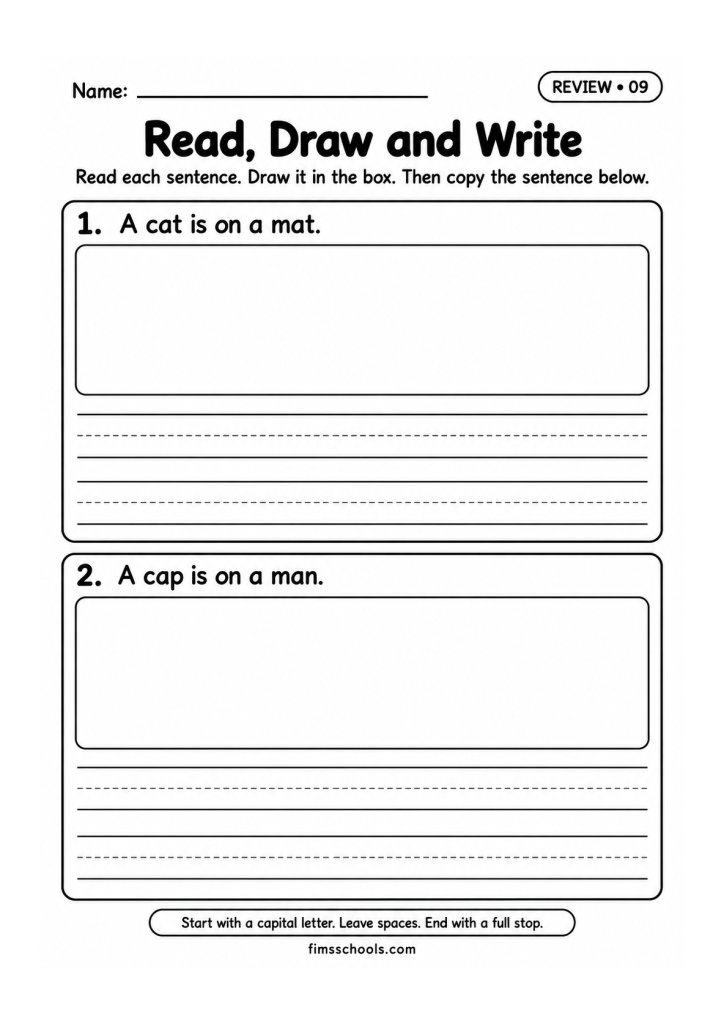
Two sentences — “A cat is on a mat.” and “A cap is on a man.” — are read, drawn in the big boxes, and then copied onto the lines below. A reminder strip at the bottom restates the sentence rules: capital letter, spaces, full stop. Skill practised: reading comprehension combined with sentence copying and drawing. Adult tip: the drawing is the comprehension check — if it matches the sentence, the reading was real.
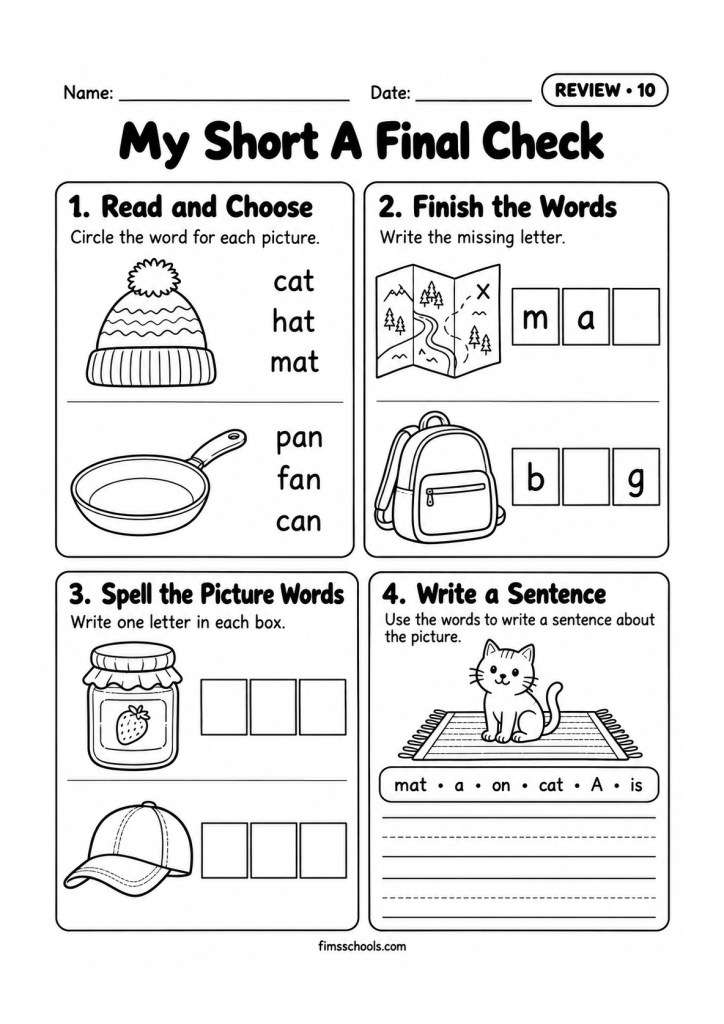
The closing assessment of the whole short a course: read and choose the correct word for two pictures (hat; pan), finish the words by writing the missing letter (map, bag), spell the picture words in sound boxes (jam, cap), and use the word bank (mat, a, on, cat, A, is) to write a sentence about the cat picture. Skill practised: every core skill of the six bundles in one page. Adult tip: keep this sheet; repeating it after a break is a fair measure of what has been retained.
Review means unaided. Resist helping with answers; what your child does alone here tells you what they have truly learned.
Use the results. Any sheet that wobbles names its own remedy — the matching skill sheet in the earlier bundles (blending, building or writing).
Short sessions. One or two sheets at a time, with an optional 10 to 15 minutes per sitting, keeps review light.
Printing. Each PDF is one A4 page — print at Actual Size (100%); choose Fit only if your printer clips edges. Keep the Final Check sheet for your records.
Frequently Asked Questions
Are these review worksheets free?
Yes. All ten worksheets are free to download and print, each as its own PDF under its preview below. No account or sign-up is needed.
Does my child need the earlier bundles first?
This review assumes the skills have already been practised. If your child has not yet worked on blending, building or writing short a words, start with the beginner collection linked above and work through the sequence first.
How should I use the Final Check?
Give Worksheet 10 last, without help, and keep it. It samples reading, completing, spelling and sentence writing in four short parts, so it shows both strengths and exactly what to practise next.
What paper size should I use?
The worksheets are A4. Print on A4 paper at Actual Size (100%) for the cleanest result.
All FIMS Schools printables are provided for non-commercial personal and classroom use only. You may print copies for your own children or students. You may not resell, redistribute, re-upload or include the files in another collection. To share these resources, link to the original FIMS Schools article. All rights reserved.
Common Core Connections
Recommended level: kindergarten and early Grade 1 learners who have completed beginner short a work — ideally the earlier FIMS Schools collections (beginner foundations, blending, word building, puzzles and writing) or equivalent practice. Prerequisites: this is a review collection; it checks skills rather than teaching them for the first time. The connections below cover only the standards this collection’s activities genuinely practise, and the collection supports practice toward selected skills within each standard rather than covering any standard in full. The grade shown with each code is the grade of the standard itself, which is not always the same as the recommended learner level above.
RF.K.2.d — Checking the three sounds in CVC words (Kindergarten)
This standard asks children to pick out and pronounce the first, middle-vowel and final sounds in three-sound CVC words. In this collection: Worksheet 2, which checks beginning, middle and ending sounds on one page, and Worksheet 8, where each pictured word is segmented into its three sounds and written in sound boxes.
RF.K.3.b — Short vowel sound and spelling (Kindergarten)
This standard connects each of the five major vowels with its long and short sounds and their common spellings. This review practises only the short a part of that standard, revisiting the link between the short a sound and the letter a across reading, sorting and spelling checks.
RF.1.2.e — Changing one sound to make a new word (Grade 1)
This Grade 1 standard asks children to add or substitute individual sounds in simple one-syllable words to make new words. In this collection: Worksheet 6, where the cat-to-pan chain is rebuilt by changing exactly one letter at each step.
RF.1.3.b — Decoding one-syllable words (Grade 1)
This Grade 1 standard asks children to read regularly spelled one-syllable words on their own. In this collection: Worksheet 1 (reading three similar words and choosing the match), Worksheet 3 (blending and matching words to pictures), Worksheet 7 (reading whole sentences and choosing the picture they describe) and the reading parts of Worksheet 10, the final check.