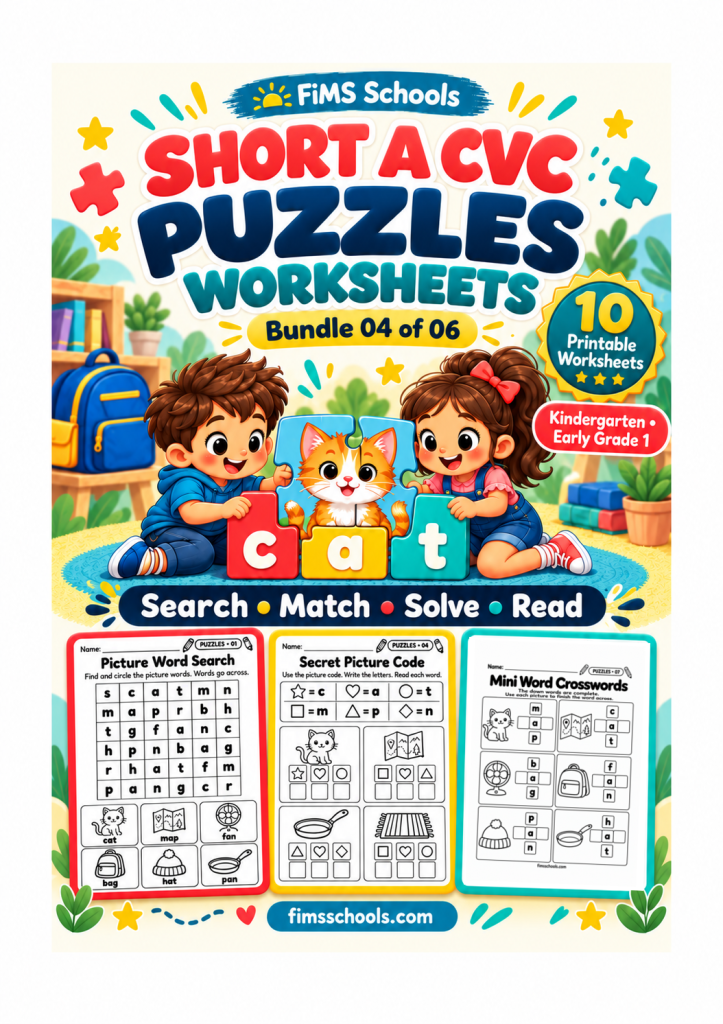
Puzzles turn reading practice into a game children ask to play again. This collection of short a CVC puzzles hides the familiar short a words — cat, hat, map, cap, fan, pan, bag and jam — inside word searches, a word maze, secret codes, mini crosswords and riddle clues. Every puzzle is solvable with short a knowledge alone, and every worksheet is free with its own separate PDF.
Who is it for? Kindergarten and early Grade 1 children who can already read simple CVC words and enjoy a challenge. These puzzles consolidate reading rather than teach it from zero; if your child is still learning to blend, start with our Short A CVC Worksheets for Beginners and blending worksheets first, then use this bundle as the reward pages. The sheets can be done in any order — pick the puzzle type your child loves.
What is included? A picture word search, an -at word-family maze, rhyming matches, a secret picture code, word-family houses, a find-the-correct-word spelling puzzle, mini crosswords, read-and-draw riddles, a missing-letter puzzle and a four-part super review. All worksheets are A4; print on A4 paper at Actual Size (100%).
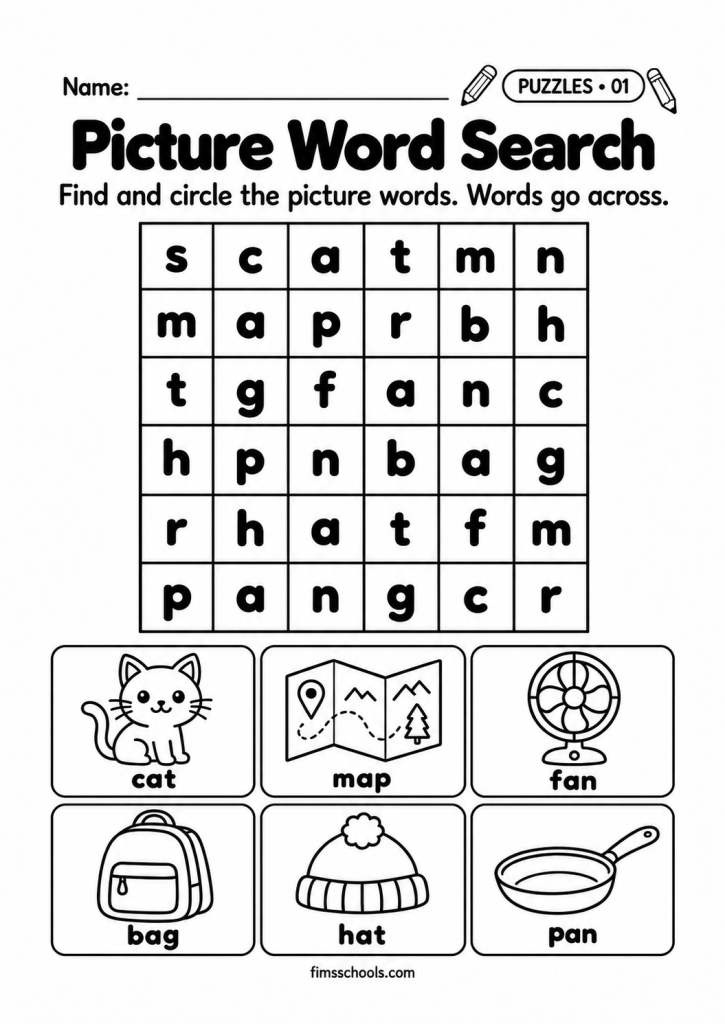
Worksheet 1: Picture Word Search
Six picture words — cat, map, fan, bag, hat and pan — are hidden across the letter grid, and the pictures at the bottom act as the word list. Your child hunts row by row and circles each word when found. All words run left to right, which keeps this first word search fair for beginners. Skill practised: scanning, letter-pattern recognition and reading words inside a busy grid. Adult tip: say the target word aloud and have your child trace the row with a finger before circling.
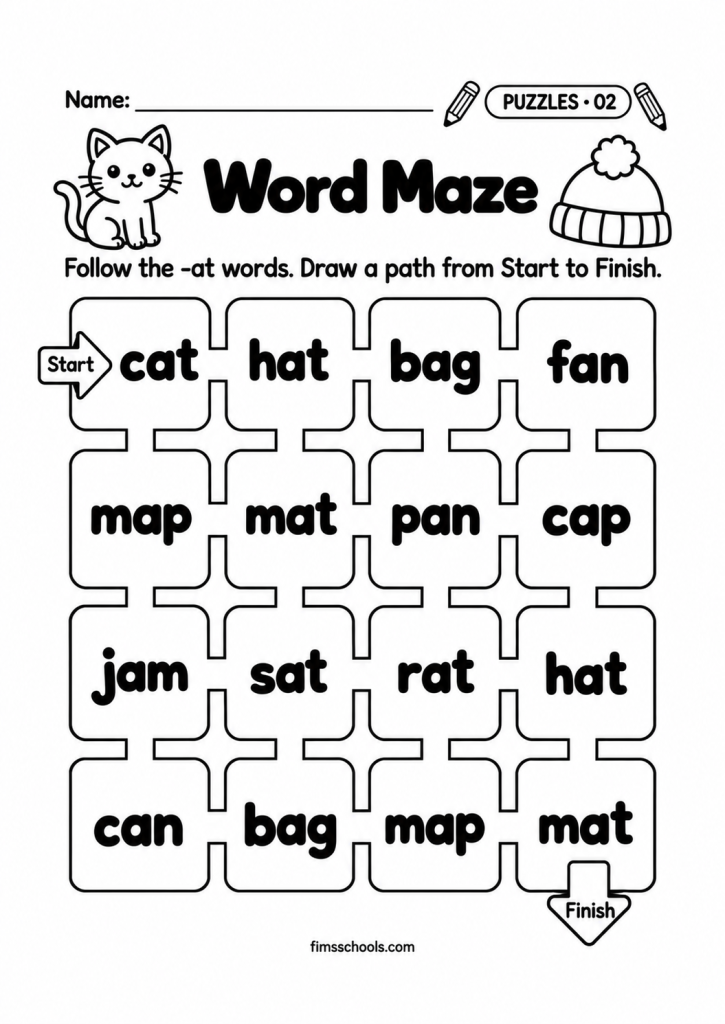
The maze is built from word tiles: cat, hat, bag, fan, map, mat, pan, cap, jam, sat, rat, can. Following the instruction to track only the -at words, your child draws a path from Start to Finish — cat, hat, mat, rat, hat, mat — stepping only on words that end in -at. Skill practised: recognising the -at word family at speed and planning a route. Adult tip: reading each tile aloud before stepping on it turns the maze into reading practice too.
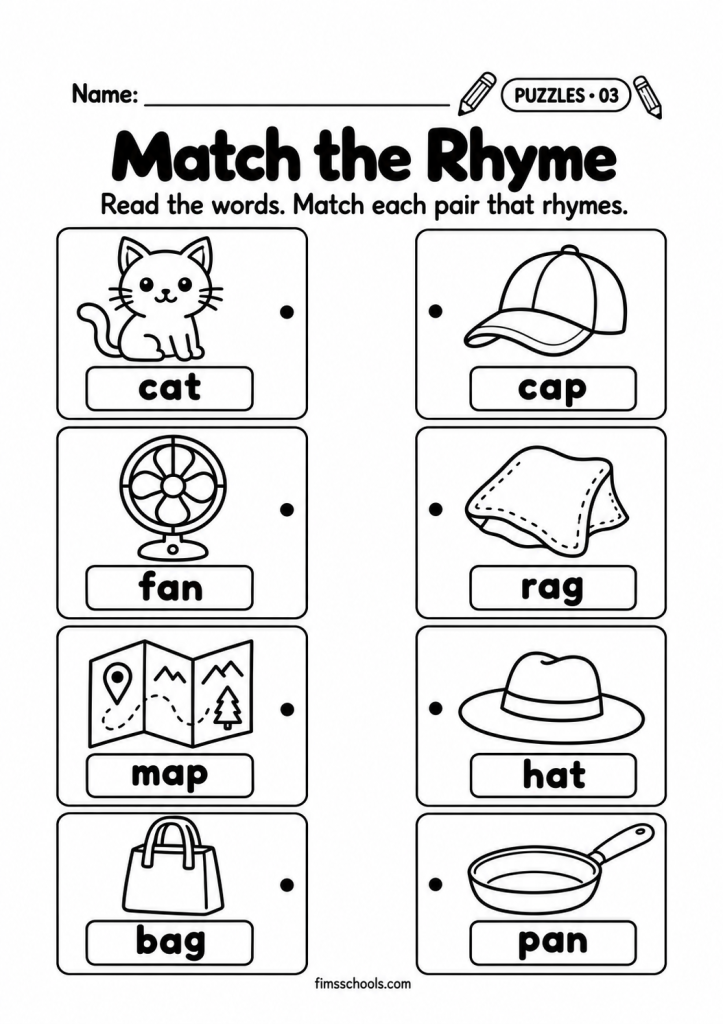
Four pictured words on the left — cat, fan, map and bag — must be matched to their rhyming partners on the right: hat, pan, cap and rag. Your child reads each word and draws a line to the word that rhymes. Skill practised: hearing and reading rhyming endings across the -at, -an, -ap and -ag families. Adult tip: say the pairs aloud together afterwards; the rhyme is much easier to hear than to see at first.
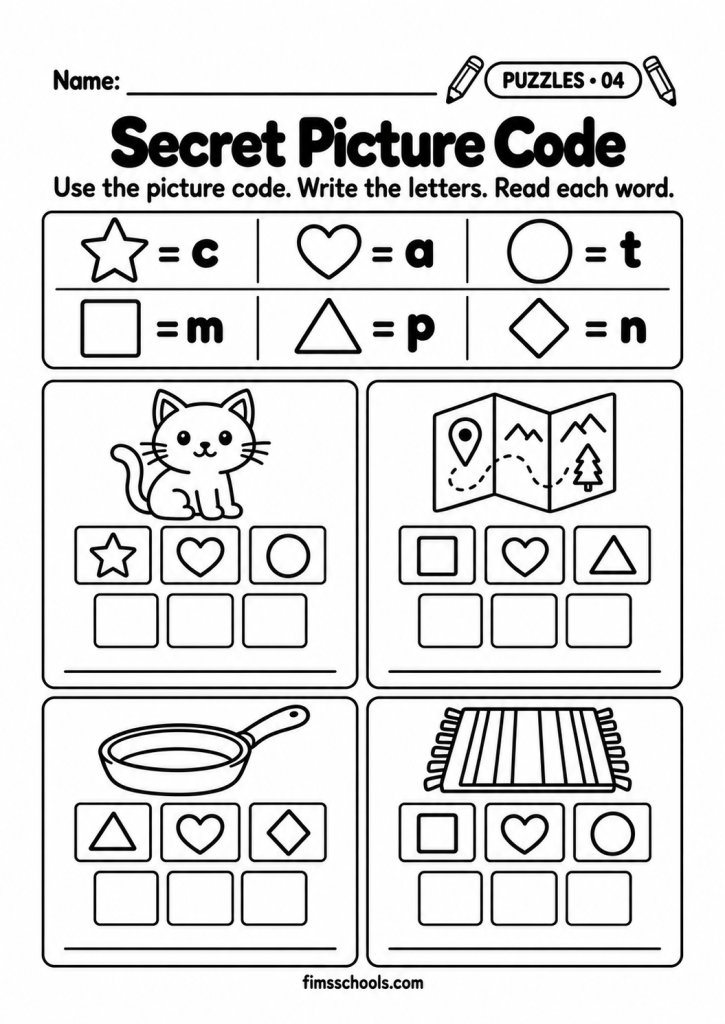
A code key at the top gives each letter a symbol: star = c, heart = a, circle = t, square = m, triangle = p, diamond = n. Under each picture, your child decodes three symbols into letters and reads the secret words: cat, map, pan and mat. Skill practised: symbol-to-letter decoding, letter formation and blending — code-breaking that is secretly reading practice. Adult tip: cover the key after the first word and see how many symbols your child remembers.
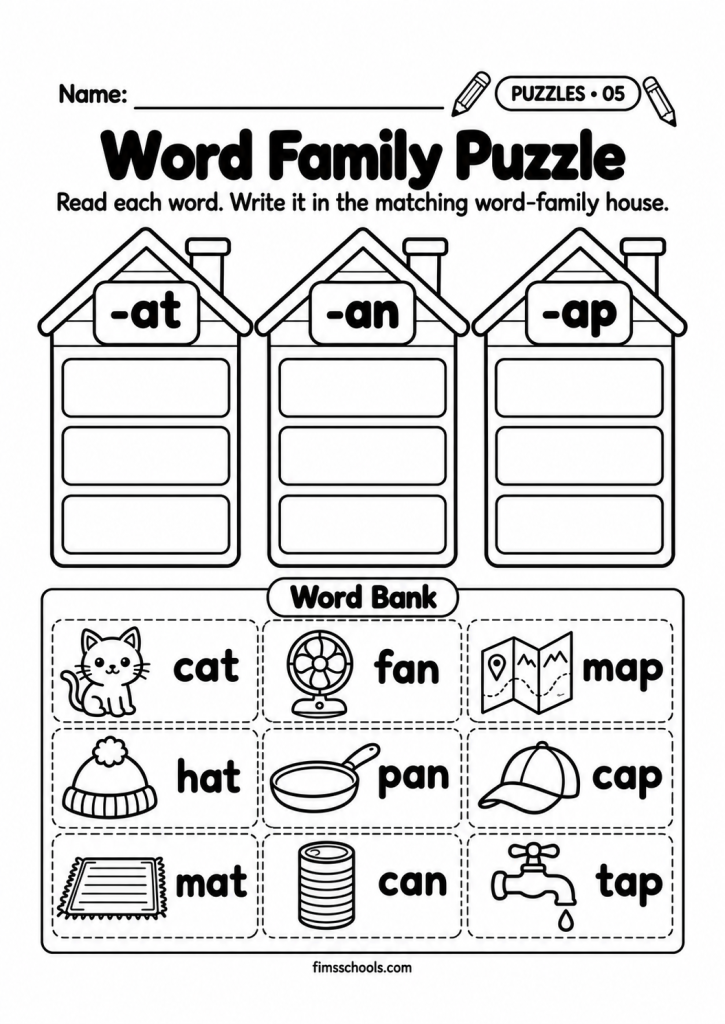
Three houses are labelled -at, -an and -ap, and a word bank offers nine words with pictures: cat, fan, map, hat, pan, cap, mat, can and tap. Your child reads each word and writes it in the house whose ending it shares — three words per house. Skill practised: sorting words by their ending and reading whole word families. Adult tip: ask your child to read a finished house top to bottom; the shared ending makes a satisfying rhyming run.
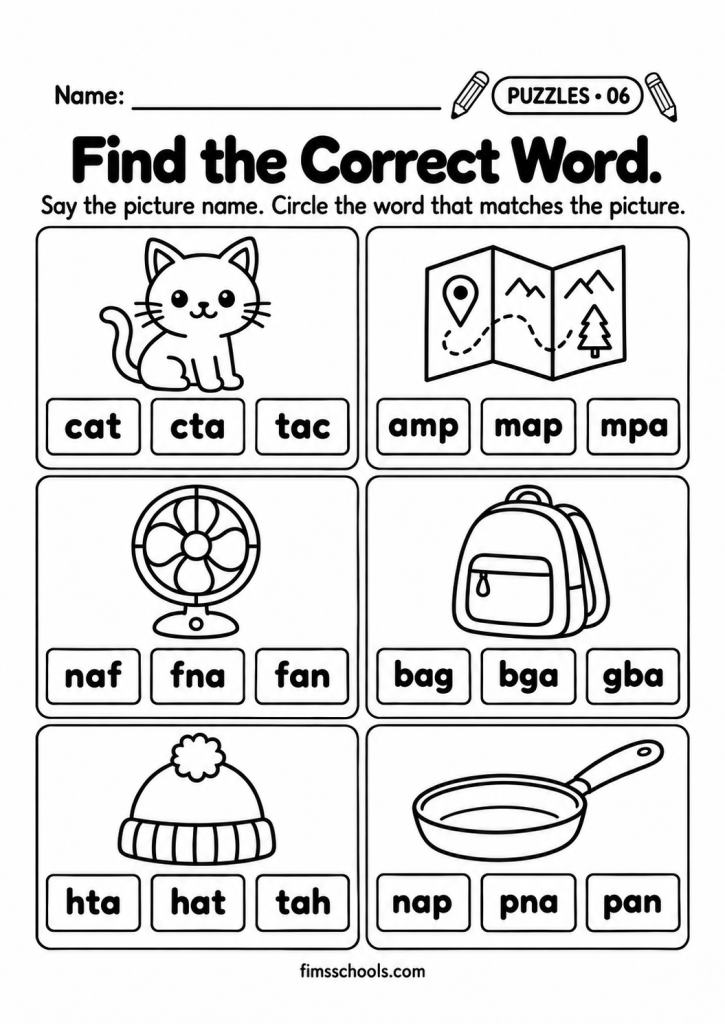
Every picture comes with three letter arrangements, only one of which is a real, correctly ordered word: cat among cta and tac; map among amp and mpa; fan, bag, hat and pan among their own scrambles. Your child says the picture name and circles the correct spelling. Skill practised: letter-order awareness — the difference between a word and a jumble. Adult tip: reading the wrong options aloud shows children exactly why order matters; they are unpronounceable.
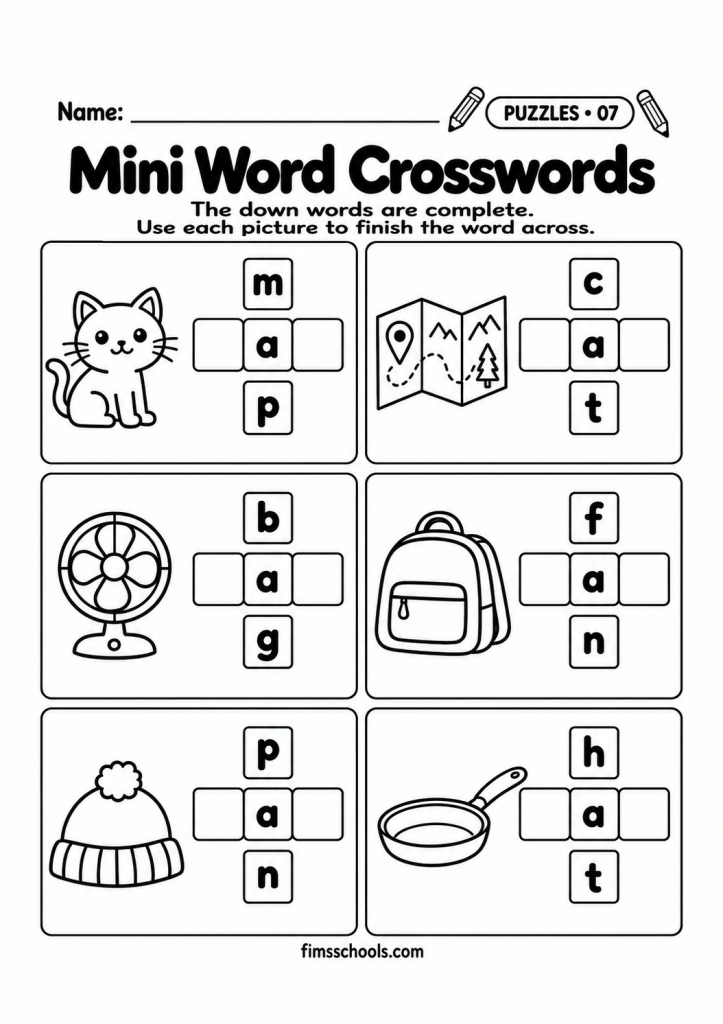
Six mini crosswords each give a complete down word (-a- in the middle column: map, cat, bag, fan, pan, hat pattern) and a picture clue; your child writes the two missing letters to complete the across word. The crossing letters act as built-in hints and self-checks. Skill practised: spelling with partial support and using crossing letters as clues. Adult tip: if a word will not fit, the down word is the place to re-check the middle sound.
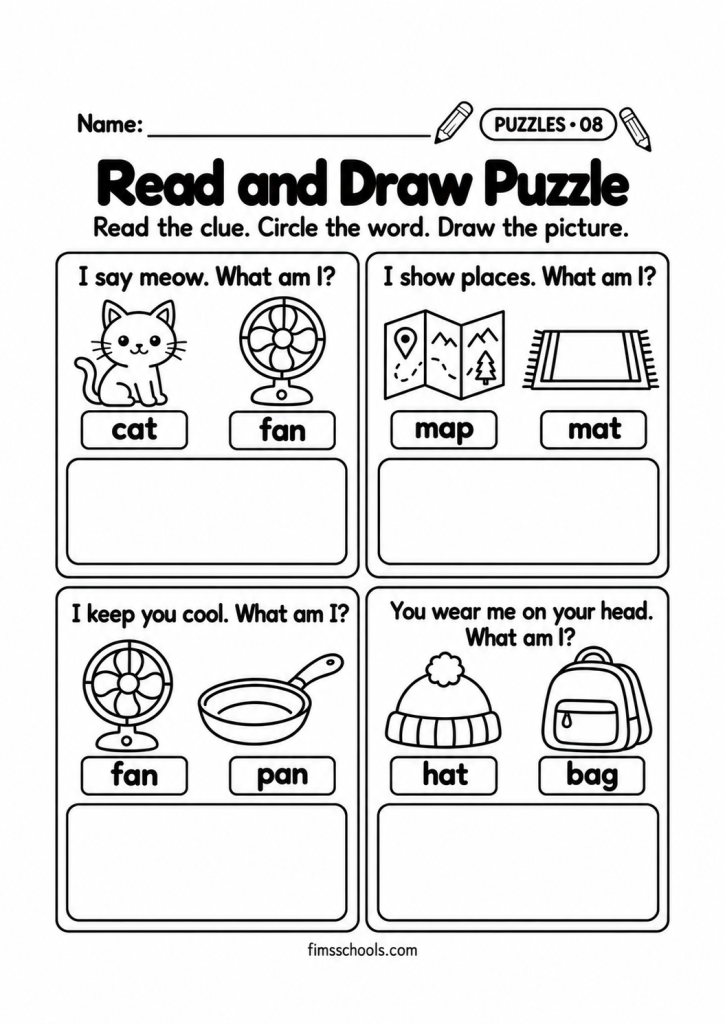
Four riddle clues must be solved: “I say meow. What am I?” (cat), “I show places” (map), “I keep you cool” (fan) and “You wear me on your head” (hat). Your child reads the clue, circles the correct word from two options, and draws the answer in the box. Skill practised: reading comprehension — understanding a sentence, not just decoding words. Adult tip: let your child read the clue to you; explaining their choice is excellent comprehension practice.
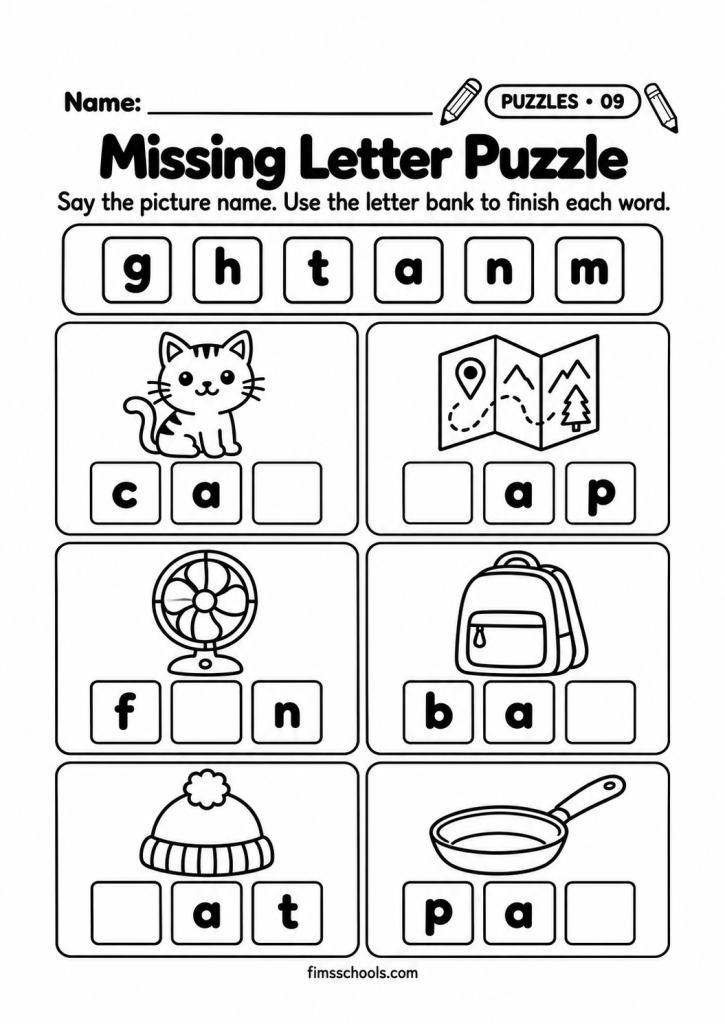
A letter bank (g, h, t, a, n, m) supplies the missing letters for six picture words: c-a-_, _-a-p, f-_-n, b-a-_, _-a-t and p-a-_. Some gaps are the final letter, some the first, so your child must listen to the whole word rather than only its middle. Answers: cat, map, fan, bag, hat and pan. Skill practised: hearing beginning and ending sounds and completing words. Adult tip: crossing out each bank letter once used teaches a useful puzzle strategy.
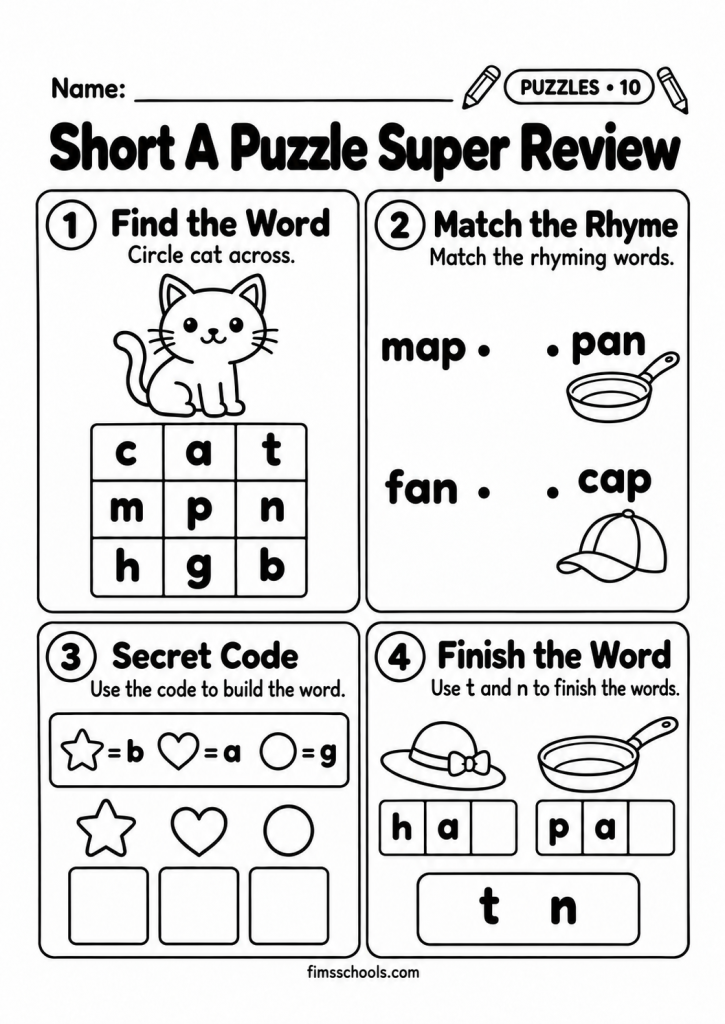
Four favourite puzzle types return in one page: find cat hidden in a mini grid, match the rhymes (map–cap, fan–pan), crack a new secret code (star = b, heart = a, circle = g makes bag), and finish hat and pan using the letters t and n. Skill practised: a playful mixed review of searching, rhyming, decoding and completing. Adult tip: finishing the whole bundle with this page makes a natural celebration point — note which puzzle type your child enjoyed most.
Let them play. Puzzles work because children choose to persist; offer hints about strategy (scan row by row, cross out used letters) rather than answers.
Reading aloud counts. Asking your child to read each found or finished word keeps the phonics purpose inside the game.
Flexible order. Unlike the skill bundles, these pages need not be done in sequence — follow your child’s favourite puzzle types; an optional 10 to 20 minutes suits most sittings.
Printing. Each PDF is one A4 page — print at Actual Size (100%); choose Fit only if your printer clips edges.
Frequently Asked Questions
Are these puzzle worksheets free?
Yes. All ten worksheets are free to download and print, each as its own PDF under its preview below. No account or sign-up is needed.
Do the puzzles have answers on the page?
The puzzles are self-checking by design — pictures confirm words, crossing letters confirm spellings, and codes decode into real words or nonsense, so children can usually tell when an answer is right.
Which skills do the puzzles practise?
Word searching builds scanning and pattern recognition; the maze and family houses build word-family fluency; the secret code builds decoding; the riddles build reading comprehension. All of them reuse the same short a vocabulary.
What paper size should I use?
The worksheets are A4. Print on A4 paper at Actual Size (100%) for the cleanest result.