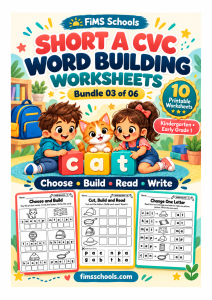
Reading words is one skill; building them letter by letter is the skill that makes spelling click. This collection of short a word building worksheets gives children ten pages of hands-on construction practice with the familiar short a words — cat, hat, map, cap, fan, pan, bag and jam. Children choose letters, cut and arrange tiles, unscramble jumbled words, change one letter at a time and finally build whole word chains and families. Every worksheet is free, with its own separate PDF.
Who is it for? Kindergarten and early Grade 1 children who can already blend simple CVC words and are ready to spell them. If blending itself is still new, work through our Short A CVC Worksheets for Beginners and the blending collection first — this bundle assumes those skills and builds on them. The sheets are ordered from supported (letters are given; your child chooses) to independent (your child produces every letter).
What is included? Choose-and-build letter selection, a cut-out tile activity, unscrambling, beginning- and ending-letter building, change-one-letter transformations, word-family construction with the -at, -an and -ap endings, a seven-word chain, unsupported picture spelling and a four-part super review. All worksheets are A4; print on A4 paper at Actual Size (100%).
Worksheet 1: Choose and Build
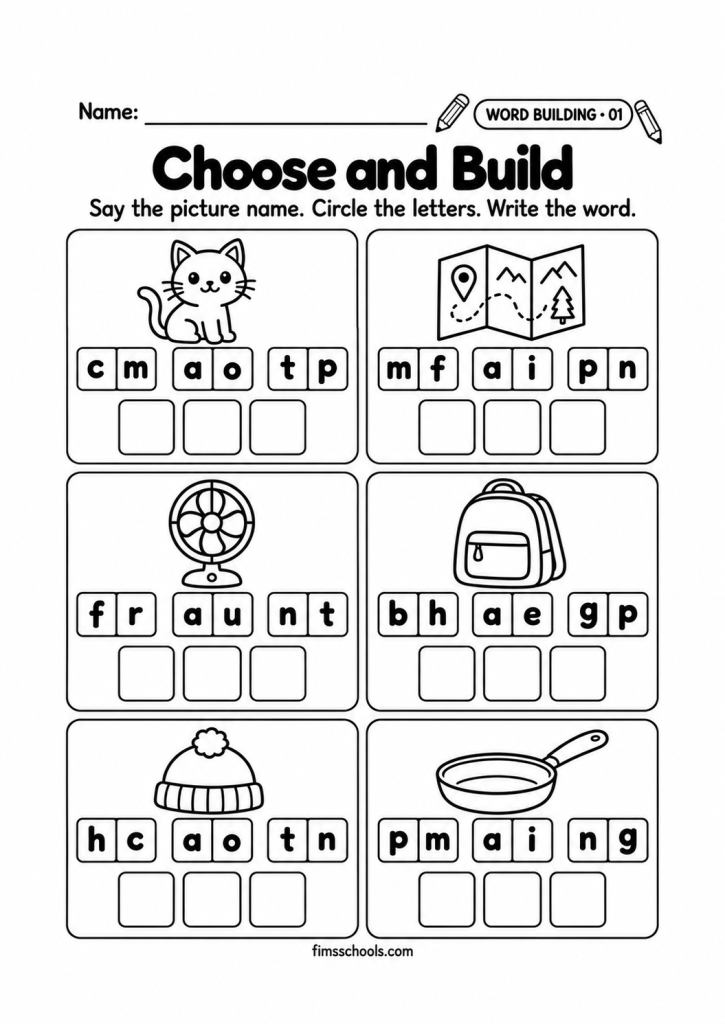
Six pictures — cat, map, fan, bag, hat and pan — each come with five jumbled letters. Your child says the picture name, circles the three letters that build the word from the choices given (for the cat: c, m, a, o, t, p — circle c, a and t), and writes the finished word in the boxes. Skill practised: choosing the correct letters and their order to spell a word. Adult tip: the extra letters are the challenge; ask your child to say the word slowly and hunt for one sound at a time.
Twelve letter tiles are cut out and arranged in the boxes to build the word for each picture: cap, pan, bag and hat. The sheet carries its own “adult help with scissors” note. Once a word is built, your child reads it aloud before moving on. Skill practised: hands-on word building and spelling, with fine-motor cutting practice. Adult tip: build and read every word before any gluing, so tiles can still be rearranged.
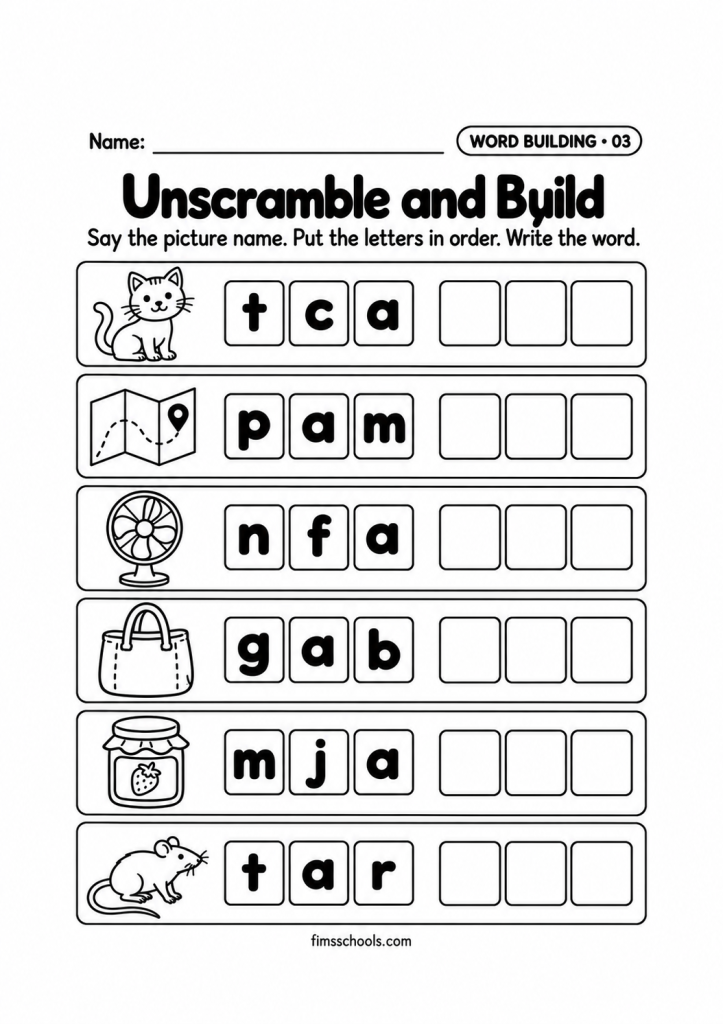
Each picture shows its letters in the wrong order: t-c-a for the cat, p-a-m for the map, n-f-a for the fan, then bag, jam and rat. Your child works out the correct order and writes the word in the boxes. Skill practised: sequencing letters to spell — hearing which sound comes first, next and last. Adult tip: saying the jumbled “word” aloud first usually makes the real word pop out.
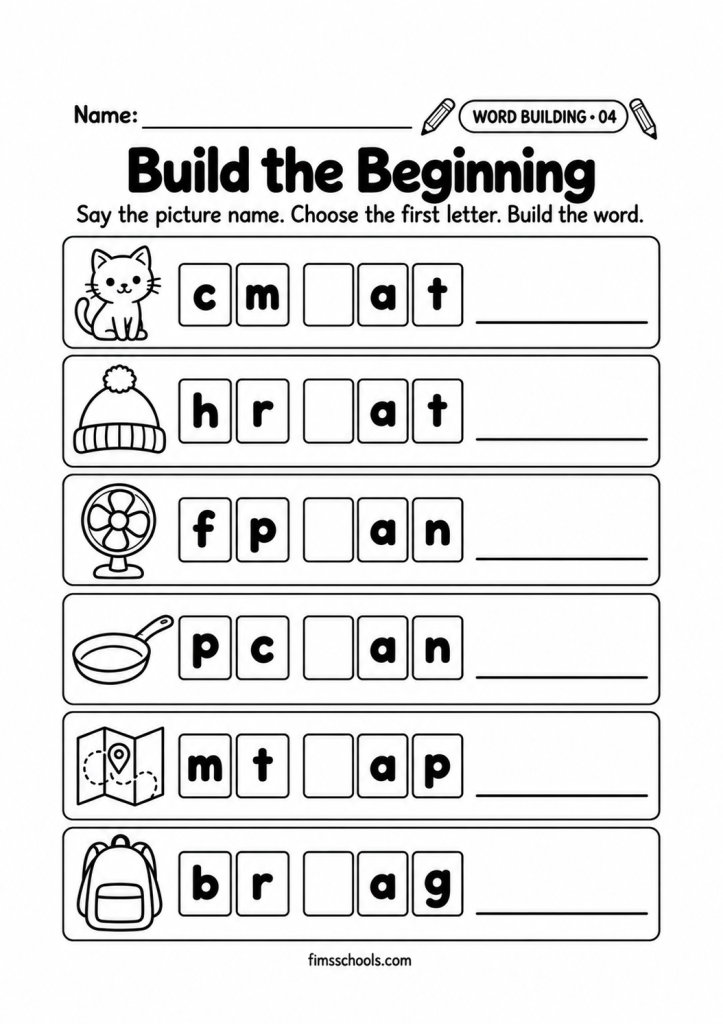
The last two letters of every word are given; your child chooses the correct first letter from two options and writes the whole word: cat (c or m), hat (h or r), fan (f or p), pan (p or c), map (m or t) and bag (b or r). Skill practised: hearing and identifying the beginning sound of a word. Adult tip: stretch the first sound (“ccc-at”) to make it easier to catch.
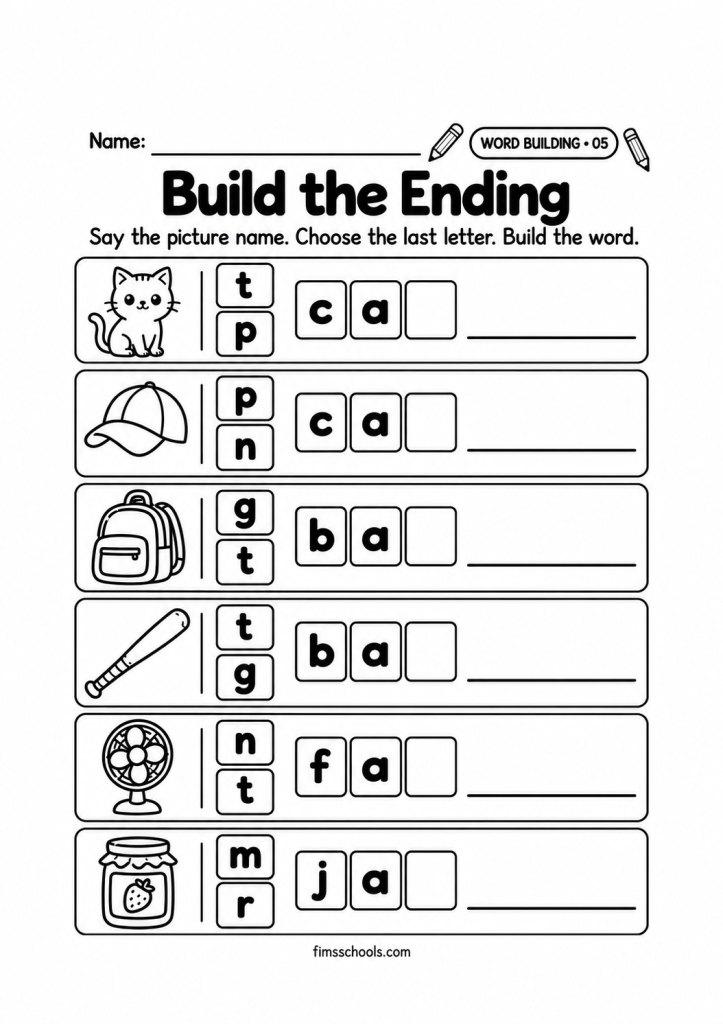
This sheet mirrors Worksheet 4 at the other end of the word: the first two letters are given and your child chooses the final letter — cat (t or p), cap (p or n), bag (g or t), bat (t or g), fan (n or t) and jam (m or r) — then writes the complete word. Skill practised: hearing the ending sound, the detail beginners most often miss. Adult tip: say the word and slightly exaggerate its last sound.
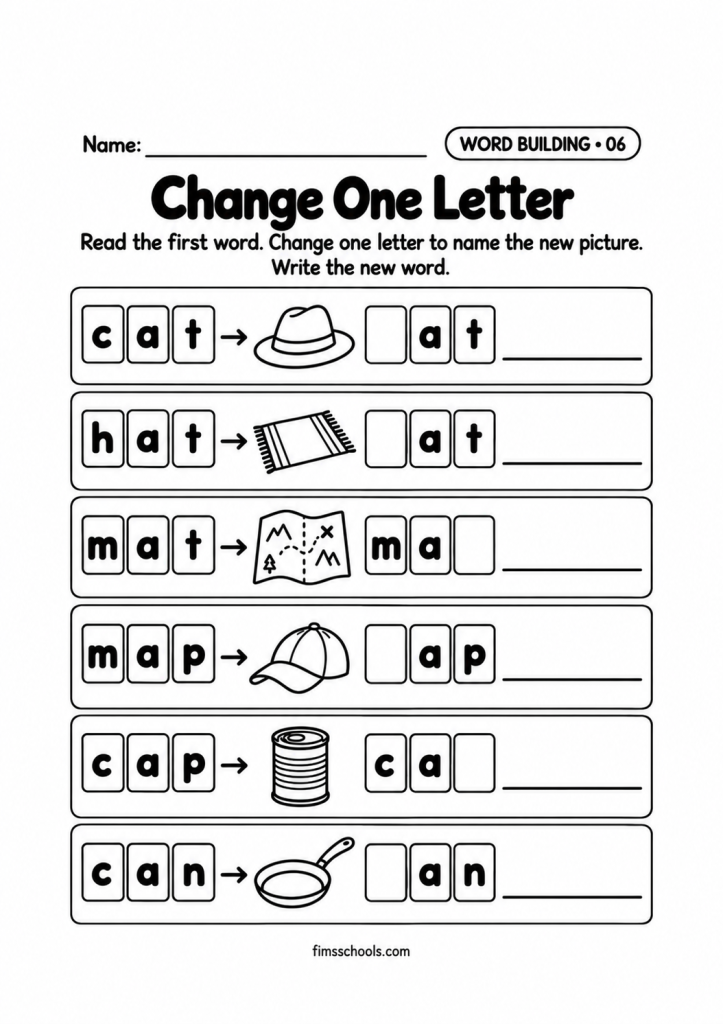
A chain of words changes one letter at a time: cat becomes hat, hat becomes mat, mat becomes map, map becomes cap, cap becomes can, and can becomes pan. Your child reads the starting word, looks at the new picture, changes a single letter, and writes the new word. Skill practised: understanding how changing one letter changes a word — powerful preparation for reading unfamiliar words. Adult tip: cover the answer boxes and predict the new word together before writing.
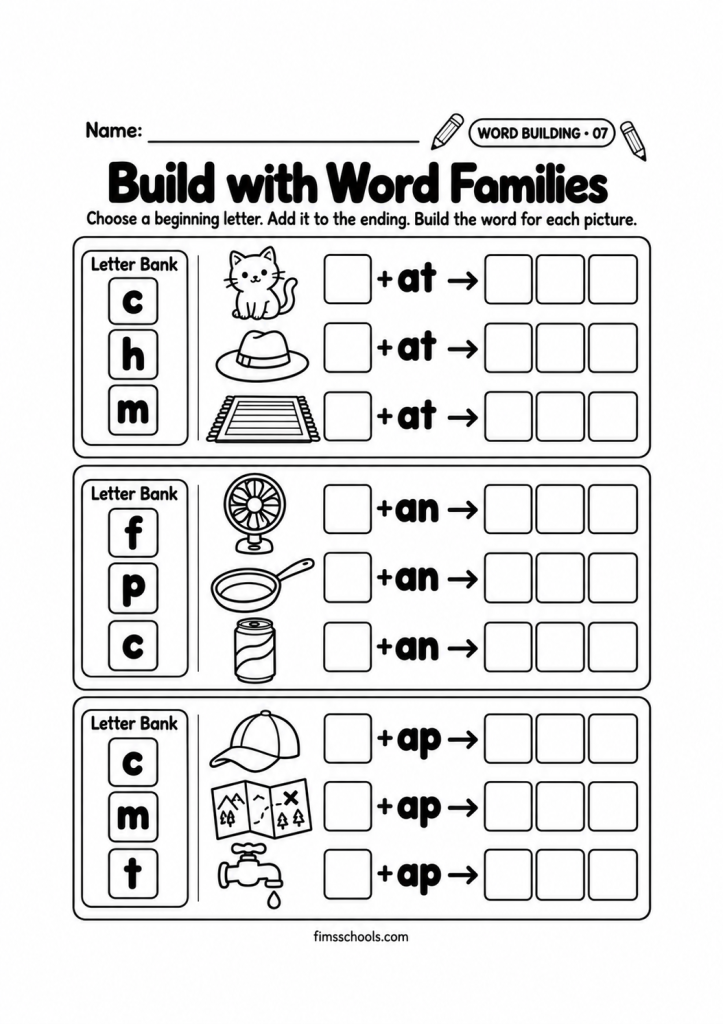
Three letter banks feed three word families. With c, h and m your child builds -at words for the cat, hat and mat pictures; with f, p and c they build -an words (fan, pan, can); with c, m and t they build -ap words (cap, map, tap). Each finished word is written in boxes beside its picture. Skill practised: constructing words from a beginning letter plus a family ending. Adult tip: read each completed family aloud — the shared ending sound ties the set together.
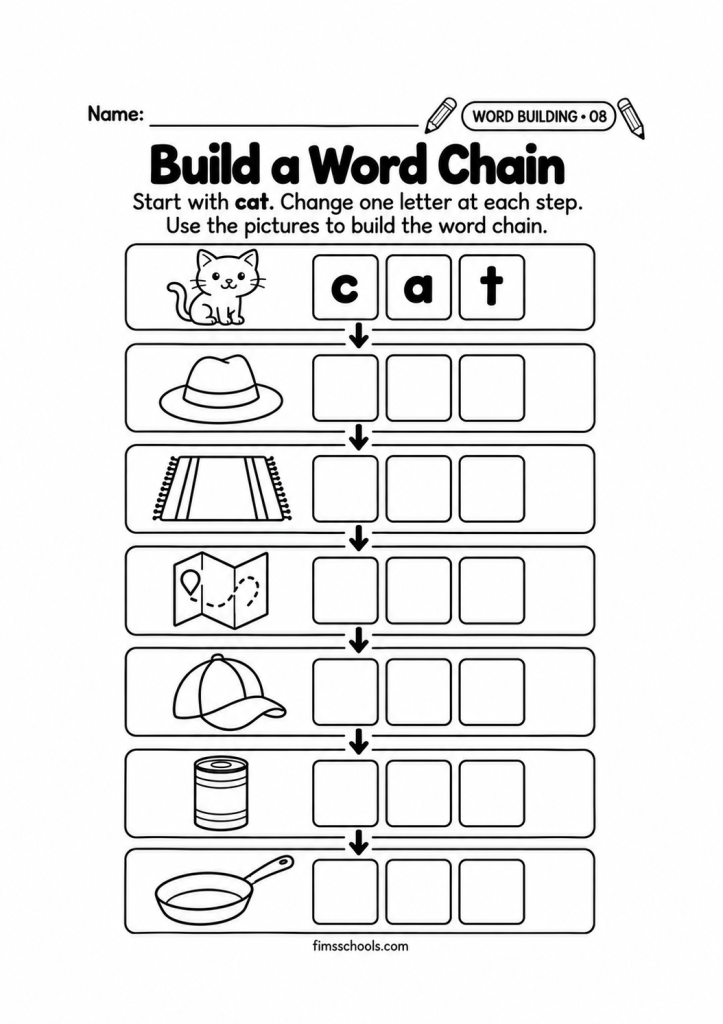
Starting from cat, a picture ladder leads down the page: hat, mat, map, cap, can and pan. At every step your child changes exactly one letter from the word above to name the new picture, building a connected chain of seven words. Skill practised: precise letter substitution and reading accuracy across a whole chain. Adult tip: if the chain breaks, the mistake is always in the step just above — check that word together first.
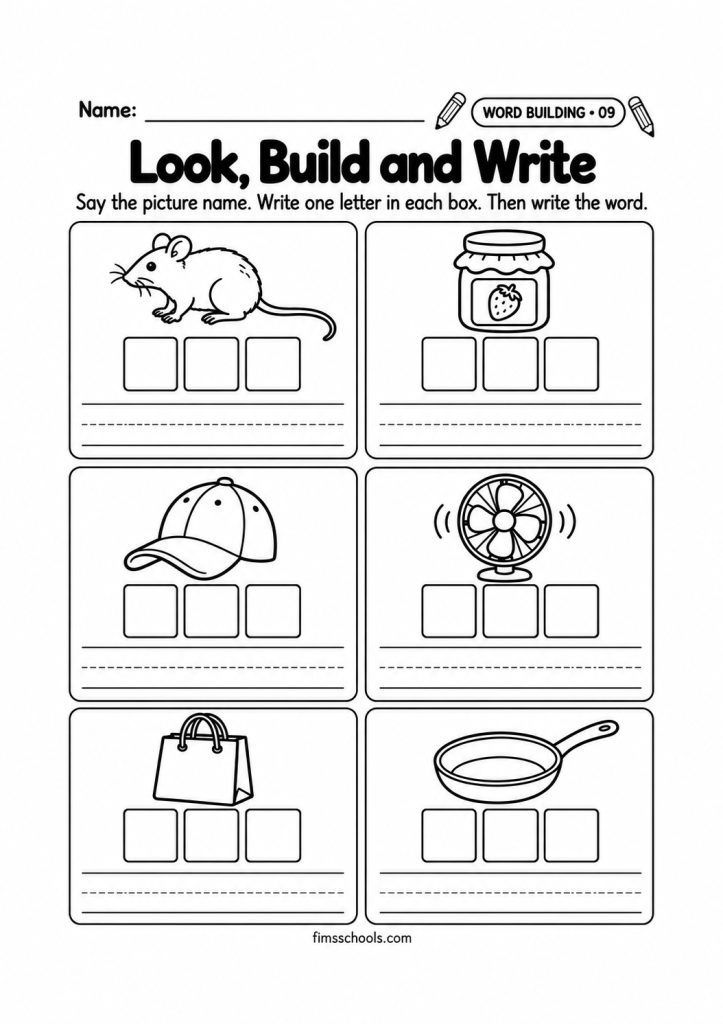
Six pictures — rat, jam, cap, fan, bag and pan — have no letters provided at all. Your child says the picture name, writes one letter in each of the three boxes, then writes the whole word on the line underneath. This is the most independent building task in the bundle. Skill practised: full word spelling from sound alone. Adult tip: let your child stretch the word and count its sounds on fingers before writing.
Four review tasks close the bundle: choose and build (cat), unscramble and build (map), change one letter (cap to can), and look, build and write from pictures (jam and fan). It samples every building skill from worksheets 1 to 9 in a single page. Skill practised: a mixed review of choosing, unscrambling, substituting and spelling. Adult tip: use any wobble here as a map back to the worksheet that practises that exact skill.
Build before writing. Where tiles or choices are given, let your child arrange and read the word before committing it to the boxes.
One letter at a time. In the change-one-letter sheets, covering the rest of the page helps children focus on the single change.
Short sessions. One or two worksheets at a time is plenty; an optional 10 to 15 minutes keeps building practice feeling like a game.
Printing. Each PDF is one A4 page — print at Actual Size (100%); choose Fit only if your printer clips edges. Worksheet 2 needs scissors and glue, with an adult nearby.
Frequently Asked Questions
Are these word building worksheets free?
Yes. All ten worksheets are free to download and print, each as its own PDF under its preview below. No account or sign-up is needed.
How is this bundle different from the blending bundle?
Blending worksheets practise reading sounds into words. This bundle works in the opposite direction — children start from a picture or a jumbled word and construct the correct letters, which is the foundation of spelling.
Which word families are covered?
The -at, -an and -ap families, using cat, hat, mat, sat, rat, fan, can, pan, man, cap, map, tap, bag and jam.
What paper size should I use?
The worksheets are A4. Print on A4 paper at Actual Size (100%) for the cleanest result.